Visto n' Visa
Blog
Notícias e artigos
Destinations
Careers
Immigrants

Want to live and work in Valley City?

Personalized immigration plan with eligible visas, costs, and next steps for your goal!

If you are not eligible, you will know exactly why and what to do to improve your approval chances.

Save up to 12 hours in meetings

No pointless assessments.

Save up to 90%

Save money on vague or unfocused consultations

Avoid Fraud and Mistakes

One mistake can cost you your visa

Total Impartiality

Zero commercial bias

Decide with peace of mind

No toxic urgency

Fast and Accurate

Answers in minutes, no guesswork

Demographics: small city, young because of the university

Population of around 6,000 residents, predominantly white of German, Norwegian, and Swedish descent, with a floating young layer of students and staff from the state university.

The population hovers around 6,000 people, a number that fluctuates during the academic year because of Valley City State University. In terms of ancestry, the base is clearly Scandinavian and German, a legacy of the migration waves of the late 19th century that settled North Dakota. Surnames like Olson, Johnson, Schmidt, and Schultz are common throughout the city.

Ethnic diversity is low compared to larger urban centers: most residents identify as white, with small Latino, Indigenous (from nearby reservations such as Spirit Lake), and international communities tied to the university. Foreign students and faculty, especially from Asia and Africa, give the city a modest cosmopolitan character not found in other towns of similar size in the region.

The age distribution skews younger due to the university presence, but there is also a significant layer of retirees who chose to stay for the tranquility and low cost of living. Newcomers quickly notice how much social life revolves around the university, churches, and county events.

Languages spoken
  • English
  • Spanish
  • German (heritage)
  • Norwegian (heritage)
Main religions
  • Lutheranism
  • Roman Catholicism
  • Methodism
  • Other Protestant denominations
  • No religion

Cost of living well below the American average

Rent, food, and services are cheaper than in almost any urban center in the US, but heating costs in winter and car transportation weigh on the budget.

Valley City is one of the most affordable places in the United States. One-bedroom apartment rent is well below the national average, and whole houses for rent can cost less than a studio in cities like Minneapolis or Chicago. Buying property is also feasible for those who arrive with some capital, as the supply of homes in quiet neighborhoods is large and prices are far below what is seen in hot markets.

Stores like Hugo's, County Market, and the nearby Walmart on the route to Jamestown cover basic needs at competitive prices. Local restaurants and casual chains have low prices. The main counterpoint is energy costs in winter: natural gas or propane heating consumes a significant share of the budget between November and March, when subzero temperatures are routine.

Without real public transportation, having a car is practically mandatory, meaning monthly expenses for fuel, insurance, maintenance, and winter tires. Even adding these costs, the equation remains favorable for families and students compared to any large urban market in the country.

Valley City

Quiet real estate market, older homes, and riverside neighborhoods

Supply dominated by early-20th-century wooden family homes, with pleasant residential neighborhoods near the university and along the Sheyenne, and limited supply of new apartments.

The housing stock is dominated by family homes built between 1900 and 1960, generally two-story with a basement and yard. Much of it is well maintained and retains historic charm, especially on streets around the downtown area and in neighborhoods that slope toward the Sheyenne River. Those who prefer newer properties will find options on the edges of the city, where more recent subdivisions have appeared over the last twenty years.

The rental apartment supply exists but is modest. Much of it is tied to the university or senior residents, in low-rise buildings. For families, the most common path is to rent or buy an entire house. The process tends to be straightforward, with local landlords who value long-term leases.

The most sought-after neighborhoods are near the Valley City State University campus, along streets like Central Avenue and in areas near Chautauqua Park. Those who work at factories to the east of the city or on county farms tend to look for homes in the far north, with faster access to I-94.

Recommended neighborhoods
  • Historic downtown (Downtown)
  • Valley City State University surroundings
  • Chautauqua Park
  • North neighborhoods (near I-94)
  • Sheyenne Riverfront

Small labor market, dependent on education, agriculture, and light industry

Jobs concentrated at the university, in the public sector, hospitals, local factories, and the agricultural supply chain; technology or finance positions are scarce and require commuting to Fargo.

The city's largest employer is Valley City State University, joined by public schools and the Sanford health system. Those seeking careers in education, nursing, occupational therapy, or public administration find more opportunities here than the city's size would suggest. CHI Mercy Health hospital and Essentia/Sanford clinics in the region also drive steady hiring.

Local industry is concentrated in light manufacturing and agricultural processing. John Deere maintains a significant operation in the city focused on parts and logistics, and smaller factories serve agricultural implement, food, and construction supply chains. The rural surroundings employ many people on soybean, corn, wheat, and cattle farms, with pronounced seasonality.

For professionals in technology, finance, design, or corporate sectors, the reality is difficult: positions in these fields are mostly in Fargo, about an hour away on I-94. It is not uncommon to find residents who chose to live in Valley City for quality of life and make the daily commute or work remotely.

Dominant sectors
  • Higher and public education
  • Healthcare
  • Light manufacturing
  • Agribusiness and grain processing
  • Local trade and services
Major employers
  • Valley City State University
  • Valley City Public Schools
  • Sanford Health
  • John Deere Seeding Group (Valley City)
  • Open Road Honda
  • +1 more

Solid public schooling and a state university as anchor

Small, well-regarded public school system, strong presence of Valley City State University, with programs in education, science, technology, and a tradition in teacher training.

Basic education is provided by Valley City Public Schools, with an elementary school, a middle school, and Valley City High School. Class sizes are small, which helps new students integrate quickly. The Catholic option St. Catherine of Siena Catholic School is also available, serving elementary education.

The educational anchor is Valley City State University, a public state institution with a strong tradition in teacher education and educational technology programs. The university was one of the first in the United States to equip all students with laptops, and maintains research partnerships in environmental science, agronomy, business, and the arts. Scholarships for international and in-state students are common.

For technical and vocational courses, many residents study at the North Dakota State College of Science in Wahpeton or at Bismarck State College. Larger research universities are about an hour away in Fargo (North Dakota State University) and three hours away in Grand Forks (University of North Dakota).

Notable universities
  • Valley City State University (VCSU)
  • Valley City High School
  • St. Catherine of Siena Catholic School
  • North Dakota State University (Fargo, ~1 hr)
  • University of Jamestown (~50 min)

Basic care covers day-to-day needs; complex cases go to Fargo

Community hospital and local clinics handle routine and urgent care, but specialized procedures and oncology treatments are typically handled in Fargo or Bismarck.

CHI Mercy Health is the city's community hospital, part of the CommonSpirit network. It covers emergencies, inpatient care, deliveries, basic surgeries, and consultations across various specialties. For many residents, it serves as the primary point of care for years, with local family doctors known throughout the community.

Sanford and Essentia clinics, strong hospital networks in the region, maintain outpatient sites and telemedicine services in the city. Community pharmacies and two large chains cover prescriptions, vaccinations, and routine tests. For mental health, services are provided by the South Central Human Service Center, with outpatient and crisis care.

When a case requires complex oncology, advanced cardiology, transplant, or major trauma, the destination is Fargo, where Sanford and Essentia hospitals operate full tertiary centers. Under normal road conditions, this is manageable; during harsh winters with blizzards, it requires medical transport logistics, which is why many residents carry health insurance with broad coverage in the Fargo metropolitan area.

Valley City

Quiet city with low violence rates

Violent crime is rare; the most common incidents involve residential burglary and substance use, typical of small rural Midwestern American cities.

Valley City typically ranks well on safety comparisons with urban American cities. The violent crime rate is low, and residents maintain strong neighborly relationships, which helps keep the environment calm. The city police and Barnes County sheriff's department work together and respond quickly.

The most common incidents involve petty theft, alcohol-related disturbances around bars on weekends, and occasional issues with methamphetamine and opioids, a reality faced by many rural Midwestern cities. Occasional vandalism affects parked cars and commercial establishments during the early morning hours.

In practical terms, walking downtown even at night is considered safe. Families with children generally move through residential neighborhoods without major concerns. Those arriving from large cities are often surprised by how much daily life unfolds without locking doors constantly.

Safer neighborhoods
  • Historic downtown (Downtown)
  • VCSU campus surroundings
  • Chautauqua Park
  • Residential neighborhoods west of the Sheyenne River
Areas to avoid
  • Isolated areas near the railroad at night
  • Empty parking lots in the eastern industrial zone

Car-dependent life: small city on the I-94 corridor

Flat, easy-to-navigate city with direct access to Interstate 94 between Fargo and Bismarck, no regular public transportation; nearest commercial airport is Fargo (FAR).

Valley City is crossed by Interstate 94, the major highway connecting Fargo to Bismarck and extending to the Pacific. This greatly facilitates life for those who need to travel east across the state in about an hour or west in a few hours. Access to the city via the highway is fast, with well-marked exits, and US Route 281 passes through in a north-south direction toward Canada and South Dakota.

There is no regular urban public transportation. A demand-responsive transportation service exists, aimed primarily at elderly and mobility-impaired residents, but any work or study routine requires a personal vehicle. The city is small enough to walk in central areas, and there are quiet streets suitable for cycling in snow-free months.

Commercial flights depart from Hector International Airport in Fargo (FAR), about an hour away on I-94, with daily connections to Minneapolis, Denver, Chicago, and other hubs. For long-distance bus travel, Jefferson Lines stops along the I-94 corridor. No passenger rail service reaches Valley City.

Airports
  • FAR — Hector International Airport (Fargo, ~96 km)
  • BIS — Bismarck Municipal Airport (~256 km)

Climate

Valley City

Scandinavian-German culture with a strong university calendar

Small but lively cultural scene, marked by university events, seasonal festivals, Scandinavian and German heritage, and local pride in the historic bridges over the Sheyenne.

Cultural life blends Scandinavian and German traditions with the university's academic and athletic programming. Church dinners featuring dishes like knoephla, lefse, and kuchen take place throughout the year and are one of the best entry points for understanding the city. University sports, primarily football and basketball for the VCSU Vikings, bring entire families together on game nights.

The Rosebud Visitor Center, housed in a restored historic rail car, is a symbol of the city's railroad pride. The Chautauqua program, with roots in the 19th century, is kept alive through events at Chautauqua Park, with outdoor music, debates, and community activities during the summer. The North Dakota Winter Show, held annually in Valley City, is one of the largest agricultural fairs in the state.

For immigrants, the natural starting points are Lutheran and Catholic churches, the university, and Chamber of Commerce events. Nightlife is simple, with a few bars, a historic cinema, and cafes that become gathering spots during the academic year.

Notable dishes
  • Knoephla soup
  • Lefse
  • Kuchen
  • Hotdish
  • Fleischkuekle
  • +1 more
Annual events
  • North Dakota Winter Show
  • Rally in the Valley
  • VCSU Homecoming
  • Chautauqua Summer Concerts
  • Bridges of Valley City Heritage Days

Historic bridges, parks, and the Sheyenne National Scenic Byway

Attractions centered on historic railroad and road bridges, parks along the Sheyenne, the Rosebud rail car, and the national scenic route heading south from the city.

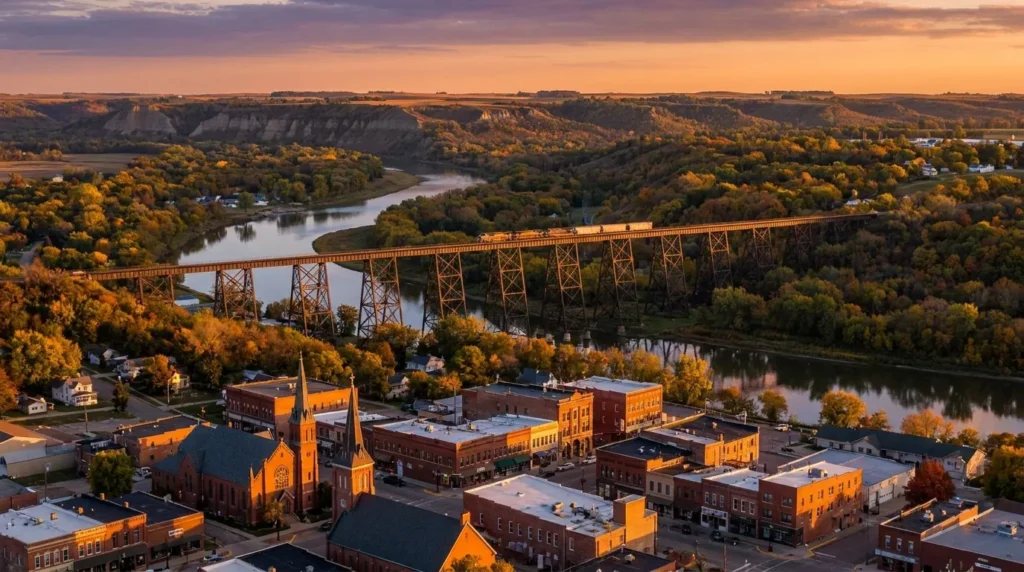
The signature landmark is the Hi-Line Railroad Bridge, a steel railroad bridge stretching over 0.7 miles, one of the tallest in the region. The city has more than ten historic bridges crossing the Sheyenne in total, which earned it the nickname City of Bridges. Walking between several of them is a typical outing for residents and visitors.

The Rosebud Visitor Center, housed in a restored 1881 Pullman rail car, tells the local railroad history and serves as a starting point for exploring the city. Chautauqua Park, with seasonal cultural programming, and Lake Ashtabula a few miles away provide the outdoor recreation that weighs heavily in residents' lives. The Sheyenne National Scenic Byway, a federal scenic route, begins near the city and extends for more than 60 miles through hills, forests, and historic villages.

For those who enjoy events, VCSU's athletic schedule and the North Dakota Winter Show are marked on the calendar. On a tourism scale, Valley City is more about landscape, history, and pace than grand monuments, attracting a specific type of resident who values outdoor life.

  1. 1Hi-Line Railroad Bridge
  2. 2Rosebud Visitor Center
  3. 3Chautauqua Park
  4. 4Sheyenne National Scenic Byway
  5. 5Medicine Wheel Park
  6. 6Valley City State University Campus
Parks & green spaces
  • Chautauqua Park
  • City Park
  • Medicine Wheel Park
  • Lake Ashtabula (nearby)
  • Sheyenne River Greenway

Small international presence, driven by the university

Immigrant community small in absolute numbers, with varied backgrounds tied to VCSU's international student body and Latino workers in the agricultural and service supply chains.

Valley City is not a traditional immigration destination in the United States. The number of foreign-born residents is small in absolute terms, but the diversity of origins stands out for a city of this size. Valley City State University receives international students from various countries, bringing a constant rotation of Asian, African, and European families living temporarily in the city.

Latino workers, primarily from Mexico and Central America, form the most consistent immigrant presence outside the university circuit, working in services, food processing, and agricultural activities in Barnes County. Communities of Filipinos and Indians, generally tied to healthcare and education, round out the picture alongside Rhine Germans, Ukrainians, and refugees resettled over the past few decades through the state's reception network.

Institutional support comes primarily from the university, churches, and regional organizations serving the entire Fargo metropolitan area. For consular services and more complex bureaucratic matters, the natural destination is the regional service hub of Fargo, or the city of Minneapolis in the neighboring state of Minnesota.

250
Foreign-born residents
estimated
Top countries of origin
  • Mexico
  • Philippines
  • India
  • Germany
  • Ukraine
  • China
  • Nigeria
  • Canada
Foreign consulates
  • Honorary Consulate of Mexico (Fargo)
  • Honorary Consulate of Norway (Fargo)
  • Honorary Consulate of Germany (Fargo)
  • Consulate General of Mexico (Minneapolis)
  • Consulate General of Canada (Minneapolis)
Community organizations
  • Lutheran Social Services of North Dakota
  • New American Consortium for Wellness and Empowerment (Fargo)
  • Cultural Diversity Resources (Fargo)
  • VCSU International Student Services
  • Catholic Charities North Dakota

Latest posts

Posts about North Dakota

Coverage and updates related to this destination.

Showing content from North Dakota, as there is no specific data for Valley City yet.