Visto n' Visa
Blog
Notícias e artigos
Destinations
Careers
Immigrants

Want to live and work in Dickinson?

Personalized immigration plan with eligible visas, costs, and next steps for your goal!

If you are not eligible, you will know exactly why and what to do to improve your approval chances.

Save up to 12 hours in meetings

No pointless assessments.

Save up to 90%

Save money on vague or unfocused consultations

Avoid Fraud and Mistakes

One mistake can cost you your visa

Total Impartiality

Zero commercial bias

Decide with peace of mind

No toxic urgency

Fast and Accurate

Answers in minutes, no guesswork

Who lives in Dickinson: Volga Germans and new oil workers

Most residents descend from Germans from Russia, Germans who lived along the Volga before migrating to North Dakota. The oil boom brought workers from other states and countries, diversifying the city.

Dickinson has a distinctive historical identity. A large share of the population descends from Germans from Russia, Germans who lived in the Volga River valley in Russia before migrating to North Dakota in the late nineteenth century in search of land. Surnames such as Schmidt, Wolf, Walter, Heinz, and Kuntz are common, and the influence shows up in dishes like kuchen, fleischkuekle, and knoephla.

The oil boom brought workers from Texas, Oklahoma, Louisiana, and other parts of the United States, along with Mexican, Honduran, and Filipino immigrants. Spanish can be heard fairly often in some markets and restaurants. A Native American presence also exists, with members of nearby nations, though smaller than in other cities in the state.

The population is younger than the state average, driven by oil and the university. Families settled in greater numbers after the initial boom, and Dickinson today has a more stable character, with people who came for work and decided to stay and put down roots.

Languages spoken
  • English
  • Spanish
  • German (heritage)
  • Tagalog
Main religions
  • Catholicism
  • Lutheranism
  • Pentecostalism
  • Various evangelical denominations
  • No religion

Cost of living in Dickinson: low, with rent affected by oil cycles

Dickinson maintains a low cost of living most of the time. Rent rises during boom phases and falls during slower periods. Food, transportation, and taxes are affordable. Winter heating is the largest expense.

Rent is typically low compared to equivalent cities in other states. During boom phases, new complexes near I-94 see prices rise; during slower periods, they return to normal. Homes for purchase are affordable even for families on median wages. Property tax falls in a moderate range, and North Dakota has a low state income tax.

The natural gas bill from November through April is the biggest budget concern. Well-insulated homes help absorb the impact. Electricity provided by local cooperatives is reasonable. Combined sales tax runs around 6.5 percent, below the national average. Fuel costs very little, a natural advantage of living in an oil-producing region.

Grocery stores such as Walmart, Cash Wise, and Family Fare cover everyday needs. The nearest Costco is in Bismarck, about 100 minutes away. Local restaurants like The Brickhouse Grille offer low prices, and the Mexican food scene has grown with the Latin immigrant community. For those who cook at home, life in Dickinson fits comfortably within mid-tier industry wages.

Dickinson

Housing in Dickinson: affordable family homes and modern apartments

The market ranges from family homes in established neighborhoods to modern apartments built during the boom. New subdivisions to the south offer large homes at low prices. Rent fluctuates with the oil cycle.

The southern and eastern parts of the city have established neighborhoods with family homes on generous lots. Lincoln Park, Patterson Lake, and the south side are popular with families for their schools and quiet atmosphere. Downtown features older homes with historic character, some with wide front porches typical of the early twentieth century.

Modern apartment complexes built during the boom are located mainly along I-94 and on West Villard Street. Many include heat, a pool, and a gym, serving oil field workers and newly arrived families. New subdivisions in neighborhoods like North Park offer large homes at prices that are low by national standards.

Newcomers typically rent in modern apartments first before buying. Local real estate agencies such as Choice Real Estate dominate the market. American credit history is required for financing, but state programs exist for first-time buyers. A heated garage is a priority in winter, and proper insulation makes a significant difference in the gas bill.

Recommended neighborhoods
  • Lincoln Park
  • Patterson Lake
  • South Dickinson
  • North Park
  • Central Dickinson
  • +1 more

Job market in Dickinson: oil, agriculture, healthcare, and the university

The economy revolves around the oil fields, traditional agriculture, CHI St. Joseph's Health, and Dickinson State University. Good openings exist in CDL transportation and technical services for qualified immigrants.

Oil is the primary driver. Companies such as Hess, Continental Resources, and Marathon Oil have operations in the region, with nearby offices and worksites. Openings range from engineers, geologists, and welders to heavy equipment operators, maintenance technicians, and CDL truck drivers, who are especially in demand. Oilfield services companies hire continuously.

CHI St. Joseph's Health is the main local hospital, with an emergency department, maternity unit, and specialty clinics. Dickinson State University, with approximately 1,400 students, offers administrative, technical, and academic positions. Dickinson Public Schools is also a major employer. Agriculture remains strong, with regional cooperatives and beef cattle ranches.

For those arriving without fluent English, restaurants, hotels, cleaning, and construction serve as quick entry points, with wages above the rural American average. Tourism tied to Theodore Roosevelt National Park has grown, generating positions in hotels and guiding. CDL-licensed truck drivers are especially valued in the oil sector.

Dominant sectors
  • Oil and gas
  • Agriculture and livestock
  • Healthcare
  • Higher education
  • CDL transportation
  • +1 more
Major employers
  • Hess Corporation
  • Continental Resources
  • CHI St. Joseph's Health
  • Dickinson State University
  • Dickinson Public Schools
  • +1 more

Education in Dickinson: a small university and an active public school system

Dickinson State University is the academic cornerstone. Public schools serve the local community, with programs for immigrant students. Catholic private schools with a long local tradition are also available.

Dickinson State University, founded in 1918, is a small public institution with approximately 1,400 students. It offers undergraduate programs in education, business, health sciences, and rural studies, with particular attention to agriculture and the regional energy sector. In-state tuition is affordable. The Theodore Roosevelt Honors Leadership Program is a distinctive local offering.

Dickinson Public Schools covers the public system, with Dickinson High School as the main secondary institution. An English as a Second Language program serves immigrant students, with Spanish interpreters available. ESL teachers typically have experience working with Hispanic families who arrived from Texas and Mexico during the oil boom.

For technical education, Dickinson State and TrainND offer certifications in welding, oilfield operations, practical nursing, and administration. Catholic private schools such as Trinity High School and Trinity Junior High maintain a local tradition. For young children, private daycare centers and the Head Start program, aimed at low-income families, are available.

Notable universities
  • Dickinson State University
  • TrainND (technical training)
  • Bismarck State College (100 min away)

Healthcare in Dickinson: local hospital and limited regional referral options

CHI St. Joseph's Health is the main hospital, with emergency and basic specialty services. Complex cases are transferred to Bismarck or Fargo. Standard American system, with insurance as the central piece.

CHI St. Joseph's Health Dickinson is the main regional hospital, with an emergency department, maternity unit, basic surgery, cardiology, and basic oncology. Sanford Health also operates clinics in the city. For complex procedures such as advanced cardiac surgery, neurosurgery, or complex oncology, patients are transferred to larger hospitals in Bismarck (100 minutes away), Fargo, or Minneapolis.

As in any American city, health insurance is essential. Formal employees typically have employer-negotiated plans. North Dakota Medicaid covers children, pregnant women, and certain low-income categories. Those without coverage turn to community clinics with income-based fees.

In an emergency, the ER treats anyone, but the bill arrives afterward and can be substantial without insurance. Specialists may have wait times of several weeks. Mental health services have limited availability, though the situation is improving, particularly for substance use treatment. Dental care is separate and expensive without a dental plan. Vision care requires separate appointments and out-of-pocket payments for exams and frames.

Healthcare index60.0 / 100
  • Life expectancyyears at birth
    78.4yrs
  • Doctors per 1kpracticing physicians
    3.7
  • Health spendper capita, per year
    $13,473
  • Public systemoverall quality rating
    Fair

Safety in Dickinson: a quiet city with occasional spikes tied to oil activity

Dickinson has low crime by American standards. During oil boom phases, alcohol-related incidents rise. Family neighborhoods are safe, and daily life is calm.

Crime in Dickinson is low by national standards. Most incidents involve retail theft, traffic violations, and domestic disputes. During oil boom phases, alcohol-related incidents on downtown weekends increase, though serious violence remains rare. The police maintain a good relationship with the local community.

Family neighborhoods such as Lincoln Park, Patterson Lake, and the new subdivisions to the south are quiet and suitable for children. Areas near downtown see more activity at night, particularly around bars. The Dickinson Police Department maintains staffing proportional to the city's size and provides support to immigrant and refugee families when needed.

The greatest ongoing hazard is winter weather. Snowstorms, wind-chill temperatures below minus 40 degrees in January, cutting prairie winds, and icy roads require serious preparation. Hypothermia cases occur every year, and those arriving from tropical countries need to invest in a thermal coat, insulated boots, and appropriate gloves before any outdoor activity.

5.8
Homicides per 100k
per year
Safety index
64.0
Crime index
36.0
Safer neighborhoods
  • Center Avenue area (historic downtown)
  • Empire Road residential area
  • Heart River area
  • Sunset Hills
  • Prairie Hills
  • West Ridge
Areas to avoid
  • Industrial oil-related areas to the west at night
  • Isolated stretches near I-94 late at night

Transportation in Dickinson: regional airport, I-94, and car dependency

Dickinson has a small regional airport with flights to Denver and Minneapolis. I-94 runs through the city, connecting it to Bismarck and Billings. Like all western cities, it depends entirely on the car.

Dickinson Theodore Roosevelt Regional Airport operates direct flights to Denver and Minneapolis via United and Delta, on a modest scale. International travelers require a connecting flight. I-94 runs east-west through the city, with Bismarck 100 minutes to the east and Billings, Montana, two and a half hours to the west. US-22 leads to Theodore Roosevelt National Park to the north.

There is no robust municipal bus system. Uber and Lyft are available but with long wait times. A pickup truck is the near-universal choice because of winter conditions, snow, and the region's geography. Amtrak does not stop in Dickinson; passengers wanting rail service need to travel to Minot or Williston.

A car is essential. The city itself is compact, but oil field jobs are often spread across the surrounding area. A North Dakota driver's license is straightforward to obtain, with the written test available in several languages at select offices. In winter, appropriate tires, stronger batteries, and an emergency kit in the trunk are necessary.

14 min
Avg commute
30
Walkability
Airports
  • DIK — Dickinson Theodore Roosevelt Regional Airport

What the Climate Is Like Living in Dickinson

Dickinson has a semi-arid continental climate, with long, frigid winters, short hot summers, and strong winds throughout the year.

Winters are severe, with lows frequently dropping below -18 degrees Celsius and plains winds that push wind chill values even lower. Snowstorms and blizzards are a regular part of life from November through March.

Summer is short and sunny, with highs between 28 and 32 degrees in July, low humidity, and cool nights. Severe storms with hail occur occasionally.

Residents need robust heating, extreme-winter outerwear, a heated garage, and snow tires. Air conditioning helps in summer, and on the coldest days wind makes face protection a necessity.

Sunny days / year215 days
Avg high (°F)
  • 31°J
  • 27°F
  • 40°M
  • 51°A
  • 66°M
  • 79°J
  • 84°J
  • 84°A
  • 75°S
  • 54°O
  • 41°N
  • 32°D
Avg low (°F)
  • 15°J
  • F
  • 20°M
  • 30°A
  • 44°M
  • 57°J
  • 62°J
  • 60°A
  • 52°S
  • 37°O
  • 25°N
  • 16°D
Rainfall (")
  • 0"J
  • 1"F
  • 1"M
  • 2"A
  • 3"M
  • 2"J
  • 1"J
  • 2"A
  • 2"S
  • 2"O
  • 1"N
  • 1"D

Culture in Dickinson: Ukrainian Days, rodeo, and the national park

Culture blends Germans from Russia roots, a ranching spirit, and proximity to Theodore Roosevelt National Park. Ethnic festivals, rodeo, and outdoor activities mark the calendar.

The Ukrainian Cultural Institute and festivals tied to the Germans from Russia tradition keep the region's deep roots alive. The Dickinson Museum Center brings together agricultural history, dinosaur fossils (the area is rich in Cretaceous fossils), and cultural exhibits. The Joachim Regional Museum adds more on prairie life and the arrival of European immigrants.

Theodore Roosevelt National Park is the heart of outdoor life. Trails, bison watching, wild horses, elk, and the badlands scenery attract both residents and visitors. Patterson Lake, within Dickinson, is a popular summer destination for fishing, swimming, and camping. Roller Coaster Hill and Heart River Golf Course round out the leisure options.

The cuisine reflects German and Ukrainian roots: knoephla, kuchen, fleischkuekle, halušky, and kraut bierocks are family staples. Local restaurants such as The Brickhouse Grille and Brew Coffee, Wine and Beer Bar offer a solid selection. Mexican food has grown with the Latin immigrant community, and there are good American pizzerias. Craft breweries began appearing after the boom.

Dickinson

What to Do in Dickinson, North Dakota: From the Dakota Dinosaur Museum to Theodore Roosevelt National Park

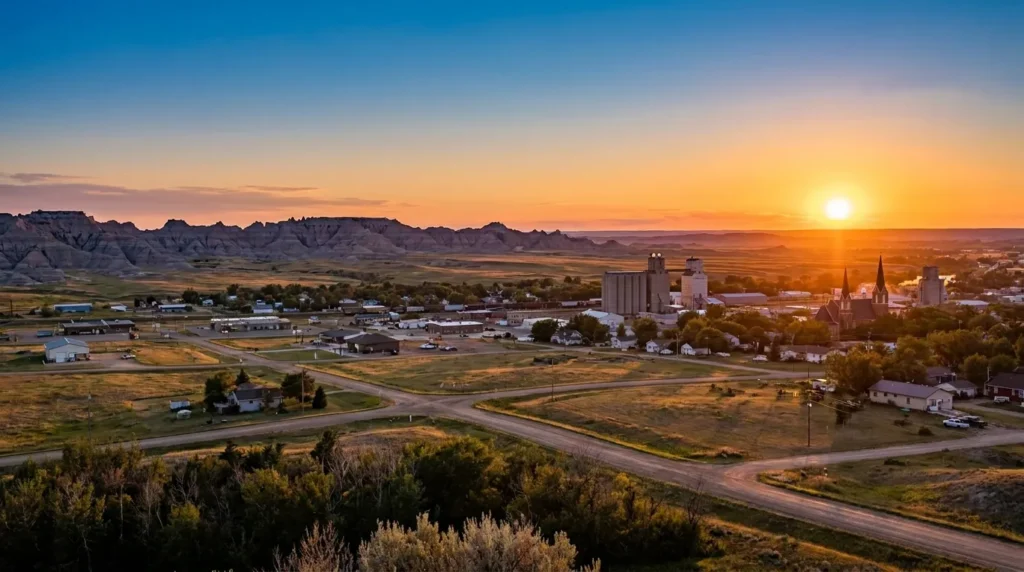
Dickinson is the largest city in the state's southwest and the gateway to North Dakota's Badlands. Life here blends oil-town energy, German-Russian heritage, and the landscapes of the Bakken.

The city has two museums worth a stop. The Dakota Dinosaur Museum features twelve full-scale complete skeletons and is a regional reference in paleontology, with specimens recovered from the Hell Creek Formation. The Joachim Regional Museum reconstructs a pioneer village from the early 20th century, with a special focus on German-Russian immigration, the community that shaped much of western North Dakota. The Ukrainian Cultural Institute on West Villard Street preserves Ukrainian traditions through a hall and rotating exhibitions.

Downtown along Villard Street has been revitalized, with restaurants, brewpubs such as Phat Fish Brewing, and the historic Elks Lodge. Dickinson State University, with around 1,400 students, is the region's largest institution and draws NSIC sporting events. The Heart River, which runs through the city, has trails on both banks, and the neighboring Patterson Lake Recreation Area offers fishing, sailing, camping, and a beach during the short warm months.

The region's main draw is Theodore Roosevelt National Park, just 50 kilometers to the west, divided into three units, with Badlands carved by the Little Missouri River, free-roaming bison, wild horses, and the Maltese Cross Cabin where Theodore Roosevelt lived in the late 19th century. The Maah Daah Hey Trail, spanning more than 200 kilometers, crosses the area for mountain biking and hiking. In winter, ice fishing and snowmobiling dominate the scene.

  1. 1["Dakota Dinosaur Museum"
  2. 2"Ukrainian Cultural Institute"
  3. 3"Joachim Regional Museum"
  4. 4"Theodore Roosevelt Center (DSU)"
  5. 5"Patterson Lake"
  6. 6"Theodore Roosevelt National Park (nearby)"
Nightlife2.0 / 10
Parks & green spaces
  • ["Patterson Lake Recreation Area"
  • "Rocky Butte Park"
  • "Legion Park"
  • "Lincoln Park"
  • "Heart River Trail"
  • +1 more

Latest posts

Posts about North Dakota

Coverage and updates related to this destination.

Showing content from North Dakota, as there is no specific data for Dickinson yet.