Visto n' Visa
Blog
Notícias e artigos
Destinations
Careers
Immigrants

Want to live and work in Devils Lake?

Personalized immigration plan with eligible visas, costs, and next steps for your goal!

If you are not eligible, you will know exactly why and what to do to improve your approval chances.

Save up to 12 hours in meetings

No pointless assessments.

Save up to 90%

Save money on vague or unfocused consultations

Avoid Fraud and Mistakes

One mistake can cost you your visa

Total Impartiality

Zero commercial bias

Decide with peace of mind

No toxic urgency

Fast and Accurate

Answers in minutes, no guesswork

Who lives in Devils Lake: mostly European descent with a Native American presence

The population is largely of Northern European origin (German, Norwegian, Swedish) with a significant Native American presence due to the proximity of the Spirit Lake Reservation.

Devils Lake has about seven thousand residents and is demographically homogeneous by American standards. Most residents have German, Norwegian, and Swedish ancestry, the result of late nineteenth-century settlement waves, and this still shows up in surnames, Lutheran churches, and community festivals today.

The most visible presence beyond that core is Native American. The Spirit Lake Reservation, home to the Dakota Sioux, lies just south of the city, and many families move between the two places for work, school, and healthcare. There is also a small Hispanic community working in seasonal agriculture, along with a few Filipino and African families connected to the local hospital.

English dominates daily life. Some churches and community agencies offer services in Dakota and Spanish, but in commerce and public life almost everything is in English. Newcomers without fluency must prepare for this from the first days.

Languages spoken
  • English
  • Dakota Sioux
  • Spanish
  • German (historical)
Main religions
  • Lutheran Christianity
  • Catholicism
  • Evangelical Christianity
  • Native American spirituality
  • No religion

Low cost of living, especially in housing and food

Devils Lake ranks among the most affordable cities in the United States, with modest rents, reasonable summer utility bills, and supermarkets without major inflation.

The cost of living in Devils Lake sits well below the American national average. Rent for a one-bedroom apartment downtown typically runs at low figures by U.S. standards, and three-bedroom houses for purchase cost a fraction of what a comparable property would run in mid-sized cities on the East or West Coast.

Grocery costs are reasonable, with chains like Walmart, Leevers Foods, and Sunmart covering the basics. Dining out is cheap, with diners and fast-food spots dominating the scene. The biggest hit to the budget is winter heating: natural gas and electricity climb during the cold months, and home insulation makes a real difference on the bill.

Transportation is another important cost because everything is done by car. Fuel tends to be cheap compared with major metros, but vehicle maintenance in winter (tires, battery, antifreeze) becomes part of the annual plan. Health insurance, even through an employer, still weighs on the paycheck.

Devils Lake

Affordable houses, little red tape, and a limited rental stock

Buying a home in Devils Lake is affordable, but the rental market is small and nearly all options are houses or duplexes rather than apartment buildings.

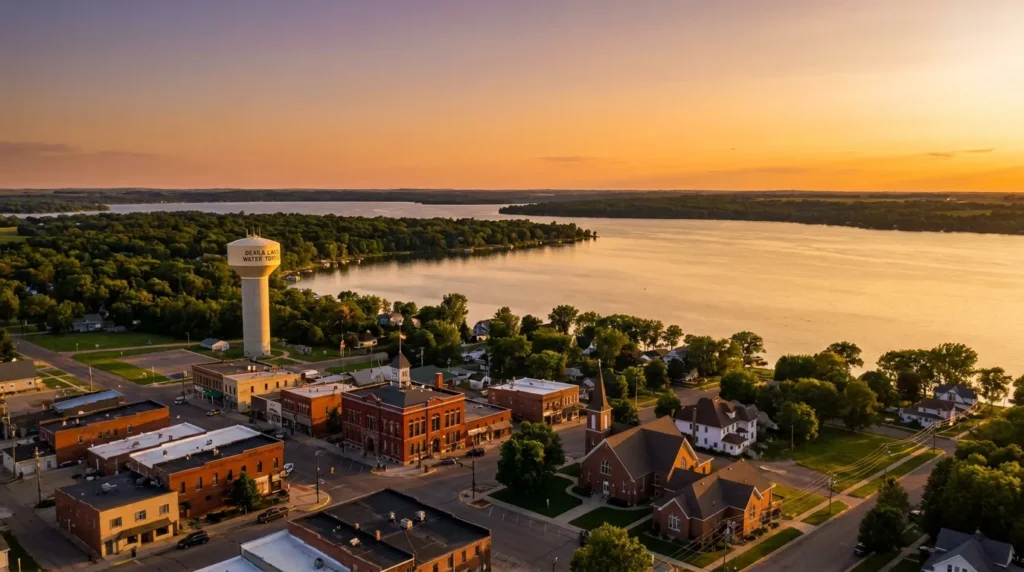
Most residents live in one- or two-story houses with a yard, garage, and basement. Residential neighborhoods sit west of downtown and north of the lake, with tree-lined streets and little traffic. New construction tends to appear on the edges of town, mostly near Highway 2.

Rentals exist but are scarce. The few available options are usually in small complexes, in duplexes, or in single-family houses rented directly by the owner. Sites like Zillow and Realtor have listings, but much still moves through word of mouth, the local paper, and the regional Facebook Marketplace. Booking before arrival is difficult without an in-person visit.

For buyers, the price barrier is low, but financing requires an American credit history. Newly arrived immigrants typically rent for one to two years before pursuing a mortgage. Properties near the lake carry a higher value due to recreational use.

Recommended neighborhoods
  • Downtown
  • West End
  • Lake Region (near the lake)
  • Creel Bay
  • Heritage Drive area

Jobs in healthcare, agribusiness, retail, and public administration

The job market revolves around the regional hospital, Lake Region State College, local retail, and the farms and agricultural cooperatives of the region.

The largest employer in the city is CHI St. Alexius Health Devils Lake Hospital, which drives steady demand for nurses, technicians, physicians, support staff, and contracted services. Lake Region State College is another pillar, generating openings in teaching and administration. Marketplace Foods, Walmart, and fast-food chains employ hundreds in retail.

Agribusiness dominates the surrounding area: grain elevators, cooperatives, machinery dealers (John Deere, Case IH), and input suppliers hire drivers, mechanics, operators, and office staff. The Camp Grafton military base and the Bureau of Indian Affairs also offer stable administrative roles.

For immigrants, the most open doors are usually in healthcare (nursing assistants, RNs with recognized licensure), food processing, hospitality, and seasonal farm work. English proficiency is practically required for formal positions. Wages are modest, but the low cost of living offsets that.

Dominant sectors
  • Healthcare
  • Agribusiness
  • Education
  • Retail
  • Public administration
  • +1 more
Major employers
  • CHI St. Alexius Health
  • Lake Region State College
  • Walmart
  • Marketplace Foods
  • Camp Grafton (National Guard)
  • +2 more

Public schools, a community college, and accessible vocational education

Devils Lake has public K-12 schools, a Catholic school, Lake Region State College, and Cankdeska Cikana Community College on the Spirit Lake Reservation.

The Devils Lake Public Schools system covers early childhood through high school, with Central Middle School and Devils Lake High School as the core institutions. There is also St. Joseph's Catholic School for families who prefer religious education. For immigrants with children, enrollment is simple and free, with English as a Second Language programs available.

In higher education, Lake Region State College is the main option, offering two-year vocational programs in nursing, mechanics, precision agriculture, peace officer training, and information technology, as well as transfer programs to four-year universities. Tuition is affordable by American standards.

Cankdeska Cikana Community College, in Fort Totten within the Spirit Lake Reservation, is a tribal college focused on Native American students and opens programs to the wider community. For full undergraduate and graduate degrees, most travel to the University of North Dakota in Grand Forks or North Dakota State in Fargo.

Notable universities
  • Lake Region State College
  • Cankdeska Cikana Community College (Fort Totten)
  • University of North Dakota (Grand Forks, 1h30)
  • North Dakota State University (Fargo, 3h30)

Solid regional care for the size of the city

CHI St. Alexius Health Devils Lake is the regional referral hospital, with an emergency room, clinics, and essential specialties; complex cases go to Grand Forks or Fargo.

The local healthcare system centers on CHI St. Alexius Health Devils Lake, a hospital with a 24-hour emergency room, maternity ward, general surgery, orthopedics, basic cardiology, and imaging. For a city of seven thousand, the infrastructure is considered good, with on-call staff every day and a helicopter for urgent transfers.

There are also primary care clinics, dentists, ophthalmologists, and physical therapists scattered throughout the city, along with pharmacies such as Walgreens, Walmart Pharmacy, and independent local pharmacies. The Indian Health Service serves residents of the Spirit Lake Reservation and covers part of the Native American demand.

Complex cases such as advanced oncology, neurosurgery, transplants, or neonatal ICU go to Altru Health in Grand Forks or Sanford Health in Fargo. The American system requires health insurance, and immigrants without formal coverage typically rely on federally subsidized community health centers, which accept income-based payment.

Devils Lake

A quiet city with low crime and few urban problems

Devils Lake is safe by American standards, with low violent crime rates and most incidents linked to theft, alcohol use, and drugs in specific spots.

Most of Devils Lake is quiet. People leave houses unlocked in residential neighborhoods, children ride bikes without supervision, and violent crime is rare. Retail theft, bar fights, and traffic violations are the most common incidents that appear in the local police log.

Areas requiring more attention include zones near some downtown bars at night, isolated gas stations on the outskirts, and stretches of the Spirit Lake Reservation where socioeconomic problems weigh more heavily. None of this prevents normal life, but it is wise to avoid exposed situations at night, especially when alcohol is involved.

Extreme cold is, by far, the biggest real risk. Winter in Devils Lake kills those who underestimate it: 40-below winds, a frozen lake that looks solid but has thin patches, and roads with ice fog. Having proper thermal clothing, keeping the car stocked with a winter kit, and respecting weather warnings matters more than any precaution against crime.

Safer neighborhoods
  • West End
  • Heritage Drive area
  • Residential neighborhoods north of the lake
  • Lake Region area
  • Areas near Lake Region State College
Areas to avoid
  • A few blocks around downtown bars at night
  • Isolated reservation roads at night
  • Areas near the lake in adverse weather conditions

A city where a car is required and there is a small regional airport

Devils Lake has no meaningful urban public transit; a car is essential. The regional airport offers flights to Denver, and Amtrak passes through the city.

In Devils Lake a car is necessary. There is no urban bus network, and the distances between supermarket, work, and home make walking impractical, especially in winter. The upside is minimal traffic, with parking that is plentiful and free almost everywhere.

Devils Lake Regional Airport (DVL) offers daily flights to Denver via United, connecting the city to the rest of the country. For international flights, most residents drive to Grand Forks (about 90 miles) or Fargo (about 200 miles). The Amtrak Empire Builder stops at the local station, linking Devils Lake to Chicago, Minneapolis, Seattle, and Portland on long-distance routes.

For the region, U.S. Highway 2 cuts through the city east to west and serves as the main artery. State highways link to the reservations, farms, and smaller towns nearby. Jefferson Lines intercity buses also serve the region with limited frequency.

Airports
  • DVL — Devils Lake Regional Airport
  • GFK — Grand Forks International (1h30 by car)
  • FAR — Fargo Hector International (3h30 by car)

Climate

Devils Lake

Small-town culture with strong Scandinavian and Native American roots

Cultural life revolves around the lake, hunting and fishing, community festivals, and Scandinavian and Dakota traditions preserved for generations.

In Devils Lake, culture is lived day to day: Lutheran churches with Christmas bazaars, ice fishing festivals, regional rodeos, and community dinners at parish halls. Scandinavian roots show up in foods like lefse and lutefisk on festive dates and in surnames ending in -son and -sen.

The Dakota presence is culturally and historically central. The Spirit Lake Reservation hosts open powwows, with traditional dance, drumming, and craft sales, and local institutions like Sullys Hill incorporate part of that history. Fishing, hunting, and outdoor activities are not just leisure, they are local identity.

For immigrants, cultural life may seem closed at first. There are no large multicultural festivals, ethnic restaurants are few, and the arts scene is modest. On the other hand, neighbors tend to be welcoming when one takes part in school, church, or fishing club events.

Notable dishes
  • Fried walleye (local fish)
  • Lefse (Norwegian flatbread)
  • Knoephla soup (German-Russian soup)
  • Hotdish (Midwestern casserole)
  • Bison burger
  • +1 more
Annual events
  • Devils Lake Ice Fishing Tournament
  • North Dakota Winter Show
  • Spirit Lake Powwow
  • Ramsey County Fair
  • Chautauqua at Fort Totten
  • +1 more

Lake, fishing, military history, and wildlife define what to do in Devils Lake

Attractions are almost all outdoors: the lake for fishing and boating, wildlife refuges, historic Fort Totten, and the Spirit Lake casino.

The lake is the center of everything. In summer, boating, walleye and perch fishing, water skiing, and camping along the shores. In winter, the landscape turns into a city of ice fishing shanties, and Devils Lake is considered one of the country's top destinations for the sport. Tournaments draw out-of-state visitors during the cold season.

Beyond the lake, Sullys Hill National Game Preserve houses bison, elk, and deer in a protected setting, with a driving trail and overlooks. Fort Totten State Historic Site preserves a 19th-century military fort and hosts events such as the summer Chautauqua. Roosevelt Park downtown brings families together for picnics and activities.

Spirit Lake Casino & Resort, a few minutes from downtown, offers gaming, shows, and a restaurant, serving as a regional gathering point. For immigrants coming from large cities, the cultural offering is modest, but nature makes up for it once one learns to take advantage of it.

  1. 1Devils Lake (the lake)
  2. 2Sullys Hill National Game Preserve
  3. 3Fort Totten State Historic Site
  4. 4Spirit Lake Casino & Resort
  5. 5Lake Region Heritage Center
  6. 6Grahams Island State Park
Parks & green spaces
  • Roosevelt Park
  • Grahams Island State Park
  • Sullys Hill National Game Preserve
  • Black Tiger Bay State Recreation Area
  • Lakewood Park
  • +1 more

Small immigrant community concentrated in healthcare, agriculture, and services

Devils Lake has a small but diverse immigrant population, with Hispanic, Filipino, African, and Eastern European families working mainly in healthcare and food processing.

The immigrant presence in Devils Lake is modest but real and has grown slowly in recent years. Most recent immigrants arrive for jobs in healthcare (nursing, technicians), seasonal agricultural processing, and hospitality services. Mexican, Salvadoran, and Guatemalan families form the largest Hispanic contingent.

There are also Filipinos linked to the hospital, a small number of Indian professionals in medicine and technology, and some African families (especially from Somalia, Sudan, and Nigeria) and Eastern European families (Ukraine, Bosnia) resettled through the federal refugee program that operates at a larger scale in Fargo and Grand Forks.

There are no visible ethnic neighborhoods or large specialized support networks. Immigrants typically connect through church, their children's school, or coworkers. For formal services (documents, ESL, advocacy), many travel to Grand Forks or Fargo, where larger organizations such as Lutheran Social Services serve them regularly.

280
Foreign-born residents
estimated
Top countries of origin
  • Mexico
  • Philippines
  • El Salvador
  • Guatemala
  • Somalia
  • India
  • Ukraine
  • Sudan
Foreign consulates
  • Consulate General of Mexico in Minneapolis (regional jurisdiction)
  • Honorary Consulate of Norway in Minneapolis
  • Consulate General of Canada in Minneapolis
  • Honorary Consulate of the Philippines in Minneapolis
Community organizations
  • Lutheran Social Services of North Dakota
  • Catholic Charities North Dakota
  • Lake Region Human Service Center
  • Spirit Lake Tribe Social Services
  • Community Action Partnership of North Dakota

Latest posts

Posts about North Dakota

Coverage and updates related to this destination.

Showing content from North Dakota, as there is no specific data for Devils Lake yet.