Visto n' Visa
Blog
Notícias e artigos
Destinations
Careers
Immigrants

Want to live and work in Chapel Hill?

Personalized immigration plan with eligible visas, costs, and next steps for your goal!

If you are not eligible, you will know exactly why and what to do to improve your approval chances.

Save up to 12 hours in meetings

No pointless assessments.

Save up to 90%

Save money on vague or unfocused consultations

Avoid Fraud and Mistakes

One mistake can cost you your visa

Total Impartiality

Zero commercial bias

Decide with peace of mind

No toxic urgency

Fast and Accurate

Answers in minutes, no guesswork

Who Lives in Chapel Hill

Around 61,000 residents, with a strong presence of students, faculty, and healthcare professionals, forming a highly educated and notably international population for a city of its size.

Chapel Hill's population hovers around 61,000 residents, a figure that fluctuates significantly with the academic calendar. During the semester, UNC brings in roughly 30,000 students, plus faculty and staff, giving the city an unusually young density for its size. In summer, the pace drops noticeably.

The socioeconomic profile is shaped upward by the university and hospital ecosystem. Most adults hold a college degree, and median family income exceeds the state average. The ethnic composition includes a non-Hispanic white majority, a Black community historically rooted in neighborhoods such as Northside and Pine Knolls, a significant Asian population connected to UNC and UNC Hospitals, and growing Hispanic and Middle Eastern communities.

Religious life is diverse and low-key. There is a strong Protestant tradition, historic churches downtown, a Catholic community centered on the Newman Center, synagogues, Hindu and Buddhist temples in the metropolitan area, and an Islamic center serving the local Muslim community and international students.

Languages spoken
  • English
  • Spanish
  • Mandarin
  • Korean
  • Hindi
  • +1 more
Main religions
  • Protestantism
  • Catholicism
  • Judaism
  • Islam
  • Hinduism
  • +1 more

Cost of Living in Chapel Hill

One of the more expensive cities in North Carolina, with rents driven up by university demand and significant property taxes, while everyday services and groceries track regional averages.

Chapel Hill is one of the most expensive cities in North Carolina to live in, particularly when it comes to housing. Demand generated by UNC, the university hospital, and the Research Triangle research hub keeps rents and home prices well above the state average. Studios and one-bedroom apartments near campus cost more than comparable units in central Raleigh neighborhoods.

Groceries, restaurants, and day-to-day services are on par with Durham and Raleigh. Supermarkets such as Harris Teeter, Trader Joe's, and Whole Foods serve the local population, with Aldi and Food Lion as lower-cost alternatives. Dining on Franklin Street carries the price level of a university town with cosmopolitan aspirations.

Property taxes are significant and help fund the quality of the school system and municipal services. Local bus transit is free within the city, which helps students and households without a second car. Overall, those earning at academic or hospital salary levels live comfortably, while the cost can weigh heavily on those arriving with lower incomes.

93Cost index (US = 100)7% below US average
CategorySingleCoupleFamily (2 + 2)
iHousing$1,208$1,394$1,765
iFood$353$707$1,283
iTransport$465$790$1,022
iHealthcare$260$520$975
iChildcare$1,692
iOther$790$1,422$1,998
Monthly total$3,076$4,833$8,735

Source: U.S. BLS Consumer Expenditure Survey 2023 + BEA Regional Price Parities 2023 · Estimates in USD, monthly.

Where to Live in Chapel Hill

Tree-lined residential neighborhoods near campus, family-oriented areas farther out, and new mixed-use zones make up the housing landscape, with strong competition for student-adjacent rentals.

Chapel Hill's housing market divides into apartments near UNC, homes in established neighborhoods, and new units in mixed-use expansion areas. Those looking to walk to campus typically explore around Franklin Street, Northside, and Cameron Avenue, where competition with students is high and supply is limited.

Families with children tend to concentrate in planned neighborhoods such as Meadowmont, Southern Village, Briar Chapel, and Chapel Hill North. These are planned communities with well-rated schools, bike paths, and neighborhood commercial centers. For a more traditional feel, Westwood, Coker Hills, and Lake Forest offer classic homes with larger lots and tree-lined streets.

Carrboro, the immediate neighbor, functions almost as an extension of Chapel Hill and attracts those seeking a more eclectic environment at slightly lower prices. Those needing to balance budget and proximity to the Triangle often end up in Hillsborough or in Durham neighborhoods with good access to I-40, trading the Chapel Hill address for affordability.

Recommended neighborhoods
  • Meadowmont
  • Southern Village
  • Briar Chapel
  • Westwood
  • Coker Hills
  • +2 more

Local Job Market

An economy heavily concentrated in higher education, healthcare, and research, with UNC and UNC Hospitals as the dominant employers and complementary opportunities across the Research Triangle.

Chapel Hill's job market is dominated by UNC and the UNC Health system, which together employ tens of thousands of people in teaching, research, administration, nursing, medicine, and support services. For those working in academic, biomedical, public health, or library fields, it is one of the strongest hubs in the southeastern United States.

Outside the university umbrella, there is a meaningful ecosystem of biotechnology startups, health-focused software companies, consulting firms, and nonprofits. Research Triangle Park, about 20 minutes by car, is home to major employers in pharmaceuticals, technology, and research, and is a common destination for Chapel Hill residents who work outside the city.

Small businesses on Franklin Street and in neighborhood centers absorb part of the workforce in retail, restaurants, and services, with high turnover tied to the student population. Those arriving from abroad tend to find opportunities more quickly in healthcare, teaching, and technical services, and with more difficulty in traditional industrial sectors, which are scarce in the area.

Dominant sectors
  • Higher education
  • Healthcare
  • Biomedical research
  • Biotechnology
  • Professional services
  • +1 more
Major employers
  • University of North Carolina at Chapel Hill
  • UNC Health
  • UNC Hospitals
  • Chapel Hill-Carrboro City Schools
  • Town of Chapel Hill
  • +1 more

Education and Schools in Chapel Hill

A public school district ranked among the best in the state, respected private schools, and higher education anchored by one of the most prestigious public universities in the country.

The Chapel Hill-Carrboro City Schools district has an established reputation as one of the best public school systems in North Carolina. Schools such as East Chapel Hill High, Chapel Hill High, and Carrboro High regularly appear in state rankings, attracting families willing to pay higher rents to secure an address within the district.

For private elementary and secondary education, there are well-regarded options such as Carolina Friends School, with a Quaker profile, and Cardinal Gibbons in Raleigh for the Catholic community. Schools with alternative, Montessori, and bilingual approaches also find demand in the area, reflecting the international profile of many local families.

In higher education, UNC at Chapel Hill is the centerpiece. With strong programs in medicine, public health, law, journalism, social sciences, and the humanities, it draws students and researchers from around the world. For immigrants planning graduate study or careers in research, it is one of the primary draws of the southeastern United States.

Notable universities
  • University of North Carolina at Chapel Hill
  • UNC School of Medicine
  • UNC Gillings School of Global Public Health
  • UNC Kenan-Flagler Business School
  • UNC School of Law

Healthcare in Chapel Hill

One of the best hospital infrastructures in the state, anchored by UNC Hospitals, with a broad range of specialties and care tightly linked to ongoing research.

Chapel Hill is home to UNC Hospitals, a public academic medical center that serves as a statewide reference for complex cases. The UNC Health system operates specialized centers in oncology, cardiology, transplantation, pediatrics, and women's health, with clinical research integrated into the university. For immigrants with chronic or rare conditions, it is one of the best-served settings in the southeastern United States.

Beyond the main hospital, there is an extensive network of clinics, physician offices, and outpatient centers throughout the city and in neighborhoods such as Meadowmont and Eastowne. Other major hospitals in the metropolitan area include Duke University Hospital in Durham and WakeMed in Raleigh, both easily reachable by road.

The central challenge remains health insurance, standard in the American system. Immigrants affiliated with UNC typically receive coverage through their employer. Those arriving independently need to evaluate individual market plans, Affordable Care Act coverage, or visitor insurance, keeping in mind that consultations and tests without coverage carry high out-of-pocket costs.

Chapel Hill

Safety in Chapel Hill

Considered safe by American standards, with property crimes typical of university areas and few points of nighttime concern.

Compared with the average of similarly sized American cities, Chapel Hill is considered safe. Violent crime is infrequent, and most incidents involve theft from student residences, bicycles, and unlocked vehicles, particularly in areas near campus and in Franklin Street parking areas.

Residential neighborhoods such as Meadowmont, Southern Village, Westwood, Coker Hills, and Briar Chapel have quiet reputations, with a strong sense of community and low crime rates. University police cover the UNC area with a visible presence, and municipal police operate in an integrated fashion.

There are no neighborhoods within the city limits that could be characterized as classically dangerous. The busier stretches of Franklin Street on weekend nights and on game days can see more isolated incidents related to alcohol. Along commercial corridors on US 15-501 and in some light-industrial sections at the city's edge, standard nighttime caution is advisable.

Safer neighborhoods
  • Meadowmont
  • Southern Village
  • Westwood
  • Coker Hills
  • Briar Chapel
  • Chapel Hill North
Areas to avoid
  • Isolated stretches of US 15-501 at night
  • Empty parking areas around Franklin Street in the late-night hours

Getting Around Chapel Hill

A small city with free local buses, an expanding bike lane network, and reliance on a car for regional connections, without its own airport but close to RDU.

Chapel Hill operates a municipal bus system, Chapel Hill Transit, which is free for all riders, funded in part by UNC and the town. Routes such as the NS, CM, and CCX cover the campus, the hospital, Franklin Street, and the main neighborhoods. For UNC students and staff, it is the standard way to get around.

For travel outside the city, GoTriangle connects Chapel Hill to Durham, Raleigh, Research Triangle Park, and RDU airport. Traffic is relatively calm most of the time, with congestion around campus and along US 15-501 during peak hours. Those living in Chapel Hill and working in Raleigh typically depend on a car.

Bicycle infrastructure has been expanding, with dedicated lanes on corridors such as Estes Drive, Fordham Boulevard, and Weaver Dairy Road, plus many calm residential streets. The main airport is RDU in Morrisville, about 30 minutes by car, offering broad domestic service and some direct international routes.

Airports
  • RDU — Raleigh-Durham International (about 30 min away)
  • Bike infrastructure

Climate

Chapel Hill

Cultural Life in Chapel Hill

A cultural scene driven by UNC, a historically significant live music tradition, college basketball with near-devotional status, and a strong legacy of Southern cuisine being reinvented.

Despite its size, Chapel Hill has a well-defined cultural identity. There is a local music scene with roots in the 1980s and 1990s, tied to bands such as Superchunk and the Merge Records label, based in neighboring Durham but closely linked to the city. Venues such as Cat's Cradle in Carrboro are regional fixtures for indie, folk, and hip-hop shows.

UNC basketball, the Tar Heels in particular, holds an almost devotional place in local life. On game nights against Duke, Franklin Street becomes a celebration point with traditional bonfires. Museums such as the Ackland Art Museum, Carolina Performing Arts events, and the Morehead Planetarium round out the cultural offerings.

The dining scene blends Southern tradition, Carolina barbecue, new takes on vegetarian cooking, and world cuisines. Dishes such as vinegar-sauce pulled pork, hush puppies, sweet tea, biscuits and gravy, and shrimp and grits share space with Mexican, Ethiopian, Indian, and Mediterranean restaurants serving the university community and hospital professionals.

Notable dishes
  • Vinegar-sauce Carolina pulled pork
  • Hush puppies
  • Shrimp and grits
  • Biscuits and gravy
  • Sweet tea
  • +1 more
Annual events
  • Festifall
  • Apple Chill (historic)
  • Carolina Performing Arts Season
  • Tar Heels Basketball Season
  • Chapel Hill Holiday Parade
  • +1 more

What to See in Chapel Hill

UNC's historic campus, university museums, a planetarium, nearby state parks, and Franklin Street as the backbone of any visit.

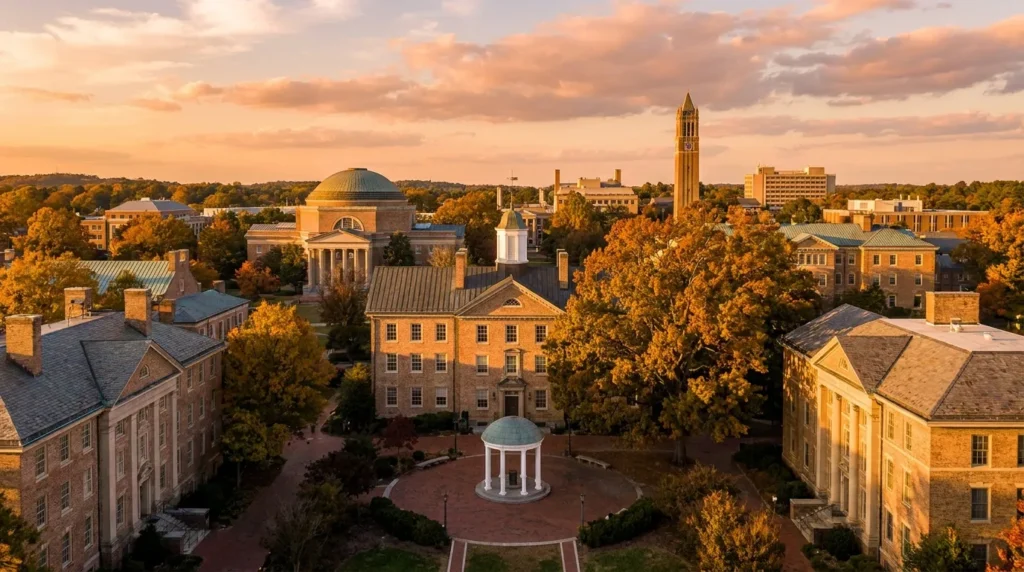
The natural starting point is UNC's historic campus. The Old Well, the university's symbol, McCorkle Place with its century-old oak trees, Wilson Library, and Coker Arboretum convey the historical weight of the place. Walking through campus on a fall day is one of the most memorable experiences the city offers.

Morehead Planetarium and Science Center is a must for families, with exhibits and astronomy sessions. The Ackland Art Museum holds a collection ranging from Asian to contemporary American art, with free admission. For those who enjoy nature, the North Carolina Botanical Garden is a reference for the flora of the southeastern United States.

Franklin Street gathers classic cafes such as Carolina Coffee Shop, bookstores, ice cream shops such as Sugarland, and historic bars. Around the city, Eno River State Park, Jordan Lake, and Duke Forest offer hiking, kayaking, and lake beaches. For a day trip, downtown Durham, historic Hillsborough, and Raleigh are all less than an hour away.

  1. 1Old Well and UNC historic campus
  2. 2Morehead Planetarium and Science Center
  3. 3Ackland Art Museum
  4. 4North Carolina Botanical Garden
  5. 5Franklin Street
  6. 6Coker Arboretum
Parks & green spaces
  • North Carolina Botanical Garden
  • Coker Arboretum
  • Battle Park
  • Cedar Falls Park
  • Carolina North Forest
  • +1 more

Immigrant Communities in Chapel Hill

A small but international city, with a strong Asian and Latin American presence tied to UNC, a regional Hispanic community, and well-structured multicultural support networks.

Chapel Hill has a share of foreign-born residents above the state average, driven by the international flow through UNC and UNC Hospitals. Graduate students, researchers, visiting physicians, and their families make up the most visible portion of this population, drawn from many different countries.

The Asian community is prominent, with significant representation from India, China, South Korea, and Vietnam, organized around temples, churches, weekend schools, and markets such as Li Ming's and Patel Brothers in the area. The Hispanic and Latino community includes Mexicans, Salvadorans, Guatemalans, Colombians, Venezuelans, and a smaller Brazilian community connected to the Triangle as a whole.

There are also smaller Arab, sub-Saharan African, and European communities, served by religious centers, cultural associations, and university programs oriented toward international families. For those arriving, the Triangle ecosystem combines easy access to services in multiple languages with the scale of a small city, making integration faster than in large metropolitan areas.

9,500
Foreign-born residents
estimated
Top countries of origin
  • China
  • India
  • Mexico
  • South Korea
  • Vietnam
  • El Salvador
  • Colombia
  • United Kingdom
Foreign consulates
  • Consulate General of Mexico in Raleigh
  • Honorary Consulate of Italy in Raleigh
  • Honorary Consulate of Germany in Raleigh
  • Honorary Consulate of France in Raleigh
  • Consulate General of India in Atlanta (jurisdiction)
  • +1 more
Community organizations
  • El Centro Hispano
  • Refugee Community Partnership
  • Orange County Literacy Council
  • Church World Service Durham
  • UNC International Student and Scholar Services
  • Chapel Hill-Carrboro Human Rights Center

Latest posts

Posts about North Carolina

Coverage and updates related to this destination.

Showing content from North Carolina, as there is no specific data for Chapel Hill yet.