Visto n' Visa
Blog
Notícias e artigos
Destinations
Careers
Immigrants

Want to live and work in Burlington?

Personalized immigration plan with eligible visas, costs, and next steps for your goal!

If you are not eligible, you will know exactly why and what to do to improve your approval chances.

Save up to 12 hours in meetings

No pointless assessments.

Save up to 90%

Save money on vague or unfocused consultations

Avoid Fraud and Mistakes

One mistake can cost you your visa

Total Impartiality

Zero commercial bias

Decide with peace of mind

No toxic urgency

Fast and Accurate

Answers in minutes, no guesswork

A growing mix of communities in the Piedmont

Burlington has around 59,000 residents, with a majority white population, a significant historic Black community, and notable growth among Latinos and refugees resettled throughout the region.

The city is majority white, but the African American community has deep roots, especially in neighborhoods like East Burlington, with historic churches and active community institutions. Demographics shifted rapidly over the past two decades with the arrival of Hispanic families, mainly Mexican and Central American, drawn by jobs in construction, food processing, and services.

Burlington is also one of North Carolina's refugee resettlement centers. Established communities from Myanmar (primarily Karen and Chin), Bhutan, Syria, the Democratic Republic of the Congo, and Vietnam are present, many concentrated in apartment complexes around Maple Avenue. Public schools offer multilingual support and Spanish bilingual education.

The median age is around 38, with a strong presence of young families and retirees who relocated from states like New York, New Jersey, and Florida seeking lower costs. English dominates public life, but Spanish, Karen, and Arabic are audible in markets, salons, and religious temples throughout the city.

Languages spoken
  • English
  • Spanish
  • Karen
  • Arabic
  • Vietnamese
Main religions
  • Protestant Christianity (Baptist, Methodist)
  • Roman Catholicism
  • Evangelical Christianity
  • Buddhism (Theravada and Mahayana)
  • Islam
  • +1 more

Cost of living well below the Triangle average

Burlington is one of the most affordable options in the Piedmont, with rents significantly lower than Raleigh, Durham, or Greensboro, and basic utility costs near the North Carolina average.

Rent is the main draw. A one-bedroom apartment in a decent complex typically costs significantly less than in Durham or Chapel Hill, and three-bedroom ranch houses in established neighborhoods are still within reach for purchase with financing. Those arriving from the American Northeast or Florida are often surprised by the purchasing power they gain.

Electricity bills run higher in summer due to nearly mandatory air conditioning, but natural gas and water stay near average. Grocery shopping is dominated by chains like Food Lion, Harris Teeter, and Walmart, with Aldi and Lidl keeping prices competitive. Latino markets like Compare Foods serve the Hispanic community at competitive prices.

A car is practically required, so fuel, insurance, and maintenance factor heavily into the budget. On the other hand, local restaurants charge considerably less than Triangle chains, and property taxes in North Carolina are moderate compared to states like Texas or New Jersey.

93Cost index (US = 100)7% below US average
CategorySingleCoupleFamily (2 + 2)
iHousing$1,208$1,394$1,765
iFood$353$707$1,283
iTransport$465$790$1,022
iHealthcare$260$520$975
iChildcare$1,692
iOther$790$1,422$1,998
Monthly total$3,076$4,833$8,735

Source: U.S. BLS Consumer Expenditure Survey 2023 + BEA Regional Price Parities 2023 · Estimates in USD, monthly.

Quiet neighborhoods and a varied stock of single-family homes

The real estate market offers single-family ranch houses in residential neighborhoods, apartment complexes near I-40, and some urban options in the revitalized Downtown.

The dominant pattern is a single-family ranch house with a yard, garage, and two or three bedrooms. Neighborhoods like Glen Raven, Hatchery, and the area north of Church Street are traditional family areas with tree-lined streets and good access routes. West Burlington features newer development, with subdivisions from the 2000s and 2010s, popular among those who work in Greensboro or Mebane.

Those preferring apartments find options along the South Church Street corridor and around Alamance Crossing, an open-air shopping center with a cinema and restaurants. Downtown has seen buildings converted into lofts in recent years, attracting younger professionals and remote workers who want to walk to cafes and bars.

Renting is more common at the entry level, but the goal for many residents is to buy. State programs like NC Home Advantage ease the down payment for first-time buyers. A pre-purchase inspection is practically mandatory, especially for older homes with brick foundations (moisture issues in basements are common in the region).

Recommended neighborhoods
  • Glen Raven
  • Hatchery
  • Downtown Burlington
  • West Burlington
  • Saxapahaw (rural neighbor)
  • +1 more

Market driven by laboratories, healthcare, and logistics

The local economy revolves around Labcorp, Cone Health and Alamance Regional hospitals, residual textile manufacturing, and distribution centers multiplying along I-40 and I-85.

Labcorp is the city's largest employer and maintains its global corporate headquarters here, with positions in laboratory sciences, IT, finance, and operations. The healthcare sector is rounded out by Alamance Regional Medical Center (part of Cone Health) and associated clinics, generating opportunities for nurses, technicians, and administrative professionals.

The textile heritage lives on in companies like Glen Raven Mills (manufacturer of Sunbrella fabrics) and Copland Industries. More recent is the logistics boom: Walmart, Amazon, and 3PL operators have opened distribution centers in the region, offering operational positions with starting wages above the federal minimum. Toyota's battery plant in Liberty, about an hour away, is reshaping the entire regional automotive supply chain.

Fluent English opens nearly every door. For recently arrived immigrants, there is real demand in construction, landscaping, commercial cleaning, hospitality, and food industry, sectors where Spanish is functional day-to-day but English accelerates career advancement.

Dominant sectors
  • Clinical laboratories and life sciences
  • Hospital healthcare
  • Textile and technical fabric manufacturing
  • Logistics and distribution centers
  • Higher education
  • +1 more
Major employers
  • Labcorp
  • Alamance Regional Medical Center (Cone Health)
  • Glen Raven Mills
  • Walmart Distribution Center
  • Elon University
  • +2 more

Broad public school system and major universities nearby

The Alamance-Burlington School System serves the public network, with charter and private school options available, and Elon University and Alamance Community College anchor local higher education.

The public system is managed by the Alamance-Burlington School System, with schools varying considerably in quality depending on the neighborhood. Families typically compare state assessment scores and research enrollment by address. Charter schools such as Clover Garden School and River Mill Academy are available, along with Christian private schools like Burlington Christian Academy.

Alamance Community College offers technical programs, associate degrees, and English as a Second Language courses, serving as an accessible entry point for immigrants seeking technical credentials or a pathway to universities. Tuition is considerably lower for North Carolina residents.

Elon University, a few minutes by car, is a nationally regarded private university with strong programs in communications, law, business, and liberal arts. Its presence brings cultural events, open lectures, and employment opportunities to the region. Research universities in the Triangle (UNC, Duke, NC State) are about an hour away.

Notable universities
  • Elon University
  • Alamance Community College
  • University of North Carolina at Greensboro (35 min)
  • North Carolina A&T State University (35 min)
  • Duke University (1h)
  • University of North Carolina at Chapel Hill (1h)

Solid access through regional hospital and Cone Health clinics

Alamance Regional Medical Center is the city's reference hospital, part of the Cone Health network, with a 24-hour emergency department and specialties covering most needs.

Alamance Regional Medical Center, on South Graham Hopedale Road, is Burlington's general hospital, integrated into the Cone Health network (headquartered in Greensboro). It has an emergency unit, maternity ward, oncology, cardiology, and a surgical center. For highly specialized procedures, patients are referred to Greensboro, Winston-Salem, or Duke in Durham.

Family clinics, dentists, and laboratories are scattered throughout the city. Labcorp, as one of the world's largest clinical laboratory companies, has local collection sites with short wait times. Chain pharmacies (CVS, Walgreens, Walmart) provide good city coverage, with extended hours at some locations.

As in the United States generally, employer-sponsored health insurance is the primary path. Without coverage, consultations and tests can be expensive. Federally qualified health centers such as Piedmont Health Services offer care on a sliding payment scale, and the Open Door Clinic serves uninsured patients with volunteer physicians, though demand is high.

Burlington

Mid-size city with moderate crime rates, varying by neighborhood

Burlington has crime rates comparable to other mid-size Piedmont cities, with quiet residential neighborhoods and some areas with higher rates of theft and drug-related crimes.

Most of the city is quiet, the kind of place where neighbors know each other and children play in the yard. Property crimes (package theft, car break-ins) occur as in any American city, particularly in commercial areas and shopping mall parking lots. Locking the car and not leaving valuables visible addresses most risks.

More central areas and some sections of East Burlington and South Mebane Street have violent crime rates above the city average, generally tied to specific disputes rather than random danger for residents. Local police maintain a visible presence and have community policing programs aimed at integration with immigrant and African American communities.

For those arriving from outside, the general American advice applies: research the neighborhood before renting, visit during the day and at night, and talk to current residents. Sites like NeighborhoodScout and the local police department's annual reports are useful, but conversations with actual residents always provide more context than raw data.

Safer neighborhoods
  • Mackintosh on the Lake
  • Glen Raven
  • West Burlington (new subdivisions)
  • Hatchery
  • Saxapahaw (neighboring village)
Areas to avoid
  • Areas near South Mebane Street at night
  • Abandoned industrial areas near the old rail line
  • Isolated motel parking lots along US-70 at night

Car-dependent city with easy access to two major airports

Burlington is car-dependent, crossed by I-40 and I-85, with basic local public transit and two large regional airports less than an hour away.

Burlington has no commercial airport of its own, but Piedmont Triad International (GSO) in Greensboro is about 40 minutes away and Raleigh-Durham International (RDU) is roughly an hour. Both offer direct flights to major US hubs and some international routes, sufficient for most travel needs.

Within the city, Link Transit operates several bus routes connecting main neighborhoods to Downtown and Alamance Crossing, with limited frequency focused on business hours. For most residents, having a car is practically a requirement. The Amtrak station in Downtown serves the Piedmont/Carolinian route, with departures to Raleigh, Charlotte, and as far as New York.

Bike lanes exist in parks and some urban stretches, but the road network was not designed for cycling as a daily mode of transport. For those working in Greensboro, Durham, or at the new Toyota battery plant in Liberty, the I-40 commute is smooth outside peak hours.

Airports
  • BUY — Burlington-Alamance Regional (general aviation)
  • GSO — Piedmont Triad International (40 min)
  • RDU — Raleigh-Durham International (1h)
  • Bike infrastructure

Climate

Burlington

Small-city cultural life with preserved industrial heritage

Local culture blends Southern tradition, textile heritage, a rising Downtown dining scene, and the growing influence of Latin American and Southeast Asian communities.

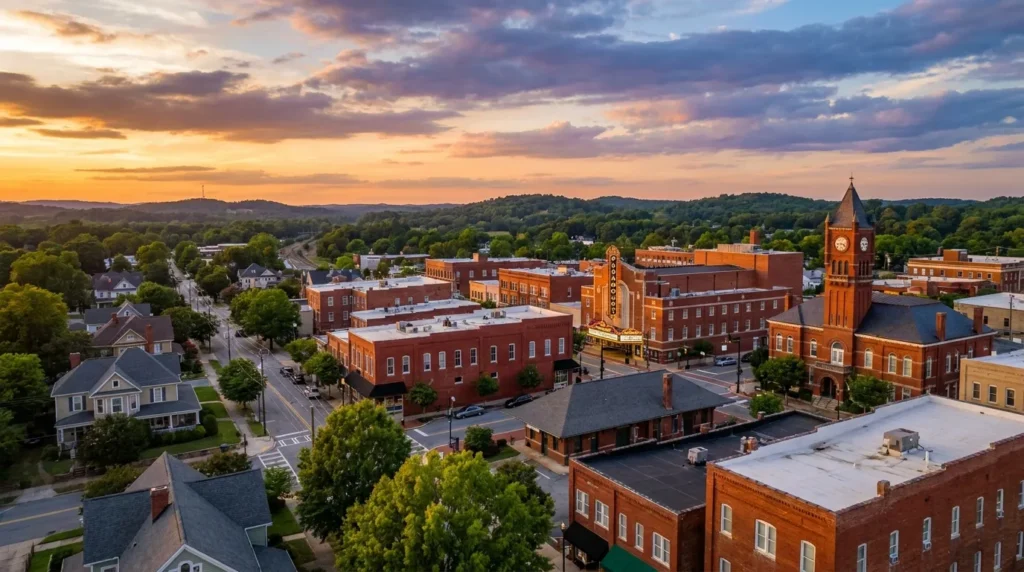
The revitalized Downtown has become the city's cultural heart over the past decade. The Paramount Theater, a restored art deco building, hosts concerts, plays, and film festivals. The historic carousel at City Park, built in 1910 and still in operation, is a landmark and a required stop for families on weekends.

Classic Southern food is everywhere, but the restaurant scene has gained layers. Carolina-style barbecue (pulled pork with vinegar-based sauce), fried catfish, sweet tea, and biscuits with gravy are found across the city. Mexican, Salvadoran, and Vietnamese restaurants serve established communities and attract residents in general, especially along South Church Street.

Annual events like the Carousel Festival, Burlington Carnival, and Festival of Trees mark the calendar. The local music scene values bluegrass, gospel, and country, with outdoor shows at City Park and Saxapahaw, a neighboring village that has become a cultural destination with award-winning restaurants and a converted barn theater.

Notable dishes
  • Carolina pulled pork barbecue (with vinegar-based sauce)
  • Fried catfish
  • Biscuits with sausage gravy
  • Sweet tea
  • Salvadoran pupusas
  • +1 more
Annual events
  • Carousel Festival
  • Burlington Carnival
  • Festival of Trees
  • North Carolina Folk Festival (Greensboro)
  • Saxapahaw Farmers Market and summer concerts

Attractions for families and industrial history enthusiasts

The main attractions blend the historic carousel, well-maintained parks, railroad heritage, and easy access to nearby destinations like Saxapahaw, Greensboro, and the Triangle.

The Dentzel Carousel at City Park is Burlington's most beloved attraction. Built in 1910 with hand-carved horses, it still operates on weekends for a nominal fee, making it a must for families with young children. City Park itself has playgrounds, a miniature train, a paddleboat lake, and a picnic area.

Downtown is worth a stroll to see the restored historic buildings, galleries, brewpubs, and the Paramount Theater. Holly Hill Mall and Alamance Crossing concentrate shopping and cinema options. Cedarock Park, just outside the city, offers trails, a fishing area, and a 19th-century historic farm open for visits.

Neighboring Saxapahaw, a former textile village that has been reimagined, is worth the trip: it has the Haw River Ballroom (an award-winning music venue), farm-to-table restaurants, and the Haw River for canoeing. The Triangle (Durham and Chapel Hill) is an hour away for those wanting opera, NBA games, Duke or UNC matchups, and a more sophisticated dining scene.

  1. 1Dentzel Carousel at City Park
  2. 2Historic Downtown Burlington
  3. 3Paramount Theater
  4. 4Cedarock Historical Farm
  5. 5Holly Hill Mall and Alamance Crossing
  6. 6Haw River Trail
Parks & green spaces
  • Burlington City Park
  • Cedarock Park
  • Springwood Park
  • Willowbrook Park
  • Joe Davidson Park
  • +1 more

Mosaic of Latin American, Southeast Asian, and refugee immigrants

Burlington is home to established communities of Mexicans and Central Americans, along with a notable flow of refugees from Myanmar, Bhutan, Syria, the Congo, and Vietnam, with support networks spread throughout the region.

The Hispanic community is the largest by numbers, with a strong Mexican, Salvadoran, Honduran, and Guatemalan presence, reflected in markets like Compare Foods, parishes with Spanish-language masses, and neighborhood restaurants. Children from these families dominate bilingual programs in public schools and form the second generation now entering regional universities.

Refugees resettled through the Church World Service office in Greensboro arrived in waves: Karen and Chin families from Myanmar in the 2010s, Nepali-origin Bhutanese, Syrians, Congolese, and more recently Afghans. Buddhist temples, mosques, and ethnic churches serve as gathering points and cultural support. A historic Vietnamese community is also present, with specialty restaurants and markets.

Smaller communities include Indians linked to healthcare and IT sectors, Filipinos in hospital work, and scattered Brazilians and Portuguese. The nearest consulate for most of these nationalities is in Atlanta, Washington DC, or New York, and most consular services involve travel or mobile consular units that visit North Carolina a few times per year.

6,500
Foreign-born residents
estimated
Top countries of origin
  • Mexico
  • El Salvador
  • Honduras
  • Guatemala
  • Myanmar
  • Bhutan (Nepali)
  • Vietnam
  • Syria
  • Democratic Republic of the Congo
  • India
Foreign consulates
  • Mexican Consulate General (Raleigh)
  • El Salvador Consulate General (Raleigh)
  • Guatemala Consulate General (Raleigh)
  • British Honorary Consulate (Raleigh)
  • Brazilian Consulate General (Atlanta, NC jurisdiction)
  • +1 more
Community organizations
  • Centro La Comunidad
  • Church World Service Greensboro (refugee resettlement)
  • African Services Coalition (Greensboro)
  • Faith Action International House (Greensboro)
  • El Vínculo Hispano (Siler City)
  • Alamance County Health Department: community health programs

Latest posts

Posts about North Carolina

Coverage and updates related to this destination.

Showing content from North Carolina, as there is no specific data for Burlington yet.