Visto n' Visa
Blog
Notícias e artigos
Destinations
Careers
Immigrants

Want to live and work in Apex?

Personalized immigration plan with eligible visas, costs, and next steps for your goal!

If you are not eligible, you will know exactly why and what to do to improve your approval chances.

Save up to 12 hours in meetings

No pointless assessments.

Save up to 90%

Save money on vague or unfocused consultations

Avoid Fraud and Mistakes

One mistake can cost you your visa

Total Impartiality

Zero commercial bias

Decide with peace of mind

No toxic urgency

Fast and Accurate

Answers in minutes, no guesswork

Who lives in Apex today

A family-oriented city with high educational attainment, middle and upper-middle class demographics, and a growing immigrant population drawn mainly from South and East Asia.

Apex's population exceeds 68,000 and continues to grow. The dominant profile is families with school-age children, young couples, and professionals working at Research Triangle Park. Median household income is well above the state average, reflecting the concentration of jobs in technology, biotechnology, and healthcare.

Diversity has increased significantly since 2010. A substantial Indian community is present, with Hindu temples, Asian grocery stores, and bharatanatyam dance schools. Groups from China, the Philippines, Mexico, Central America, and Eastern Europe have also grown, alongside an African American population historically present in older neighborhoods.

English is the dominant language in daily life, but Spanish, Hindi, Mandarin, Telugu, and Tagalog are frequently heard in schools, businesses, and places of worship. Most families are Christian, with a strong presence of Baptist, Methodist, and Catholic congregations, but the Hindu community and Muslim congregations also have their own established spaces.

Languages spoken
  • English
  • Spanish
  • Hindi
  • Telugu
  • Mandarin
  • +1 more
Main religions
  • Protestant Christianity
  • Catholicism
  • Hinduism
  • Islam
  • No religion

Cost of living above the state average, below major metros

Apex is more expensive than the North Carolina average, but still competitive compared to cities like New York, Boston, or San Francisco.

The biggest expense in Apex is housing. A three- or four-bedroom home in a new neighborhood typically costs well above the state average, and renting a family house generally exceeds apartment costs in neighboring cities. Planned neighborhoods near top-rated schools carry even higher prices due to competition.

The rest of the budget is more manageable. Groceries, restaurants, gas, and services run close to the Triangle regional average. A car is essentially required, so fuel, insurance, and maintenance factor into the monthly budget. Families with young children need to account for private childcare, which is expensive throughout the region.

Those working at the RTP or in Raleigh can earn salaries commensurate with local costs, particularly in technology and healthcare. For those coming from cities like New York, Boston, Toronto, or London, the perception is of more space and quality of life for comparable money, even as housing prices have risen.

93Cost index (US = 100)7% below US average
CategorySingleCoupleFamily (2 + 2)
iHousing$1,208$1,394$1,765
iFood$353$707$1,283
iTransport$465$790$1,022
iHealthcare$260$520$975
iChildcare$1,692
iOther$790$1,422$1,998
Monthly total$3,076$4,833$8,735

Source: U.S. BLS Consumer Expenditure Survey 2023 + BEA Regional Price Parities 2023 · Estimates in USD, monthly.

Single-family homes are the norm, planned communities are the rule

Apex is dominated by single-family homes in planned subdivisions, with few apartments and almost no high-rise buildings.

The real estate stock is predominantly residential. Most available properties are three- to five-bedroom homes with two-car garages, in gated communities or HOA-governed neighborhoods. The most sought-after neighborhoods are around Beaver Creek, Salem Village, Haddon Hall, and near Apex Friendship and Apex High schools.

The downtown and surrounding streets have older restored homes with more character but less space. Apartments exist, mainly in newer complexes along US-64 and Ten-Ten Road, but inventory is limited and those arriving from outside often find the options sparse.

For those in transition or still deciding where to settle, renting a townhouse or short-term house is the most common approach. Purchasing typically involves competition in well-rated neighborhoods, and prices have risen considerably in recent years.

Recommended neighborhoods
  • Downtown Apex
  • Salem Village
  • Haddon Hall
  • Bella Casa
  • Scotts Mill
  • +2 more

Working in Apex, Cary, or the RTP

Most residents do not work within the city limits: they have short commutes to Research Triangle Park, Raleigh, or Cary.

Apex itself concentrates jobs in retail, services, public education, healthcare, and construction. Wake County district schools employ a large number of people, as does the town government and the regional hospital network. Small businesses in the downtown drive activity in food and beverage and professional services.

The real economic center, however, revolves around Research Triangle Park, about 20 minutes away. That is where major employers in biotechnology, pharmaceuticals, software, and research are located, including IBM, Cisco, GSK, Fidelity, Lenovo, RTI International, and dozens of smaller companies. Neighboring Cary is home to SAS Institute's headquarters.

For professionals in technology, science, and healthcare, the regional job market is one of the strongest on the East Coast. For those working in trades, retail, and services, local demand in Apex and neighboring cities remains steady due to continued population growth.

Dominant sectors
  • Technology
  • Biotechnology and pharmaceuticals
  • Healthcare
  • Public education
  • Retail and services
  • +1 more
Major employers
  • Wake County Public Schools
  • WakeMed Health
  • SAS Institute
  • Cisco Systems
  • IBM
  • +2 more

Strong public schools and universities within an hour

Apex is part of the Wake County Public School System, one of the highest-rated districts in North Carolina, with several prestigious universities in the region.

Wake County operates the public schools serving Apex, including Apex High, Apex Friendship High, and Green Level High. The schools are among the most frequently cited reasons families relocate here, with strong state test results, advanced course offerings (AP, IB at some campuses), and broad extracurricular activities.

Private and charter schools are also available, along with magnet schools in Raleigh offering specialized programs. For younger children, the supply of private preschools and daycares is large, though waitlists at well-regarded options can be long.

For higher education, the region offers NC State in Raleigh, Duke in Durham, UNC in Chapel Hill, and several community colleges, including Wake Tech, which has a campus in Apex. For adult immigrants, English as a Second Language programs are available at libraries, churches, and Wake Tech itself.

Notable universities
  • Wake Technical Community College (Apex campus)
  • North Carolina State University (Raleigh)
  • Duke University (Durham)
  • University of North Carolina at Chapel Hill
  • Meredith College (Raleigh)

Access to major hospitals through Raleigh and Cary

Apex has local clinics and urgent care centers, but more complex cases are handled at hospitals in neighboring cities.

Within Apex and surrounding areas, family clinics, urgent care centers, and specialist offices affiliated with major regional networks operate throughout the area. WakeMed, UNC Health, and Duke Health maintain satellite offices and outpatient services nearby, making routine appointments and tests accessible.

For inpatient care, surgery, and intermediate to high-complexity treatment, the main hospitals are in Raleigh, Cary, and Durham. WakeMed Cary Hospital is just a few minutes away, and WakeMed Raleigh, UNC Rex, and Duke Raleigh handle more serious cases. Duke University Hospital in Durham is a national reference for complex conditions.

As elsewhere in the country, access depends on employer health insurance or individual market plans. Those arriving for the first time need to understand deductibles, copays, and network coverage before scheduling appointments. State programs cover children and low-income families in specific situations.

Apex

A city considered quite safe by regional standards

Apex has low crime rates compared to larger Triangle cities, with incidents concentrated in petty theft and traffic-related occurrences.

Overall, Apex consistently ranks among the safest cities in North Carolina. Violent crime is rare, and most incidents involve parking lot theft, vehicle break-ins, and traffic accidents on access roads. Established residential neighborhoods are quite quiet.

The more active and busy areas, such as the downtown, Beaver Creek Commons, and the commercial corridors along US-64, have a steady police presence and good lighting. At night, even in the historic core, the atmosphere is family-friendly, with restaurants and cafes rather than a heavy nightlife scene.

As in any city in the United States, common-sense precautions apply: not leaving valuables visible in a car, locking doors, and avoiding industrial or closed-commercial areas at night. In emergencies, calling 911 is appropriate. For recently arrived immigrants, contacting local police does not carry direct immigration risk.

Safer neighborhoods
  • Downtown Apex
  • Salem Village
  • Haddon Hall
  • Bella Casa
  • Scotts Mill
  • Beaver Creek
Areas to avoid
  • Industrial areas along US-1 at night
  • Isolated parking lots near US-64 after business hours

A car-dependent city with good regional access

Apex relies on the automobile for almost everything, but has quality highways and RDU international airport nearby.

The car is the primary mode of transportation. The main roads are US-1, US-64, and NC-55, all connecting Apex to Raleigh, Cary, Durham, and the RTP. Traffic during peak hours is heavy on corridors near the RTP, but flow within the city remains reasonably manageable.

Public transit is limited. The GoApex Route 1 connects the city to the GoCary system and indirectly to GoRaleigh, but frequency is low and few residents use it daily. There is no metro in the region, and regional rail remains a future project.

Raleigh-Durham International Airport is approximately 20 minutes away by car and offers direct flights to major American hubs, along with some international routes to London, Paris, Reykjavik, and Mexico City. Cycling works within neighborhoods and on greenway segments, but is not a practical primary mode of transport between areas.

Airports
  • RDU — Raleigh-Durham International (approx. 20 min)
  • Bike infrastructure

Climate

Apex

A small historic core, neighborhood festivals, and diverse cuisine

Apex's cultural scene is local and family-friendly, with events in the downtown and culinary influences brought by immigrants.

The cultural heart is the downtown along Salem Street. Events there include PeakFest in the fall, seasonal festivals, craft fairs, and outdoor performances in the summer. Halle Cultural Arts Center hosts exhibitions, workshops, and productions from small local theater companies.

The food scene reflects demographic change. Traditional eastern North Carolina barbecue, classic Southern cuisine, and a strong wave of Indian, Chinese, Mexican, Vietnamese, Korean, and Middle Eastern restaurants coexist. Ethnic grocery stores in Apex and Cary serve as gathering points for various communities.

College sports are part of local life: many residents follow NC State, UNC, and Duke, all within an hour's drive. For a more robust cultural calendar with major museums and international performances, residents head to Raleigh, Durham, and Chapel Hill.

Notable dishes
  • Eastern North Carolina barbecue
  • Hush puppies
  • Southern fried chicken
  • Banana pudding
  • Sweet tea
Annual events
  • PeakFest
  • Apex Music in the Park
  • Apex Christmas Parade
  • Olde Fashioned Fourth of July

Parks, trails, and a preserved historic core

Apex's attractions are local and outdoor-focused, with greenways, nearby lakes, and a historic downtown at the center of city life.

Jordan Lake and its recreational areas, a few kilometers away, are the region's signature destination, offering swimming, trails, fishing, and boating. Within the city, parks such as Apex Community Park, Pleasant Park, and Salem Pond Park offer courts, playgrounds, and trails.

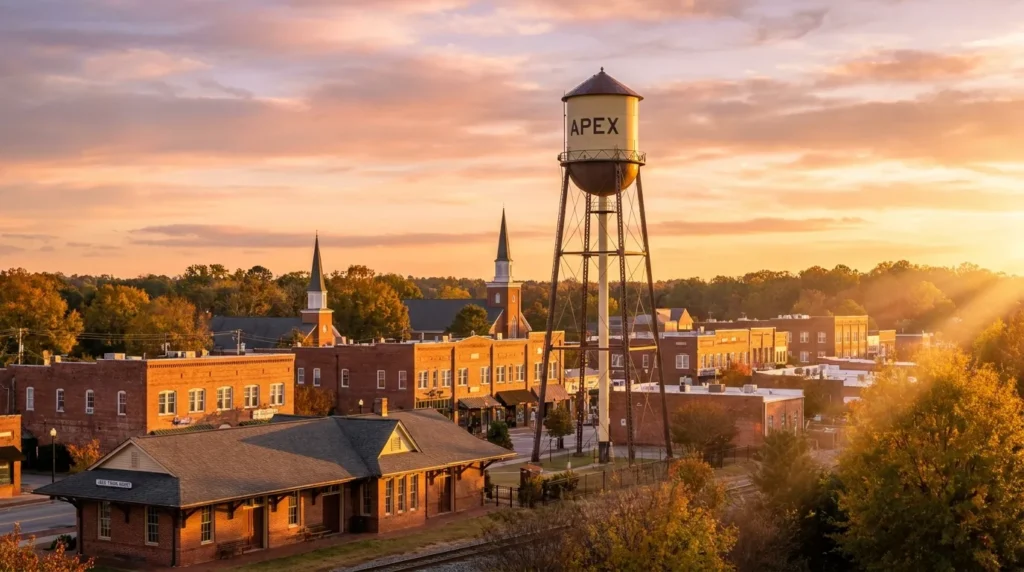
The downtown is an attraction in its own right. The Victorian buildings, historic depot, antique shops, independent bookstores, craft breweries, and restaurants form a rare combination for a city of this size. Walking along Salem Street on a weekend is part of the regular routine for many residents.

For more substantial outings, museums, a zoo, an aquarium, and major performances are available in neighboring cities. The North Carolina Museum of Art, the Museum of Natural Sciences, Durham Bulls Athletic Park, and the Carolina Hurricanes are all within a 40-minute drive.

  1. 1Downtown Apex (Salem Street)
  2. 2Apex Union Depot
  3. 3Halle Cultural Arts Center
  4. 4Beaver Creek Commons
  5. 5Jordan Lake State Recreation Area (nearby)
  6. 6Apex Nature Park
Parks & green spaces
  • Apex Community Park
  • Pleasant Park
  • Salem Pond Park
  • Apex Nature Park
  • Hunter Street Park
  • +1 more

A growing immigrant community, predominantly Asian

Apex and the Triangle region attract immigrants in technology, research, and healthcare, with a strong presence of Indian families and growth from other backgrounds.

The most visible immigrant community in Apex is the Indian community, with Hindu temples, music and dance schools, grocery stores, and festivals such as Diwali that are open to the broader city. Chinese, Filipino, Korean, and Vietnamese communities are also present, partly due to jobs at the RTP and area hospitals.

Established Latin American communities include Mexicans, Salvadorans, Guatemalans, and Venezuelans, working in construction, services, and increasingly in skilled professions. Brazilian immigrants exist in smaller numbers, more concentrated in Raleigh, Durham, and Cary, with a modest presence in Apex. Immigrants from Eastern Europe, the Middle East, and sub-Saharan Africa are also found in the region's schools and places of worship.

For consular services, most consulates are located in Atlanta, Washington, and New York. Locally, nonprofits and multicultural associations assist with translation, basic legal guidance, English classes, and the integration of new families.

11,000
Foreign-born residents
estimated
Top countries of origin
  • India
  • China
  • Mexico
  • Philippines
  • South Korea
  • Vietnam
  • El Salvador
  • United Kingdom
Foreign consulates
  • Consulate General of Mexico in Raleigh
  • Honorary Consulate of Germany in Raleigh
  • Honorary Consulate of France in Raleigh
  • Consulate General of India in Atlanta (jurisdiction)
  • Consulate General of Brazil in Atlanta (jurisdiction)
Community organizations
  • Hispanic Family Center of Wake County
  • El Pueblo NC
  • Hindu Society of North Carolina
  • Refugee Community Partnership
  • Catholic Charities of the Diocese of Raleigh
  • International Focus

Latest posts

Posts about North Carolina

Coverage and updates related to this destination.

Showing content from North Carolina, as there is no specific data for Apex yet.