Visto n' Visa
Blog
Notícias e artigos
Destinations
Careers
Immigrants

Want to live and work in Brooklyn?

Personalized immigration plan with eligible visas, costs, and next steps for your goal!

If you are not eligible, you will know exactly why and what to do to improve your approval chances.

Save up to 12 hours in meetings

No pointless assessments.

Save up to 90%

Save money on vague or unfocused consultations

Avoid Fraud and Mistakes

One mistake can cost you your visa

Total Impartiality

Zero commercial bias

Decide with peace of mind

No toxic urgency

Fast and Accurate

Answers in minutes, no guesswork

Who Lives in Brooklyn

A mosaic of African Americans, Caribbeans, Hispanics, Orthodox Jews, South and East Asians, European whites, and new creative professionals.

Brooklyn is New York's most multicultural borough. Black residents (African American and Caribbean) account for roughly 30%, non-Hispanic whites 36%, Hispanics 19%, and Asians 13%. Those averages tell only part of the story: each neighborhood has its own ethnic character. Bedford-Stuyvesant and Crown Heights have a strong Afro-Caribbean presence; Sunset Park combines Mexican and Chinese communities; Brighton Beach is Russian and Ukrainian.

The Orthodox Jewish community in Borough Park, South Williamsburg, and Crown Heights is among the largest outside Israel. Sikh, Hindu, and Muslim communities are also growing, especially in southern Brooklyn. Brazilians are present, though dispersed, with pockets in Greenpoint, Sunset Park, and Bay Ridge.

Languages reflect this diversity: English, Spanish, Yiddish, Russian, Mandarin, Cantonese, Haitian Creole, Arabic, Urdu, Polish, and Portuguese appear on streets and commercial signs. More than 36% of residents are first-generation immigrants.

Languages spoken
  • English
  • Spanish
  • Yiddish
  • Russian
  • Chinese (Mandarin and Cantonese)
  • +5 more
Main religions
  • Christianity (Catholic)
  • Christianity (Protestant)
  • Judaism (including Hasidic)
  • Islam
  • Christianity (Orthodox)
  • +2 more

Cost of Living in Brooklyn

Expensive, but generally cheaper than Manhattan. Williamsburg, Park Slope, and DUMBO approach Manhattan prices; southern and eastern areas offer alternatives.

Brooklyn became expensive over the last two decades. In Williamsburg, Park Slope, DUMBO, Brooklyn Heights, Greenpoint, and Carroll Gardens, renting a room in a shared apartment can cost nearly as much as in Manhattan. Studios and one-bedrooms in those neighborhoods rarely go for less than $2,500 to $3,500 per month.

The upside is that Brooklyn is enormous. In neighborhoods like Sunset Park, Bay Ridge, Bensonhurst, Flatbush, Crown Heights, and East Flatbush, prices drop significantly. Ethnic markets in Sunset Park (Mexican and Chinese) and Brighton Beach (Russian) offer groceries at prices well below mainstream supermarkets.

The MTA subway and bus network covers nearly the entire borough, so living farther out does not mean being isolated, though the A, C, F, L, and Q lines each have their own travel-time dynamics. Like the rest of New York, residents pay city income taxes in addition to state and federal taxes.

142Cost index (US = 100)42% above US average
CategorySingleCoupleFamily (2 + 2)
iHousing$1,845$2,129$2,696
iFood$539$1,078$1,958
iTransport$710$1,207$1,560
iHealthcare$398$794$1,490
iChildcare$2,583
iOther$1,207$2,170$3,050
Monthly total$4,699$7,378$13,337

Source: U.S. BLS Consumer Expenditure Survey 2023 + BEA Regional Price Parities 2023 · Estimates in USD, monthly.

Where to Live in Brooklyn

Brownstones in Park Slope and Brooklyn Heights, lofts in Williamsburg, new buildings in DUMBO, houses in Bay Ridge. There is an option for every budget.

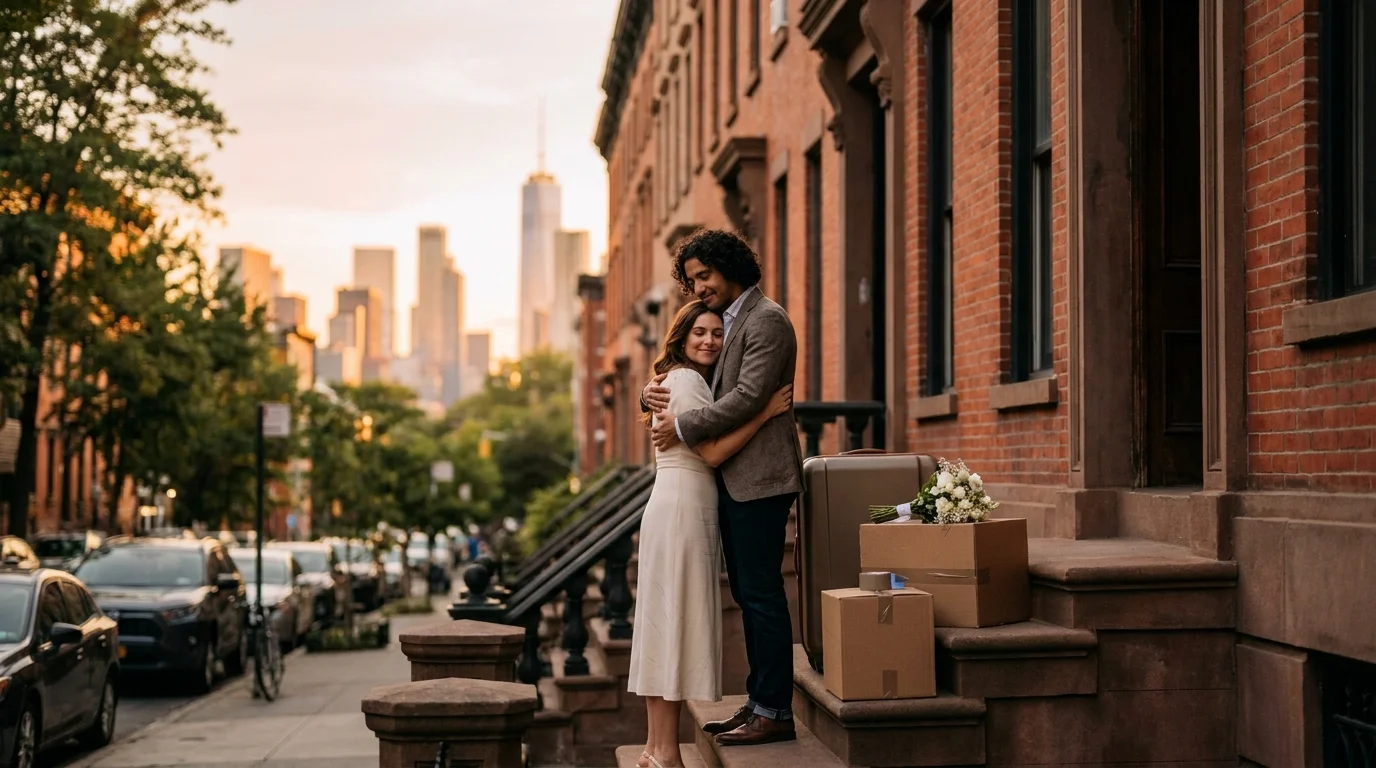
Brooklyn has some of the most attractive residential neighborhoods in the United States. Park Slope, Brooklyn Heights, Cobble Hill, Carroll Gardens, and Boerum Hill are known for their 19th-century brownstones, tree-lined streets, and proximity to Prospect Park or the waterfront. Williamsburg and Greenpoint attract a younger crowd, with industrial lofts and new construction along the East River.

Bushwick and Bedford-Stuyvesant have undergone intense gentrification and host vibrant arts scenes. Crown Heights and Prospect Lefferts Gardens blend Caribbean heritage with new residents. Bay Ridge, Sunset Park, and Bensonhurst have a more family-oriented, residential feel, with brick houses and front yards.

For those prioritizing price, Sunset Park, Kensington, Flatbush, Midwood, and East Flatbush are worth exploring. Brighton Beach draws those who want to live near the beach, with a distinct Russian heritage. Brokers charge high commissions (12 to 15% of annual rent); searching directly with landlords or in no-broker-fee buildings is a common strategy among newly arrived immigrants.

Recommended neighborhoods
  • Park Slope
  • Williamsburg
  • Greenpoint
  • Brooklyn Heights
  • Cobble Hill
  • +4 more

Working in Brooklyn

Healthcare, education, creative industries, retail, and technology. Many residents work in Manhattan, but local employment has grown significantly.

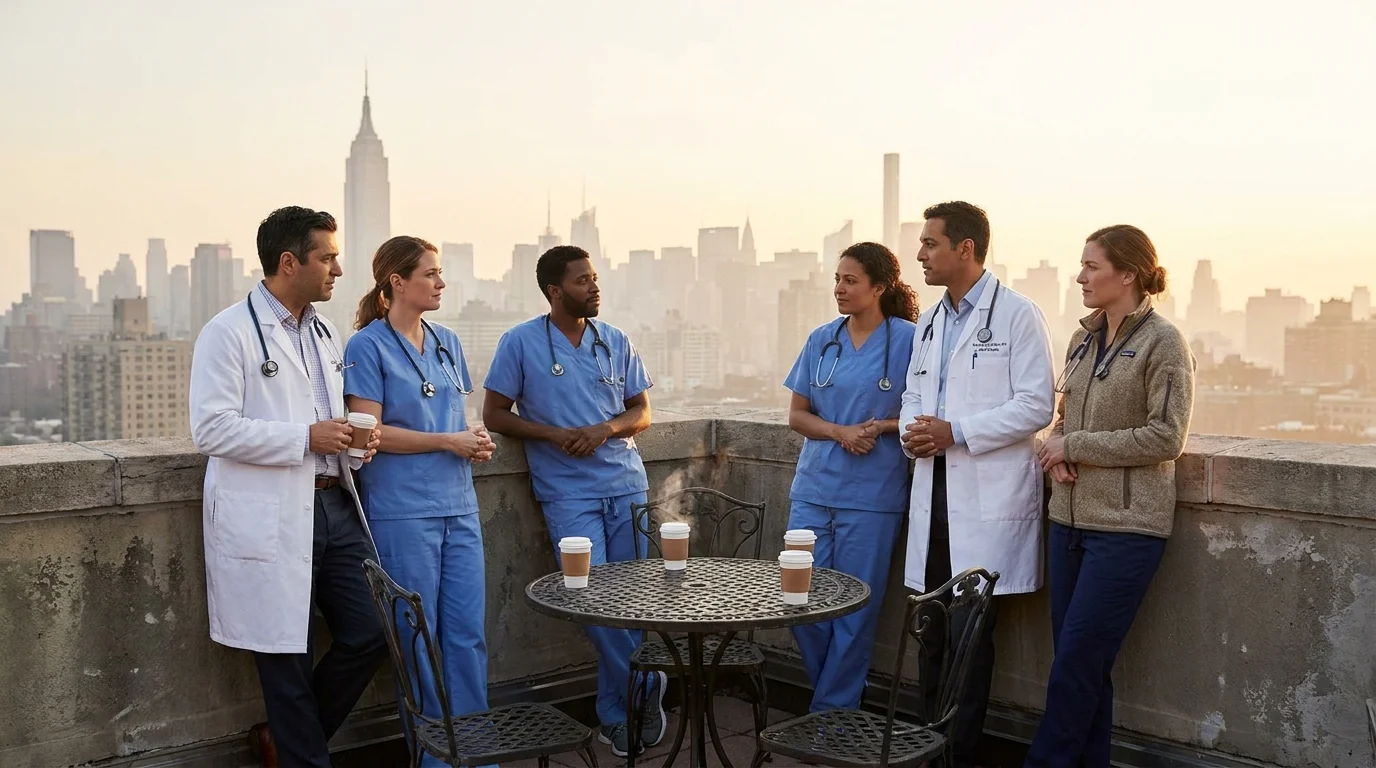
Many residents cross the river daily to work in Manhattan, especially in finance, media, and law. But employment within Brooklyn has grown considerably. Hospitals such as Maimonides Medical Center, NewYork-Presbyterian Brooklyn Methodist, Kings County, and SUNY Downstate are among the borough's largest employers.

The creative sector is strong: film studios in Greenpoint (Steiner Studios), design agencies in DUMBO, startups at Industry City, and chef-driven restaurants throughout the borough. The Brooklyn Navy Yard has reinvented itself as a modern industrial complex, housing urban manufacturing, artisan food producers, and technology firms.

Education employs thousands: Brooklyn College, Pratt Institute, Long Island University Brooklyn, NYU Tandon (in Downtown Brooklyn), and the public school system. For newcomers without an established network, restaurants, construction, delivery, retail, and care services offer quick entry into the job market.

Dominant sectors
  • Healthcare
  • Education
  • Creative industries (film, design)
  • Technology and startups
  • Retail and food service
  • +2 more
Major employers
  • NewYork-Presbyterian Brooklyn Methodist Hospital
  • Maimonides Medical Center
  • Kings County Hospital Center
  • SUNY Downstate
  • Brooklyn College
  • +3 more

Education

Major public and private universities, a broad school system, and free English classes at libraries and community organizations.

Brooklyn is home to important universities. Brooklyn College, part of CUNY, is one of the most highly regarded public institutions in the country. Pratt Institute, in Clinton Hill, is a world reference in design and architecture. Long Island University Brooklyn and NYU Tandon School of Engineering (in Downtown Brooklyn) round out the academic landscape, alongside Medgar Evers College and SUNY Downstate, which focuses on health sciences.

The public school system falls under the NYC Department of Education, with schools that vary widely in quality by neighborhood. Brooklyn Tech, in Fort Greene, is one of the best public high schools in the United States, with a competitive entrance exam. Charter schools and private religious schools (Catholic, Jewish, and Muslim) have a strong presence.

For adult immigrants, free English classes are available at the Brooklyn Public Library and organizations such as Make the Road New York, Arab American Family Support Center, and BPL Adult Learning. CUNY offers ESL and degree programs at affordable rates for legal state residents.

Notable universities
  • Brooklyn College (CUNY)
  • Pratt Institute
  • Long Island University Brooklyn
  • NYU Tandon School of Engineering
  • Medgar Evers College (CUNY)
  • SUNY Downstate Health Sciences University

Healthcare

Large private and public hospitals serve the borough. NYC Health + Hospitals provides care for uninsured residents, including undocumented immigrants.

Brooklyn is home to some of the state's largest hospitals. Maimonides Medical Center, in Borough Park, is one of the borough's largest employers. NewYork-Presbyterian Brooklyn Methodist (Park Slope), Mount Sinai South Nassau, NYU Langone Brooklyn, and SUNY Downstate are known for different specialties. Kings County Hospital, part of the public network, handles major emergencies.

NYC Health + Hospitals operates several units in Brooklyn, including Woodhull, Coney Island, and Kings County, providing universal care. NYC Care offers primary care access for uninsured residents on a sliding income scale. Federally Qualified Health Center (FQHC) community clinics serve patients in multiple languages, including Russian, Mandarin, Spanish, Creole, and Arabic.

Brazilian doctors and dentists who see patients in Portuguese can be found in Greenpoint and nearby Astoria, as well as Newark. Those with employer-sponsored insurance typically choose from major networks such as Aetna, UnitedHealthcare, or Empire BlueCross. Without insurance, emergency room care is extremely expensive and should be avoided for non-urgent situations.

Healthcare index70.0 / 100
  • Life expectancyyears at birth
    78.4yrs
  • Doctors per 1kpracticing physicians
    3.7
  • Health spendper capita, per year
    $13,473
  • Public systemoverall quality rating
    Good

Safety in Brooklyn

Safety has improved significantly since the 1990s, but there is wide variation between neighborhoods. The north and west are safe; parts of the east warrant caution at night.

Brooklyn is safer than it has been in decades, but variation between neighborhoods remains high. Park Slope, Brooklyn Heights, Cobble Hill, Carroll Gardens, Bay Ridge, Greenpoint, Williamsburg, and Bensonhurst are considered very safe, with low violent crime rates. Crown Heights, Prospect Heights, and Bedford-Stuyvesant have become considerably safer, though some areas still warrant attention.

The eastern part of the borough, in neighborhoods such as East New York, Brownsville, and parts of eastern Bushwick, has historically recorded higher rates of violent crime. That does not make them impassable, but it is worth getting to know a specific block before signing a lease. Cell phone theft on the subway is an ongoing concern; keeping devices out of sight is standard practice.

Women walking alone at night generally report feeling comfortable across most of western and central Brooklyn. Isolated subway stations during late-night hours require extra awareness. The NYPD maintains precincts in each neighborhood, and many residents use the Citizen app to monitor local incidents in real time.

Safer neighborhoods
  • Park Slope
  • Brooklyn Heights
  • Carroll Gardens
  • Bay Ridge
  • Greenpoint
  • Cobble Hill
  • Bensonhurst
  • Windsor Terrace
Areas to avoid
  • East New York at night
  • Brownsville
  • Parts of eastern Bushwick
  • Isolated subway stations late at night

Getting Around

The MTA subway and bus network covers nearly the entire borough. Citi Bike and NYC Ferry fill the gaps. JFK and LaGuardia are nearby.

The subway is the backbone of Brooklyn. Lines 2, 3, 4, 5, A, C, F, G, L, N, Q, R, and D cross the borough in all directions. Williamsburg, Greenpoint, Park Slope, and Downtown Brooklyn have direct access to Manhattan in under 30 minutes. Brighton Beach and Coney Island, at the southern tip, are an hour or more away.

NYC Ferry connects the East River waterfront (Greenpoint, Williamsburg, DUMBO, Brooklyn Navy Yard, Bay Ridge) to Manhattan and Queens. Citi Bike has broad coverage, with dedicated bike lanes on streets like Bedford Avenue and along the waterfront. Neighborhoods in southern and eastern Brooklyn still have more limited bike-share coverage.

Airports: JFK is in Queens, roughly 30 to 50 minutes by subway from central Brooklyn. LaGuardia is farther, but bus and LIRR options via Jamaica are available. Cars are useful for those living in more remote areas, but parking is a challenge in nearly every neighborhood, and alternate-side parking rules require close attention.

Airports
  • JFK - John F. Kennedy International Airport (Queens, nearby)
  • LGA - LaGuardia Airport (Queens)
  • EWR - Newark Liberty International Airport (NJ)
  • Bike infrastructure

What the Climate Is Like Living in Brooklyn

Humid subtropical climate on the Atlantic coast, with hot and humid summers near 86°F, cold winters with regular snowfall, and four well-defined seasons.

Summer in Brooklyn runs from June through September, with highs between 82 and 90°F and high humidity. July heat waves push the heat index above 95°F, and the subway becomes a sauna during rush hour. Window air conditioning units are nearly universal in apartments, even in older buildings.

Winter is cold and active. From December through March, highs stay between 37 and 45°F, with lows dropping to 23–34°F. The city accumulates 24 to 35 inches of snow per year, with occasional major storms. A heavy coat, waterproof boots, and gloves become wardrobe essentials.

Spring and fall are short but pleasant, with cherry blossoms in April and red foliage in October. Newcomers adapt over time, though the humid summers and the shock of the first winter are commonly noted. An apartment window with a tree view is a prized feature during the milder months.

Sunny days / year224 days
Avg high (°F)
  • 42°J
  • 43°F
  • 50°M
  • 58°A
  • 66°M
  • 76°J
  • 83°J
  • 81°A
  • 76°S
  • 65°O
  • 54°N
  • 46°D
Avg low (°F)
  • 30°J
  • 30°F
  • 35°M
  • 44°A
  • 52°M
  • 63°J
  • 71°J
  • 70°A
  • 63°S
  • 54°O
  • 41°N
  • 35°D
Rainfall (")
  • 4"J
  • 4"F
  • 4"M
  • 5"A
  • 4"M
  • 3"J
  • 5"J
  • 4"A
  • 5"S
  • 6"O
  • 3"N
  • 5"D

Culture and Daily Life

One of the country's richest food and music scenes. Ethnic festivals year-round. The Brooklyn Museum, BAM, and Barclays Center anchor the formal cultural calendar.

Brooklyn became a global reference for food and drink over the past decade. Brooklyn-style pizza at historic spots like Di Fara, Lucali, and Roberta's; bagels in Greenpoint and Williamsburg; cheesecake at Junior's; Polish sandwiches in Greenpoint; Caribbean dishes in Flatbush and Crown Heights; Mexican taquerias in Sunset Park. Specialty coffee shops appear in nearly every neighborhood.

The cultural scene goes well beyond bohemia. The Brooklyn Museum holds one of the country's finest collections of African and American art. The Brooklyn Academy of Music (BAM) is a leading venue for opera, dance, and independent film. Barclays Center hosts the Brooklyn Nets, hip-hop concerts, and UFC events. Smorgasburg, the summer food festival, draws large crowds to Williamsburg and Prospect Park.

Calendar highlights: the West Indian American Day Parade on Labor Day, with a Caribbean procession along Eastern Parkway, is the borough's largest event. Other fixtures include Atlantic Antic, Brooklyn Book Festival, the Coney Island Mermaid Parade, and the Halloween Parade in Park Slope. Brooklyn has no UNESCO World Heritage Sites, but the Brooklyn Bridge is one of the world's most recognized architectural landmarks.

Notable dishes
  • Brooklyn-style pizza (Di Fara, Lucali)
  • Bagel with lox and cream cheese
  • Junior's-style cheesecake
  • Pierogi and kielbasa (Greenpoint)
  • Roti and Trinidadian curry (Flatbush)
  • +2 more
Annual events
  • West Indian American Day Parade (September)
  • Smorgasburg (all summer)
  • Coney Island Mermaid Parade (June)
  • Brooklyn Book Festival (September)
  • Atlantic Antic (September)
  • +1 more

What to See and Do

Brooklyn Bridge, Prospect Park, Coney Island, DUMBO, Brooklyn Museum, and dozens of neighborhoods to explore on foot. The brewery and market scene is strong.

The Brooklyn Bridge, walkable from DUMBO or Manhattan, is the essential photo stop. Brooklyn Bridge Park, along the waterfront, offers cinematic views of the skyline. DUMBO provides the iconic shot of the Manhattan Bridge framed between buildings. Prospect Park, designed by the same team behind Central Park, is a weekend refuge with a lake, amphitheater, and zoo.

Coney Island features Luna Park (a historic amusement park), the boardwalk, the New York Aquarium, and the Russian Brighton Beach neighborhood just next door. For art, the Brooklyn Museum and Brooklyn Botanic Garden sit side by side. Williamsburg and Greenpoint are home to craft breweries and markets, including the summer Smorgasburg.

Neighborhoods worth exploring without a fixed itinerary: Park Slope, Carroll Gardens, Williamsburg, Bedford-Stuyvesant (brownstones), Sunset Park (skyline views), and Brighton Beach (Russian atmosphere). Atlantic Avenue is lined with historic Arab restaurants. There are no UNESCO sites in the borough, but Green-Wood Cemetery, with sweeping city views, is a surprisingly rewarding cultural stop.

  1. 1Brooklyn Bridge
  2. 2Brooklyn Bridge Park (DUMBO)
  3. 3Prospect Park
  4. 4Brooklyn Museum
  5. 5Coney Island and Luna Park
  6. 6Brooklyn Botanic Garden
Parks & green spaces
  • Prospect Park
  • Brooklyn Bridge Park
  • Brooklyn Botanic Garden
  • Marine Park
  • Green-Wood Cemetery (cemetery park)
  • +1 more

Latest posts

Posts about New York

Coverage and updates related to this destination.

Showing content from New York, as there is no specific data for Brooklyn yet.