Visto n' Visa
Blog
Notícias e artigos
Destinations
Careers
Immigrants

Want to live and work in Bayonne?

Personalized immigration plan with eligible visas, costs, and next steps for your goal!

If you are not eligible, you will know exactly why and what to do to improve your approval chances.

Save up to 12 hours in meetings

No pointless assessments.

Save up to 90%

Save money on vague or unfocused consultations

Avoid Fraud and Mistakes

One mistake can cost you your visa

Total Impartiality

Zero commercial bias

Decide with peace of mind

No toxic urgency

Fast and Accurate

Answers in minutes, no guesswork

A diverse population rooted in old European communities and new Asian and Latino waves

Bayonne combines established European communities, particularly Polish, Italian, and Irish, with a strong presence of Filipinos, Indians, Dominicans, Ecuadorians, and Arabs.

The population reflects several layers of immigration. Polish, Italian, and Ukrainian Catholic parishes still hold masses in the original languages, and Eastern European surnames are common in Broadway businesses. Recent decades brought significant growth in the Filipino community, particularly in the healthcare sector, and in the Indian community along the corridor between Bayonne and Jersey City.

There are also established Latino communities from the Dominican Republic, Ecuador, Mexico, and Colombia, with markets, restaurants, and Spanish-language evangelical churches along 22nd Street and surrounding areas. The Arab and Egyptian community is growing in the northern part of the city, while Brazilians are present in smaller numbers, typically working in construction, salons, and food service across the metropolitan area.

Languages spoken at home include English, Spanish, Tagalog, Polish, Arabic, Hindi/Punjabi, Italian, and Portuguese. Most public schools offer ESL services, and business signage often mixes English with Spanish or Polish depending on the neighborhood.

Languages spoken
  • English
  • Spanish
  • Tagalog
  • Polish
  • Arabic
  • +2 more
Main religions
  • Roman Catholic
  • Protestant
  • Muslim
  • Hindu
  • Jewish
  • +2 more

More affordable than Jersey City and Manhattan, though still expensive by American standards

Rent is the largest expense but remains well below Manhattan, Hoboken, and downtown Jersey City. Ethnic markets and proximity to Newark help balance household budgets.

Bayonne is one of the more accessible options within Hudson County for those working in New York. One-bedroom apartments in older buildings typically cost significantly less than equivalents in downtown Jersey City or Hoboken, especially away from the Light Rail corridor. Newer buildings along the waterfront, such as those in the former military terminal, push prices upward.

Groceries and food costs are more manageable thanks to ethnic supermarkets along Broadway and Avenue C, stocking Polish, Latino, Filipino, and South Asian products. ShopRite, Lidl, and small local markets compete with each other. Dining at a local diner or bakery is far less expensive than in Manhattan.

The hidden cost is transportation: many residents combine the Light Rail and PATH, which requires a monthly NJ TRANSIT pass plus a PATH pass. Driving is feasible, but street parking is competitive and residential permit zones apply. New Jersey property taxes are high and weigh on homebuyers.

108Cost index (US = 100)8% above US average
CategorySingleCoupleFamily (2 + 2)
iHousing$1,414$1,632$2,067
iFood$414$827$1,501
iTransport$544$924$1,196
iHealthcare$304$609$1,142
iChildcare$1,980
iOther$924$1,664$2,339
Monthly total$3,600$5,656$10,225

Source: U.S. BLS Consumer Expenditure Survey 2023 + BEA Regional Price Parities 2023 · Estimates in USD, monthly.

Row houses, small apartment buildings, and new waterfront developments

The traditional housing stock consists of two- and three-story multifamily homes; recent growth comes from residential towers at the former military terminal and along the Light Rail corridor.

Most of Bayonne consists of row houses and three- to four-story buildings constructed between the late nineteenth century and the 1950s. Families purchase entire homes and occupy one floor while renting out the others, the classic Hudson County model. This is one of the more accessible ways to enter the New York metropolitan real estate market.

Bergen Point, in the south, has tree-lined streets and higher-priced Victorian homes. The Broadway corridor concentrates retail and mixed-use buildings. The eastern waterfront, overlooking the bay, has seen new condominium developments near Light Rail stations, including 22nd Street, 34th Street, and 45th Street, attracting professionals who commute to Manhattan.

Harbor Station South, on the former Military Ocean Terminal site, has become a new neighborhood with towers, views of the Statue of Liberty, and a marina. Rents there are significantly higher than in the rest of the city but remain below Hoboken and downtown Jersey City prices.

Recommended neighborhoods
  • Bergen Point
  • Harbor Station South
  • Uptown near 45th Street Light Rail
  • Broadway corridor between 22nd and 32nd
  • Constable Hook (eastern waterfront)

Port logistics, healthcare, and employment in Manhattan and Jersey City

The local economy depends on the port, logistics, and the healthcare sector, though most residents commute to New York or Jersey City.

Bayonne retains a strong industrial and port presence. Port Jersey Marine Terminal, operated by Global Container Terminals, is one of the leading container terminals on the East Coast. The area also has warehouses, trucking companies, remaining refineries, and logistics firms that employ local workers.

The second major employer is healthcare, with Bayonne Medical Center (CarePoint Health network) and various clinics, nursing homes, and home care services. The Filipino community's presence in this sector is longstanding. Local retail along Broadway employs thousands in small businesses, restaurants, salons, and services.

The majority of residents, however, commute daily. Jersey City, home to banks, consulting firms, and fintech companies, is minutes away; Manhattan, the region's primary market for finance, technology, media, and professional services, is roughly half an hour away. Those working at the Port of Newark or Newark Liberty Airport (EWR) access them via Route 440 and the Newark Bay Bridge.

Dominant sectors
  • Port logistics and container shipping
  • Healthcare and home care services
  • Construction
  • Local retail
  • Professional services (via New York City and Jersey City)
Major employers
  • Global Container Terminals (Port Jersey)
  • Bayonne Medical Center / CarePoint Health
  • IMTT liquid terminals
  • Bayonne Board of Education
  • City of Bayonne

Large public schools and easy access to universities in Newark and New York

The school district serves more than 9,000 students, and the city's location allows access to nearby universities such as NJCU, Rutgers Newark, NJIT, and institutions in Manhattan.

Bayonne Public Schools operates two high schools (Bayonne High School being the main one) and a network of elementary and middle schools, with ESL and bilingual programs to serve the many immigrant families. There are also Catholic schools with century-long traditions tied to Italian, Polish, and Irish parishes.

The city does not have its own university, but New Jersey City University is located in neighboring Jersey City, offering accessible undergraduate and graduate programs. Hudson County Community College provides technical and transfer programs. Rutgers Newark and NJIT are a short drive across the Newark Bay Bridge.

Those seeking Manhattan have access to CUNY, NYU, The New School, and others via PATH. This proximity makes Bayonne attractive for students who want to pay lower rent while pursuing graduate studies or balancing work and school.

Notable universities
  • New Jersey City University (Jersey City)
  • Hudson County Community College
  • Rutgers University Newark
  • New Jersey Institute of Technology (NJIT)
  • Saint Peter's University (Jersey City)

Local hospital plus major centers in Jersey City and Newark

Bayonne has its own hospital for emergencies and general care, and is close to university and specialty hospitals in Jersey City, Newark, and New York.

Bayonne Medical Center, part of the CarePoint Health network, is the city's general hospital, with an emergency room, maternity ward, surgical services, and affiliated clinics. Several community clinics, health posts, dental offices, and pharmacies are distributed along Broadway and Avenue C.

For complex cases, residents are often referred to Jersey City Medical Center (RWJBarnabas), Hackensack Meridian, and university hospitals in Newark, such as University Hospital. Cancer specialists and rare disease experts are typically seen in Manhattan at centers such as NYU Langone, Mount Sinai, and Memorial Sloan Kettering.

Access depends on health insurance coverage. Those with formal employment in the United States typically have employer-sponsored health insurance; immigrants without coverage can use community health clinics (FQHCs) and the public NJ FamilyCare program, which covers children and pregnant women under specific eligibility criteria. Costs in the American healthcare system remain high even with insurance.

Bayonne

A city considered relatively safe by Hudson County standards

Bayonne has crime rates below the average for neighboring cities such as Jersey City and Newark, with active neighborhood life and visible local police patrols.

Generally, Bayonne is regarded by residents as a quiet city by New York metropolitan area standards. Residential neighborhoods such as Bergen Point, the Broadway corridor, and the streets near the Light Rail stations have good foot traffic and businesses open into the evening.

Industrial areas and the surroundings of Constable Hook, with refineries and warehouses, are more isolated and see little activity after business hours. As with any port city, caution is advisable regarding petty theft at public transit stations, particularly on the Light Rail at night. Residential burglaries have declined over recent decades but continue to occur.

For those new to the area, the practical advice mirrors that for any major American city: stay alert in isolated parking areas at night, avoid leaving valuables visible in vehicles, and research neighborhoods before signing a lease. The Bayonne Police Department maintains a visible presence at schools and community events.

Safer neighborhoods
  • Bergen Point (southern city)
  • Harbor Station South (eastern waterfront)
  • Broadway between 22nd and 32nd
  • Near the Hudson Bergen Light Rail 45th Street station
  • Uptown residential near Newark Bay Park
Areas to avoid
  • Isolated industrial areas of Constable Hook at night
  • Empty stretches near refineries and warehouses
  • Surroundings of Light Rail stations late at night

Light Rail to Jersey City, PATH to Manhattan, and express buses to Port Authority

Even without its own subway, Bayonne is well connected to Manhattan via the Hudson Bergen Light Rail and PATH, express buses, and Route 440 for drivers.

The Hudson Bergen Light Rail has five stations in the city (8th Street, 22nd Street, 34th Street, 45th Street, and East 45th Street), all operated by NJ TRANSIT. The trip to Exchange Place in Jersey City takes about 20 minutes, and from there the PATH reaches Manhattan in under ten. This is the backbone of the daily commute.

For those who prefer a single-seat ride, NJ TRANSIT express buses (such as the 119 and 81 lines) run directly to the Port Authority Bus Terminal in midtown Manhattan. Local routes cross the city along Broadway and Avenue C, with bus connections to the PATH at Journal Square.

Drivers use Route 440, which runs north-south through the city, with exits for the Bayonne Bridge (Staten Island) and the Newark Bay Bridge (NJ Turnpike Extension I-78). Traffic is heavy during peak hours at the bridges and tunnels. Bike lanes exist on some waterfront stretches and scattered points around the city, though the network is limited.

Airports
  • EWR — Newark Liberty International (approximately 12 miles)
  • LGA — LaGuardia (approximately 19 miles)
  • JFK — John F. Kennedy International (approximately 25 miles)
  • Bike infrastructure

Climate

Bayonne

Ethnic festivals, waterfront parks, and a Catholic working-class tradition

Cultural life blends ethnic parades, Catholic events, street fairs on Broadway, and public art in the new waterfront parks.

Bayonne preserves the calendar of the communities that shaped it. There is a Saint Patrick's Day Parade, Polish parish events, Italian festivals with processions and masses, along with Filipino and Latino celebrations. The Hispanic Heritage Parade and events at Veterans Stadium and local parks take place throughout the year.

The dining scene is neighborhood-style: classic slice pizzerias, Polish bakeries with pierogi, Italian delis with oversized sandwiches, Dominican panaderias, and Filipino restaurants. The New York bagel and the pork roll, a New Jersey sandwich staple, are part of everyday life. Late-night diners define the local lifestyle.

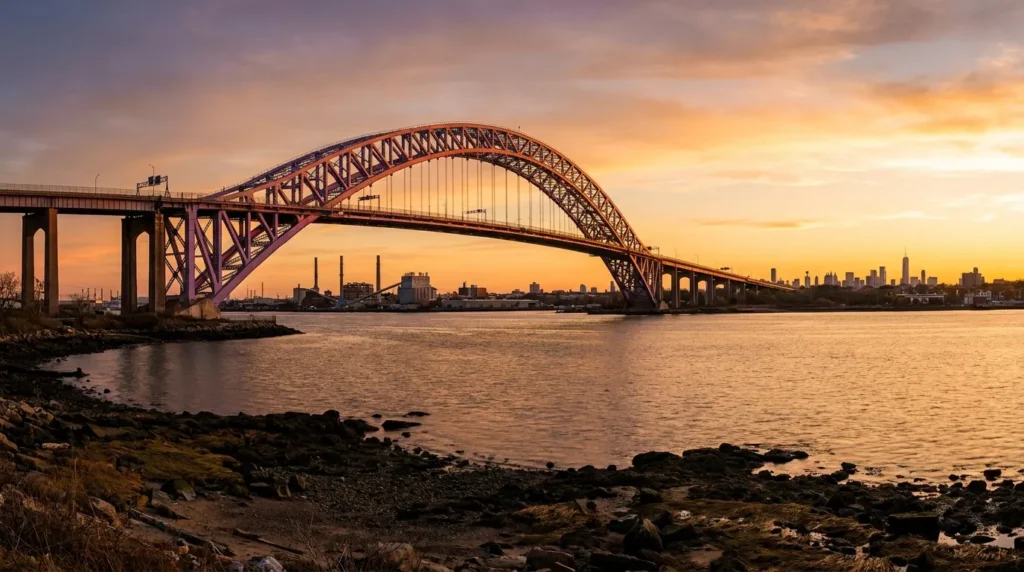
Cultural landmarks include the Tear of Grief, a monument by Zurab Tsereteli dedicated to the victims of September 11, installed at the former military terminal with a view of Manhattan; small museums covering naval and port history; and the imposing presence of the Bayonne Bridge on the horizon.

Notable dishes
  • Pork roll, egg and cheese (New Jersey sandwich staple)
  • New York-style pizza by the slice
  • Pierogi and Polish kielbasa
  • Italian sub from local delis
  • Dominican mofongo and mangu
  • +1 more
Annual events
  • Bayonne St. Patrick's Day Parade
  • Hispanic Heritage Parade and Festival
  • Bayonne Hometown Fair (annual)
  • Polish Pilsudski Day Parade
  • September 11 ceremonies at the Tear of Grief

Waterfront views of Manhattan, historic parks, and the Bayonne Bridge

The main points of interest combine a waterfront with views of New York, historic parks, September 11 memorials, and the iconic Bayonne Bridge.

The main draw of Bayonne is the view. From the former Military Ocean Terminal, now Harbor Station South, the Statue of Liberty, Ellis Island, and the Manhattan skyline are visible across the water. The Tear of Grief monument, sculpted by Zurab Tsereteli and donated by Russia in memory of the victims of September 11, stands at the tip of the peninsula.

Stephen R. Gregg Park, on the western waterfront along Newark Bay, is the city's largest public green space, with a walking track, pool, playgrounds, and courts. Hudson County Park at Bayonne, the former Veterans Park, hosts events, sports, and ethnic festivals throughout the year. The Bayonne Bridge, with its iconic steel arch, is a visual landmark to the southwest.

For shorter outings, a walk along Broadway with its churches, bakeries, and diners is worthwhile; the Newark Bay Park overlook offers sunset views; and crossing the bridge to Staten Island extends the trip. Manhattan is one Light Rail and one PATH ride away.

  1. 1Tear of Grief Memorial (To the Struggle Against World Terrorism)
  2. 2Stephen R. Gregg Park (Hudson County Park)
  3. 3Bayonne Bridge and views of Staten Island
  4. 4Harbor Station South with views of Manhattan
  5. 5Hudson Bergen Light Rail waterfront
  6. 6Bayonne Town Square (Broadway)
Parks & green spaces
  • Stephen R. Gregg Park (Newark Bay)
  • Hudson County Park at Bayonne (Veterans Park)
  • 16th Street Park
  • Dennis P. Collins Park (eastern waterfront)
  • Rutkowski Park (Newark Bay)

A city historically shaped by European immigrants, now with a strong Filipino, Indian, Latino, and Arab presence

Bayonne is a city built by successive waves of migration. The Polish, Italian, and Irish communities still carry symbolic weight, but recent decades have brought Filipinos, Indians, Dominicans, Ecuadorians, Egyptians, and Arabs.

The city preserves ethnic parishes and markets that reflect this layered history. Polish bakeries sell pierogi and kielbasa, Italian delis are run by fourth-generation families, and Irish pubs are concentrated along Broadway. This European core persists even as families relocate to the suburbs.

The newer Bayonne is more Asian and Latino. Filipinos arrived primarily through the healthcare sector and form one of the largest national communities; Indians expanded via Jersey City, with their own businesses and nearby temples. Latinos come primarily from the Dominican Republic, Ecuador, Colombia, Mexico, and Peru, with restaurants, salons, and Spanish-language evangelical churches. Arab, Egyptian, and Coptic communities have grown in the past decade, with their own mosques and cafes.

Brazilians are a small minority in Bayonne, more visible in neighboring cities such as Newark (Ironbound) and Long Branch, but they use the services and consulates based in New York. Support for newly arrived immigrants typically comes from regional nonprofits, parishes, and community centers, with programs covering English instruction, legal assistance, and employment readiness.

24,000
Foreign-born residents
estimated
Top countries of origin
  • Philippines
  • India
  • Dominican Republic
  • Ecuador
  • Poland
  • Egypt
  • Colombia
  • Mexico
Foreign consulates
  • Consulate General of the Philippines in New York
  • Consulate General of India in New York
  • Consulate General of the Dominican Republic in New York
  • Consulate General of Ecuador in Newark
  • Consulate General of Poland in New York
  • +3 more
Community organizations
  • Catholic Charities of the Archdiocese of Newark
  • International Rescue Committee (IRC) New Jersey office
  • American Friends Service Committee Immigrant Rights Program (Newark)
  • Hudson County Office of Immigrant Affairs
  • Hispanic Federation (regional)
  • Polish American Congress (New Jersey chapter)

Latest posts

Posts about New Jersey

Coverage and updates related to this destination.

Showing content from New Jersey, as there is no specific data for Bayonne yet.