Visto n' Visa
Blog
Notícias e artigos
Destinations
Careers
Immigrants

Want to live and work in Hampton?

Personalized immigration plan with eligible visas, costs, and next steps for your goal!

If you are not eligible, you will know exactly why and what to do to improve your approval chances.

Save up to 12 hours in meetings

No pointless assessments.

Save up to 90%

Save money on vague or unfocused consultations

Avoid Fraud and Mistakes

One mistake can cost you your visa

Total Impartiality

Zero commercial bias

Decide with peace of mind

No toxic urgency

Fast and Accurate

Answers in minutes, no guesswork

Who lives in Hampton and what the population profile looks like

Hampton is primarily residential, with a relatively older population, many retirees, and established families. Ethnic diversity is lower than in larger regional cities, but the immigrant base exists and grows slowly.

Hampton's year-round population hovers at just over 16,000, but swells significantly in summer with tourists and seasonal visitors. The dominant profile is middle-class families, retirees drawn by the beach, and professionals commuting to Portsmouth or Boston.

Most residents speak English at home, but smaller communities speak Brazilian Portuguese, Spanish, and Canadian French, the latter a historical legacy of French-Canadian migration to the region. Catholic, Protestant, and a few independent congregations form the local religious base, with a strong New England Congregationalist tradition.

The pace of new arrivals has increased in recent years as people leave Massachusetts in search of lower taxes. The city is not as ethnically diverse as Manchester or Nashua, but has gradually become more open to families relocating from out of state and abroad.

Languages spoken
  • English
  • Spanish
  • Portuguese
  • French
Main religions
  • Catholic
  • Congregationalist
  • Methodist
  • Episcopal
  • No religion

Cost of living in Hampton: cheaper than Boston, expensive by New Hampshire standards

Hampton is one of the most expensive cities in New Hampshire due to its proximity to the beach and Boston, but remains more affordable than the Massachusetts urban corridor. No state income tax or sales tax.

Living in Hampton costs more than the New Hampshire average, particularly for properties near the beach or downtown. Groceries, gas, and services are in line with the rest of the state, but waterfront restaurants charge tourist-city prices in summer.

The main financial advantage is tax-related: New Hampshire levies no income tax on wages and no retail sales tax, which makes a real difference in the annual budget for those coming from Massachusetts, New York, or California. On the other hand, property taxes are high, especially for homes near the beach, and this weighs on monthly costs for homeowners.

Renters generally pay less than in Portsmouth or the Boston corridor, but more than in inland New Hampshire cities such as Concord or Manchester. Winter heating is a significant expense, with fuel oil or natural gas adding to the budget for several months of the year.

Hampton

Where to live in Hampton and how to choose the right neighborhood

Hampton has three distinct residential zones: the beachfront strip, the historic downtown, and the more residential interior neighborhoods. Resident profiles and prices vary considerably across them.

The Hampton Beach strip is the most touristy and expensive area, with ocean-facing houses, condos, and seasonal rental cottages. Year-round residents there face very busy summers but have the ocean at their doorstep. North Beach is a quieter alternative within the same shoreline.

Hampton Center concentrates schools, local commerce, and more classic residential neighborhoods with traditional New England-style wood-frame homes. It is the preferred area for families with school-age children.

More interior neighborhoods such as the areas around Exeter Road, Mill Road, and the Hampton Falls-adjacent zone offer larger lots, newer homes, and classic suburban settings. A good option for those wanting space and quiet while remaining a few minutes from the beach and I-95 access.

Recommended neighborhoods
  • Hampton Beach
  • North Beach
  • Hampton Center
  • Exeter Road area
  • Mill Road area
  • +1 more

Work in Hampton: small local economy with commutes to Portsmouth and Boston

The local economy relies heavily on beach tourism, retail, and services, but most residents work in Portsmouth, at Portsmouth Naval Shipyard, or commute north of Boston.

Hampton's own job market is concentrated in hospitality, restaurants, retail, and beach-tourism services. Construction, maintenance, and healthcare positions exist, but volume is limited by the city's size.

Those seeking higher wages commute to Portsmouth, where Portsmouth Naval Shipyard, hospitals, and defense-related technology companies offer strong employment. Others take I-95 southbound toward the Newburyport, Andover, and Boston corridor, with travel times varying widely depending on traffic.

Summer tourism creates thousands of seasonal positions between May and September, in restaurants, hotels, shops, and beach activities. Newcomers to the city often use these positions as an entry point while getting established.

Dominant sectors
  • Tourism and hospitality
  • Retail
  • Restaurants and food service
  • Healthcare services
  • Construction
  • +1 more
Major employers
  • Town of Hampton
  • Hampton Beach businesses
  • Lamie's Inn & Tavern
  • Galley Hatch Restaurant
  • Portsmouth Naval Shipyard (commute)
  • +2 more

Education in Hampton: local public schools and universities in the region

Hampton has its own well-regarded public school system by New Hampshire standards and is close to major regional universities, though no university campus sits within the city.

Hampton's public school system includes elementary schools and Winnacunnet High School, which serves Hampton and neighboring towns such as Hampton Falls, North Hampton, and Seabrook. Academic reputation is considered solid within New Hampshire, with strong standardized test results and active sports programs.

There is no university within the city, but the region offers several options within a short distance. The University of New Hampshire in Durham is about 30 minutes away, and Great Bay Community College has a campus in Portsmouth. Boston and Cambridge, home to Harvard, MIT, Northeastern, and Boston University, are about an hour away.

Immigrant families relocating here generally find limited ESL support in public schools, since the volume of non-native students is lower than in Manchester or Nashua. Consulting with the local school district before enrolling children is advisable.

Notable universities
  • University of New Hampshire (Durham, 30 min)
  • Great Bay Community College (Portsmouth)
  • Southern New Hampshire University (Manchester)
  • Northeastern University (Boston)
  • Boston University (Boston)

Healthcare in Hampton: basic local care and regional hospitals

Hampton has no hospital of its own, but has local clinics and is close to well-regarded hospitals in Exeter and Portsmouth. Emergency care is accessible quickly via I-95.

For routine appointments, clinics and medical offices are found throughout the city, affiliated with Core Physicians and Exeter Health Resources networks. Walk-in clinics and urgent care centers handle non-emergency cases, particularly useful in summer when the floating population increases.

The reference hospitals are Exeter Hospital, about 15 minutes via Route 101, and Portsmouth Regional Hospital, about 20 minutes via I-95. Both handle emergencies, deliveries, and more complex surgeries. For highly specialized cases, patients are referred to Boston, primarily Massachusetts General Hospital and Brigham and Women's.

Those relocating to New Hampshire should arrange health insurance through the federal Healthcare.gov marketplace, through an employer, or through programs such as Medicaid and Medicare, depending on their situation. Plan costs are a significant fixed expense that needs to be factored into monthly budgeting.

Hampton

Safety in Hampton: a quiet city with seasonal considerations

Hampton is considered safe compared to the US average, with low crime rates year-round. In summer, the beach strip warrants extra attention due to tourist volume and nightlife.

Hampton's residential neighborhoods have low crime, with incidents dominated by petty theft, vandalism, and traffic violations. Families who relocate here typically report a strong sense of safety, particularly in Hampton Center and interior neighborhoods.

The Hampton Beach strip concentrates nightlife in summer and draws visitors from across the region. Incidents of intoxication, occasional altercations, and car break-ins increase. Nothing that disqualifies the city as safe, but common sense at night is warranted, as with any tourist destination.

Local police have a solid reputation and short response times. Hampton Falls and North Hampton, neighboring towns, are even quieter. Areas along Route 1 toward Seabrook tend to be less attractive for residential purposes, with heavier commercial traffic and some more worn-down zones.

Safer neighborhoods
  • Hampton Center
  • North Beach
  • Exeter Road area
  • Mill Road area
  • Plaice Cove
Areas to avoid
  • Route 1 stretches toward Seabrook after midnight
  • Open waterfront parking lots late at night in summer

Getting around Hampton and reaching other cities

Hampton is a car-dependent city with direct access to I-95 and Route 1, and C&J regional bus service connecting to Portsmouth and Boston. No commercial airport of its own, but two are nearby.

A car is practically required in Hampton. I-95 runs through the city on a north-south axis and provides quick access to Portsmouth, Newburyport, and Boston. US Route 1 crosses the downtown and the waterfront, with traffic lights and reduced speeds, particularly busy in summer.

Local public transit is minimal, but the C&J Bus line offers direct connections to Portsmouth, Boston South Station, and Logan Airport, an option used by those who work in Boston and prefer not to drive. In summer, a local trolley covers the waterfront.

For international flights, residents use Boston Logan International Airport (BOS), roughly one hour via I-95, or Manchester-Boston Regional Airport (MHT), which has fewer flights but is closer and cheaper for parking. There is no passenger rail service in the city.

Airports
  • BOS — Boston Logan International (approx. 1 hr)
  • MHT — Manchester-Boston Regional (approx. 1 hr)
  • PSM — Portsmouth International at Pease (regional, nearby)

Climate

Hampton

Culture and daily life in Hampton

Hampton's identity revolves around the beach, outdoor life, and the coastal traditions of New England. Summer is the high season for events; winter is quiet neighborhood life.

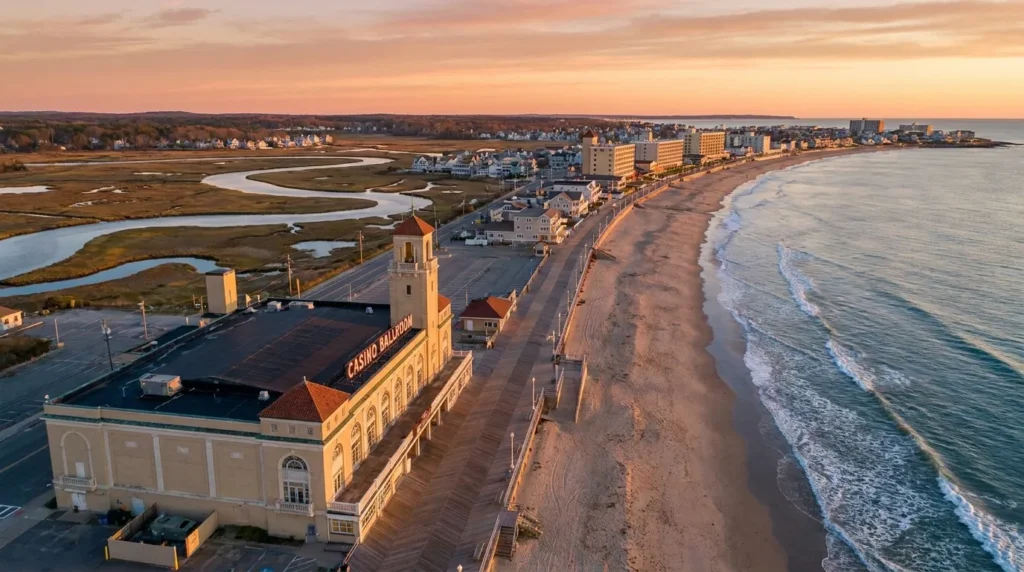
Local culture blends New England colonial heritage with beach-town living. Historic churches, the annual town meeting, and community festivals remain part of the identity for longtime residents. The beach strip has a more tourist-oriented culture, with arcades, food trucks, ice cream shops, and outdoor concerts at Hampton Beach Casino Ballroom.

Local food is strongly coastal: lobster, clam chowder, fried clams, lobster rolls, and classic Atlantic seafood. Old Salt Restaurant, Ron's Beach House, and Ray's Seafood are longtime stops. In fall and winter, life slows and the community centers on schools, local sports, and seasonal events.

The city hosts annual events such as the Hampton Beach Seafood Festival in early September, the Master Sand Sculpting Classic in June, and fireworks and shows throughout the summer. The cultural calendar is heavily seasonal, with few events in winter and many between May and October.

Notable dishes
  • New England clam chowder
  • Lobster roll
  • Fried clams
  • Steamed lobster
  • Fried haddock
  • +1 more
Annual events
  • Hampton Beach Seafood Festival
  • Master Sand Sculpting Classic
  • Hampton Beach Fireworks (weekly in summer)
  • Hampton Beach Children's Festival
  • Hampton Memorial Day Parade

Things to do in Hampton: beach, parks, and historic landmarks

Hampton Beach is the city's main draw, but Hampton also has state parks, colonial historic landmarks, and easy access to nearby destinations such as Portsmouth and the Maine coast.

Hampton Beach State Park is the showpiece, with a long sandy beach, boardwalk, arcades, restaurants, and Hampton Beach Casino Ballroom for concerts. North Beach is quieter and preferred by families and residents. Hampton Beach State Pier offers Atlantic views and fishing activities.

The historic downtown has colonial homes and Tuck Memorial Museum, which recounts local history since the town's founding in 1638. Events such as the Master Sand Sculpting Classic and the Seafood Festival are major draws during peak season.

The city also serves as a base for exploring the New Hampshire coast and southern Maine: Portsmouth is 20 minutes away, Kittery and its outlets are just across the bridge, and York Beach (Maine) is half an hour away. For outdoor activities, state parks such as Odiorne Point and Rye Beach expand the options.

  1. 1Hampton Beach State Park
  2. 2Hampton Beach Boardwalk
  3. 3Hampton Beach Casino Ballroom
  4. 4Tuck Memorial Museum
  5. 5Hampton Beach State Pier
  6. 6North Beach
Parks & green spaces
  • Hampton Beach State Park
  • North Hampton State Park
  • Plaice Cove
  • Meadow Pond conservation area
  • Batchelder Pond

Immigrant communities in Hampton and available support

Hampton has a small immigrant community compared to Manchester and Nashua, with a historical presence of French Canadians, Irish, and Portuguese, and more recent arrivals from Latin America and Asia.

Migration to Hampton is primarily domestic, coming from Massachusetts and other states. Among foreign-born residents, historical French Canadians from Quebec predominate, along with Portuguese tied to old coastal fishing communities and Irish descendants of the great 19th-century migration. In recent decades, families have arrived from Central America, Brazil, the Dominican Republic, and the Philippines.

Direct immigrant support services are concentrated in larger cities in the region. For legal advisory services, ESL, and community integration, residents turn to organizations based in Portsmouth, Manchester, and Boston, all within a short drive.

The nearest consulates are in Boston, which hosts diplomatic representations for virtually every country with an immigrant presence in New Hampshire. For documents, notarizations, and renewals, a day trip to the Boston consular district is standard practice.

900
Foreign-born residents
estimated
Top countries of origin
  • Canada
  • Portugal
  • Ireland
  • United Kingdom
  • Brazil
  • Dominican Republic
  • Philippines
  • Mexico
Foreign consulates
  • Consulate General of Brazil in Boston
  • Consulate General of Portugal in Boston
  • Consulate General of Canada in Boston
  • Consulate General of the United Kingdom in Boston
  • Consulate General of Mexico in Boston
  • +1 more
Community organizations
  • Catholic Charities New Hampshire
  • Organization for Refugee and Immigrant Success (ORIS, Manchester)
  • International Institute of New England (Boston)
  • New Hampshire Alliance for Immigrants and Refugees
  • Seacoast Family Promise

Latest posts

Straight from the blog

There are no posts specifically about Hampton yet. In the meantime, check out our latest posts.