Visto n' Visa
Blog
Notícias e artigos
Destinations
Careers
Immigrants

Want to live and work in Concord?

Personalized immigration plan with eligible visas, costs, and next steps for your goal!

If you are not eligible, you will know exactly why and what to do to improve your approval chances.

Save up to 12 hours in meetings

No pointless assessments.

Save up to 90%

Save money on vague or unfocused consultations

Avoid Fraud and Mistakes

One mistake can cost you your visa

Total Impartiality

Zero commercial bias

Decide with peace of mind

No toxic urgency

Fast and Accurate

Answers in minutes, no guesswork

Concord Demographics: small capital with resettled refugees

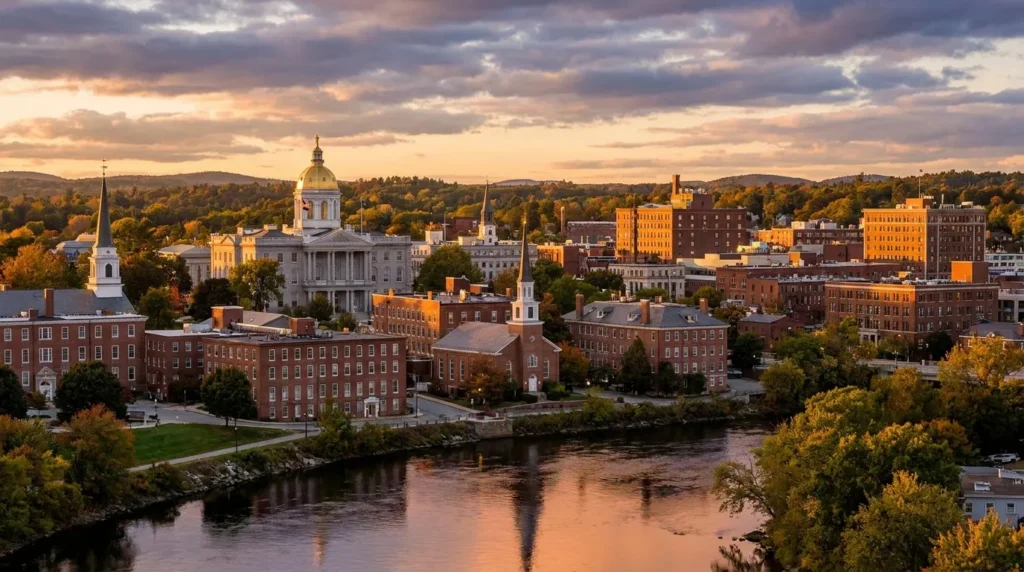
The majority population is white, with English, Irish, and French-Canadian roots. A significant community of Bhutanese-Nepali, Sudanese, and Congolese refugees has been resettled here since the 2000s.

The historical profile is predominantly white, with a strong Yankee Protestant heritage complemented by Irish and French-Canadian immigration in the 19th century. Surnames such as Webster (Daniel Webster) and Pierce (Franklin Pierce, president) shape local identity.

Concord became one of New Hampshire's primary refugee resettlement hubs starting in the 2000s. Families from Bhutan of Nepali origin, South Sudan, Somalia, the Democratic Republic of the Congo, and Iraq have established rooted communities. Public schools serve students who speak more than 70 languages at home.

Religiously, Congregationalist Protestants, Roman Catholics, and Episcopalians form the base. Hindu and Buddhist temples serve the Bhutanese-Nepali community. Independent African churches and a mosque serve newer communities. South Congregational Church and St. John the Evangelist Catholic Church anchor the downtown.

Languages spoken
  • English
  • Nepali
  • Spanish
  • Arabic
  • Swahili
  • +1 more
Main religions
  • Protestant
  • Catholic
  • Unaffiliated
  • Hindu
  • Muslim
  • +1 more

Cost of Living in Concord: balanced by New Hampshire standards

Less expensive than Nashua or Portsmouth, with no state income tax or sales tax. Rents have risen but remain moderate by New England standards.

Renting a two-bedroom apartment in a decent building runs below what comparable units cost in Manchester or Nashua, and well below Boston. Buying a home in neighborhoods such as Eastman or Penacook offers larger lots and bigger yards in exchange for less density.

Market Basket, Hannaford, Shaw's, and the Concord Food Co-op serve the city. The Co-op is the reference for organics and local products. With no state sales tax, purchases of electronics, furniture, and clothing cost less than just across the border in Massachusetts.

Electricity and winter heating are significant expenses, with natural gas and heating oil dominating. A car is necessary for most daily needs, though downtown allows many errands on foot. Public education is free and well regarded, and affordable community childcare options are available.

Concord

Where to Live in Concord: neighborhoods and housing types

Victorian homes downtown, suburban character in East Concord and Penacook, and newer condominiums near I-93. The market is active but offers more inventory than larger cities.

The historic downtown, around Main Street and South State Street, features Victorian homes and condominiums in converted buildings. It is the most convenient option for those working at the State House or in legal offices. South End and West End attract families with colonial-style homes.

East Concord and the Penacook neighborhood (annexed to the city) feature newer homes, large lots, and a suburban profile. Heights, on the east side of the Merrimack, offers a mix of single-family homes and residential complexes. Carter Hill Road and nearby areas have higher-end homes.

Newcomers typically rent first in complexes such as The Eddy on Manchester Street or in apartments above downtown storefronts. The neighboring towns of Bow, Hopkinton, and Loudon offer larger homes 10 to 20 minutes by car from downtown.

Recommended neighborhoods
  • Downtown / South State Street
  • West End
  • East Concord
  • Penacook
  • Heights
  • +2 more

Job Market in Concord: government, healthcare, and insurance

Being a state capital means government is the top employer. Concord Hospital, insurance firms, and the legal sector round out the economy.

The State of New Hampshire employs thousands in the city, distributed across the State House, Department of Health and Human Services, Department of Transportation, Department of Justice, and other agencies. For lawyers, lobbyists, policy analysts, and administrators, Concord is the natural destination.

Concord Hospital, part of the Dartmouth Health network, is the second-largest employer, with an emergency department, maternity ward, oncology, and cardiology. Nursing and technical professionals are in constant demand. Affiliated clinics and Riverbend Community Mental Health add additional healthcare positions.

Insurance carriers such as Lincoln Financial and Concord Group Insurance maintain significant operations. Merrimack County Savings Bank and credit unions employ workers in financial services. For tech or biotech, the path runs through Manchester (30 minutes) or Boston. The Capital Region Development Council supports local startups.

Dominant sectors
  • State government
  • Healthcare
  • Insurance
  • Legal services
  • Education
  • +1 more
Major employers
  • State of New Hampshire
  • Concord Hospital
  • Lincoln Financial Group
  • Concord Group Insurance
  • Riverbend Community Mental Health
  • +2 more

Education in Concord: solid public schools and nearby higher education

Concord School District has a strong reputation, with private schools such as St. Paul's drawing national and international students. Technical colleges and universities are within easy reach.

Concord School District operates Concord High School, elementary schools, and Rundlett Middle School. Concord Christian Academy offers a private alternative. Bishop Brady High School (Catholic) has a strong academic and athletic reputation.

St. Paul's School, an Episcopal boarding school, is one of the most prestigious prep schools in the United States, drawing students from across the country and abroad. Its monumental campus sits on the west side of the city. NHTI (NH Technical Institute), the state's community college, offers technical programs in healthcare, manufacturing, accounting, and computer science at low cost.

Granite State College (part of the USNH system) offers adult degree completion. The University of New Hampshire in Durham is about an hour away. Franklin Pierce University in Rindge and New England College in Henniker are regional alternatives. For elite colleges, Dartmouth in Hanover is 90 minutes away.

Notable universities
  • St. Paul's School (prep school)
  • NHTI - Concord's Community College
  • Granite State College
  • New England College (Henniker)
  • Franklin Pierce University (Rindge)
  • University of New Hampshire (Durham, 1 hr)

Healthcare in Concord: regional hospital and a well-distributed ambulatory network

Concord Hospital is the anchor, part of the Dartmouth Health network. Broad coverage, with referrals to Lebanon (Dartmouth-Hitchcock) or Boston for highly complex cases.

Concord Hospital, integrated into Dartmouth Health, has an emergency department, maternity ward, oncology, cardiology, and surgery. It is also one of the city's largest employers. Affiliated clinics are spread across Concord, Hopkinton, Bow, and Pittsfield, serving the region.

Riverbend Community Mental Health Center provides mental health services on a sliding-scale fee, serves patients in multiple languages, and is a regional reference. NH Catholic Charities assists refugee families in navigating the healthcare system through bilingual navigators.

Employer-sponsored private plans are standard. Expanded Medicaid covers low-income adults. For highly complex cases, transplants, or experimental treatments, Dartmouth-Hitchcock Medical Center in Lebanon (1.5 hours) and Boston hospitals (Mass General, Brigham) are the natural referrals.

Healthcare index68.0 / 100
  • Life expectancyyears at birth
    78.4yrs
  • Doctors per 1kpracticing physicians
    3.7
  • Health spendper capita, per year
    $13,473
  • Public systemoverall quality rating
    Good

Safety in Concord: a very safe city by American standards

Violent crime is rare. Some vehicle break-ins and petty offenses occur downtown. As a state capital, the city benefits from a strong state and municipal police presence.

Concord consistently ranks among the safest cities in the state and country for its size. Residential neighborhoods are quiet, with neighbors who know one another. Police maintain a positive relationship with the community, including outreach programs with refugee families and the school department.

Downtown has a low-key nightlife scene with few problems. Manchester Street and some areas around State Plaza see occasional vehicle break-ins. Those parking downtown at night should avoid leaving valuables visible. Penacook has a calm residential profile.

Heavy snowstorms and nor'easters are the most common risk. The Merrimack River can flood during intense spring thaws. NH Alerts sends warnings, and the city maintains warming centers in winter. The most serious risk for newcomers is sliding on icy roads without prior experience driving in winter conditions.

Safer neighborhoods
  • West End
  • South End
  • Penacook
  • East Concord
  • Bow (neighboring town)
  • Hopkinton (neighboring town)
Areas to avoid
  • Stretches of Manchester Street at night
  • Beaver Meadow zone (isolated nighttime activity)

Transportation in Concord: interstate crossroads and regional bus service

Interstates 93, 89, and 393 converge in the city, enabling travel in all directions. Local bus service is limited, but Concord Coach Lines has a well-served hub.

Concord is a natural highway hub. I-93 runs south to Boston and north to the White Mountains. I-89 leads to Vermont and Canada. I-393 extends east toward Portsmouth and the seacoast. Downtown parking is abundant and inexpensive compared to larger cities.

The Concord Transit Center on Stickney Avenue serves as the Concord Coach Lines hub, offering direct buses to Boston Logan, South Station, Portland (ME), and the White Mountains. For many residents, this is the most practical route to international flights. C&J Bus Lines supplements the routes.

Concord Area Transit (CAT) operates local bus lines with modest frequency. Manchester-Boston Regional Airport (MHT) is 30 minutes away by car. Boston Logan (BOS) is an hour and a half away. Bike lanes exist on some corridors, and the Merrimack River Greenway Trail is an expanding project for both recreational and commuter use.

Airports
  • CON - Concord Municipal Airport (general aviation)
  • MHT - Manchester-Boston Regional Airport (30 min)
  • BOS - Boston Logan International (1h30)
  • Bike infrastructure

What the Climate Is Like Living in Concord

Concord has a humid continental climate, with long snowy winters, short hot summers, and spectacular New England fall foliage.

Winters are long and cold, with lows frequently between -12 and -5 degrees Celsius and heavy snowfall from December through March. Snowstorms close schools and roads several times each year.

Summer is short and warm, with highs between 27 and 30 degrees Celsius in July and moderate humidity. Evenings are comfortable, and spring brings intense blooming.

Residents need robust heating, a heavy winter coat, snow boots, and snow tires. Air conditioning helps in summer, and the golden autumn is considered among the finest on the East Coast.

Sunny days / year197 days
Avg high (°F)
  • 51°J
  • 52°F
  • 63°M
  • 70°A
  • 83°M
  • 90°J
  • 92°J
  • 90°A
  • 87°S
  • 77°O
  • 69°N
  • 57°D
Avg low (°F)
  • J
  • -7°F
  • 10°M
  • 25°A
  • 34°M
  • 44°J
  • 55°J
  • 53°A
  • 42°S
  • 31°O
  • 20°N
  • 10°D
Rainfall (")
  • 4"J
  • 3"F
  • 3"M
  • 5"A
  • 3"M
  • 3"J
  • 6"J
  • 4"A
  • 3"S
  • 5"O
  • 3"N
  • 5"D

Culture in Concord: history, politics, and a small creative scene

A local-granite capitol building, history and science museums, an independent theater, and an annual multicultural festival.

The New Hampshire State House is the oldest state capitol in the United States where the legislature still meets in its original chambers. Guided tours are free. The McAuliffe-Shepard Discovery Center, honoring teacher Christa McAuliffe (killed in the Challenger disaster) and astronaut Alan Shepard, is a family astronomy destination.

The Capitol Center for the Arts brings concerts, comedy, theater, and dance to downtown. Red River Theatres screens independent films. Bookery Manchester (bookstore) and cafes such as True Brew Barista keep downtown culture alive. The annual Multicultural Festival at the State Plaza celebrates the city's refugee and immigrant communities.

Food blends New England traditions with newer flavors. Nepali, Sudanese, Ethiopian, and Mexican restaurants have opened in recent years alongside classics such as The Common Man and Hermanos Cocina Mexicana. Traditional staples include whoopie pies, lobster rolls, apple cider donuts, and maple syrup on everything.

Notable dishes
  • Whoopie pie
  • Apple cider donuts
  • Maple syrup
  • Lobster roll
  • Boiled dinner (meat and vegetables)
  • +1 more
Annual events
  • Concord Multicultural Festival
  • Market Days Festival (June)
  • Capitol Arts Festival
  • New Hampshire Highland Games
  • Concord Holiday Stroll
  • +1 more

What to See and Do in Concord: capitol, science, and the outdoors

The State House, McAuliffe-Shepard Discovery Center, parks along the Merrimack, and easy access to the White Mountains and lakes.

The New Hampshire State House is a must-see stop. Free tours, statues, presidential portraits, and local-granite architecture. The McAuliffe-Shepard Discovery Center features a planetarium, astronomy exhibits, and regular family programming.

Pierce Manse, the restored home of President Franklin Pierce, the only U.S. president born in New Hampshire, is open to the public. The New Hampshire Historical Society Museum downtown chronicles the state's history through well-curated exhibits. The Capitol Center for the Arts and Red River Theatres form the cultural backbone.

White Park, centrally located, has trails and winter ice skating. Rollins Park offers fields, a track, and courts. The Merrimack River Greenway Trail follows the river. The White Mountains (1 to 2 hours), Lake Winnipesaukee (1 hour), and the NH seacoast (1.5 hours) are within reach for outdoor weekends.

  1. 1New Hampshire State House
  2. 2McAuliffe-Shepard Discovery Center
  3. 3Pierce Manse
  4. 4NH Historical Society Museum
  5. 5Capitol Center for the Arts
  6. 6Kimball Jenkins Estate
Parks & green spaces
  • White Park
  • Rollins Park
  • Merrimack River Greenway Trail
  • Carter Hill Orchard
  • Beaver Meadow Golf Course (green area)
  • +1 more

Latest posts

Straight from the blog

There are no posts specifically about Concord yet. In the meantime, check out our latest posts.