Visto n' Visa
Blog
Notícias e artigos
Destinations
Careers
Immigrants

Want to live and work in Pahrump?

Personalized immigration plan with eligible visas, costs, and next steps for your goal!

If you are not eligible, you will know exactly why and what to do to improve your approval chances.

Save up to 12 hours in meetings

No pointless assessments.

Save up to 90%

Save money on vague or unfocused consultations

Avoid Fraud and Mistakes

One mistake can cost you your visa

Total Impartiality

Zero commercial bias

Decide with peace of mind

No toxic urgency

Fast and Accurate

Answers in minutes, no guesswork

Who lives in Pahrump

Community with an older profile than Nevada's average, with a strong presence of retirees, workers who commute to Las Vegas, and recent growth among Hispanic families.

Pahrump has a predominantly non-Hispanic white population, with a growing share of Hispanics and Latinos coming mainly from Mexican families who settled in the region over the past two decades. There is also a small but steady presence of Filipinos, Southeast Asians, and African Americans, generally arriving from the greater Las Vegas area.

The median age is higher than the state's, pulled up by the large contingent of retirees who choose the valley for its lower cost of living and dry climate. Young families exist and are concentrated in newer subdivisions, but the dominant profile is middle-aged adults and seniors.

The most commonly heard languages are English and Spanish. The most common religions reflect the pattern of the American interior West, with a strong presence of evangelical, Catholic, and Church of Jesus Christ of Latter-day Saints congregations. Religiously unaffiliated communities are also significant.

Languages spoken
  • English
  • Spanish
  • Tagalog
Main religions
  • Evangelical Christianity
  • Catholicism
  • LDS Church (Mormons)
  • No religion

Cost of living in Pahrump

Cheaper than Las Vegas and far more affordable than US coastal cities, especially for homes and large lots at prices that would be unthinkable in Clark County.

Pahrump's biggest financial draw is housing. Buying a home with a large lot here costs a fraction of what it would in Las Vegas, and rent also runs below what is paid in the neighboring county. That explains much of the population growth over the past two decades, with people migrating from southern Las Vegas in search of more space.

Day-to-day fixed expenses, such as groceries and utilities, stay close to Nevada's average, but electricity consumption tends to be heavy in summer due to nearly continuous air conditioning. Fuel tends to be a bit more expensive than in Las Vegas, since everything is trucked in, and those who commute to the Strip spend considerably on gasoline.

Nevada does not levy a state income tax, which especially helps retirees and self-employed professionals. On the other hand, the lack of public transit makes a car a mandatory cost, and residents generally keep at least one vehicle per adult in the household.

Pahrump

Housing and neighborhoods in Pahrump

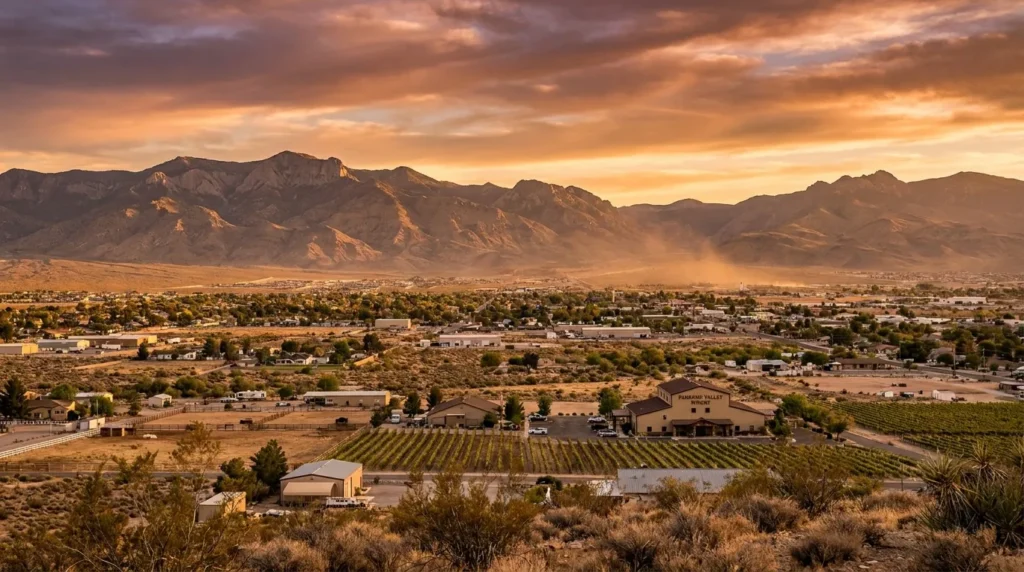
Mix of homes in planned communities, isolated ranches on one-acre or larger lots, and recent subdivisions west of Highway 160.

Most housing consists of single-story homes on spacious lots, many with an acre or more, which gives the valley a rural feel even in its denser areas. Planned communities, known as master-planned communities, offer newer homes, paved streets, and full infrastructure, while older areas keep the desert ranch style with private wells and septic tanks.

Those looking for a home with urban infrastructure usually focus on subdivisions near Highway 160, close to the commercial center. Those who want more isolation and space for animals or recreational vehicles head north of town, toward Bell Vista Avenue, or south, toward Tecopa Road.

Rentals are rarer than in large cities, and most of the market is for purchase. Manufactured homes, or prefabricated houses on their own lots, are common and affordable, especially for first-time buyers. Always check whether the lot has access to the water and sewer network before closing a deal.

Recommended neighborhoods
  • Mountain Falls
  • Calvada Valley
  • Comstock Park
  • Artesia
  • Charleston Park

Local job market

Local economy of services, retail, healthcare, mining, and tourism on the edge of Death Valley, with many people commuting daily to jobs in Las Vegas.

Pahrump has no major industrial hubs, and most local jobs are in basic services, retail, hospitality, construction, healthcare, education, and Nye County public administration. Local casinos such as the Pahrump Nugget and Saddle West employ dozens in food service, housekeeping, and security.

Mining still exists in the region, with operations tied to gold and industrial minerals in the surrounding area, and there is also activity tied to wineries and logistics serving Death Valley. For many, however, real employment lies in Las Vegas, and the one-hour commute on NV-160 becomes part of the routine, especially for Strip workers and southern Nevada's construction industry.

Remote workers find Pahrump attractive for its housing cost, but need to secure decent internet, since fiber coverage is still uneven and many areas rely on fixed wireless or satellite internet.

Dominant sectors
  • Retail and services
  • Hospitality and casinos
  • Healthcare
  • Construction
  • Public administration
  • +1 more
Major employers
  • Desert View Hospital
  • Pahrump Nugget Hotel & Casino
  • Saddle West Hotel Casino
  • Nye County School District
  • Nye County Government
  • +1 more

Education in Pahrump

Public school network of the Nye County School District, with limited local higher education options and reliance on Las Vegas for colleges and universities.

Primary and secondary education is served by the Nye County School District, with schools such as Pahrump Valley High School, Rosemary Clarke Middle School, and several elementary schools distributed across the valley. Most families use the public system, and there are also homeschool options and some smaller charter or Christian schools.

For higher education, Pahrump has a Great Basin College campus offering technical courses, professional certificates, and some degrees in partnership with Nevada universities. For a traditional degree, most students travel to Las Vegas, home to the University of Nevada, Las Vegas (UNLV) and the College of Southern Nevada.

Public libraries and community centers complement the educational offering, with adult literacy programs, English classes for immigrants, and continuing education courses geared to retirees. Decent internet is essential for online learners, and remains a concern in some areas of the valley.

Notable universities
  • Great Basin College, Pahrump Valley Center
  • University of Nevada, Las Vegas (UNLV, in Las Vegas)
  • College of Southern Nevada (in Las Vegas)

Healthcare and medical services

Basic and urgent care covered locally by Desert View Hospital; complex cases go to Las Vegas.

The town's main hospital is Desert View Hospital, which offers an emergency room, general inpatient care, elective surgeries, imaging, and outpatient services. For specialized treatments such as advanced oncology, neurosurgery, transplants, or high-complexity trauma, patients are generally transferred to larger hospitals in Las Vegas, such as University Medical Center, Sunrise Hospital, or Valley Hospital.

Private clinics and community health centers, including units dedicated to mental health and dentistry, serve the valley. There are also national chain pharmacies such as Walgreens and CVS, in addition to independent pharmacies. Newly arrived immigrants often seek services tied to the Nye Communities Coalition for guidance on health insurance, Medicaid, and state programs.

As in almost all of the United States, having private health insurance, Medicare, or Medicaid makes an enormous difference in cost. Those who arrive without coverage face real difficulty in treating chronic conditions, and it is worth seeking out community clinics that apply reduced fees based on income.

Pahrump

Safety in Pahrump

Community with a low profile of violent crime, with problems more tied to theft, drugs, and isolation in rural areas; policed by the Nye County Sheriff's Office.

Pahrump has no municipal police of its own, and public safety is the responsibility of the Nye County Sheriff's Office, with a local detachment covering the entire valley. Violent crimes are uncommon for the town's size, but residential burglaries, vehicle theft, methamphetamine-related incidents, and suspicious activity in isolated desert areas are part of the police routine.

The busier areas perceived as quiet are in planned communities such as Mountain Falls and Calvada Valley, and along the Highway 160 commercial corridor with its supermarkets and banks. Outlying areas, especially isolated rural lots to the north and east, require more caution due to isolation and police response time.

Natural risks deserve attention: extreme summer heat, sandstorms, flash floods on roads that cross dry washes, and wildlife such as rattlesnakes and scorpions. New arrivals need to learn basic desert habits, such as keeping water in the car and avoiding trails without informing someone.

Safer neighborhoods
  • Mountain Falls
  • Calvada Valley
  • Highway 160 commercial corridor
  • Comstock Park
Areas to avoid
  • isolated rural lots north of the valley after dark
  • industrial and deserted areas off Highway 372 without lighting

Transportation and mobility

Town that is 100% car-dependent, with no regular public transit, connected to Las Vegas by NV-160 and to Death Valley by NV-372 and Bell Vista.

Pahrump is a town designed around the car. There is no regular urban bus system, and the distances between neighborhoods and commerce make walking impractical for most trips. The only relevant collective transport is the on-demand Nye County service for seniors and people with disabilities, which covers medical appointments and essential shopping within the valley.

The main external connection is Nevada State Route 160, which links Pahrump to Las Vegas in about an hour through the Spring Mountains. To the west, Bell Vista Avenue and NV-372 lead to Death Valley National Park, on the California border. There is no commercial airport in Pahrump, and air travelers use Harry Reid International Airport in Las Vegas.

Calvada Meadows Airport exists, a small airstrip used by general aviation. Structured bike paths are rare, but some main avenues have pavement shoulders used by local cyclists. New residents need to count on at least one vehicle per adult.

Airports
  • LAS, Harry Reid International (Las Vegas, ~60 mi)
  • 74P, Calvada Meadows Airport (Pahrump, general aviation)

Climate

Pahrump

Culture and social life

Informal cultural life, marked by community fairs, rural festivals, casino events, local wineries, and proximity to Death Valley.

Pahrump's culture is that of a desert town blending American ranch life, a retiree community, and more recent migration from families from southern California and Las Vegas. Annual festivals such as the Pahrump Fall Festival and the Wine and Balloon Festival bring residents together around live music, hot air balloons, food, and wine tastings from the Pahrump Valley Winery.

The food scene is simple and practical, with family restaurants, American steakhouses, Mexican taquerías, and the buffets of the local casinos. Wineries such as the Pahrump Valley Winery and the Sanders Family Winery are frequent weekend gathering spots, and offer affordable tours and tastings.

Social life happens in churches, veterans' clubs, homeowners' associations of the planned communities, and in the casinos themselves, which function as community centers. There is no large museum or professional theater, but the Pahrump Valley Museum preserves the region's mining and pioneer history.

Notable dishes
  • Grilled tri-tip steak
  • Western-style BBQ ribs
  • Tacos al pastor from local taquerías
  • Wines from the Pahrump Valley Winery
  • American casino buffet
Annual events
  • Pahrump Fall Festival
  • Pahrump Balloon Festival
  • Pahrump Social Powwow
  • Wine and Rhythm Festival
  • Nye County Fair

What to see and do

Local wineries, pioneer history museums, casinos, community events, and above all the gateway to Death Valley National Park.

The most famous attraction associated with Pahrump is not within the town, but a few minutes away: Death Valley National Park, one of the most spectacular parks in the United States, with dunes, salt flats, canyons, and the lowest point in North America at Badwater Basin. NV-372 leads directly to the park's eastern entrance, at Death Valley Junction.

In town itself, wineries such as the Pahrump Valley Winery and the Sanders Family Winery are required stops, with tours and dinners. The Pahrump Valley Museum holds artifacts from mining, pioneer life, and the region's indigenous Paiute history. Casinos such as the Pahrump Nugget and the Saddle West offer shows, restaurants, bowling, and bingo.

For nature lovers, there are trails in the Spring Mountains National Recreation Area, with snow areas in winter at Mount Charleston, and stargazing at isolated points in the valley, with skies among the darkest in the American Southwest.

  1. 1Death Valley National Park (access via the eastern side)
  2. 2Pahrump Valley Winery
  3. 3Sanders Family Winery
  4. 4Pahrump Valley Museum
  5. 5Pahrump Nugget Hotel & Casino
  6. 6Saddle West Hotel Casino
Parks & green spaces
  • Petrack Park
  • Discovery Park
  • Simkins Park
  • Ian Deutch Memorial Park
  • Spring Mountains National Recreation Area (surroundings)

Immigrants and foreign communities

Small but present immigrant community, with weight from Mexicans and Filipinos, and reliance on Las Vegas consular services.

Immigration in Pahrump is modest in absolute numbers compared to Las Vegas, but it exists and is growing. The most visible presence is of Mexican families, reflected in the taquerías, Catholic churches with Spanish-language Mass, and businesses with bilingual signage. Filipinos form the second most notable group, many tied to the healthcare sector at Desert View Hospital and to local commerce.

There is also a smaller presence of retired Canadians who choose the valley as a winter destination, British and Germans in similar situations, and families of Chinese, Indian, and Central American origin scattered across commerce and services. Most consular services take place in Las Vegas, home to consulates general of several countries that cover southern Nevada.

For practical support, newcomers benefit from Nye County community organizations and larger networks based in Las Vegas, which serve the valley with English programs, public health guidance, food assistance, and basic immigration guidance.

4,500
Foreign-born residents
estimated
Top countries of origin
  • Mexico
  • Philippines
  • Canada
  • Germany
  • United Kingdom
  • China
  • El Salvador
Foreign consulates
  • Consulate of Mexico in Las Vegas
  • Consulate of El Salvador in Las Vegas
  • Consulate of Guatemala in Las Vegas
  • Honorary Consulate General of Canada in Las Vegas
  • Honorary Consulate General of Germany in Las Vegas
Community organizations
  • Nye Communities Coalition
  • Catholic Charities of Southern Nevada (services extended to the valley)
  • Hispanic Federation (regional programs)
  • Pahrump Family Resource Center
  • Pahrump Valley Rotary Club

Latest posts

Straight from the blog

There are no posts specifically about Pahrump yet. In the meantime, check out our latest posts.