Visto n' Visa
Blog
Notícias e artigos
Destinations
Careers
Immigrants

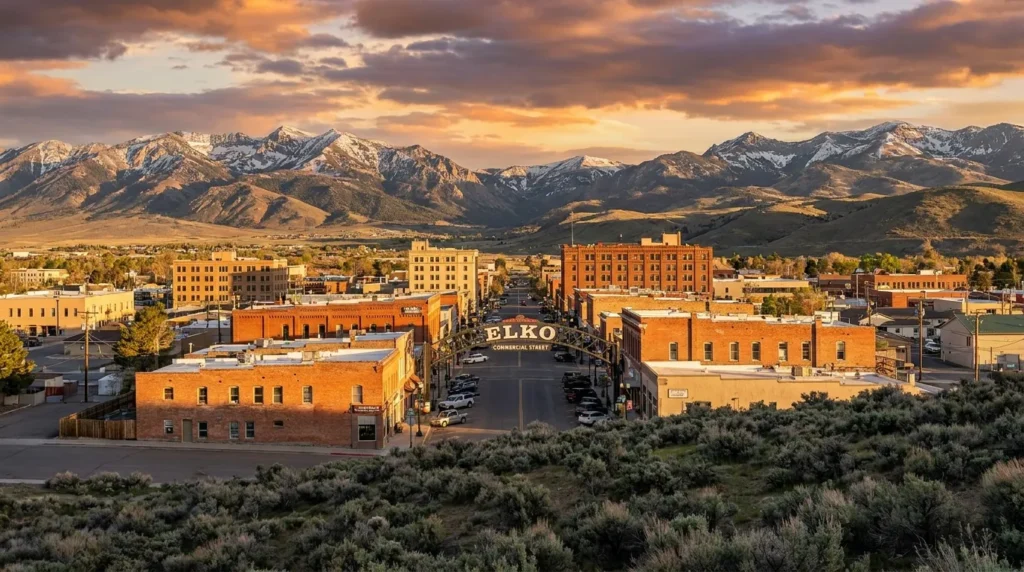
Want to live and work in Elko?

Personalized immigration plan with eligible visas, costs, and next steps for your goal!

If you are not eligible, you will know exactly why and what to do to improve your approval chances.

Save up to 12 hours in meetings

No pointless assessments.

Save up to 90%

Save money on vague or unfocused consultations

Avoid Fraud and Mistakes

One mistake can cost you your visa

Total Impartiality

Zero commercial bias

Decide with peace of mind

No toxic urgency

Fast and Accurate

Answers in minutes, no guesswork

A small city with an unexpected mix of cultures

Elko combines historic Basque roots, a growing Latino presence in mining and agribusiness, and a recognized Western Shoshone tribal community in the region.

Despite having just over 20,000 residents in the city proper, Elko has a diversity that surprises anyone expecting a homogeneous rural town. The Basque heritage arrived in the late 19th century with sheep herders from the Pyrenees and still shows up in restaurants, the annual Basque Festival, and surnames like Aguirre, Etcheverry, and Goicoechea scattered around town.

The most recent wave is Latino: Mexicans, Salvadorans, and Guatemalans now make up a significant share of the workforce, mainly in surface mining, construction, and agriculture. There is also a Filipino and Indian presence tied to the mines, especially in technical engineering and operations roles. The Te-Moak Reservation of the Western Shoshone sits nearby and maintains an active cultural presence.

English is the working lingua franca, but Spanish is everywhere on construction sites and in the service sector. The dominant religions are Catholicism (strong among Basques and Latinos), evangelical Protestantism, Mormonism (Nevada borders Utah), and Western Shoshone spiritual traditions. It is a city where rodeos, Basque festivities, and Latino celebrations coexist on the same civic calendar.

Languages spoken
  • English
  • Spanish
  • Basque (cultural use)
  • Shoshone (tribal use)
  • Tagalog
Main religions
  • Roman Catholicism
  • Evangelical Protestantism
  • Mormonism (LDS)
  • Western Shoshone spiritual traditions
  • No declared religion

Moderate cost pushed upward by mining wages

Elko has a cost of living below the average of large American cities, but rents are pressured by demand from mine workers.

The cost of living in Elko is below the U.S. national average, but with one important distortion: because mining pays well (equipment operators earn between 70,000 and 110,000 dollars a year), housing demand keeps rents higher than one would expect for a city of this size. Three-bedroom homes in decent neighborhoods rent for amounts similar to suburbs of mid-sized Midwestern cities.

Food is reasonable, with Smith's, Albertsons, and Walmart Supercenter covering the basics, but diverse ethnic markets are lacking: anyone cooking Indian, Filipino, or African cuisine needs to stock up on trips to Salt Lake City or order online. Fuel tends to be slightly more expensive than the average for the American West due to logistical isolation, and winter heating bills weigh on the budget.

On the other hand, Nevada has no state income tax, which helps significantly for those with higher salaries. Outdoor recreation is cheap (direct access to public mountains, lakes, and deserts), and social activities revolve around barbecues, rodeos, and community festivals more than expensive urban consumption. For an immigrant with a mining job, the balance tends to be positive.

Pressured rentals, home ownership more accessible than in larger metros

The rental market is tight because of the mining cycle; buying a home in Elko is still cheaper than in big cities, but inventory is small.

Elko's housing market runs on a boom-and-bust rhythm tied to gold cycles. When the metal's price rises, the mines hire, and rentals vanish quickly from listings. In slower periods, the market eases. Newcomers arriving for mine work usually spend their first months in extended-stay motels or company-paid furnished apartments before finding stable housing.

The most sought-after neighborhoods are to the south, toward Spring Creek (about 9 miles from downtown, with larger lots and newer homes), and west of the city near Elko Regional Airport. Buying land and building is a common practice: many people who came to stay end up with a home on a half-acre lot or larger. Short-term rentals are rare, and most leases are annual.

For newly arrived immigrants, the typical path is to start in an apartment downtown or along Idaho Street, get to know the city over six months to a year, and then move to Spring Creek or Lamoille for more space, or stay downtown if walkable life is a priority. The inventory of homes for sale is limited and most transactions happen through referrals or direct contact with owners.

Recommended neighborhoods
  • Spring Creek
  • South Elko (near Errecart Boulevard)
  • Historic downtown
  • West Elko (near the airport)
  • Lamoille (rural area with large homes)

Gold mining dominates, with cowboy economy and logistics rounding it out

Newmont and Barrick (Nevada Gold Mines) are the largest employers; agriculture, transportation, and services tied to the mines make up the rest of the economy.

Elko is quite literally powered by gold. The Nevada Gold Mines joint venture, formed by Newmont and Barrick, operates several mines in the surrounding area (Carlin, Goldstrike, Cortez) and directly and indirectly employs thousands of people across the region. Those arriving with experience in mining, geology, mining engineering, heavy mechanics, or haul-truck operation find work quickly and well paid.

Outside of mining, the second leg of the economy is agribusiness and ranching: cattle ranches, alfalfa, and professional rodeos are a structural part of the city. Heavy logistics is growing thanks to the I-80 position (Union Pacific has an important yard in Elko), and there is steady demand for truck drivers, diesel mechanics, and equipment operators. Healthcare, education, and local government round out the picture.

Average wages in Elko are high for a city of this population because of the mining effect: experienced operators easily clear six figures. The challenge for those arriving without mining experience is breaking into the sector, usually starting as a general helper or with subcontractors. Working English is essential, but there are positions where Spanish is tolerated, mainly in construction and surface operations.

Dominant sectors
  • Gold mining
  • Agriculture and ranching
  • Logistics and road transport
  • Healthcare
  • Retail and services
  • +1 more
Major employers
  • Nevada Gold Mines (Newmont + Barrick)
  • Newmont Corporation
  • Barrick Gold
  • Elko County School District
  • Northeastern Nevada Regional Hospital
  • +3 more

Functional public schools and a community college with technical heft

The Elko County School District serves the region, and Great Basin College offers technical training geared to mining, healthcare, and the trades.

The Elko County School District runs the public schools in the city and county, with elementary schools spread across the neighborhoods, two high schools (Elko High and Spring Creek High), and the typical structure of a rural American district. Quality is considered average by Nevada standards, with strong FFA (Future Farmers of America) programs and athletics thanks to local culture.

For higher education, Great Basin College is the key piece. It offers two- and four-year degrees focused on areas that align with the local economy: nursing, mining technology, welding, operations management, applied computing, and education. It is an accessible entry point for immigrants who want to revalidate diplomas, improve academic English, or retrain for the local job market.

For full undergraduate degrees in areas not locally covered, most students head to the University of Nevada, Reno (UNR) or the University of Nevada, Las Vegas (UNLV). There are also smooth transfer agreements from Great Basin College. English as a Second Language (ESL) programs exist at the college and through community organizations for adult immigrants.

Notable universities
  • Great Basin College
  • University of Nevada, Reno (UNR), nearby partner campus
  • Western Nevada College (regional partnerships)

A solid regional hospital for emergencies, with specialties requiring travel

Northeastern Nevada Regional Hospital covers emergencies and general care; complex cases are referred to Salt Lake City or Reno.

Northeastern Nevada Regional Hospital is the city's main healthcare facility, offering a 24-hour emergency room, maternity, general surgery, orthopedics, and some specialties. For common emergencies, it is a reliable reference for all of northeastern Nevada. There are also private clinics, family practices, and Nevada Health Centers for subsidized care.

Rarer specialties such as advanced oncology, interventional cardiology, neurosurgery, or complex pediatric treatments typically require a trip to Salt Lake City (three hours) or Reno (four and a half hours). It is not unusual for families to plan concentrated appointments to make the most of a single trip. Telemedicine has grown significantly in the region and helps reduce that travel.

For immigrants, securing health insurance is a central part of the relocation decision. Most mining positions include robust corporate health plans (Newmont and Barrick offer broad coverage). Those working in construction, agriculture, or services need to evaluate plans through the federal marketplace or their employer. Service in Spanish is available at the hospital and in several clinics, but other languages depend on an interpreter or app.

A safe city overall, with a few specific spots to watch

Elko is considered relatively safe for its size, with crime rates close to the average of small Western American cities.

Elko is, overall, a safe city for immigrants and families. The violent crime rate is low in absolute terms, and most incidents involve opportunistic theft, alcohol-related issues downtown on weekends, and domestic disturbances. Residential neighborhoods like Spring Creek and the south side of the city are calm, with active neighborhood involvement and low turnover.

The areas that warrant more attention are stretches of Idaho Street at night (the older casino and bar zone) and a few cheap motels along Interstate 80, which historically attract drug users and prostitution. They are not dangerous in a big-city sense, but walking alone in the early morning hours through those areas should be avoided.

The Elko Police Department is responsive and has a good community relationship. For undocumented immigrants, it is worth noting that Nevada is not a sanctuary state and cooperation with federal authorities exists, so caution in interactions with police is prudent. In general, with basic urban common sense, Elko is considered one of the most peaceful cities to live in across northeastern Nevada.

Safer neighborhoods
  • Spring Creek
  • South Elko (residential area)
  • Lamoille
  • West Elko (near the airport)
Areas to avoid
  • Stretches of Idaho Street at night (old casino zone)
  • Cheap motels near Interstate 80
  • Industrial areas east of downtown after dark

A car-driven city, with a small regional airport and Interstate 80 as its spine

Elko depends almost entirely on cars; the regional airport connects to Salt Lake City, and Greyhound and Amtrak maintain a historic presence.

Transportation in Elko is synonymous with the car. There is no meaningful urban bus system, and the city is spread out enough that walking between neighborhoods is impractical. Interstate 80 cuts through the valley and is the main route in any direction: Salt Lake City to the east in about three hours, Reno to the west in just over four. For those arriving without an American driver's license, obtaining a CDL or at least a regular license is a priority.

Elko Regional Airport (EKO) operates regular commercial flights to Salt Lake City via SkyWest/Delta, providing easy access to the international hub for long trips. It is a small airport, two or three flights a day, but functional. For destinations not covered, many people drive to Salt Lake City and fly from there. Amtrak stops in downtown Elko with the California Zephyr (Chicago–Emeryville), a slow but scenic option.

Urban bike lanes are limited, although the city has multi-use trails along the Humboldt River and in parks. The local cycling vocation leans more toward mountain biking in the surrounding area than commuting. Winter brings snow frequently, and driving with winter tires or chains is part of the routine between December and March. Parking is abundant and almost always free.

Airports
  • EKO, Elko Regional Airport (flights to Salt Lake City via SkyWest/Delta)

Basque culture, cowboy poetry, and festivals that mix it all together

Elko hosts the National Cowboy Poetry Gathering and the National Basque Festival, two events that capture the city's identity.

Elko's culture is a curious mix found in almost no other place in the United States. The National Cowboy Poetry Gathering takes place every January and draws poets, musicians, and storytellers from the Western cowboy tradition for a week of events at the Western Folklife Center. It is one of the most respected cultural events of its kind in the country.

The National Basque Festival, in late June or early July, is the other pillar: traditional Basque games such as stone lifting and log chopping, folk dances, mass in Basque, and a communal barbecue. The downtown Basque restaurants (Star Hotel, Toki Ona) serve family-style meals with multiple courses that have become a local institution. Typical dishes revolve around meat, hearty soups, picon punch (a Basque cocktail), and house-made chorizo.

The calendar also includes the Silver State Stampede (professional rodeo), summer county fairs, Latino festivals such as Cinco de Mayo, and Western Shoshone community celebrations. Cultural life is not on the scale of a big city, but it is dense for the population size, with a strong sense of historic continuity.

Notable dishes
  • Picon punch (traditional Basque cocktail)
  • Basque bean and chorizo soup
  • Family-style Basque dinner (several shared dishes)
  • Lamb chops with Basque sauce
  • House-made chorizo
  • +1 more
Annual events
  • National Cowboy Poetry Gathering (January)
  • National Basque Festival (June/July)
  • Silver State Stampede (July)
  • Elko County Fair (August/September)
  • Mining Expo (June)
  • +1 more

Ruby Mountains, unique museums, and gateways to the wild West

Main attractions include the Western Folklife Center, the Ruby Mountains, historical museums, and direct access to the desert and outdoor recreation.

Elko's biggest asset is its proximity to the raw nature of the American West. The Ruby Mountains, southeast of the city, offer trails, alpine lakes such as Lamoille Lake and Liberty Lake, helicopter skiing in winter, and summer hikes considered among the most beautiful in Nevada. Lamoille Canyon is nicknamed the Yosemite of Nevada and is about 30 minutes by car.

Within the city, the Western Folklife Center is a must-stop for understanding cowboy and Basque culture. The Northeastern Nevada Museum covers the history of mining, the Shoshone tribes, and the settlement of the valley. The California Trail Interpretive Center, just west of the city, tells the saga of the pioneers who crossed the region in the 19th century on their way to California.

For outdoor life, the area around Elko is generous: South Fork State Recreation Area for fishing and boating, Wild Horse State Recreation Area farther north, natural hot springs scattered across the region, and the Humboldt-Toiyabe National Forest for camping. Within an hour by car, one leaves the urban center and steps into Western-movie scenery. Immigrants who value nature find an outdoor lifestyle here that is hard to match.

  1. 1Western Folklife Center
  2. 2Ruby Mountains and Lamoille Canyon
  3. 3Northeastern Nevada Museum
  4. 4California Trail Interpretive Center
  5. 5South Fork State Recreation Area
  6. 6Lamoille Lake
Parks & green spaces
  • Lamoille Canyon
  • South Fork State Recreation Area
  • Wild Horse State Recreation Area
  • Humboldt River Greenbelt
  • City Park
  • +1 more

Historic Basques, growing Latinos, and technical professionals arriving from Asia

Elko's immigrant community blends 19th-century Basque heritage, a strong Mexican and Central American presence, and Filipino and Indian professionals in the mines.

Elko's immigrant history begins with Basque shepherds who arrived from the Pyrenees in the late 19th century to manage sheep flocks in the high desert. Those surnames are still all over the city, and the Basque community keeps the Euzkaldunak Club, annual festivities, and restaurants that have become institutions alive. It is a rare case of a European immigrant community that has preserved an active cultural identity for more than a century.

The second major wave is Latino, primarily Mexican and to a lesser degree Salvadoran and Guatemalan, drawn by work in surface mining, agriculture, and construction. Markets, restaurants, and Spanish-language services are growing in the south side of the city. More recently, technical openings at the mines have attracted Indian and Filipino engineers and operators, creating a new layer of professional diversity.

Resources for newcomers include English classes at Great Basin College, community support organizations, churches with masses in Spanish, and informal networks via coworkers at the mining companies. There are no foreign consulates based in Elko, so consular documents require travel to Las Vegas, Salt Lake City, or Reno depending on jurisdiction.

2,400
Foreign-born residents
estimated
Top countries of origin
  • Mexico
  • El Salvador
  • Guatemala
  • Philippines
  • India
  • Spain (Basque heritage)
  • Peru
  • Canada
Foreign consulates
  • Consulate General of Mexico in Las Vegas (jurisdiction over Elko)
  • Consulate of Mexico in Salt Lake City
  • Consulate General of Canada in Denver (regional jurisdiction)
  • Consulate General of the Philippines in Los Angeles (jurisdiction)
  • Consulate General of Spain in San Francisco (jurisdiction)
Community organizations
  • Communities In Schools of Northeastern Nevada
  • Nevada Health Centers (multilingual service)
  • Catholic Community Services of Northern Nevada
  • Great Basin College ESL Program
  • Euzkaldunak Club (Basque community)
  • Elko Family Resource Center

Latest posts

Straight from the blog

There are no posts specifically about Elko yet. In the meantime, check out our latest posts.