Visto n' Visa
Blog
Notícias e artigos
Destinations
Careers
Immigrants

Want to live and work in Whitefish?

Personalized immigration plan with eligible visas, costs, and next steps for your goal!

If you are not eligible, you will know exactly why and what to do to improve your approval chances.

Save up to 12 hours in meetings

No pointless assessments.

Save up to 90%

Save money on vague or unfocused consultations

Avoid Fraud and Mistakes

One mistake can cost you your visa

Total Impartiality

Zero commercial bias

Decide with peace of mind

No toxic urgency

Fast and Accurate

Answers in minutes, no guesswork

Small population, predominantly white, and growth driven by newcomers

Whitefish has about 8,000 residents, with a strong white majority, a historic presence of Kootenai and Salish communities in the region, and a recent influx of internal migrants from the West Coast.

The resident population hovers around 8,000 people, but doubles in high season with tourists and seasonal workers. The ethnic profile is predominantly white, with a small but important presence of Indigenous communities from the Confederated Salish and Kootenai tribes, whose reservation lies south of Flathead Lake.

In recent years, the town has received a large influx of new residents from California, Washington, Oregon, and Colorado, seeking quality of life and remote work. This movement has changed the demographic profile, brought in young families and tech professionals, and put pressure on the housing market.

Most residents speak English as their first language. There is a small Spanish-speaking community tied to the hospitality and construction sectors, along with some families originally from Eastern European and Latin American countries working in hotels and restaurants at the ski resort.

Languages spoken
  • English
  • Spanish
Main religions
  • Protestant Christianity
  • Catholicism
  • No declared religion

High cost of living by Montana standards

Whitefish is one of the most expensive towns in Montana, with housing prices close to resort destinations such as Aspen and Jackson Hole, though food, energy, and taxes follow the statewide standard.

Housing costs are the biggest shock for newcomers. Rents and purchase prices have risen sharply since 2020, and Whitefish has become one of the most expensive places in the state, with average home prices well above local salary realities. Hospitality workers often live in Columbia Falls or Kalispell and commute daily.

Grocery prices are close to the U.S. average, with Super 1 Foods and Markus Foods covering everyday shopping. Restaurants on Central Avenue are pricey due to proximity to the tourist market, while options in Columbia Falls and Kalispell cost considerably less.

Montana does not levy a state sales tax, which helps the budget, but property taxes have risen alongside assessed values. Winter heating weighs on monthly bills between November and March. Health insurance and gasoline track the average of the American West.

Whitefish

A market contested between longtime residents and new buyers

Whitefish's housing market is dominated by single-family homes, second residences, and luxury cabins near the lake and the mountain, with very little affordable rental inventory.

The town center, around Central Avenue, features historic homes and a few new condominiums, with high prices and heavy competition. The areas to the north, near Whitefish Mountain Resort, and to the west, along the shore of Whitefish Lake, are concentrated with luxury homes and vacation properties, many operated as short-term rentals.

Neighborhoods such as Mountainside, Iron Horse, and the Big Mountain condominiums tend to appear in searches by buyers with high budgets. For long-term rentals, supply is scarce and prices are high, leading many people to look at Columbia Falls, Kalispell, or Evergreen as a base.

Families with children typically prioritize areas near the Whitefish School District. For those working in seasonal hospitality, hostels, employee housing offered by resorts, and shared rooms are common alternatives during the season.

Recommended neighborhoods
  • Central Whitefish
  • Iron Horse
  • Mountainside
  • Big Mountain
  • Whitefish Lake area
  • +1 more

Hospitality, construction, and remote work

The local economy depends heavily on tourism, hospitality, and construction, with significant complementary roles in healthcare, retail, and remote professionals who have relocated in recent years.

Whitefish Mountain Resort is the region's largest employer, with openings across all areas, from lift operations to kitchens, lodging, and ski school. Hotels, inns, restaurants, and outdoor gear shops form the second major block, with strong seasonality between winter and summer.

Construction sees steady demand due to real estate growth, and skilled trades such as electrical, plumbing, and carpentry find well-paid work. The healthcare sector revolves around Logan Health Whitefish and the larger hospital in Kalispell, with openings in nursing, technicians, and administrative roles.

Remote work has exploded since 2020, and today there is a considerable layer of technology, design, and finance professionals working for outside companies. For those arriving from another country, hospitality and construction roles are the most common points of entry, with basic English often acceptable for many positions.

Dominant sectors
  • Tourism and hospitality
  • Construction
  • Outdoor retail
  • Healthcare
  • Remote work (tech and services)
  • +1 more
Major employers
  • Whitefish Mountain Resort
  • Logan Health Whitefish
  • Glacier National Park (concessionaires)
  • BNSF Railway
  • Averill Hospitality
  • +1 more

Small, well-rated public schools, with higher education in Kalispell

The Whitefish School District has a solid reputation in the state, with small schools and a focus on outdoor education, while higher education is located in Kalispell and Missoula.

The Whitefish School District serves children from preschool through high school, with Whitefish High School, Whitefish Middle School, and Muldown Elementary. The schools are small compared to those in larger cities and have a strong outdoor education component, with skiing, hiking, and natural science programs.

For higher education, the closest reference is Flathead Valley Community College, in Kalispell, which offers technical courses, two-year programs, and partnerships with Montana universities. The University of Montana, in Missoula, is about two and a half hours away by car.

International families typically enroll their children directly in the public system, which accepts ESL students at no cost. There is no large offering of international or bilingual schools in town, and private tutoring is expensive, reflecting the overall cost of living.

Notable universities
  • Flathead Valley Community College (Kalispell)
  • University of Montana (Missoula, 2h30)
  • Montana State University (Bozeman, 5h)

Basic local care, with a referral hospital in Kalispell

Whitefish has local clinics and a small hospital managed by Logan Health, with regional referrals for complex cases sent to Logan Health Medical Center in Kalispell.

Logan Health Whitefish is the local hospital, with an emergency room, short-stay inpatient care, imaging, and associated clinics. For more complex procedures, specialized surgery, or cancer treatment, patients are referred to Logan Health Medical Center, in Kalispell, the largest regional hospital.

Access to specialists may require appointments with weeks of waiting, which is common in small towns. For after-hours emergencies, the Whitefish ER is open 24 hours, and ambulances and ALERT medical helicopters operate in the region.

As is the case throughout the United States, having robust health insurance is essential. Salaried workers usually receive benefits through their employer, while remote workers and freelancers purchase plans through healthcare.gov or directly with Blue Cross Blue Shield of Montana. Without coverage, a simple appointment can cost hundreds of dollars.

Whitefish

A town considered very safe, with typical mountain-area precautions

Whitefish is one of the safest towns in the state in terms of crime, with low rates of violence and greater concerns tied to wildlife, weather, and trail safety.

The violent crime rate is very low, and most incidents involve petty theft, vandalism, and DUI tied to tourism. Downtown and residential neighborhoods are quiet for walking at night, with a visible presence of the Whitefish Police Department.

The main risks are environmental. Encounters with black bears and grizzlies happen in the area, and following the rules on food and trash storage is required by law. In winter, driving on icy and snowy roads demands proper tires and attention, and the summer wildfire season can bring dense smoke for days.

For newly arrived immigrants, it is worth understanding the local wildlife rules, securing home and auto insurance suited to cold weather, and never underestimating snowstorms. In remote areas, cell signal fails, so carrying a physical map and letting someone know the destination are basic habits.

Safer neighborhoods
  • Central Whitefish
  • Iron Horse
  • Mountainside
  • Whitefish Lake neighborhoods
Areas to avoid
  • Isolated trails without preparation in winter
  • Secondary roads during snowstorms

A car is essential, but downtown is walkable and long-distance rail is available

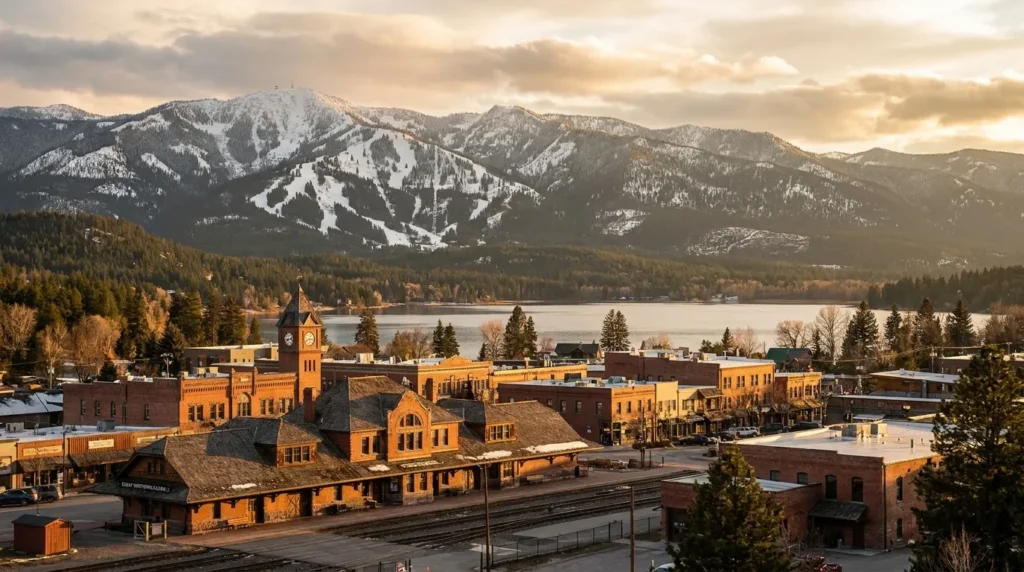
Whitefish is a town built around driving, but downtown is compact and walkable, with an active Amtrak station and Glacier Park International, the regional airport, just 25 minutes away.

Daily life for most residents depends on a car, especially in winter, when snow and ice make walking and biking more difficult. US-93 cuts through town and connects to the rest of the Flathead Valley, while US-2 leads to the west entrance of Glacier National Park.

The downtown area around Central Avenue is compact, with shops, restaurants, and the Amtrak Empire Builder station just a few blocks away. The rail line connects Whitefish to Seattle to the west and Chicago to the east, making it one of the few small American towns with daily Amtrak service.

Glacier Park International Airport (FCA), in Kalispell, serves the town with direct flights to Seattle, Denver, Minneapolis, Salt Lake City, and some seasonal routes to major hubs. There is no regular public transit within Whitefish, only the SNOW Bus to the mountain during high season.

Airports
  • FCA, Glacier Park International (Kalispell, 25 min)
  • Bike infrastructure

Climate

Whitefish

Mountain, railroad, and outdoor culture

Whitefish's identity blends Great Northern railroad heritage, ski culture, and the wilderness of the American Northwest, with a strong presence of craft breweries and local art.

Cultural life revolves around the relationship with nature and the railroad heritage. The Stumptown Historical Society Museum, inside the old depot building, tells the story of the town's tie to the Great Northern Railway, while the Whitefish Theatre Company maintains active theater and music programming year-round.

Breweries such as Bonsai Brewing Project and Great Northern Brewing are part of daily life, alongside independent cafes and restaurants that favor local ingredients. The food scene blends American mountain cuisine, steakhouse-style restaurants, and a growing influence of Mexican and Asian food.

The events calendar is strong in summer and winter. The Whitefish Winter Carnival, in February, is the most traditional event, with a parade and street activities. In summer, Huckleberry Days and outdoor shows at Depot Park draw residents and visitors from across the region.

Notable dishes
  • Huckleberry pie
  • Bison burger
  • Grilled trout
  • Elk chili
  • Pretzel with craft beer
Annual events
  • Whitefish Winter Carnival
  • Huckleberry Days Arts Festival
  • Whitefish Lake Run
  • Great Northwest Oktoberfest
  • Whitefish Songwriter Festival

Lake, mountain, and gateway to Glacier

Whitefish's attractions revolve around nature, with Whitefish Lake, Whitefish Mountain Resort, and Glacier National Park dominating the calendar of both residents and visitors.

Whitefish Mountain Resort is the heart of outdoor life, with skiing and snowboarding in winter and mountain biking, alpine slide, and trails in summer. Whitefish Lake, just minutes from downtown, draws families for swimming, sailing, and fishing between June and September, and City Beach is the most-used public spot.

Glacier National Park, 40 minutes away by car via US-2, is one of the country's greatest natural attractions, featuring the Going-to-the-Sun Road, Lake McDonald, and dozens of trails. Many Whitefish residents use the park as a weekend backyard during summer.

Downtown, the Stumptown Historical Society Museum and the Whitefish Theatre Company offer cultural programming year-round. Les Mason State Park and the Whitefish Trail System provide access to short and scenic trails right from town, great for daily walks and runs.

  1. 1Whitefish Mountain Resort
  2. 2Whitefish Lake and City Beach
  3. 3Glacier National Park (west entrance)
  4. 4Stumptown Historical Society Museum
  5. 5Whitefish Trail System
  6. 6Central Avenue (downtown)
Parks & green spaces
  • Whitefish Lake State Park
  • Les Mason State Park
  • Depot Park
  • Riverside Park
  • Whitefish Trail

A small immigrant community, tied to hospitality and construction

Whitefish has a small immigrant community in absolute numbers, mainly Latin Americans in the service sector, Canadians due to the border's proximity, and Europeans in high-end hospitality.

The foreign-born community is small compared to those in larger cities, reflecting the town's size. The most visible presence comes from Latin Americans, especially Mexicans and Central Americans, working in hotels, restaurants, construction, and landscaping in the region.

There is also a layer of Canadians, favored by the border being 90 minutes away by car, and Europeans, mainly from the United Kingdom, Germany, France, and Eastern European countries, in seasonal positions tied to the ski resort and premium hospitality. In recent years, remote professionals from Australia and New Zealand have also settled in the region.

Services specifically for immigrants are concentrated in Kalispell, where regional organizations offer English classes, legal support, and social assistance. In Whitefish, churches and the public library are usually initial points of contact for newcomers, along with informal groups of seasonal workers.

400
Foreign-born residents
estimated
Top countries of origin
  • Mexico
  • Canada
  • Guatemala
  • United Kingdom
  • Germany
  • Philippines
  • Honduras
Foreign consulates
  • Consulate General of Canada (Seattle, jurisdiction)
  • Consulate General of Mexico (Seattle, jurisdiction)
  • Consulate General of the United Kingdom (Denver, jurisdiction)
  • Consulate General of Germany (San Francisco, jurisdiction)
Community organizations
  • Flathead Valley Community College ESL Program
  • Catholic Charities of Montana
  • Sparrow's Nest of Northwest Montana
  • Whitefish Community Library
  • North Valley Food Bank

Latest posts

Posts about Montana

Coverage and updates related to this destination.

Showing content from Montana, as there is no specific data for Whitefish yet.