Visto n' Visa
Blog
Notícias e artigos
Destinations
Careers
Immigrants

Want to live and work in Sidney?

Personalized immigration plan with eligible visas, costs, and next steps for your goal!

If you are not eligible, you will know exactly why and what to do to improve your approval chances.

Save up to 12 hours in meetings

No pointless assessments.

Save up to 90%

Save money on vague or unfocused consultations

Avoid Fraud and Mistakes

One mistake can cost you your visa

Total Impartiality

Zero commercial bias

Decide with peace of mind

No toxic urgency

Fast and Accurate

Answers in minutes, no guesswork

Who lives in Sidney: small population, rural roots, and cycles of labor migration

Sidney has about six thousand residents, with a strong majority of northern European descent and seasonal cycles of workers tied to oil and the sugar beet harvest.

Sidney's resident population is small, around six thousand people, and historically formed by descendants of German, Norwegian, Scandinavian, and Eastern European immigrants who arrived in the region in the early 20th century to work in agriculture. This profile is still reflected in the surnames in the phone book, the Lutheran churches, and community festivals.

Over the past two decades, the Bakken oil boom has brought waves of temporary workers from other parts of the United States, Mexico, and Central America, mainly young men seeking high wages in the oil and gas industry. Some have settled in town, opened small businesses, and started families, gradually expanding Sidney's diversity.

The local age range tends to split between young families tied to industrial work and retired older residents of farming origin. English is the dominant language in practically every setting, and Spanish appears in work environments tied to construction, agribusiness, and the refinery. Religion weighs on social life, with Lutherans, Catholics, and Evangelicals forming the majority of congregations.

Languages spoken
  • English
  • Spanish
Main religions
  • Lutheran Christianity
  • Catholicism
  • Protestant Evangelicalism
  • No religion

Cost of living in Sidney: cheap overall, but sensitive to oil

Sidney is usually much cheaper than the American average in housing and food, but rents rise quickly during oil boom cycles and can surprise those arriving at the wrong time.

Compared to medium and large cities in the United States, Sidney is considered inexpensive. Buying a three-bedroom house in a residential neighborhood usually costs a fraction of what it would in states like California, New York, or even Colorado. Markets like Reynolds and Albertsons have prices aligned with Montana's rural standard, and eating out at local chains rarely strains the budget.

The important detail is the oil cycle. When the Bakken formation heats up, workers arrive in mass and the rental supply tightens, with prices climbing aggressively in a few months. During downturns, the market relaxes and good rental and purchase opportunities appear. Anyone moving needs to understand which part of the cycle they are stepping into.

Energy bills tend to be high in winter, since heating runs many months per year in sub-zero temperatures. Fuel is cheap by American standards, which helps those who depend on a car. Overall, a family with average income can live comfortably, as long as they do not try to replicate big-city habits.

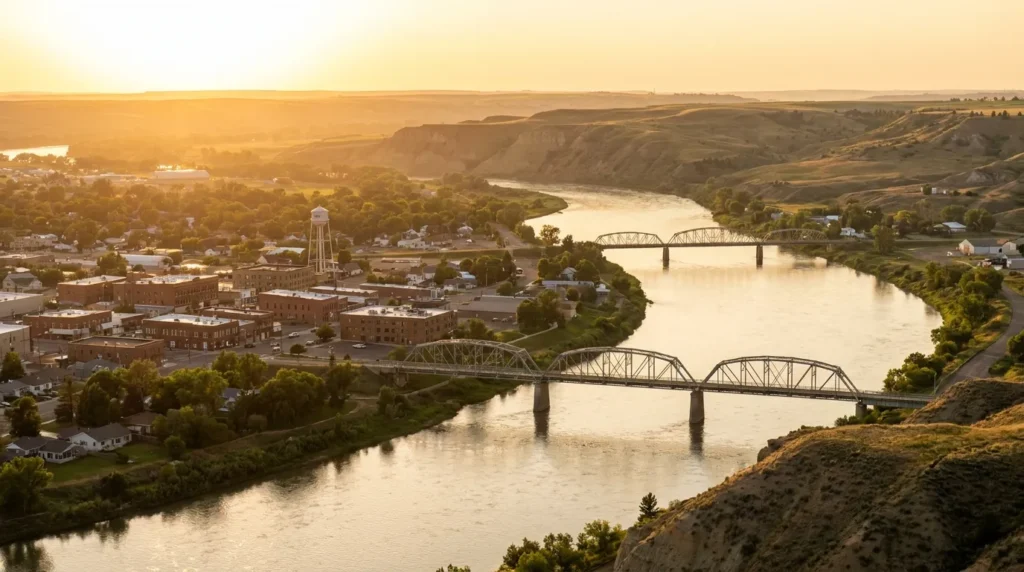
Sidney

Where to live in Sidney: spacious homes, quiet streets, and few rental options

Sidney is dominated by single-family homes with yards, with quiet residential neighborhoods near downtown and new developments on the edge of town, but the rental market is small and volatile.

Most of Sidney is made up of single-family homes with garages, yards, and basements, typical of small towns in interior America. Neighborhoods near downtown have older houses, built between the 1940s and 1970s, with tree-lined streets and wide sidewalks. Further toward the edges, new subdivisions appear with larger homes and a suburban standard.

The rental market is limited and heavily influenced by oil. During boom times, finding a two-bedroom apartment can become a treasure hunt, and many people end up sharing houses with coworkers or renting trailers in RV parks. In calmer periods, there is more supply, especially in small complexes and duplexes around Central Avenue.

For families, residential neighborhoods west of downtown are usually preferred for their proximity to schools, parks, and the regional hospital. Those who work at the refinery or in oil sometimes prefer the south side, closer to the routes leading out to the fields. Buying a house is the most common path for those who decide to stay for real.

Recommended neighborhoods
  • West Side residential
  • Central Avenue
  • South Sidney
  • Vicinity of Sidney Health Center
  • New developments on the north edge

Working in Sidney: oil, agriculture, sugar, and support services

Jobs in Sidney are concentrated in oil and gas, agriculture, the sugar refinery, healthcare, and public services, with wages above the American rural average when the energy sector is heated.

The oil and gas industry of the Bakken basin is the strongest engine of the regional job market. Service companies provide drilling, fracking, fluid transportation, and well maintenance work, hiring operators, CDL truck drivers, welders, and technicians. These positions pay well but require availability for long shifts and harsh weather.

The second major employer is Sidney Sugars, a historic refinery that processes sugar beets grown in the region. Alongside it, family farms hire seasonal labor for planting and harvest. Sidney Health Center, the regional hospital, is another pillar and offers stable positions in nursing, technical, administrative, and support roles. Public schools, city hall, and local commerce complete the mosaic.

For qualified professionals, there are good opportunities in healthcare, engineering, accounting, and management tied to the energy sector. For those arriving without specific qualifications, retail, restaurants, hotels, and cleaning services absorb a good share. The oil cycle sets the pace: in boom times, workers are scarce; in downturns, resumes pile up.

Dominant sectors
  • Oil and gas (Bakken)
  • Agriculture and sugar beets
  • Sugar refinery
  • Healthcare
  • Retail and services
  • +1 more
Major employers
  • Sidney Sugars Incorporated
  • Sidney Health Center
  • Richland County
  • Sidney Public Schools
  • Bakken oilfield services companies
  • +1 more

Studying in Sidney: local public schools and a regional community college

Sidney has a public school network well rated by Montana's rural standard and access to a regional community college, while four-year universities require moving to another city.

The Sidney Public Schools district operates elementary, middle, and Sidney High School, which has a good reputation by Montana's rural standard, with small classes, active sports, and vocational programs tied to agribusiness and the oil industry. Families arriving from elsewhere often consider the quality of these schools as a positive point of the move.

For higher education, the nearest option is Dawson Community College, in Glendive, and Williston State College, on the other side of the border in North Dakota. Both offer technical courses, two-year associate programs, and training geared toward oil, healthcare, agriculture, and business. For a traditional bachelor's degree, one must go to Billings, Bozeman, or Missoula.

Private and religious schools exist on a reduced scale, mainly tied to local parishes. Vocational courses in welding, industrial mechanics, and practical nursing attract young people who want to enter the Bakken job market quickly. Online programs from state universities help those who need to study without leaving town.

Notable universities
  • Dawson Community College (Glendive, nearby)
  • Williston State College (Williston, ND, nearby)
  • Montana State University Billings (regional)

Healthcare in Sidney: solid regional hospital and specialized services in Billings

Sidney Health Center is the pillar of the local healthcare system, serving the entire MonDak region, while more complex specialized care is usually handled in Billings or Williston.

Sidney Health Center is the regional hospital and functions as the backbone of the local healthcare network. It offers 24-hour emergency care, inpatient admissions, maternity, general surgeries, physical therapy, and outpatient clinics in various specialties. For a small town, the structure is considered good, which helps attract doctors and nurses from other parts of the United States.

Private offices for general practice, pediatrics, dentistry, and chiropractic occupy downtown. For more advanced specialties such as complex oncology, interventional cardiology, or neurosurgery, patients are usually referred to larger hospitals in Billings, Bismarck, or Williston, with air transport in critical cases through the region's medical helicopter service.

The cost of care follows the American model based on private insurance, with large employers offering plans and self-employed professionals facing higher premiums. Programs like Medicaid and Medicare serve low-income families and retirees. For newly arrived immigrants, it is worth adjusting coverage right in the first days.

Sidney

Safety in Sidney: a quiet town with peaks tied to the oil cycle

Sidney is, overall, a safe and quiet town, but it records occasional spikes in crime and social tension during oil boom periods, with more traffic of transient workers.

Most of the time, Sidney is a town where people leave doors unlocked and children ride bicycles through the streets without much concern. Violent crime is low by American standards, with most reports involving petty theft, bar fights, and traffic violations. Families often describe the town as very safe for raising children.

The picture changes during Bakken oil boom periods, when floods of transient workers raise incidents of drunkenness, drunk driving, fights, and property crimes. The local police and county sheriff have already adapted their structures to handle these cycles. Even so, even at peak times, the town remains much calmer than mid-sized urban centers.

Livelier commercial and leisure areas downtown tend to be well patrolled, especially on weekend nights. Newly arrived workers who do not yet know the community are usually advised to avoid specific bars when alone. Overall, the usual care with belongings and vehicles is enough to feel comfortable.

Safer neighborhoods
  • Residential neighborhoods west of downtown
  • Vicinity of Sidney Health Center
  • New developments on the north edge
  • Area near public schools
Areas to avoid
  • Isolated industrial areas around oil fields at night
  • Remote RV park parking lots without lighting
  • Deserted rural roads on stormy nights

Getting around Sidney: total car dependence and rural roads

Sidney is a city where the car rules absolutely, with virtually no public transportation, large regional distances, and a small airport that connects the town to the rest of Montana.

Walking works well within downtown, which is compact and flat, but for anything beyond that, a car is practically mandatory. There is no urban bus network in the style of large cities, and trips between neighborhoods, work, and markets are almost always made by pickup, SUV, or sedan. Families usually have two or more vehicles.

The main highway is U.S. Route 200, which crosses Sidney from east to west and connects the town to Williston, in North Dakota, as well as to the interior of Montana heading toward Glendive and Billings. Regional distances are long and winter snowfall demands attention. The town has Sidney-Richland Regional Airport, with limited commuter flights primarily linking to Billings.

For longer trips, the Williston airport, on the North Dakota side, is usually a practical option, with more commercial flights. Cyclists find some comfortable streets, parks, and short trails, but dedicated cycling infrastructure is minimal. In winter, ice and snow make biking impractical for much of the year.

Airports
  • SDY, Sidney-Richland Regional Airport
  • XWA, Williston Basin International (nearby, in North Dakota)

Climate

Sidney

Culture in Sidney: rodeos, agricultural fairs, and prairie tradition

Cultural life in Sidney revolves around rodeos, county fairs, church events, school sports, and culinary traditions tied to the region's rural and Scandinavian heritage.

Sidney's culture is typical of the prairies of the American West, with a strong presence of rodeos, agricultural fairs, school sports, and community festivities. The Richland County Fair & Rodeo is one of the highlights of the year, drawing people from across the region for livestock competitions, country shows, fair food, and farm machinery exhibits. High school football and basketball teams stir up the town on Friday nights.

The German, Norwegian, and Scandinavian heritage appears in church gatherings, community dinners, and dishes like hotdish, lefse, and knoephla soup, common in winter. Local cuisine is not refined, but it is hearty and familiar, with ribs barbecue, farm steaks, potatoes, and homemade pies dominating the menus at restaurants like Meadowlark Brewing and diners along Central Avenue.

Those seeking an urban cultural scene, large museums, or concert halls will need to travel to Billings or other regional cities. In exchange, Sidney offers a rare sense of small-community life, with attentive neighbors, constant charitable events, and a rural identity proud of its prairie roots.

Notable dishes
  • Tater tot hotdish
  • Lefse
  • Knoephla soup
  • Farm-raised Angus steak
  • Smoker pork ribs
  • +1 more
Annual events
  • Richland County Fair & Rodeo
  • Sunrise Festival of the Arts
  • MonDak Heritage Center exhibitions
  • Year-end Christmas Stroll
  • Sidney Independence Day Parade

What to see in Sidney: prairie history, Yellowstone nature, and outdoor life

Sidney's attractions blend the small regional museum, the Yellowstone River, local parks, and excursions to historic landmarks and natural areas in eastern Montana and western North Dakota.

The main cultural attraction is the MonDak Heritage Center, a regional museum dedicated to the history of the prairies, Indigenous peoples, European settlers, and the local agricultural and oil economy. Temporary exhibitions and community workshops keep the programming active throughout the year and attract residents and tourists curious about the region's past.

The Yellowstone River, which passes near the town, is the great stage for fishing, boat rides, bird watching, and picnics in hot summers. A few hours away are Theodore Roosevelt National Park, in North Dakota, and the historic Fort Union Trading Post, a landmark of the fur trade era. Those who enjoy geology visit the nearby badlands and spectacular rock formations.

Within Sidney, municipal parks, sports courts, and golf courses offer everyday leisure. High school sporting events fill gyms in winter and stadiums in fall. For immigrants coming from large cities, the main appeal is not monuments, but the open landscape, the starry night sky, and nature so close to the doorstep.

  1. 1MonDak Heritage Center
  2. 2Sidney-Richland Regional Airport area
  3. 3Veterans Memorial Park
  4. 4Fishing and canoeing on the Yellowstone River
  5. 5Fort Union Trading Post National Historic Site (nearby)
  6. 6Theodore Roosevelt National Park (nearby)
Parks & green spaces
  • Veterans Memorial Park
  • Sidney Central Park
  • Sidney Country Club golf course
  • Yellowstone River access points
  • Richland Park

Immigrants in Sidney: a small community tied to oil and agribusiness

The presence of immigrants in Sidney is small in absolute numbers, concentrated in Latin American workers in oil and agribusiness, with smaller groups of other origins and support coming from churches and regional associations.

Sidney is a small and historically white town, but the Bakken oil boom brought a new layer of diversity. Workers born in Mexico, Honduras, El Salvador, Guatemala, and other Latin American countries arrived to fill positions in oilfield services, transportation, and construction. Small communities from the Philippines, India, and Eastern Europe also appear, generally tied to healthcare, engineering, or technical services.

On a smaller scale, there are residents of Canadian origin drawn by work or cross-border marriages, as well as Africans and South Americans who arrived through specific work routes in the energy sector. There are no defined ethnic neighborhoods: integration tends to happen at the children's school, at work, at the Catholic church, and at small markets that began to sell imported products.

Institutional support for immigrants is limited within the town, but it arrives through parishes, regional NGOs, and the county social services office. For more complex consular and legal matters, most turn to consulates in larger cities. Despite the distances, informal networks among neighbors are usually efficient in guiding newcomers.

250
Foreign-born residents
estimated
Top countries of origin
  • Mexico
  • Honduras
  • El Salvador
  • Guatemala
  • Canada
  • Philippines
  • India
Foreign consulates
  • Consulate of Mexico in Billings
  • Consulate General of Canada in Minneapolis
  • Consulate General of the Philippines in Chicago
  • Consulate General of India in Chicago
  • Consulate General of El Salvador in Minneapolis
Community organizations
  • Catholic Charities of Eastern Montana
  • Sidney Health Center community outreach
  • Richland County Public Health
  • Local Catholic church with Spanish-language masses
  • MonDak Heritage Center community programs

Latest posts

Posts about Montana

Coverage and updates related to this destination.

Showing content from Montana, as there is no specific data for Sidney yet.