Visto n' Visa
Blog
Notícias e artigos
Destinations
Careers
Immigrants

Want to live and work in Missoula?

Personalized immigration plan with eligible visas, costs, and next steps for your goal!

If you are not eligible, you will know exactly why and what to do to improve your approval chances.

Save up to 12 hours in meetings

No pointless assessments.

Save up to 90%

Save money on vague or unfocused consultations

Avoid Fraud and Mistakes

One mistake can cost you your visa

Total Impartiality

Zero commercial bias

Decide with peace of mind

No toxic urgency

Fast and Accurate

Answers in minutes, no guesswork

Who lives in Missoula: students, professionals, and new residents

Missoula is predominantly white but more diverse than the Montana average. It has a large student population, professionals tied to the university and healthcare sector, and a growing number of refugees and immigrants supported by local programs.

The demographic profile blends undergraduate and graduate students from the University of Montana, faculty, healthcare professionals, environmental attorneys, and workers in creative industries. The younger age skew is more visible than the state average due to the university, but families and retirees drawn by quality of life are also well represented.

The majority of the population is white, with Native American communities (notably Salish, Kootenai, and Blackfeet from nearby reservations), Hispanic, Asian, and African populations also present. Soft Landing Missoula resettles refugees from countries such as Eritrea, the Democratic Republic of Congo, Syria, and Afghanistan, contributing to a level of diversity rare in small inland American cities.

Missoula has a reputation for being welcoming to immigrants. Churches, mosques, Buddhist temples, and community centers are active in reception efforts. The university tends to serve as an initial meeting point, and the job market in healthcare, hospitality, and technology opens doors for those with intermediate to advanced English.

Languages spoken
  • English
  • Spanish
  • Tigrinya
  • Swahili
  • Arabic
  • +1 more
Main religions
  • Protestant Christianity
  • Catholicism
  • No religious affiliation
  • Buddhism
  • Islam
  • +1 more

Cost of living in Missoula: risen quickly, but still below the expensive West

Missoula has become considerably more expensive in recent years, especially for housing. Overall costs are above the Montana average and near the national average, but still cheaper than Bozeman, Seattle, or Denver.

Housing is the main pressure point in Missoula. Rents and home prices climbed sharply after 2020 as new residents arrived from California, Washington, and Colorado. The median home price exceeds the state average, and studios near downtown and campus have moved out of reach for lower-wage earners.

On the other hand, Montana has no state sales tax, which helps with everyday expenses. Groceries are covered by Albertsons, Rosauers, Costco, and the Good Food Store cooperative at various price points. Small ethnic markets and the downtown farmers market round out the options.

Heating in winter is a notable expense, especially in older homes. Electricity rates are stable and gasoline tends to run above the state average. Healthcare, as everywhere in the United States, is a significant cost. Newcomers and young professionals frequently share housing to stay within budget, particularly in the first year.

91Cost index (US = 100)9% below US average
CategorySingleCoupleFamily (2 + 2)
iHousing$1,181$1,362$1,725
iFood$345$690$1,253
iTransport$454$772$999
iHealthcare$254$509$953
iChildcare$1,653
iOther$772$1,389$1,953
Monthly total$3,006$4,722$8,536

Source: U.S. BLS Consumer Expenditure Survey 2023 + BEA Regional Price Parities 2023 · Estimates in USD, monthly.

Housing in Missoula: historic homes, walkable neighborhoods, and a tight supply

Housing supply has tightened considerably in recent years. Historic homes downtown, bungalows in the University District, and apartments in newer mixed-use buildings all compete for tenants. Buying requires speed and financial preparation.

Missoula is unusual in Montana for offering walkable neighborhoods across several areas. The University District, near campus, features historic bungalows and tree-lined streets. Lower Rattlesnake is quieter, with homes close to trailheads. Downtown has seen new mixed-use buildings rise with apartments above ground-floor retail.

To the south in Target Range and to the west in Grant Creek are newer subdivisions with larger family homes. To the east, East Missoula offers more affordable options. For immigrants, renting near the university or downtown simplifies the first year, with access to public transit and essential services.

The market moves fast and rental applications are typically competitive. U.S. credit history, proof of income, and references are generally required. Buying requires approved financing, and HOA rules in newer subdivisions deserve careful review. Heating efficiency, insulation quality, and window condition are important points to inspect before signing any lease or purchase agreement.

Recommended neighborhoods
  • University District
  • Lower Rattlesnake
  • Downtown Missoula
  • Grant Creek
  • Target Range
  • +2 more

Work in Missoula: university, healthcare, and a growing tech presence

Missoula has a diversified job market for its size. The University of Montana and two large hospital systems lead. Technology, hospitality, creative industries, and craft breweries grow year over year.

The University of Montana and higher education broadly employ thousands, from faculty to administrative, technical, and operational staff. Providence St. Patrick Hospital and Community Medical Center are the largest healthcare employers, with openings for physicians, nursing, physical therapy, and administration.

Technology has a growing footprint. Companies such as Submittable, ATG (LumenAd), and Onlyboth maintain operations in the city, drawn by quality of life and access to university-trained talent. Creative industries, architecture firms, environmental communications, and conservation-focused nonprofits also concentrate employment.

Immigrants with backgrounds in healthcare, IT, environmental engineering, and education find opportunities, though the market is smaller than in major metros. Hospitality, restaurants, craft breweries, and construction offer entry-level positions year-round. Intermediate English is helpful, and professional credential validation is an important step in regulated fields.

Dominant sectors
  • Higher education
  • Healthcare
  • Technology
  • Hospitality and tourism
  • Creative industries
  • +2 more
Major employers
  • University of Montana
  • Providence St. Patrick Hospital
  • Community Medical Center
  • Missoula County Public Schools
  • Washington Corporations
  • +3 more

Education in Missoula: solid public schools and a well-regarded university

Missoula County Public Schools maintains strong schools with advanced programs and growing diversity. The University of Montana is a regional reference point in law, journalism, forestry, and the arts. An accessible community college rounds out the options.

Missoula County Public Schools covers K-12 education. Hellgate, Big Sky, and Sentinel High School are the main secondary schools. Advanced programs, athletics, and ESL support for immigrant students function consistently. For young children, public, private, and cooperative community preschools and daycares are available.

The private and charter sector is smaller. Religious schools such as Loyola Sacred Heart exist alongside a few Waldorf and Montessori options. Families who prioritize religious tradition or alternative educational models often consider these, though the local public system is strong by American standards.

In higher education, the University of Montana is the central institution. Programs in law, journalism, forestry, creative writing, environmental biology, and the arts are well regarded nationally. Missoula College offers accessible technical programs and associate degrees. Adult immigrants can take advantage of English-language classes, GED preparation, and low-cost professional training programs offered in the city.

Notable universities
  • University of Montana
  • Missoula College
  • University of Providence (Great Falls regional campus)

Healthcare in Missoula: two major hospitals serving western Montana

Missoula is home to two main hospitals, Providence St. Patrick and Community Medical Center, which serve all of western Montana. Complex specialties and maternity care are well covered, but costs are significant without insurance.

Providence St. Patrick Hospital and Community Medical Center offer 24-hour emergency care, surgery, oncology, maternity, pediatrics, cardiology, and orthopedics. For highly specialized cases, patients occasionally travel to Seattle or Salt Lake City, but the vast majority of medical needs are addressed locally. Telehealth has expanded considerably throughout the region.

As throughout the United States, the system is private. Large employers typically offer health insurance; independent contractors and newcomers need to explore options through HealthCare.gov or insurers such as Blue Cross Blue Shield of Montana, Allegiance, and PacificSource. Without coverage, a single emergency room visit can cost thousands of dollars.

For immigrants in the early stages of settling, the Partnership Health Center offers care on a sliding payment scale, focused on low-income families, refugees, and uninsured residents. Pharmacies including Walgreens, CVS, and Albertsons fill prescriptions. Interpreter services are available at major hospitals upon patient request.

Healthcare index65.0 / 100
  • Life expectancyyears at birth
    78.4yrs
  • Doctors per 1kpracticing physicians
    3.7
  • Health spendper capita, per year
    $13,473
  • Public systemoverall quality rating
    Good

Safety in Missoula: a safe city with typical urban-neighborhood precautions

Missoula is considered safe by American standards. Violent crime is infrequent, and property crime occurs most often downtown and in parking areas. Natural hazards, especially wildfires, are a real risk.

Crime in Missoula is consistent with that of a mid-sized college town. Violent crime is infrequent, but bicycle theft, vehicle break-ins, and minor incidents downtown and near campus do occur. Homeless shelter areas and some isolated spots call for extra awareness at night.

Missoula's police department maintains a positive relationship with the community, and the Missoula County Sheriff serves the surrounding rural area. For immigrants, filing a police report is straightforward and interpreters are available for formal cases. Hate crimes are rare, but active reporting programs exist through the Montana Human Rights Network.

The primary risk in Missoula is environmental. Wildfires between July and September strongly affect air quality and can close trails, parks, and roads. Winter snowstorms and localized spring flooding complete the picture. Families typically keep emergency kits, N95 masks, and evacuation plans in mind throughout the year.

5.8
Homicides per 100k
per year
Safety index
58.0
Crime index
42.0
Safer neighborhoods
  • University District
  • Rattlesnake
  • Lower Rattlesnake
  • Lewis and Clark
  • Historic downtown (Downtown Missoula)
  • South Hills
Areas to avoid
  • Isolated stretches of West Broadway at night
  • Areas near Reserve Street with poor lighting after business hours

Getting around Missoula: solid buses, strong cycling culture, and a useful car

Missoula is one of the most walkable and bike-friendly cities in Montana. The Mountain Line provides free urban bus service. Even so, a car makes out-of-town travel and harsh winters considerably easier.

Mountain Line, the city's bus system, has been fare-free since 2015 and covers much of the city, with routes connecting campus, downtown, hospitals, and residential neighborhoods. Frequency is best during business hours and drops in the evenings and on weekends. For many students and young professionals, the system removes the need for a car on a daily basis.

Cycling is strong. Dedicated bike lanes, urban trails such as the Riverfront Trail and the Bitterroot Branch Trail, and an established cycling culture all support it. Snow and ice make winter riding challenging, but many cyclists continue through the cold months. Walking around downtown and the university area is pleasant and safe.

For travel outside the city, a car is the practical option. Interstate 90 connects westward to Spokane and eastward to Butte and Bozeman. Missoula Montana Airport offers direct flights to Denver, Seattle, Salt Lake City, Minneapolis, and Las Vegas, among other destinations. Car rentals and rideshare services like Uber and Lyft operate with reasonable coverage downtown.

17 min
Avg commute
50
Walkability
Airports
  • MSO — Missoula Montana Airport
  • International airport
  • Bike infrastructure

What the climate is like living in Missoula

Missoula has a moderate humid continental climate, with cold, snowy winters, hot and dry summers, and thermal inversions that trap fog in the valley.

Winters are cold but milder than other Montana cities, with lows frequently between -8 and -3 degrees Celsius. Thermal inversions trap cold air in the valley, and fog can persist for days.

Summer is hot, sunny, and dry, with highs between 30 and 33 degrees Celsius in July, low humidity, and comfortable nights. Regional wildfires can affect air quality.

Residents need heating, a winter coat, and air conditioning for July and August. An air purifier is useful when wildfire smoke settles into the valley.

Sunny days / year195 days
Avg high (°F)
  • 35°J
  • 37°F
  • 51°M
  • 66°A
  • 73°M
  • 83°J
  • 93°J
  • 92°A
  • 88°S
  • 74°O
  • 54°N
  • 42°D
Avg low (°F)
  • -11°J
  • -15°F
  • -3°M
  • 14°A
  • 26°M
  • 31°J
  • 41°J
  • 43°A
  • 29°S
  • 10°O
  • N
  • -6°D
Rainfall (")
  • 2"J
  • 3"F
  • 1"M
  • 2"A
  • 4"M
  • 4"J
  • 1"J
  • 2"A
  • 2"S
  • 2"O
  • 2"N
  • 2"D

Cultural life in Missoula: a vibrant scene for a city its size

Missoula has a rich cultural scene for its population: craft breweries, documentary film festivals, university theater, live music, farmers markets, and a strong outdoor culture tied to rivers and mountains.

Downtown is lively. Breweries such as Big Sky Brewing, Bayern Brewing, Imagine Nation, and KettleHouse are essential stops. Restaurants span from the Thai James Bar and Sushi Hana to Masala Indian cuisine. The Top Hat and the Wilma bring in national touring acts, and the Big Sky Documentary Film Festival in February draws filmmakers from around the world.

The Missoula Art Museum, the Roxy Theater, and Missoula Community Theatre sustain the arts scene. The River City Roots Festival takes over downtown in August, and the Saturday farmers market at Circle Square serves as a multigenerational gathering point. University sports, especially Montana Grizzlies football, dominate fall and winter social calendars.

Outdoor life defines local identity: fishing on the Clark Fork and Bitterroot rivers, skiing at Snowbowl, mountaineering in the Bitterroot Range, and trails in nearly every direction. For immigrants, ethnic restaurants, Soft Landing community events, and festivals such as the Festival of Cultures provide entry points into social life.

Missoula

What to do in Missoula, Montana's university city

A university city in western Montana, at the confluence of five valleys and two rivers, with an identity shaped by the University of Montana, fly fishing, craft beer, and a progressive scene within the state.

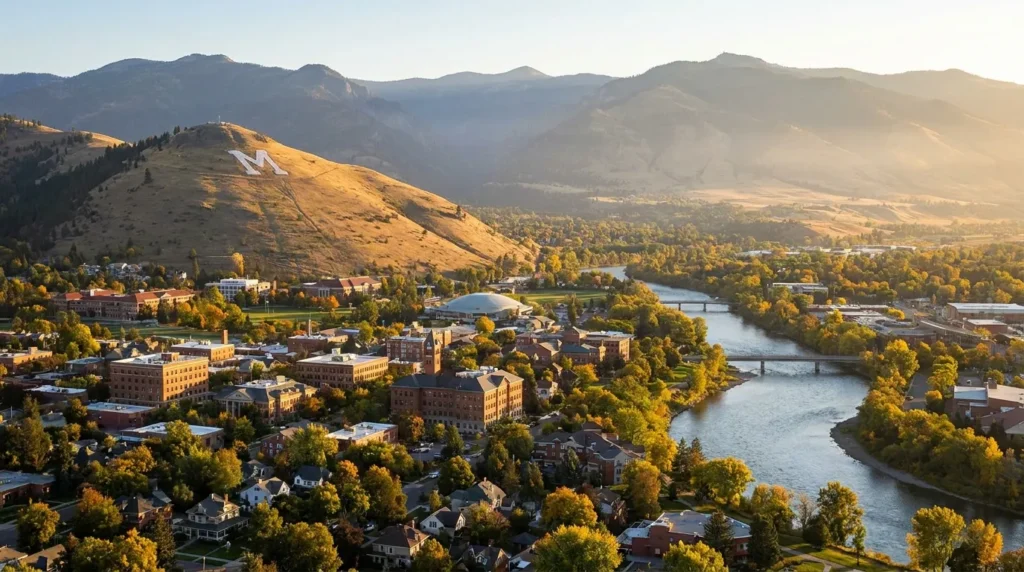
The University of Montana, with its M-shaped mountain rising behind campus, drives cultural life. The Clark Fork River cuts through downtown, with Caras Park on one bank and Brennan's Wave, an artificial surf wave, beneath the Madison Street Bridge. The Missoula Art Museum and the Montana Museum of Art and Culture are both free admission.

Downtown along Higgins Avenue concentrates bookstores (Fact and Fiction, Shakespeare and Co.), the Wilma Theatre, and the Top Hat. The Saturday Market and the Clark Fork River Market are seasonal must-visits. The Smokejumper Visitor Center, located at an aerial firefighting base, is the only facility of its kind in the country.

For outdoor access, Mount Sentinel with the M Trail and Mount Jumbo sit within city limits. The Rattlesnake National Recreation Area begins 10 minutes away. Trout fishing on the Bitterroot and Blackfoot rivers draws visitors from across the country, and the Rocky Mountain Elk Foundation is headquartered here.

  1. 1["A Carousel for Missoula (hand-carved carousel)"
  2. 2"Missoula Art Museum"
  3. 3"Historical Museum at Fort Missoula"
  4. 4"Smokejumper Visitor Center"
  5. 5"Caras Park"
  6. 6"Mount Sentinel and the 'M' Trail"
Nightlife5.0 / 10
Parks & green spaces
  • ["Caras Park"
  • "Greenough Park"
  • "Mount Sentinel (trails)"
  • "Rattlesnake National Recreation Area"
  • "Kim Williams Nature Area"
  • +1 more

Latest posts

Posts about Montana

Coverage and updates related to this destination.

Showing content from Montana, as there is no specific data for Missoula yet.