Visto n' Visa
Blog
Notícias e artigos
Destinations
Careers
Immigrants

Want to live and work in Laurel?

Personalized immigration plan with eligible visas, costs, and next steps for your goal!

If you are not eligible, you will know exactly why and what to do to improve your approval chances.

Save up to 12 hours in meetings

No pointless assessments.

Save up to 90%

Save money on vague or unfocused consultations

Avoid Fraud and Mistakes

One mistake can cost you your visa

Total Impartiality

Zero commercial bias

Decide with peace of mind

No toxic urgency

Fast and Accurate

Answers in minutes, no guesswork

Who Lives in Laurel: Refinery Workers, Railroaders, and Retirees

Laurel has a predominantly white, working-class profile, with a strong presence of longtime families tied to the railroad and refinery, and a growing minority of Hispanics and Native Americans.

The population hovers at just over seven thousand, with an average age skewed upward by retirees who chose the city for its affordability. The majority are white, of German, Scandinavian, and Irish descent, a legacy of the waves who arrived with the railroad in the late 19th century. Families often have roots of three or four generations in the area.

The Hispanic community is growing slowly, driven by seasonal agricultural workers and jobs in the refinery and construction. There is also a Native American minority, primarily from the Crow and Northern Cheyenne peoples, whose reservations lie a few hours' drive away. Recent immigrants are still few in number and tend to settle first in Billings before considering Laurel.

Religiously, it is a traditional Christian city, with a Catholic parish, several Lutheran, Methodist, and Baptist churches, and an active Latter-day Saints community. Social life revolves largely around the church, Laurel High School, and events at the Fairgrounds, which serve as a gathering place for people of all ages.

Languages spoken
  • English
  • Spanish
  • Crow
  • German
Main religions
  • Christianity (Lutheran)
  • Christianity (Catholic)
  • Christianity (Methodist)
  • Christianity (Baptist)
  • The Church of Jesus Christ of Latter-day Saints (Mormons)
  • +1 more

Low Cost of Living by American Standards

Laurel offers one of the most affordable costs of living in the region, with rents well below Billings and moderate daily expenses, though groceries and gas weigh more due to the distance.

A working family's monthly budget can comfortably fit in Laurel, with two- or three-bedroom house rentals at prices that would be unthinkable in Billings. Those renting a simple apartment or a trailer in a residential park can save considerably, and homeownership is common among longtime residents.

Groceries and fuel are the heaviest expenses. The supermarket selection is limited, with one local Albertsons and a few convenience stores, so many residents do their major shopping in Billings at the Walmart or Costco on Interstate 90. Gas prices tend to run slightly below the national average, but the heavy car use offsets that.

Energy, water, and heating costs rise between November and March, when the cold strains the system. Restaurants and entertainment are inexpensive, with diners, barbecue, and neighborhood bars costing far less than urban chains. Overall, the average cost sits clearly below the United States average, attracting remote workers and retirees.

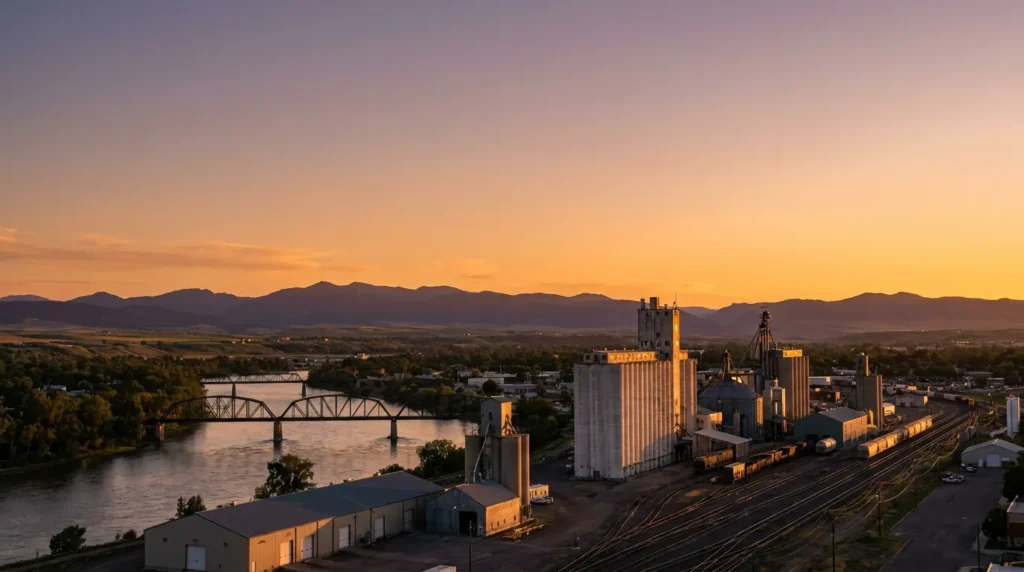
Laurel

Old Houses, Trailer Parks, and New Subdivisions to the East

The housing stock is dominated by postwar single-story wood-frame houses, spacious ranch homes, and mobile home parks, with new subdivisions emerging toward Billings.

Most of Laurel's homes are single-story ranch houses with two-car garages, large yards, and wood-frame construction, typical of rural Montana. Neighborhoods near Main Street feature older properties, some from the early 20th century, with porches and gabled roofs, many restored by longtime residents.

Several mobile home parks sit on the edges of the city, a common option for refinery workers and young families. The area to the east, closer to the highway toward Billings, has been receiving new subdivisions with larger homes and curved streets, targeting professionals who work elsewhere but want to escape big-city traffic.

Renting is harder than buying because the rental supply is small and moves quickly. Newcomers typically start with a month in a motel or Airbnb while searching, and local referrals are very helpful. Prices are still friendly but have been rising since Billings appeared on the American domestic migration radar.

Recommended neighborhoods
  • West Laurel
  • East Laurel near Riverside
  • Downtown near Main Street
  • New neighborhoods to the southeast

Refinery, Railroad, Agribusiness, and Jobs in Billings

The local market revolves around the CHS refinery, the Montana Rail Link railroad, agribusiness, and light industry, with many residents commuting daily to Billings.

The CHS refinery is the heart of the economy, processing crude oil from the Bakken basin and employing hundreds of workers, technicians, and engineers. Surrounding it are companies in industrial maintenance, fuel transport, and security services. The railroad still moves grain, coal, and containers, supporting jobs in the rail yard.

Agribusiness appears in sugar beet, barley, alfalfa, and livestock farms in the surrounding area, with seasonal jobs in harvest and storage. Construction is growing with Billings' expansion, and stable positions exist in public schools, the local hospital, and city government. Small businesses, repair shops, and farm equipment dealers round out the picture.

For those seeking careers in healthcare, higher education, technology, finance, or specialized retail, Billings is the natural destination, with a 25 to 40 minute commute via Interstate 90. English proficiency is practically mandatory, and technical skills in welding, mechanics, industrial electrical work, and CDL truck driving are in strong demand year-round.

Dominant sectors
  • Oil Refining
  • Railroad and Logistics
  • Agribusiness
  • Construction
  • Healthcare
  • +1 more
Major employers
  • CHS Inc. (refinery)
  • Montana Rail Link
  • Laurel Public Schools
  • Beartooth Billings Clinic
  • Western Sugar Cooperative
  • +1 more

Local Public Schools and Universities in Billings

Laurel has its own well-regarded public school system and easy access to two universities and a community college in Billings.

The Laurel Public Schools district operates early childhood, elementary, middle, and high school education at Laurel High School, known for its agriculture, vocational, and athletic programs. Class sizes are small, which helps immigrant children adjust, but English as a Second Language support is limited due to the size of the district. Catholic parochial school options are also available.

For higher education, the natural destination is Billings. Montana State University Billings offers undergraduate and graduate programs in education, health, business, and technology, along with online programs. Rocky Mountain College, a small private institution, is strong in aviation, biology, and environmental law. City College, part of the MSU Billings system, focuses on technical and vocational programs.

Short-term programs in welding, practical nursing, diesel mechanics, and CDL training are in high demand and offer quick pathways to the local job market. For children who speak another language at home, extracurricular English tutoring is often essential, as instruction is fully immersive and bilingual resources are limited.

Notable universities
  • Montana State University Billings (in Billings)
  • Rocky Mountain College (in Billings)
  • City College at MSU Billings (in Billings)

Local Clinic and Major Hospitals in Billings

Basic care is handled at Beartooth Billings Clinic within Laurel, and complex cases are referred to the major hospitals in Billings, the regional medical center.

Within Laurel, Beartooth Billings Clinic operates a health center with general practice, pediatrics, basic imaging, urgent care, and pharmacy services. It is sufficient for everyday needs, routine checkups, minor emergencies, and chronic disease management, and holds a good reputation among residents.

For more serious procedures, childbirth, surgery, and oncology, residents go to Billings, home to two major hospital systems: Billings Clinic and SCL Health St. Vincent. Both serve as regional references for all of southern Montana and northern Wyoming, with trauma units, transplant services, advanced cardiology, and specialized pediatrics. The drive from Laurel takes 25 to 35 minutes under normal conditions.

The American healthcare system requires private insurance, typically employer-based, or coverage through Medicaid and Medicare for those who qualify. Newly arrived immigrants should research insurance marketplaces and low-income subsidies, as costs rise quickly without coverage. Private dentists and optometrists are present in the city, but the selection is limited.

Laurel

A Quiet City, with Isolated Drug-Related Issues

Laurel is considered safe, with rare violent crimes, but contends with theft, vandalism, and the impact of methamphetamine and fentanyl affecting much of the rural American West.

Overall, Laurel is a safe city by American standards. Violent crimes such as homicide and armed robbery are rare and typically linked to personal disputes or drugs. The most common incidents are residential burglary, vehicle break-ins, school vandalism, and alcohol-related occurrences at bars and gatherings.

The major social challenge, as in nearly all of the rural American West, is methamphetamine, and more recently fentanyl, which strains local law enforcement, the healthcare system, and the courts. Domestic violence incidents are also a persistent concern and a constant focus of prevention campaigns. The Laurel Police Department operates with a community-oriented approach, maintaining direct contact between officers and residents.

Neighborhoods near Main Street and the new southeastern subdivisions are considered the quietest. Areas near the refinery, the rail yard, and some trailer parks on the outskirts see more minor theft incidents and should be evaluated carefully when renting. For newcomers, the practical advice is the same as anywhere in rural America: lock the car, keep valuables out of sight, and maintain good relations with neighbors.

Safer neighborhoods
  • West Laurel residential
  • New southeastern neighborhoods
  • Riverside Park area
  • Downtown near Main Street
Areas to avoid
  • Rail yard surroundings at night
  • Isolated trailer parks on the outskirts
  • Industrial areas south of the refinery after hours

A Car-Dependent City, with I-90 Nearby and the Airport in Billings

Laurel is entirely car-dependent, bisected by Interstate 90 and railroad lines, with commercial airport service in Billings and virtually no public transit.

A personal vehicle is essential in Laurel. Interstate 90 runs close to the city, quickly connecting Billings to the east and Park City and Big Timber to the west. US Route 212 heads south toward Red Lodge and the northeast entrance to Yellowstone National Park. Internal streets are flat and easy to navigate, with little congestion outside refinery shift changes.

Public transit within the city is virtually nonexistent, and Billings' MET system does not serve Laurel regularly. Van services and interstate bus routes pass along I-90, but these are geared toward long-distance travel. Cycling is feasible within the urban grid, but bike lanes are scarce and strong winds discourage it in winter.

Billings Logan International Airport, about 30 minutes by car, connects the area to hubs such as Denver, Salt Lake City, Seattle, Minneapolis, and Dallas. Those needing international flights typically connect through Denver. For freight and moving, the proximity of the railroad and the interstate highway makes cargo arrivals considerably easier.

Airports
  • BIL — Billings Logan International (in Billings, ~30 min)

Climate

Laurel

Small-Town Culture with a Montana Accent

Cultural life is family-oriented and outdoors-focused, marked by rodeos, high school games, a famous Fourth of July fireworks display, and a strong tradition of fishing and hunting.

Local culture is quintessential Montana interior: practical, outdoors-oriented, tied to the land and family. Laurel High School football games, featuring the Locomotives, fill the stadium on autumn Fridays and function as the city's main social event. Rodeos and competitions at the Yellowstone County Fairgrounds reinforce this Western identity.

The calendar revolves around summer. Laurel's Fourth of July is well known in the region for fireworks considered among the best in the state, drawing visitors from Billings and surrounding areas. Autumn brings harvest festivals, farmers markets, and deer and elk hunting season, an almost mandatory sport in these parts. In winter, life retreats to church, bowling alleys, and neighborhood bars.

The cuisine is simple and hearty, with local beef barbecue, counter-service burgers, heavy diner breakfasts, and craft beer from Billings-area microbreweries. Typical dishes include Montana Angus steak, baked potato, fry bread of Native American origin, and homemade pies at Main Street bakeries.

Notable dishes
  • Montana Angus steak
  • Native American fry bread
  • Huckleberry pie
  • Bison burger
  • Grilled Yellowstone River trout
  • +1 more
Annual events
  • Laurel 4th of July Fireworks
  • Yellowstone County Fair (in Billings, nearby)
  • Herbstfest in autumn
  • Laurel Locomotives Friday Night Football
  • Laurel Christmas Stroll

Riverside Parks, Fishing, and the Gateway to Yellowstone

Attractions are outdoors-focused: the Yellowstone River, municipal parks, the historic Chief Joseph Park, and easy access to Beartooth Pass and Yellowstone National Park.

Within the city, the heart of recreation is Riverside Park, along the Yellowstone River, with trails, picnic areas, and access for trout and walleye fishing. Thomson Park features playgrounds and sports courts and is where the Fourth of July fireworks take place. The small downtown has antique shops, local gift stores, and welcoming cafes.

The region's main attraction lies outside Laurel's city limits. A few hours' drive along the Beartooth Highway, considered one of the most scenic roads in the United States, leads to the northeast entrance of Yellowstone National Park, with geysers, bison, and bears. To the south, the town of Red Lodge offers a ski resort, restaurants, and a historic downtown.

Weekends often include fly fishing, kayaking on the Yellowstone, hiking in the Beartooth Mountains, hunting in season, and trips to Billings for shopping, movies, and minor league baseball games. For nature lovers, Laurel is an excellent, affordable, and strategically located base.

  1. 1Riverside Park on the Yellowstone River
  2. 2Thomson Park
  3. 3Chief Joseph Park
  4. 4Laurel historic Main Street
  5. 5Beartooth Highway (access)
  6. 6Yellowstone National Park northeast entrance (access)
Parks & green spaces
  • Riverside Park
  • Thomson Park
  • Chief Joseph Park
  • Fireman's Park
  • Canyon Creek Battleground (nearby)

Small, Dispersed Immigrant Population Tied to the Refinery and Agriculture

Laurel's immigrant population is modest, with Mexicans, Central Americans, Filipinos, and some Eastern Europeans drawn by work at the refinery, in agriculture, and in Billings healthcare.

Laurel does not have large or organized immigrant communities, unlike coastal American cities. Those who arrive typically come in pursuit of specific employment at the CHS refinery, regional farms, construction sites, or hospitals and clinics in Billings. The most visible presence is Mexican and Central American families, followed by Filipinos connected to nursing and a few Eastern European and South Asian families.

Direct immigrant support is stronger in Billings, with organizations such as Catholic Charities and Hispanic Ministry. In Laurel, the network runs through Catholic parishes, a few Spanish-language evangelical churches, and the limited bilingual program in public schools. Documentation, taxes, driving, and healthcare are typically handled with the help of these informal networks and immigration attorneys in Billings.

For immigrants considering Laurel, the picture is straightforward: a small community, slow integration, quiet and affordable life, but little visible cultural diversity in daily life. Those who arrive with secured employment, a vehicle, and some English tend to do well; those who depend on a strong ethnic community will miss it and generally prefer Billings as a base.

350
Foreign-born residents
estimated
Top countries of origin
  • Mexico
  • Philippines
  • Guatemala
  • Honduras
  • Germany
  • Canada
  • India
  • Ukraine
Foreign consulates
  • Mexican Consulate in Salt Lake City (jurisdiction)
  • Consulate General of Canada in Denver (jurisdiction)
  • Consulate General of Brazil in San Francisco (jurisdiction)
  • Philippine Consulate in Los Angeles (jurisdiction)
  • Consulate General of Germany in Denver (jurisdiction)
Community organizations
  • Catholic Charities of Eastern Montana
  • Hispanic Ministry (Diocese of Great Falls-Billings)
  • Montana Migrant and Seasonal Farmworker Council
  • Billings Adult Education ESL Program
  • St. Vincent de Paul Society Laurel

Latest posts

Posts about Montana

Coverage and updates related to this destination.

Showing content from Montana, as there is no specific data for Laurel yet.