Visto n' Visa
Blog
Notícias e artigos
Destinations
Careers
Immigrants

Want to live and work in Helena Valley Southeast?

Personalized immigration plan with eligible visas, costs, and next steps for your goal!

If you are not eligible, you will know exactly why and what to do to improve your approval chances.

Save up to 12 hours in meetings

No pointless assessments.

Save up to 90%

Save money on vague or unfocused consultations

Avoid Fraud and Mistakes

One mistake can cost you your visa

Total Impartiality

Zero commercial bias

Decide with peace of mind

No toxic urgency

Fast and Accurate

Answers in minutes, no guesswork

Small population, predominantly white and middle-class

Just over nine thousand residents, most born in the United States, with a strong presence of families working in Helena. Ethnic diversity is low, but small communities exist.

Helena Valley Southeast has approximately 9,300 residents, according to the most recent census. It is a small population spread across a large area, with low density. The majority is white, descended from Europeans who arrived in Montana in the 19th century alongside the region's gold and silver mining.

The Hispanic community is the largest minority, though modest in absolute numbers. There are also residents of Native American origin, reflecting the historical presence of peoples such as the Salish, Kootenai, and Blackfeet in Montana. Recent immigrants are few; most arrive through federal or state employment transfers.

The age profile is balanced, with families raising school-age children and a growing share of retirees who choose the valley for its tranquility. English is nearly universal, and services in other languages are rare outside of Helena. Religiously, Protestantism in various denominations and the Catholic Church predominate.

Languages spoken
  • English
  • Spanish
  • German
Main religions
  • Protestantism
  • Catholicism
  • Mormons (LDS)
  • No religion

Moderate cost of living by American standards, with high energy costs in winter

Housing is below the national average but rising. Food and fuel are at levels typical of the rural West. Heating in winter weighs heavily on household budgets.

The cost of living in Helena Valley Southeast is considered moderate by American standards. Housing remains below the average of large western cities, though prices have risen in recent years with an influx of people from California and Colorado seeking space.

Grocery stores, restaurants, and services are located in Helena, with prices similar to those of other mid-sized western capitals. Fuel tends to be slightly above the national average, since everything requires a car. Montana has no state sales tax, which helps with day-to-day expenses, but property taxes weigh on those with larger homes.

The biggest budget challenge is heating. Montana winters are severe, and natural gas or propane bills rise significantly between November and March. Those arriving from warmer regions should budget carefully for the first winter, including home insulation, snow tires, and appropriate cold-weather clothing.

Helena Valley Southeast

Large homes on spacious lots, with mountain views

Single-family homes on half-acre or larger lots predominate. Rentals are scarce, with most residents being homeowners. New construction remains strong in the area.

The real estate market in Helena Valley Southeast is heavily dominated by single-family homes on large lots, many with direct views of the Big Belt Mountains. Neighborhoods such as North Hills, Forest Park, and areas along York Road offer the classic valley style: one- or two-story homes, two-car garages, large yards, and often space for a horse or small livestock.

Rentals are rare. Most residents are homeowners, and those arriving should consider buying or renting in Helena proper until a suitable property is found in the valley. Prices have risen in recent years but remain below markets such as Bozeman or Missoula. New home construction continues, primarily near US-12.

Recent immigrants typically start by renting in Helena and move to the valley later, once they have a better understanding of the geography, roads, and winters. Access to services, distance to schools, and road performance under snow are all worth evaluating before committing to a home far from town.

Recommended neighborhoods
  • North Hills
  • Forest Park
  • York Road corridor
  • Canyon Ferry Road
  • East Helena (neighboring)

Jobs come from Helena: state government, healthcare, and construction

Helena Valley Southeast serves as a bedroom community for Helena. Real opportunities lie in state government, hospitals, schools, and small industry. Remote work has grown since 2020.

Helena Valley Southeast itself has little economic activity of its own. Professional life takes place in Helena, a few minutes by car, where the region's largest employer is located: the Montana state government, with agencies, departments, and the state legislature.

Beyond the public sector, the main employers are the St. Peter's Health system, Helena Public Schools, retail, and construction, the latter very active with the valley's residential expansion. Small independent businesses such as auto shops, farms, and landscaping services also employ part of the community.

For immigrants, two scenarios are worth distinguishing: skilled professionals in healthcare, engineering, and IT can pursue positions in state government or at St. Peter's; operational work is available in construction, services, and area ranches. Remote work has grown since 2020 and has attracted technology professionals who maintain jobs in Seattle, Denver, or San Francisco.

Dominant sectors
  • State government
  • Healthcare
  • Public education
  • Construction
  • Retail trade
  • +1 more
Major employers
  • State of Montana
  • St. Peter's Health
  • Helena Public Schools
  • Carroll College
  • Costco Helena

Helena public schools and a nearby Catholic university

Valley children attend Helena Public Schools, with solid K-12 options. Higher education is in Helena, with Carroll College and Helena College of the University of Montana.

Families in Helena Valley Southeast send their children to the Helena Public Schools district, with schools such as Capital High School, Helena High School, and several elementary schools throughout the valley, including Four Georgians Elementary. The system is considered solid by Montana standards, with strong results in math and reading.

For higher education, the closest option is Carroll College, a well-regarded private Catholic university, particularly strong in pre-medicine, engineering, and nursing. Helena College, part of the University of Montana system, offers technical programs, certificates, and two-year degrees at significantly lower cost.

For larger research universities, local students typically travel to Montana State University in Bozeman or the University of Montana in Missoula, both a few hours away. Immigrants who need to validate degrees or learn English have access to ESL and community education courses at Helena College.

Notable universities
  • Carroll College
  • Helena College (University of Montana system)
  • Montana State University (in Bozeman)
  • University of Montana (in Missoula)

Regional hospital in Helena serves the entire valley and surrounding areas

St. Peter's Health is the main hospital, with an emergency department, maternity services, and multiple specialties. Complex cases are referred to Missoula, Bozeman, or Salt Lake City.

The healthcare system for Helena Valley Southeast centers on St. Peter's Health, a nonprofit regional hospital in Helena with a 24-hour emergency department, maternity services, a cancer center, and multiple specialties. It is the area's largest healthcare employer and serves all of central Montana.

For primary care, clinics are distributed throughout Helena, affiliated with both St. Peter's and smaller networks such as PureView Health Center, which serves lower-income populations. Access to specialists is reasonable, but highly specific cases such as transplants or rare surgeries are typically referred to Missoula, Bozeman, Spokane, or Salt Lake City.

Immigrants should arrange health insurance from day one. Without coverage, a single emergency room visit can result in a bill of thousands of dollars. Those working for state government or St. Peter's have access to solid employer plans. Self-employed individuals typically purchase coverage through the Affordable Care Act marketplace.

Healthcare index62.0 / 100
  • Life expectancyyears at birth
    78.4yrs
  • Doctors per 1kpracticing physicians
    3.7
  • Health spendper capita, per year
    $13,473
  • Public systemoverall quality rating
    Good

Quiet community, with low crime rates and a focus on road safety

Helena Valley Southeast is considered safe, with crime rates well below the national average. The main concerns are winter road accidents and wildlife on rural roads.

Helena Valley Southeast is a quiet community with crime rates well below the American urban average. Violent crime is rare; what occurs most frequently involves minor theft, occasional vandalism, and drug-related incidents, all at modest levels. Neighbors know one another, homes are often left unlocked, and children ride bikes freely.

Policing is shared between the Lewis and Clark County Sheriff's Office and the Montana Highway Patrol on state roads. Response times can be longer than in urban areas, simply because of the distances involved. Volunteer firefighters handle most calls for house fires and grass fires.

The real risks come more from nature than from crime: accidents on icy roads in winter, deer collisions (very common at dawn and dusk), and occasional bears or mountain lions near rural properties. Those arriving from urban areas should learn to drive in snow, keep an emergency kit in the car, and respect local wildlife.

5.8
Homicides per 100k
per year
Safety index
72.0
Crime index
28.0
Safer neighborhoods
  • Residential areas along Canyon Ferry Road
  • Suburban East Helena
  • Neighborhoods near Lake Helena
  • Areas near York Road
Areas to avoid
  • Isolated stretches of rural roads at night
  • Areas near former industrial smelting sites in East Helena

Everything by car, with Helena Regional Airport a few minutes away

There is no meaningful public transportation. Nearly all residents depend on personal vehicles. Helena Regional Airport connects to Denver, Salt Lake City, Seattle, and Minneapolis via regional flights.

In Helena Valley Southeast, a car is not a luxury; it is a prerequisite. The area has virtually no continuous sidewalks, no regular bus service, and long distances between neighbors, schools, and stores. Residents drive for everything, including the 5 to 15 minutes to downtown Helena.

The main routes are US-12 and Custer Avenue, both with direct access to the capital's downtown. Heading north, York Road leads to Hauser Lake reservoir; heading east, it connects to East Helena and then Townsend. In winter, snow tires are essential, and drivers should be comfortable handling icy and snow-packed roads.

Helena Regional Airport is just a few minutes away and offers daily flights to Denver, Salt Lake City, Seattle, and Minneapolis, operated by United, Delta, and Alaska Airlines. International flights always require a connection. For cheaper fares, many residents drive to Bozeman Yellowstone International Airport, about two and a half hours away.

20 min
Avg commute
18
Walkability
Airports
  • HLN — Helena Regional Airport

What the climate is like in Helena Valley Southeast

Helena Valley Southeast has a continental semi-arid climate, with cold, dry winters, hot and short summers, and clear skies for most of the year.

Winters are cold and dry, with lows frequently ranging from -12 to -5 degrees Celsius. Snowfall is light, and the dry air makes the cold less biting than in humid regions.

Summers are hot, sunny, and short, with highs between 28 and 31 degrees Celsius in July and nights dropping below 12 degrees. Low humidity keeps the heat comfortable.

Residents need home heating, a heavy coat, and winter tires. Air conditioning is useful for a few months, and rural living makes a car an essential.

Sunny days / year215 days
Avg high (°F)
  • 38°J
  • 44°F
  • 56°M
  • 71°A
  • 76°M
  • 84°J
  • 91°J
  • 90°A
  • 87°S
  • 72°O
  • 57°N
  • 45°D
Avg low (°F)
  • -10°J
  • -17°F
  • -2°M
  • 12°A
  • 23°M
  • 33°J
  • 42°J
  • 42°A
  • 29°S
  • O
  • N
  • -5°D
Rainfall (")
  • 1"J
  • 2"F
  • 1"M
  • 2"A
  • 3"M
  • 3"J
  • 1"J
  • 2"A
  • 2"S
  • 2"O
  • 1"N
  • 1"D

Practical western culture, tied to mountains, fishing, and hunting

Outdoor life is the center of local identity: fishing, hunting, hiking, skiing at Great Divide. A small community, with churches, regional rodeos, and the ranching culture of the American West.

Valley life revolves around nature. Families organize around fishing at Canyon Ferry Lake and the Missouri River, fall hunting, camping, and hiking in the surrounding mountains. In winter, Great Divide Ski Area, about 40 minutes away, draws local skiers. It is a practical, rural western culture with a strong connection to the land.

Social events take place in Helena: the Last Chance Stampede and Fair (annual rodeo in July), Symphony Under the Stars, Alive at Five in the historic downtown, and farmer's markets in summer. The capital has quality museums such as the Montana Historical Society and the Holter Museum of Art, along with small theaters.

Immigrant communities are small, and social life tends to revolve around churches, schools, and clubs tied to outdoor activities. For those coming from large cities, the pace is slower: neighbors wave hello, the grocery store serves as a social hub, and nearly everyone knows someone who knows someone.

Helena Valley Southeast

Helena Valley Southeast is a rural-residential corridor between Helena and East Helena

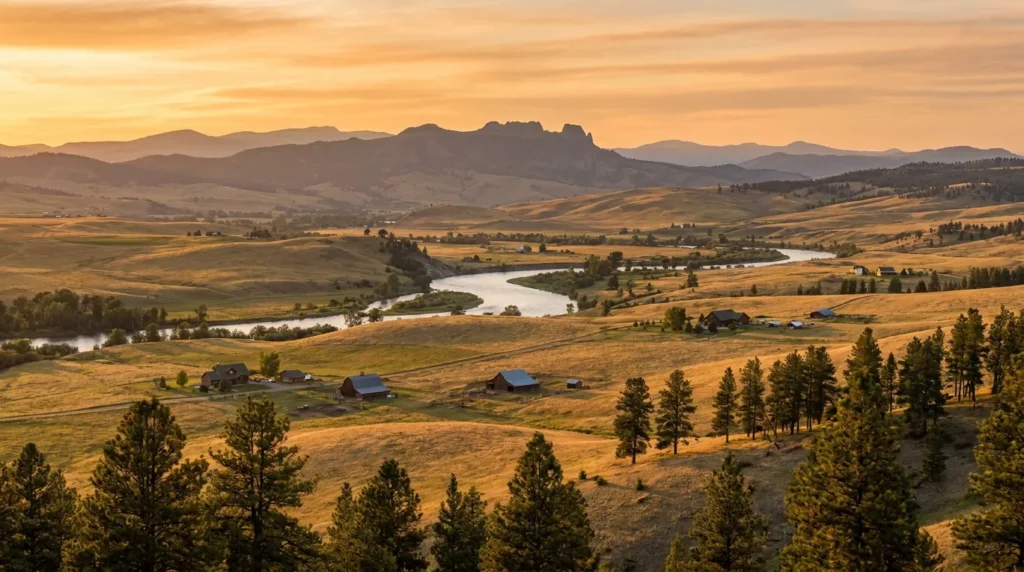
A census-designated place east of Helena, Montana's capital, Helena Valley Southeast combines homes on large lots, views of the Big Belt Mountains, and easy access to Last Chance Gulch and Spring Meadow Lake.

Helena Valley Southeast is a census-designated place in Lewis and Clark County, made up of subdivisions east of the capital, Helena, and west of East Helena. The landscape consists of high prairie with views of the Big Belt Mountains and Mount Helena, and daily life centers on Helena, just minutes away via US-12 and MT-518.

The main attractions are in Helena: the Montana State Capitol, with its copper dome; the Cathedral of Saint Helena, an early-20th-century Gothic structure; Last Chance Gulch, the historic gold rush pedestrian mall; and the Holter Museum of Art. Carroll College, a Catholic institution, and Helena College are about fifteen minutes away.

For outdoor recreation, Spring Meadow Lake State Park in Helena serves as the main urban lake. Mount Helena City Park offers mountain biking trails. Farther out, the Gates of the Mountains Wilderness along the Missouri River features boat tours through limestone walls first described by Lewis and Clark in 1805. Canyon Ferry Lake to the east is a popular destination for fishing and boating.

  1. 1["Canyon Ferry Lake"
  2. 2"Spring Meadow Lake State Park"
  3. 3"Mount Helena City Park"
  4. 4"Montana State Capitol (in Helena)"
  5. 5"Cathedral of Saint Helena"
  6. 6"Last Chance Gulch (Helena's historic district)"
Nightlife2.0 / 10
Parks & green spaces
  • ["Spring Meadow Lake State Park"
  • "Mount Helena City Park"
  • "Centennial Park"
  • "Lake Helena Wildlife Management Area"
  • "Canyon Ferry Recreation Area"]

Latest posts

Posts about Montana

Coverage and updates related to this destination.

Showing content from Montana, as there is no specific data for Helena Valley Southeast yet.