Visto n' Visa
Blog
Notícias e artigos
Destinations
Careers
Immigrants

Want to live and work in Helena?

Personalized immigration plan with eligible visas, costs, and next steps for your goal!

If you are not eligible, you will know exactly why and what to do to improve your approval chances.

Save up to 12 hours in meetings

No pointless assessments.

Save up to 90%

Save money on vague or unfocused consultations

Avoid Fraud and Mistakes

One mistake can cost you your visa

Total Impartiality

Zero commercial bias

Decide with peace of mind

No toxic urgency

Fast and Accurate

Answers in minutes, no guesswork

Who lives in Helena: government workers, professionals, and families

Helena is predominantly white, with small Latino, Asian, and Native American communities. The professional profile is elevated due to state government employment, law, and healthcare. Young families and retirees are also a strong presence.

Helena's demographics reflect its administrative character. State government workers make up a significant share of the adult population, alongside lawyers, accountants, lobbyists, healthcare professionals, and teachers. The average educational level is high by state standards, with a solid percentage of residents holding a bachelor's degree or higher.

The majority of the population is white, with German, Irish, Scandinavian, and Eastern European heritage. Hispanic, Asian, and Native American communities are small but present. Young families with children choose Helena for its schools, cost of living, and safety. Retirees appreciate the small-city atmosphere and proximity to nature and healthcare services.

For immigrants, Helena is more homogeneous than Missoula and Bozeman, but offers an educated and professionally welcoming environment. Churches, community programs, and schools contribute to integration. The skilled job market in law, accounting, healthcare, education, and technology opens doors for those with advanced English proficiency.

Languages spoken
  • English
  • Spanish
  • Mandarin
  • German
  • Salish
Main religions
  • Catholicism
  • Protestant Christianity (Lutherans, Methodists, Presbyterians)
  • LDS Church (Mormons)
  • No declared religion
  • Native American religions

Cost of living in Helena: moderate, more affordable than Bozeman

Helena has a moderate cost of living by Montana standards, below Bozeman and Missoula but above Great Falls and Butte. Housing is balanced, and the absence of a state sales tax helps with everyday expenses.

The cost of living in Helena falls at an intermediate level within the state. Property prices have risen in recent years with an influx of remote workers, but remain below Bozeman and even Missoula. Apartment rents fit professional salaries without significant strain.

Montana does not charge a state sales tax, which is a positive factor for everyday purchases. Grocery stores such as Albertsons, Safeway, Costco, and several smaller natural food shops cover the basics. Restaurants have median prices; organic food and artisan cafes cost more. Property taxes are moderate by American standards.

Heating in winter adds up, especially in older homes in the Mansion District or at higher elevations. Electricity is stable and gas prices follow the state average. Healthcare, as throughout the US, is a recurring significant expense. For immigrants, Helena offers a balance between affordability and reasonable quality of life on a smaller scale.

Helena

Housing in Helena: historic homes, quiet neighborhoods, and new developments

The housing stock combines historic homes in the Mansion District, traditional residential neighborhoods, and newer developments to the west. Purchasing is viable on professional salaries; maintenance on older homes requires planning.

The Mansion District, with homes in Queen Anne, Victorian, and Tudor styles, is the historic heart of Helena's residential areas. For those seeking architectural character, it is the most sought-after neighborhood, but it requires significant upkeep. Neighborhoods near Carroll College and Last Chance Gulch combine homes from the 1950s and 1960s with established infrastructure.

To the west, toward the Helena Valley area, newer developments have emerged with larger family homes and townhouses. Modern apartments are growing near York Road and in complexes in the renovated downtown. For immigrants in the early stages of settling, renting before buying is the most common strategy, with leases requiring proof of income and references.

Purchasing property in Helena is more accessible than in Bozeman, but requires approved financing and attention to HOAs in newer developments. Pre-purchase inspections are essential in historic homes, particularly for the roof, foundation, plumbing, insulation, and windows. Local banks such as Stockman Bank and First Interstate finance buyers with solid credit.

Recommended neighborhoods
  • Mansion District
  • South Helena
  • West Side
  • Helena Valley
  • Downtown / Last Chance Gulch
  • +1 more

Work in Helena: state government, healthcare, and professional services

The economic engine is state government, with thousands of public sector jobs. Healthcare, law, accounting, and education round out the picture. The market is stable but less diversified than in Bozeman or Missoula.

The State of Montana is Helena's largest employer, with thousands of civil servants across various departments, agencies, and the state supreme court. Positions range from administrative and technical to legal, environmental, and managerial. For bilingual professionals with university degrees, openings arise through civil service processes and ongoing hiring throughout the year.

St. Peter's Health and Shodair Children's Hospital, focused on mental and pediatric health, are major healthcare employers. Law firms, accounting offices, lobbying, and consulting operations proliferate due to the city's capital status. NorthWestern Energy, Helena Sand and Gravel, and smaller technology companies also figure among local employers.

For immigrants with backgrounds in healthcare, law, accounting, IT, and education, Helena offers stable niches. Construction, hospitality, and services hire year-round. Advanced English is generally required for formal positions, especially in government. Credential validation is a critical step in regulated professions such as law and medicine.

Dominant sectors
  • State government
  • Healthcare
  • Legal and accounting services
  • Education
  • Construction
  • +1 more
Major employers
  • State of Montana
  • St. Peter's Health
  • Shodair Children's Hospital
  • Helena Public Schools
  • NorthWestern Energy
  • +3 more

Education in Helena: a solid public school district and Carroll College as a regional reference

Helena Public Schools maintains well-rated schools, with Helena High School and Capital High as the main options. Catholic private schools are available. Carroll College is a private Catholic institution and a regional reference in healthcare and the humanities.

Helena Public Schools serves the city with Helena High School and Capital High School as its main secondary schools. Advanced programs, sports, music, and ESL classes for immigrant students operate consistently. Families relocate to the city in part because of public school quality, considered among the best in the state.

The private sector includes Helena Catholic Schools, with programs from kindergarten through high school. Several independent Christian schools and Montessori cooperatives are also present. For young children, private, public, and church-affiliated preschool programs and daycare centers are available, as well as pre-K programs offered through the school district.

Carroll College, a private Catholic institution, is the centerpiece of local higher education. Programs in nursing, pre-medicine, biology, civil engineering, and theology are well regarded nationally. Helena College, part of the University of Montana system, offers accessible technical programs and associate degrees. For medical professions, training programs are available through St. Peter's Health.

Notable universities
  • Carroll College
  • Helena College University of Montana

Healthcare in Helena: two hospitals serve the city and the region

Helena has St. Peter's Health, a general hospital, and Shodair Children's Hospital, focused on mental and pediatric health. For highly complex cases, patients are typically referred to Missoula, Bozeman, or Salt Lake City.

St. Peter's Health is Helena's main hospital, with a 24-hour emergency room, surgery, maternity, oncology, cardiology, and orthopedics. Associated clinics throughout the city cover primary care, women's health, and pediatrics. Shodair Children's Hospital is the statewide reference for child and adolescent mental health.

As throughout the US, healthcare is private and insurance-based. Large employers such as the State of Montana, hospitals, Carroll College, and technology companies provide coverage for employees. Self-employed workers and newcomers can explore options on HealthCare.gov or through insurers such as Blue Cross Blue Shield of Montana, headquartered in Helena, and PacificSource.

For immigrants in the early stages of settling, the Cooperative Health Center offers care on a sliding payment scale, aimed at low-income families and uninsured residents. Pharmacies such as Walgreens, CVS, and Albertsons handle prescriptions. Interpreters can be requested at major hospitals, particularly for Spanish.

Healthcare index65.0 / 100
  • Life expectancyyears at birth
    78.4yrs
  • Doctors per 1kpracticing physicians
    3.7
  • Health spendper capita, per year
    $13,473
  • Public systemoverall quality rating
    Good

Safety in Helena: among the safest state capitals in the US

Helena is considered one of the safest state capitals in the United States. Violent crime is rare and petty theft predominates. The main real risks are wildfires and snowstorms in winter.

By American standards, Helena is one of the safest state capitals. Violent crime is infrequent, and property crime occurs at modest levels. Vehicle break-ins and occasional burglaries are the most common incidents. Local law enforcement maintains a good relationship with the community.

Residential neighborhoods tend to be quiet, with attentive neighbors and well-lit streets. Downtown attracts slightly more nighttime activity, but at low levels compared to larger cities. Standard precautions common in American cities address most everyday concerns for immigrants.

The main risk in Helena is environmental. Wildfires in July and August significantly affect air quality and can close nearby mountain areas. Snowstorms can briefly close roads in winter. Wildlife, including deer, elk, and bears, requires caution on trails and in neighborhoods close to natural areas. A family emergency plan makes a real difference.

5.8
Homicides per 100k
per year
Safety index
64.0
Crime index
36.0
Safer neighborhoods
  • Historic downtown (Last Chance Gulch)
  • West Side
  • Mansion District
  • Helena Valley
  • South Hills
  • Carroll College area
Areas to avoid
  • Isolated stretches of N Last Chance Gulch at night
  • Industrial areas near I-15 after peak hours

Getting around Helena: car-centric, with a walkable core and modest bus service

Helena combines a walkable historic downtown with the need for a car elsewhere. Capital Transit provides modest urban routes, and the regional airport serves limited domestic flights. Interstate 15 connects the city north and south.

Downtown and Last Chance Gulch are walkable, with wide sidewalks, restaurants, shops, and government offices in close proximity. For the rest of the city, a car is practically essential. The distances between home, work, school, and grocery stores typically require daily driving, especially in winter.

Capital Transit operates modest urban routes connecting downtown, the hospital, Carroll College, and some residential areas. Frequency is limited and the system functions more as a supplement. Cycling is feasible on flat stretches in summer, with some bike lanes and urban trails. In winter, snow and ice limit its use.

Interstate 15 runs through Helena on a north-south axis, connecting to Great Falls to the north and Butte and Bozeman to the south. Helena Regional Airport offers limited flights, generally to Salt Lake City, Seattle, and Minneapolis. For more flight options, many residents drive to Bozeman, which has a considerably busier airport. Rideshare services operate with reasonable coverage downtown and in main neighborhoods.

15 min
Avg commute
42
Walkability
Airports
  • HLN — Helena Regional Airport
  • Bike infrastructure

What the Climate Is Like Living in Helena

Helena has a semi-arid continental climate, with cold and dry winters, short and hot summers, and partial mountain shelter that reduces rainfall and snowfall compared to other parts of Montana.

Winters are cold and dry, with lows frequently ranging between -12 and -5 degrees Celsius. Snowfall occurs but in lower volumes than in other Montana regions, due to the rain shadow effect of the surrounding mountains.

Summer is warm, sunny, and dry, with highs between 28 and 31 degrees Celsius in July and cool nights that drop below 12 degrees. Brief afternoon thunderstorms are common in late summer.

Residents need heating systems, heavy coats, and winter tires. Air conditioning helps in July and August, but low humidity makes the heat less oppressive than in plains regions.

Sunny days / year215 days
Avg high (°F)
  • 38°J
  • 44°F
  • 56°M
  • 71°A
  • 76°M
  • 84°J
  • 91°J
  • 90°A
  • 87°S
  • 72°O
  • 57°N
  • 45°D
Avg low (°F)
  • -10°J
  • -17°F
  • -2°M
  • 12°A
  • 23°M
  • 33°J
  • 42°J
  • 42°A
  • 29°S
  • O
  • N
  • -5°D
Rainfall (")
  • 1"J
  • 2"F
  • 1"M
  • 2"A
  • 3"M
  • 3"J
  • 1"J
  • 2"A
  • 2"S
  • 2"O
  • 1"N
  • 1"D

Cultural life in Helena: history, opera, and a growing dining scene

Helena has a varied cultural scene for its size. The historic State Capitol, museums, opera, jazz festivals, and craft breweries fill the calendar. Downtown has undergone a culinary revival in recent years.

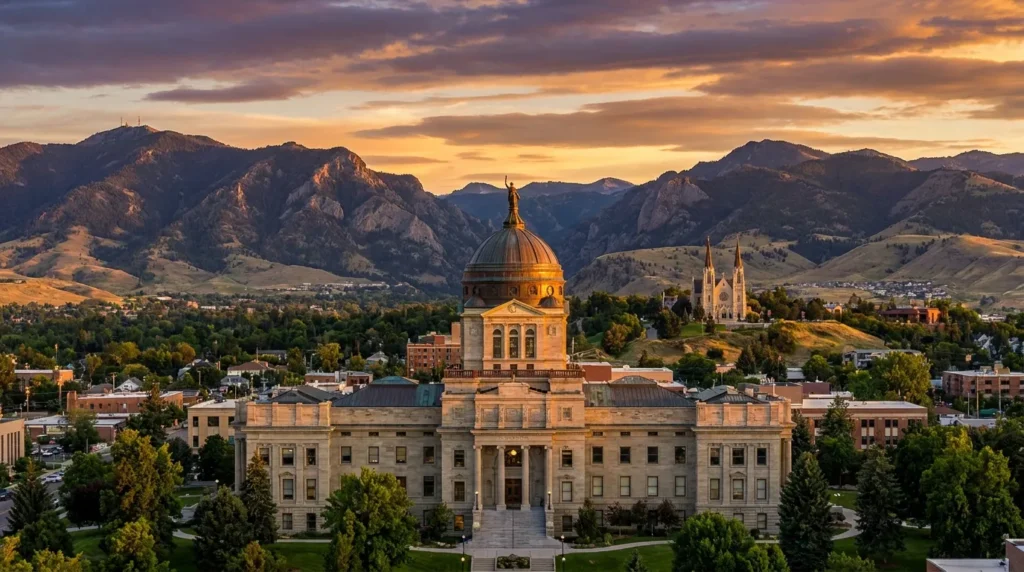
The Montana State Capitol, with its copper dome and historic murals, is a must-visit for any newcomer. St. Helena Cathedral, in Gothic style, and the Original Governor's Mansion complete the historic circuit. The Holter Museum of Art and the Myrna Loy Theater enrich the arts scene with exhibitions, independent cinema, and performances.

Festivals such as the Symphony Under the Stars, the Last Chance Stampede and Fair, and the Helena Jazz Festival animate the city throughout the year. Breweries such as Lewis and Clark Brewing, Blackfoot River Brewing, and 10 Mile Creek Brewing are growing in the downtown area. Restaurants such as Lucca's, Karmadillos (homestyle Mexican cuisine), and several Asian options round out the dining scene.

For immigrants, churches, community organizations, and clubs connected to Carroll College serve as social hubs. The smaller scale facilitates integration, and the cultural life, more active than in other small state capitals, offers a reasonable variety of events. Outdoor sports, hiking, skiing, and fishing fill the social calendar on weekends.

Helena

What to See in Helena, Montana's Historic Capital

Helena was born from the Gold Rush in 1864 as Last Chance Gulch. Today it is Montana's state capital, featuring Victorian architecture built by wealthy miners, surrounding mountains, and a strong arts scene.

Last Chance Gulch is the main street and part of the original gold vein discovered in 1864. It concentrates restaurants, cafes, the Parrot Confectionery (established 1922), and the Holter Museum of Art. The Montana State Capitol, topped with a copper dome, and the Original Governor's Mansion preserve the state's political history. The Cathedral of Saint Helena, in neo-Gothic style, was inspired by the Cologne Cathedral.

The Montana Historical Society Museum holds the largest collection of Charles M. Russell artwork and the history of Montana's First Nations peoples. Reeder's Alley, a restored historic mining neighborhood, and the Pioneer Cabin, a frontier home from 1864, illustrate life on the frontier. Carroll College, a Catholic institution, anchors the local student scene. Mount Helena, just outside the city, offers hiking trails and the Devil's Kitchen Cave.

Helena National Forest surrounds the city, with Mount Ascension, Mount Helena, and the Continental Divide Trail all nearby. Spring Meadow Lake State Park provides swimming and canoeing. The Last Chance Tour Train operates in summer. Daily life in this small capital of about 33,000 residents revolves around state government workers, healthcare professionals at St. Peter's Health, and a mountain climate that can bring snow as late as May.

  1. 1["Montana State Capitol"
  2. 2"Cathedral of Saint Helena"
  3. 3"Last Chance Gulch (historic street)"
  4. 4"Montana Historical Society Museum"
  5. 5"Holter Museum of Art"
  6. 6"Reeder's Alley"
Nightlife3.0 / 10
Parks & green spaces
  • ["Mount Helena City Park"
  • "Spring Meadow Lake State Park"
  • "Memorial Park"
  • "Centennial Park"
  • "Hill Park"
  • +1 more

Latest posts

Posts about Montana

Coverage and updates related to this destination.

Showing content from Montana, as there is no specific data for Helena yet.