Visto n' Visa
Blog
Notícias e artigos
Destinations
Careers
Immigrants

Want to live and work in Havre?

Personalized immigration plan with eligible visas, costs, and next steps for your goal!

If you are not eligible, you will know exactly why and what to do to improve your approval chances.

Save up to 12 hours in meetings

No pointless assessments.

Save up to 90%

Save money on vague or unfocused consultations

Avoid Fraud and Mistakes

One mistake can cost you your visa

Total Impartiality

Zero commercial bias

Decide with peace of mind

No toxic urgency

Fast and Accurate

Answers in minutes, no guesswork

Who lives in Havre: a small community with Indigenous and rural roots

About 9,000 residents, with a strong presence of Chippewa Cree Indigenous families, descendants of European settlers, and a growing minority of Latin American workers.

Havre has around 9,000 residents in the city and about 16,000 across Hill County, with very low population density. Most of the population is white, descended from German, Scandinavian, and Eastern European immigrants who settled the region in the late 19th century, drawn by land grants from the Homestead Act.

Indigenous presence is central to local identity. The Rocky Boy Chippewa Cree Reservation is 30 minutes south, and many Indigenous residents live or study in Havre, especially at Montana State University-Northern. There is also a Métis population and descendants of the Assiniboine Nation. These groups make up somewhere between 10% and 15% of city residents.

English is the dominant language. Spanish appears in farmworker families, and Cree is still spoken in more traditional Indigenous community households. The age distribution is balanced, with the university campus bringing in young adults who typically leave town after graduating.

Languages spoken
  • English
  • Spanish
  • Cree
  • German (heritage)
Main religions
  • Catholicism
  • Lutheranism
  • Indigenous spirituality (Native American Church)
  • Methodism
  • Non-denominational Evangelicals
Cost of living in Havre: one of the lowest in the American West

Rent, groceries, and energy well below the U.S. average; what weighs is the distance to larger services and fuel cost on long trips.

Havre is one of the cheapest cities in the western United States to live in. A one-bedroom apartment goes for figures well below what one pays in Bozeman or Missoula, and three-bedroom family homes still appear at prices that would be unthinkable in any mid-sized city in the country. Supply is limited, so the search requires patience, but those who find a place usually buy rather than rent.

Groceries, restaurants, and basic services follow the pattern of small Plains towns: simple, cheap, without much gourmet variety. The electric bill is reasonable in summer and higher in winter due to heating, usually with natural gas or propane. NorthWestern Energy serves most homes.

The hidden cost is transportation. For specialty medical services, larger shopping trips, or international flights, residents must drive to Great Falls (180 km) or fly via a regional airport. Anyone living in Havre needs a car and a budget for gasoline and maintenance.

Havre

Where to live in Havre: quiet neighborhoods and affordable homeownership

Most of the residential stock consists of older single-family homes with yards; apartments are few, concentrated near the university and downtown.

The dominant model in Havre is the single-family wood-frame house, generally built between the 1940s and 1970s, with a basement, garage, and yard. The most sought-after neighborhoods are south of Highway 2, on tree-lined residential streets such as those near Pepin Park and the 5th Avenue area, where the neighborhood is older and more established.

Renters find modest options near Montana State University-Northern and downtown, in small two- or three-story buildings. Supply is limited and turns over quickly, so it is worth contacting local real estate agencies such as Triple Dot Realty or monitoring community Facebook groups. Rooms in family homes and roommate arrangements are common among students.

For families with children, the south-side neighborhoods, near Havre High School and Sunnyside Elementary, are the most sought-after. The north side of town, near the railroad, tends to be cheaper but has more industrial traffic.

Recommended neighborhoods
  • South Havre (near Pepin Park)
  • 5th Avenue area
  • Sunnyside
  • Historic downtown (1st Street)
  • Near MSU-Northern

Job market in Havre: railroad, healthcare, education, and agriculture

Formal jobs are concentrated in BNSF Railway, Northern Montana Hospital, the university, and public services; family farming and seasonal contracts round out the picture.

BNSF Railway is the largest private employer in Havre. The local railroad complex maintains maintenance shops, switching yards, and train crews, with wages above the city average and union benefits. Openings usually require specific certifications and are posted through the BNSF corporate site.

Northern Montana Hospital is another pillar, employing doctors, nurses, and technicians to serve the Hi-Line region. Montana State University-Northern provides academic and administrative positions. Hill County government, the school system, and the regional Border Patrol base are also stable employers.

Beyond these sectors, there is work on the region's wheat and cattle ranches, retail on 1st Street, restaurants, and gas stations. Average wages are modest but match the low cost of living well. Skilled openings in technology, finance, or advanced industry are rare.

Dominant sectors
  • Rail transport
  • Healthcare
  • Higher education
  • Grain agriculture
  • Retail trade
  • +1 more
Major employers
  • BNSF Railway
  • Northern Montana Hospital
  • Montana State University-Northern
  • Havre Public Schools
  • U.S. Border Patrol
  • +2 more

Education in Havre: a solid public system and a regional technical university

The Havre Public Schools district serves kindergarten through high school; Montana State University-Northern and Stone Child College (on the reservation) provide higher education.

Havre's public network is the right size for the city: Havre High School, two elementary schools (Sunnyside and Highland Park), and a middle school. Class sizes are small, teachers know students by name, and school sports, especially football and basketball, are a central part of social life.

For higher education, Montana State University-Northern stands out. It offers degrees in diesel technology, agriculture, nursing, education, and business administration, with a strong vocational focus. It is one of the few universities in the U.S. with a recognized program in heavy diesel, attracting students from other regions. Tuition is affordable compared to coastal universities.

On the Rocky Boy Reservation, Stone Child College offers two-year programs focused on Chippewa Cree culture, nursing, and environmental studies. For graduate work or more specialized courses, most students move on to Bozeman, Missoula, or out of state.

Notable universities
  • Montana State University-Northern
  • Stone Child College (Rocky Boy Reservation)

Healthcare in Havre: a regional hospital covers the Hi-Line

Northern Montana Hospital is the region's reference medical center; complex specialties require travel to Great Falls or Billings.

Northern Montana Hospital, with about 25 beds, is the heart of the local health system. It handles emergencies, deliveries, general surgeries, orthopedics, and offers outpatient services. The hospital is affiliated with the Billings Clinic network, which enables telemedicine consultations with specialists and quicker transfers when needed.

For primary care, there is Bullhook Community Health Center, a community health center with income-based sliding fees, and several small private clinics. Dentists, physical therapists, and mental health clinics exist, but supply is limited and waiting lists can be long. The Rocky Boy Reservation has the Rocky Boy Health Center, managed by the Indian Health Service.

For complex treatments such as oncology, interventional cardiology, or neurosurgery, travel is required to Great Falls (180 km), Billings (390 km), or even Spokane (crossing toward the Pacific). Health insurance is practically mandatory, and many rural plans cover medical transport.

Havre

Safety in Havre: a quiet city with small areas of caution

Violent crime is low; petty theft and methamphetamine-related issues appear in some spots; a safe city for daytime walks.

Havre is considered a safe city by American standards. Violent crime is rare, neighbors know each other, and the municipal police work closely with the community. Walking along 1st Street or through residential neighborhoods by day or at night is usually peaceful, and residents often leave cars and homes unlocked, a practice worth rethinking for anyone arriving from larger cities.

Existing problems follow the patterns of small, isolated towns in the American West: petty theft from garages, some cases related to methamphetamine use, and domestic disputes. Industrial areas near the railroad on the north side and some dark streets far from downtown deserve more attention at night, but they are not considered dangerous in the urban sense.

The presence of state highway patrol and the regional U.S. Border Patrol office reinforces the sense of policing. In emergencies, response time is quick given the city's size, and the hospital is less than 10 minutes from any point.

Safer neighborhoods
  • South Havre (residential)
  • Pepin Park area
  • Neighborhoods near MSU-Northern
  • 5th Avenue
Areas to avoid
  • Industrial areas north of the railroad (at night)
  • Isolated parking lots on the eastern outskirts

Getting around Havre: a car is required, Amtrak connects the Hi-Line

A car-oriented city, with the Amtrak Empire Builder stopping downtown, a small regional airport, and highway access via US-2.

Havre was built around the railroad, but in daily life a car is essential. The city is compact and flat, so internal travel is quick, without traffic. Parking is abundant and free almost everywhere. There is no regular urban bus system, only transportation services for seniors and students.

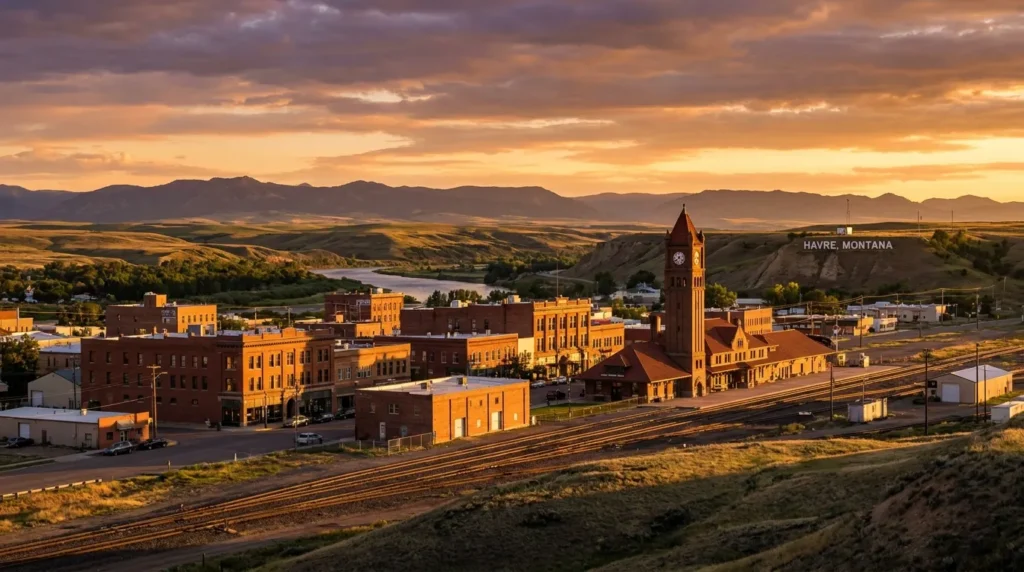
The Amtrak Empire Builder, which links Chicago to Seattle, stops daily at the historic BNSF station in downtown Havre, offering connections to Whitefish, Spokane, and east to Minneapolis. It is the most romantic and inexpensive way to reach the city from afar. US-2 cuts through Havre from east to west, and US-87 heads south to Great Falls.

Havre City-County Airport (HVR) has limited commercial flights via Cape Air connecting to Billings. For larger flights, most drivers head to Great Falls International Airport (GTF). To the north, the Wild Horse port of entry with Canada is an hour's drive away.

Airports
  • HVR, Havre City-County Airport
  • GTF, Great Falls International (180 km)

Climate

Havre

Havre's culture: railroad, rodeo, and Plains heritage

Cultural identity blends cowboy tradition, Chippewa Cree Indigenous heritage, and the Great Northern Railway's history, with museums, fairs, and festivals throughout the year.

Cultural life in Havre revolves around strong markers of local history: the railroad, the agricultural frontier, and Indigenous presence. The H. Earl Clack Museum holds artifacts from the Great Northern Railway and from the prehistory of the Plains, including the Wahkpa Chu'gn archaeological site, a 2,000-year-old bison butchering ground discovered literally beneath the city.

The Great Northern Fair, in August, is the event of the year: rodeo, agricultural exhibit, country shows, and fireworks. There is also Festival Days at the end of summer, with a parade, street food, and musical acts. The Rocky Boy Reservation holds the Rocky Boy Powwow in early August, one of the largest in northern Montana, open to visitors.

Cuisine follows the American Plains pattern: steak, potatoes, black coffee, homemade pies. Places like Wolfer's Diner, Murphy's Pub, and Triple Dog Brewing Company are traditional gathering spots. Local craft beer has grown with Triple Dog in recent years.

Notable dishes
  • Montana Angus steak
  • Huckleberry pie
  • Bison burger
  • Frybread (Indigenous fried bread)
  • Grilled trout
  • +1 more
Annual events
  • Great Northern Fair (August)
  • Havre Festival Days (September)
  • Rocky Boy Powwow (August)
  • Holiday Stroll (December)
  • St. Jude Marathon

What to see in Havre: prehistoric bison, museums, and wide open nature

Attractions combine archaeology, railroad history, and Hi-Line landscapes, with easy access to the Rocky Boy Reservation and the Bear Paw Mountains.

The highlight of Havre is the Wahkpa Chu'gn archaeological site, a bison butchering ground used for 2,000 years by Plains peoples, with guided tours that descend along trails to the excavated layers. Another icon is Havre Beneath the Streets, a tour of underground tunnels from the era when part of the city's commerce operated below street level after a fire in 1904.

The H. Earl Clack Museum, at the fairgrounds, brings together local history and the Great Northern Railway museum, next to the Amtrak station. For those who enjoy nature, the Bear Paw Mountains to the south offer trails, fishing, and camping at Beaver Creek Park, considered the largest county park in the United States.

The Rocky Boy Chippewa Cree Reservation opens some areas to visitors, especially during the annual powwow. For more remote experiences, Fresno Reservoir, to the west, is a popular destination for boating, walleye fishing, and summer picnics.

  1. 1Wahkpa Chu'gn Buffalo Jump
  2. 2Havre Beneath the Streets
  3. 3H. Earl Clack Memorial Museum
  4. 4Beaver Creek Park (Bear Paw Mountains)
  5. 5Great Northern Railway Depot
  6. 6Fort Assinniboine Historic Site
Parks & green spaces
  • Pepin Park
  • Beaver Creek Park
  • Lions Park
  • Fresno Reservoir
  • Bear Paw Mountains (recreation area)

Immigrant communities in Havre: small but present

Immigration is numerically modest, with a historic European presence and current flows of Latin American workers and international students at the university.

Havre is not a traditional immigration destination in the United States. The foreign-born population is small, around 2% to 3% of residents, reflecting the rural reality of northern Montana. Even so, there is a consistent presence of Mexican and Central American families working on farms, in restaurants, and in service jobs, along with smaller communities of Canadians crossing the border for family or professional reasons.

Montana State University-Northern hosts international students in its diesel, agriculture, and nursing programs, primarily from African countries, Southeast Asia, and Latin America. They form a small but active cultural nucleus on campus. American war veterans with families formed abroad also contribute to local diversity.

Resources for immigrants are limited by the city's scale. Most rely on Catholic religious services, the Bullhook public health network, and statewide organizations such as the Montana Immigrant Justice Alliance, headquartered in Missoula. For consular services, the trip is to Calgary (Canada), Denver, or Seattle, depending on the country.

250
Foreign-born residents
estimated
Top countries of origin
  • Mexico
  • Canada
  • Guatemala
  • Philippines
  • Ethiopia
  • Honduras
Foreign consulates
  • Consulate General of Mexico in Calgary (jurisdiction)
  • Consulate General of Canada in Great Falls (consular agency)
  • Consulate General of the Philippines in Calgary (jurisdiction)
Community organizations
  • Bullhook Community Health Center
  • Catholic Charities of Eastern Montana
  • Montana Immigrant Justice Alliance (regional)
  • MSU-Northern International Student Services
  • St. Jude Parish (community support)

Latest posts

Posts about Montana

Coverage and updates related to this destination.

Showing content from Montana, as there is no specific data for Havre yet.