Visto n' Visa
Blog
Notícias e artigos
Destinations
Careers
Immigrants

Want to live and work in Great Falls?

Personalized immigration plan with eligible visas, costs, and next steps for your goal!

If you are not eligible, you will know exactly why and what to do to improve your approval chances.

Save up to 12 hours in meetings

No pointless assessments.

Save up to 90%

Save money on vague or unfocused consultations

Avoid Fraud and Mistakes

One mistake can cost you your visa

Total Impartiality

Zero commercial bias

Decide with peace of mind

No toxic urgency

Fast and Accurate

Answers in minutes, no guesswork

Who lives in Great Falls: military families, farmers, and regional professionals

Great Falls is predominantly white, with a significant Native American community and a growing Latino presence. Military families from Malmstrom Air Force Base bring some diversity from various regions across the United States.

Local demographics rest on three main pillars. First, the traditional white community, descended from early-20th-century European immigration, particularly German, Irish, Scandinavian, and Italian. Second, the Native American community, especially Blackfeet, Chippewa Cree, and descendants of several other nations, with a strong presence in schools and community organizations.

Third, military families connected to Malmstrom, who rotate through the city every few years. This turnover brings regional diversity, with people from Texas, Georgia, California, and the South. The Hispanic community has grown in recent decades, linked to agribusiness, construction, and services, and there is a small Asian community, primarily Filipino.

For newly arrived immigrants, it is worth understanding that Great Falls is more conservative and religious than Missoula, and less diverse than Billings. Churches, schools, and the military base are important social hubs. English programs exist in schools and some churches, but the options are fewer than in university cities.

Languages spoken
  • English
  • Spanish
  • Blackfeet
  • Cree
  • Tagalog
Main religions
  • Catholicism
  • Protestant Christianity (Lutherans, Methodists)
  • LDS Church (Mormons)
  • Native American religions
  • No declared religion

Cost of living in Great Falls: among the lowest in Montana

Great Falls is one of the most affordable cities in Montana. Housing is inexpensive by American standards, and the absence of a state sales tax eases everyday expenses. Average wages, however, are also modest.

Great Falls is considered the most affordable among Montana's larger cities. Median home prices are well below Bozeman and Missoula, and two-bedroom apartment rents fit within median salaries. For immigrants coming from expensive cities, the relief is immediate.

Montana does not impose a state sales tax, which makes purchasing food, clothing, and consumer goods easier. Markets such as Albertsons, Smith's, Walmart, and Costco compete on price, and small Latino and Asian grocery stores are scattered throughout the city. Property taxes are moderate by American standards.

Heating costs in winter can be substantial, especially in older homes. Electricity is reliable and gasoline tends to be cheaper than in western Montana. Healthcare, as throughout the United States, is a significant expense to plan for. Wages, however, are generally lower than in larger cities, and that must factor into any budget calculation.

91Cost index (US = 100)9% below US average
CategorySingleCoupleFamily (2 + 2)
iHousing$1,181$1,362$1,725
iFood$345$690$1,253
iTransport$454$772$999
iHealthcare$254$509$953
iChildcare$1,653
iOther$772$1,389$1,953
Monthly total$3,006$4,722$8,536

Source: U.S. BLS Consumer Expenditure Survey 2023 + BEA Regional Price Parities 2023 · Estimates in USD, monthly.

Housing in Great Falls: spacious homes, historic neighborhoods, and reasonable supply

The housing stock includes historic homes downtown, postwar bungalows, and newer subdivisions to the west. Buying is feasible on average salaries; rentals are plentiful. Maintenance in older homes requires attention to heating systems.

Great Falls has distinct neighborhoods. The historic downtown, near Central Avenue, features craftsman and Victorian-style homes. To the west, in Riverview, newer subdivisions offer spacious homes with yards. Skyline and the area near the College of Great Falls have mid-range prices and established infrastructure.

For immigrants in the early stages of settling, renting an apartment near 10th Avenue South or in newer complexes on the west side is the most common approach. Leases are generally twelve months and require proof of income and a US credit history. Houses for rent are also available, especially for larger families.

Buying property is more accessible than in most of the western United States. Local banks such as Stockman Bank and First Interstate finance buyers with good credit. Special attention is warranted for heating systems, insulation, roofing, and foundations in older homes, as winters put considerable strain on structures and repair costs can be substantial.

Recommended neighborhoods
  • Riverview
  • Skyline
  • West Great Falls
  • Downtown / Central Avenue
  • Sun Prairie
  • +1 more

Work in Great Falls: military, healthcare, agriculture, and services

The local economy centers on the air base, regional hospitals, agriculture, and retail. The market is stable but offers fewer openings in technology or the creative industries. Technical professionals and healthcare workers are well placed.

Malmstrom Air Force Base, home to intercontinental missiles and thousands of military and civilian personnel, is a central economic pillar. Civilian positions are available in maintenance, logistics, contracts, and support services. Military families also sustain local commerce, schools, and the real estate market.

Benefis Health System hospitals dominate the healthcare sector, with openings for physicians, nurses, technicians, and administrators. Calumet Refinery, ADF, Pasta Montana, ADM, agricultural operations, and grain cooperatives round out the economic base. Commerce along 10th Avenue South and in shopping centers such as Holiday Village concentrates retail and restaurant employment.

For immigrants with technical training in mechanics, industrial refrigeration, welding, and maintenance, good opportunities exist. Healthcare demands nurses, physical therapists, and physicians with validated credentials. Construction and agriculture employ workers year-round. Intermediate English is necessary for formal positions, and fluency significantly aids advancement.

Dominant sectors
  • Defense and military
  • Healthcare
  • Agriculture and agribusiness
  • Refining and energy
  • Commerce and services
  • +1 more
Major employers
  • Malmstrom Air Force Base
  • Benefis Health System
  • Great Falls Public Schools
  • Calumet Refinery
  • ADF International
  • +4 more

Education in Great Falls: large public schools and modest higher education

Great Falls Public Schools serves the city with large schools and varied programs, including ESL. Catholic and other private schools are available. Higher education is represented by the University of Providence and Great Falls College MSU.

Great Falls Public Schools maintains two main high schools, C.M. Russell High School and Great Falls High School, both with advanced programs, sports, and extracurricular activities. For immigrants, English as a second language programs are available, especially in schools with greater diversity. Younger children attend dozens of elementary schools distributed throughout the city.

The private sector includes Great Falls Catholic Schools, with elementary schools and Great Falls Central Catholic High School. Several independent Christian schools also operate in the area. Military families tend to use both public and private schools, depending on religious affiliation and location.

In higher education, the University of Providence is a private Catholic college offering programs in healthcare, education, and business. Great Falls College Montana State University, a public community college, provides accessible technical programs and associate degrees. For medical professions, Benefis offers training programs and local residencies.

Notable universities
  • University of Providence
  • Great Falls College Montana State University

Healthcare in Great Falls: Benefis Health System concentrates regional care

Great Falls is a regional healthcare hub for north-central Montana. The Benefis Health System provides emergency care, complex specialties, and maternity services. The system is private and requires American health insurance.

Benefis Health System is the dominant local healthcare institution, with a main hospital, cancer center, cardiology, orthopedics, maternity, and pediatrics. Patients from north-central Montana, the Hi-Line, and even parts of southern Alberta rely on the system. Medical specialists are concentrated around the Benefis campus on 26th Street.

As throughout the United States, healthcare is private and insurance-based. Large employers such as Benefis, Malmstrom, and the school district offer coverage to employees. Self-employed individuals and newcomers can explore options on HealthCare.gov or through insurers such as Blue Cross Blue Shield of Montana and PacificSource. Out-of-pocket costs without insurance are prohibitive.

For immigrants in the early stages of settling, Alluvion Health offers care on a sliding payment scale, aimed at low-income families and residents without insurance. Pharmacies such as Walgreens, CVS, and Albertsons fill prescriptions. Interpreters can be requested at major hospitals, though support for less common languages is more limited than in larger cities.

Healthcare index62.0 / 100
  • Life expectancyyears at birth
    78.4yrs
  • Doctors per 1kpracticing physicians
    3.7
  • Health spendper capita, per year
    $13,473
  • Public systemoverall quality rating
    Good

Safety in Great Falls: moderate rates, standard mid-size city precautions

Great Falls has crime rates around the average for American cities of its size. Property crimes are more common than violent ones. Downtown areas and some commercial zones warrant attention at night.

Crime rates in Great Falls fall near the average for mid-size American cities. Theft, vehicle break-ins, and minor offenses predominate. Violent crimes occur at low but present levels, especially in some central areas and near downtown during late-night hours.

Neighborhoods such as Riverview, Skyline, and most of the west side are typically quiet. The Lower South Side and some areas near Central Avenue call for greater awareness. The presence of the military base and local police keeps most of the city safe for everyday life.

For immigrants, standard American precautions apply: avoid leaving valuables visible in vehicles, keep doors locked, use GPS navigation, and stay alert in unfamiliar areas at night. Winter snowstorms and occasional summer tornadoes are environmental risks to consider. A family emergency plan and property insurance make a meaningful difference in critical situations.

5.8
Homicides per 100k
per year
Safety index
52.0
Crime index
48.0
Safer neighborhoods
  • Riverview
  • West Side
  • Charles M. Russell area
  • Skyline
  • Highwood
  • Historic downtown (Downtown Great Falls)
Areas to avoid
  • Parts of downtown at night, outside of events
  • Areas near 10th Avenue South with poor lighting
  • Industrial sectors along the Missouri River

Getting around Great Falls: cars are essential, buses exist but are limited

Great Falls is a typical American city: spread out, built around cars, with a few urban bus lines running infrequently. The regional airport serves domestic flights, and US-87 and I-15 connect to the interstate network.

Anyone relocating to Great Falls needs a car. Distances between home, school, work, and grocery stores typically require daily driving. Streets are wide, parking is abundant, and traffic rarely becomes a problem. In winter, snow and ice require appropriate tires and extra precautions.

The Great Falls Transit District operates urban bus lines with limited frequency and hours, especially in the evenings and on weekends. It functions as a supplementary network, not a complete solution. Cycling is viable on flat stretches in summer, and trails run along the Missouri River, including the River's Edge Trail.

US-87 and I-15 connect Great Falls to Helena, Billings, Bozeman, and north toward Alberta, Canada. Great Falls International Airport offers direct flights to Denver, Minneapolis, Salt Lake City, Seattle, and Phoenix, among others. Uber and Lyft operate with reasonable coverage, best during business hours.

16 min
Avg commute
38
Walkability
Airports
  • GTF - Great Falls International Airport
  • International airport
  • Bike infrastructure

What the climate is like living in Great Falls

Great Falls has a semi-arid continental climate, with cold winters, hot dry summers, and the famous chinook winds that bring sudden warmth on frigid days.

Winters are cold and dry, with lows that frequently drop below -10 degrees Celsius. Warm winds known as chinooks descend from the Rockies and can push temperatures up by 20 degrees within hours, melting snow in the process.

Summer is hot, sunny, and dry, with highs between 28 and 31 degrees Celsius in July, low humidity, and comfortable nights. Late-afternoon thunderstorms occur but tend to be brief.

Residents need adequate heating, layered clothing, windproof outerwear, and winter tires. Air conditioning helps during the summer peak, and the low humidity calls for consistent attention to skin hydration.

Sunny days / year215 days
Avg high (°F)
  • 39°J
  • 31°F
  • 44°M
  • 54°A
  • 65°M
  • 76°J
  • 86°J
  • 86°A
  • 76°S
  • 57°O
  • 45°N
  • 38°D
Avg low (°F)
  • 24°J
  • 15°F
  • 24°M
  • 33°A
  • 43°M
  • 53°J
  • 60°J
  • 60°A
  • 52°S
  • 38°O
  • 30°N
  • 24°D
Rainfall (")
  • 1"J
  • 1"F
  • 1"M
  • 2"A
  • 2"M
  • 3"J
  • 0"J
  • 1"A
  • 1"S
  • 2"O
  • 1"N
  • 1"D

Cultural life in Great Falls: Western history, Russell's art, and military tradition

Local culture combines Western heritage, the art of Charles M. Russell, military identity, and agricultural traditions. The scene is smaller than Missoula's, but museums, festivals, small ethnic restaurants, and a downtown nightlife are present.

The C.M. Russell Museum, dedicated to cowboy painter Charles M. Russell, is one of Montana's best-known cultural institutions. The Lewis and Clark Interpretive Center chronicles the 1805 expedition. In March, Western Art Week brings galleries, auctions, and events throughout the city, drawing a national audience.

Local restaurants include traditional steakhouses, pizza, Chinese, Mexican, and some Ethiopian and Thai options that have appeared in recent years. Craft breweries such as Mighty Mo Brewing and The Front Brewing Company enliven the downtown area. The State Fair, in July, features rodeo, country music shows, and fair food.

For immigrants, churches and community centers are important social gathering points. The Hispanic community holds Spanish-language Masses, and the military base brings together families from many backgrounds at events open to the public. The scale is small-town, but organized social life and integration opportunities through schools and children's activities are available.

Great Falls

Montana's Missouri River city, home to five waterfalls, Lewis and Clark history, and Old West art

Montana's third-largest city, where Lewis and Clark made their famous portage; home to the C.M. Russell Museum and the Lewis and Clark National Historic Trail Interpretive Center.

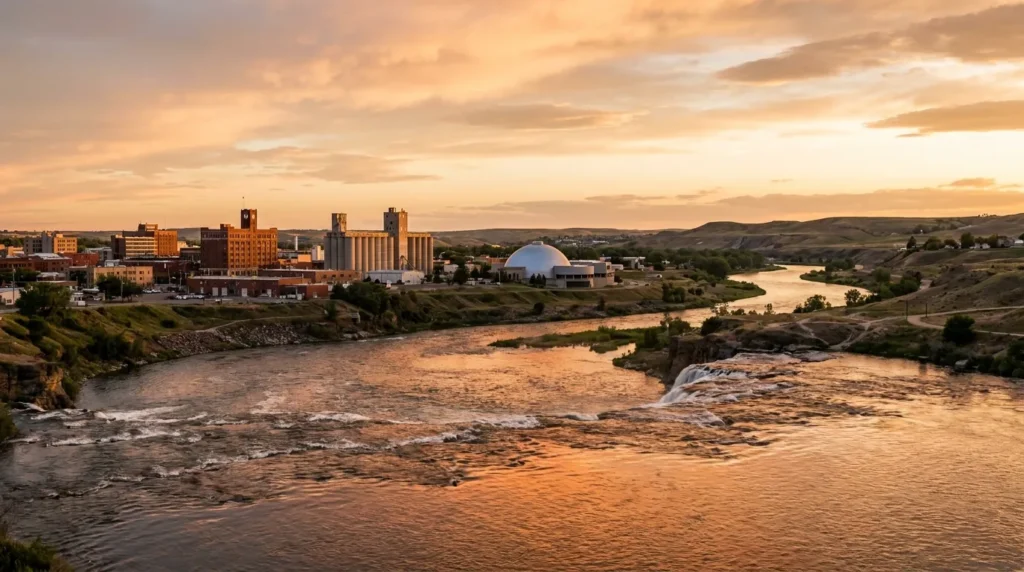
Great Falls takes its name from the five waterfalls on the Missouri River that forced the Lewis and Clark Expedition into a lengthy portage in 1805. The Lewis and Clark National Historic Trail Interpretive Center, perched on a bluff overlooking the river, tells that story in detail and is the city's most-visited cultural landmark. The River's Edge Trail stretches more than 60 miles along the river, passing all five falls.

The C.M. Russell Museum is dedicated to painter Charles M. Russell, who lived in Great Falls and captured the Old West of Montana with unmatched skill. The complex includes the artist's original studio and home. The Paris Gibson Square Museum of Art and the History Museum cover additional cultural layers.

Malmstrom Air Force Base, home to intercontinental ballistic missiles, plays a significant role in the city's economy and identity. For outdoor recreation, Giant Springs State Park, one of the largest natural springs in the United States, sits within city limits, and First Peoples Buffalo Jump State Park, about 25 minutes away, preserves a cliff where Native Americans hunted bison.

  1. 1["C.M. Russell Museum"
  2. 2"Lewis and Clark National Historic Trail Interpretive Center"
  3. 3"Giant Springs State Park"
  4. 4"Great Falls of the Missouri River"
  5. 5"The History Museum"
  6. 6"Children's Museum of Montana"
Nightlife3.0 / 10
Parks & green spaces
  • ["Giant Springs State Park"
  • "River's Edge Trail (over 60 miles)"
  • "Gibson Park"
  • "Black Eagle Falls"
  • "Sunnyside Park"
  • +1 more

Latest posts

Posts about Montana

Coverage and updates related to this destination.

Showing content from Montana, as there is no specific data for Great Falls yet.