Visto n' Visa
Blog
Notícias e artigos
Destinations
Careers
Immigrants

Want to live and work in Butte?

Personalized immigration plan with eligible visas, costs, and next steps for your goal!

If you are not eligible, you will know exactly why and what to do to improve your approval chances.

Save up to 12 hours in meetings

No pointless assessments.

Save up to 90%

Save money on vague or unfocused consultations

Avoid Fraud and Mistakes

One mistake can cost you your visa

Total Impartiality

Zero commercial bias

Decide with peace of mind

No toxic urgency

Fast and Accurate

Answers in minutes, no guesswork

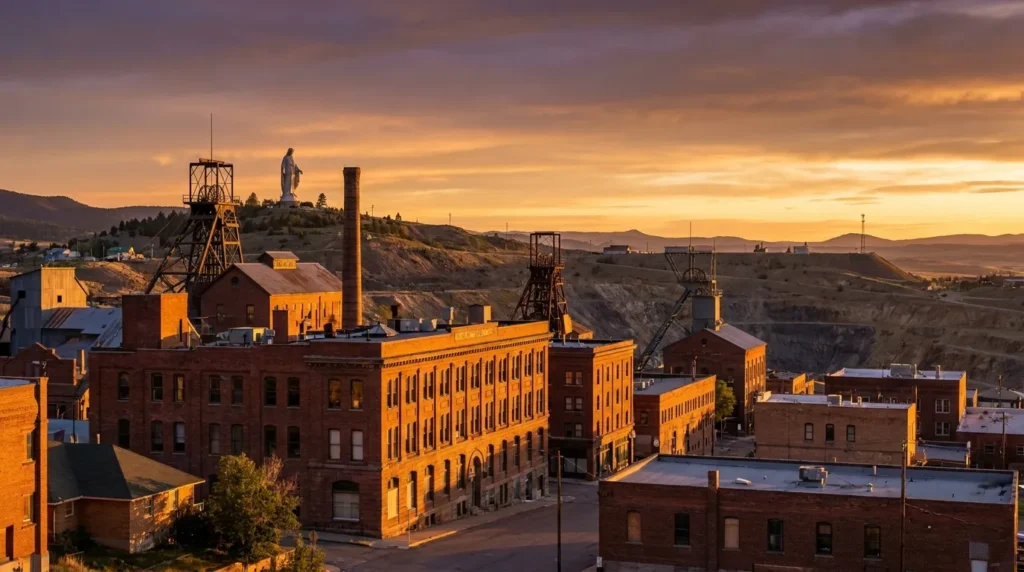
Who Lives in Butte: Descendants of Miners, Professionals, and Students

Butte is predominantly white, with strong Irish and Eastern European ancestry rooted in the mining era. There is a small Hispanic community, a modest Native American presence, and students from Montana Tech.

The demographic profile reflects a century of European immigration tied to mining. Irish, Italian, Serbian, Croatian, Finnish, Cornish, and Chinese workers established their own neighborhoods at the city's peak, and their descendants maintain cultural traditions still visible today. St. Patrick's Day is taken seriously, with the most well-known celebration in Montana.

The majority of the population is white, with a small Hispanic community and a Native American presence connected to nearby tribes. Students at Montana Tech, a university specializing in engineering and mining, bring some age and international diversity, with students coming from several countries to study engineering.

For immigrants, Butte offers a traditional, working-class, and Catholic environment with strong community ties, but less visible diversity than Missoula or Bozeman. Catholic, Orthodox, and Lutheran churches play a central role in social life. Integration tends to happen through work, schools, and connections with Montana Tech.

Languages spoken
  • English
  • Spanish
  • Serbian
  • Italian
  • Irish (vestiges)
Main religions
  • Catholicism
  • Protestant Christianity
  • Serbian Orthodox Christianity
  • No declared religion
  • Native American religions

Cost of Living in Butte: Among the Lowest in Montana

Butte is one of the most affordable cities in Montana, with housing prices well below Bozeman, Missoula, and Helena. Food and services fall below the national average, though winter heating adds up.

Butte is considered one of the most affordable places to live in Montana. The median home price is well below half of what is paid in Bozeman, and apartment rents fit comfortably within median wages. Remote workers and Montana Tech students benefit from this contrast with the state's more sought-after cities.

Montana does not charge a state sales tax, which eases everyday purchases. Grocery stores such as Albertsons, Walmart, Smith's, and several smaller chains cover the basics. Local restaurants are priced well below those in college towns. Property tax is moderate, depending on property value.

The major expense in winter is heating. Older homes, very common in Butte, require proper maintenance and insulation. Gas prices tend to be average; electricity is stable. Healthcare, as throughout the United States, is the most financially sensitive recurring expense, particularly for self-employed individuals without subsidized coverage.

Butte

Housing in Butte: Affordable Historic Homes and Traditional Neighborhoods

The housing stock includes historic homes in Uptown, bungalows in traditional neighborhoods, and few new developments. Purchasing is feasible on median wages; maintenance of older homes and efficient heating are critical considerations.

Uptown Butte, the city's historic upper section, features Victorian-style homes and brick buildings from the mining peak. Many of these structures require significant renovation but offer charm and affordable pricing. The Flats, the newer lower section, contains traditional residential neighborhoods with homes from the 1950s and 1960s.

For immigrants, renting before buying is the most common approach. Modest apartments are scattered throughout the city, with some newer options near Continental Drive. Leases generally require proof of income and references, though the market is less competitive than in Bozeman.

Buying a home in Butte is more accessible than in most of Montana. Local banks and credit unions finance buyers with good credit. A pre-purchase inspection is essential for older homes, particularly for the roof, foundation, plumbing, and insulation. Environmental risks related to historic mining, though monitored, merit attention in some neighborhoods near former industrial sites.

Recommended neighborhoods
  • Uptown Butte
  • The Flats
  • Centerville
  • Walkerville
  • South Side
  • +1 more

Work in Butte: Mining, Healthcare, Technical Education, and Transportation

The local economy combines active mining (reduced from its historic peak), healthcare, renewable energy, transportation, and technical education. Montana Resources operates the active mine, and Montana Tech is a central piece of the professional ecosystem.

Montana Resources maintains active mining operations for copper, molybdenum, and silver in Butte, with technical and operational workforce needs. NorthWestern Energy, involved in transmission and clean energy, is a major employer. The Federal Highway Administration maintains a national technical center in the city, focused on pavement research and infrastructure.

Healthcare also carries significant weight. St. James Healthcare is the main hospital, with an emergency room, medical specialties, and associated clinics. Montana Tech, a university specializing in engineering, mining, and the sciences, employs hundreds and hosts research laboratories connected to local companies.

For immigrants with technical backgrounds in engineering, mining, geology, industrial chemistry, and information technology, Butte offers interesting niches. Construction, transportation, and services hire year-round. Intermediate English is required for formal positions; fluency helps with advancement and mobility between companies.

Dominant sectors
  • Mining
  • Healthcare
  • Energy
  • Technical Education and Research
  • Transportation and Logistics
  • +1 more
Major employers
  • Montana Resources
  • Montana Technological University
  • St. James Healthcare
  • NorthWestern Energy
  • Federal Highway Administration (Western Federal Lands)
  • +2 more

Education in Butte: Public Schools and a Leading Technical University

Butte-Silver Bow School District serves the city with traditional public schools and technical programs. Montana Technological University is a national reference in mining engineering, geology, and metallurgy, attracting students from around the world.

Butte School District serves the city with Butte High School as its main secondary school. Technical and vocational programs have a strong tradition, reflecting the city's industrial history. ESL programs for immigrant students exist at a smaller scale than in larger university cities. Elementary schools are distributed throughout the neighborhoods.

The private sector includes Butte Central Catholic Schools, with programs from kindergarten through high school. Traditional Catholic families often choose these schools, which have a strong religious and athletic identity. For young children, private daycare centers and federally subsidized Head Start programs are available.

Montana Technological University, formerly Montana Tech, is the major center of higher education. Mining engineering, geology, metallurgy, environmental science, and computer science programs are a national reference. The university attracts international students for master's and doctoral programs, especially from countries with strong mining industries. Highlands College, affiliated with the university, offers short technical programs.

Notable universities
  • Montana Technological University
  • Highlands College of Montana Tech

Healthcare in Butte: Regional Hospital Covers City and Surroundings

St. James Healthcare is the main hospital, covering emergency care, specialties, and outpatient services. For highly complex cases, patients travel to Missoula, Bozeman, or Salt Lake City. The system is private, as throughout the United States.

St. James Healthcare, part of the Intermountain Health network, is Butte's central hospital. It offers a 24-hour emergency room, surgery, maternity care, cardiology, and orthopedics. Associated clinics throughout the city cover primary care, women's health, and pediatrics. For highly complex cases, patients are transferred to Missoula, Bozeman, or Salt Lake City.

As throughout the United States, healthcare is private and insurance-based. Major employers such as Montana Tech, Montana Resources, NorthWestern Energy, and the hospital offer coverage for employees. Self-employed individuals and newcomers can explore options at HealthCare.gov or through insurers such as Blue Cross Blue Shield of Montana and PacificSource.

For immigrants in the early stages, the Butte Community Health Center offers care on a sliding payment scale, aimed at low-income families and uninsured residents. Pharmacies such as Walgreens, CVS, and Albertsons cover prescriptions. Interpreters can be requested at St. James, though the range of languages available is smaller than in larger cities.

Healthcare index60.0 / 100
  • Life expectancyyears at birth
    78.4yrs
  • Doctors per 1kpracticing physicians
    3.7
  • Health spendper capita, per year
    $13,473
  • Public systemoverall quality rating
    Fair

Safety in Butte: A Quiet City with Caution Needed in Older Areas

Butte is generally considered safe, with crime rates below the average for American cities of its size. Environmental risks from historic mining and the harsh winter are the main points of concern.

Crime rates in Butte are relatively low for mid-sized American cities. Property crimes, such as vehicle break-ins and occasional burglaries, are the most common. Violent crime exists but at modest levels. Police maintain good community relations and respond quickly to calls.

Some parts of Uptown, particularly near older vacant buildings, require more attention at night. The Flats and newer residential neighborhoods are typically quiet. For immigrants, standard precautions common in any American city address most concerns: locking vehicles, avoiding displaying valuables, and using a reliable GPS.

The major risk in Butte is environmental. The Berkeley Pit, a former open-pit mine containing highly acidic water, is monitored continuously. Areas contaminated by historic mining remain under remediation, and residents should pay attention when researching neighborhoods before purchasing property. Winter brings snow, ice, and strong winds, requiring preparation for both home and vehicle.

5.8
Homicides per 100k
per year
Safety index
55.0
Crime index
45.0
Safer neighborhoods
  • Uptown Butte (historic center)
  • West Park
  • Country Club Drive
  • Centerville
  • Walkerville (nearby)
  • South Butte residential areas
Areas to avoid
  • Sections of East Park Street at night
  • Areas near former abandoned mines
  • Isolated industrial sectors around the Berkeley Pit

Getting Around Butte: A Car Is Essential in a Hilly City

Butte is a spread-out city at two elevations, requiring a car for daily life. There are modest urban bus lines, and Bert Mooney Airport offers limited regional connections. Interstates 15 and 90 cross through the city.

Anyone moving to Butte needs a car. The city is divided into two geographic areas, the high Uptown and the flat lower section, connected by steep streets. Distances and elevation changes make public transportation and cycling less practical, especially in winter when snow and ice dominate roads and sidewalks.

Butte-Silver Bow Transit operates modest urban bus lines, covering downtown, Montana Tech, and some residential areas. Frequency is limited, and the system functions more as support for seniors, students, and those without a vehicle. Walking through the historic Uptown is feasible for sightseeing, but the rest of the city is designed around the automobile.

Interstate 15 and Interstate 90 meet in Butte, connecting to Helena to the north, Bozeman and Billings to the east, and Missoula to the west. Bert Mooney Airport offers limited flights, typically with connections to Salt Lake City or Denver. For more varied flights, many residents drive to Bozeman or Helena. Uber operates with reasonable coverage in the downtown area.

15 min
Avg commute
40
Walkability
Airports
  • BTM — Bert Mooney Airport
  • BZN — Bozeman Yellowstone International (approximately 80 miles away)
  • Bike infrastructure

What the Climate Is Like Living in Butte

Butte has a high-altitude continental climate, with long, frigid winters, short mild summers, and cool nights even at the height of summer.

Winters are severe due to the altitude, with lows frequently between -15 and -10 degrees Celsius and snowfall common from October through April. The air is dry and the cold is intense.

Summers are short and pleasant, with highs between 25 and 28 degrees Celsius, nights dropping below 10 degrees, and low humidity. Few days exceed 30 degrees.

Residents need solid heating, heavy coats, snow boots, and layered clothing. Air conditioning is unnecessary in most homes, and a heavy blanket stays in use for much of the year.

Sunny days / year200 days
Avg high (°F)
  • 30°J
  • 28°F
  • 37°M
  • 44°A
  • 57°M
  • 68°J
  • 78°J
  • 78°A
  • 69°S
  • 51°O
  • 39°N
  • 31°D
Avg low (°F)
  • 12°J
  • 10°F
  • 15°M
  • 21°A
  • 33°M
  • 41°J
  • 48°J
  • 49°A
  • 41°S
  • 28°O
  • 19°N
  • 13°D
Rainfall (")
  • 1"J
  • 2"F
  • 1"M
  • 2"A
  • 3"M
  • 3"J
  • 1"J
  • 1"A
  • 1"S
  • 2"O
  • 1"N
  • 1"D

Cultural Life in Butte: St. Patrick's Day, Working-Class Heritage, and Historic Theater

Butte has an intense local culture, anchored in the working-class and ethnic heritage of the mining peak. St. Patrick's Day is a central event, and festivals tied to Irish and Serbian communities fill the annual calendar.

St. Patrick's Day in Butte is the largest in the American West, with a parade, a special mass, packed bars, and thousands of visitors arriving to celebrate the Irish heritage. The An Ri Ra festival, held in August, celebrates Irish culture with traditional music, dance, and food. The Serbian-American community maintains Orthodox celebrations and an annual festival at Sokol Hall.

The World Museum of Mining, at the former Orphan Girl Mine, and the Mai Wah Society Museum, covering the historic Chinese community, tell the city's story. The restored Mother Lode Theater hosts concerts and plays. Local restaurants offer pasties (Cornish meat pies), Serbian and Italian food, and the traditional pork chop sandwich, a signature regional dish.

For immigrants, churches and ethnic centers open doors. The city's scale helps with integration; it is easy to meet neighbors and participate in community events. The food scene is smaller than in larger cities but has its own identity and is being renewed with new cafes, breweries, and restaurants catering to the younger Montana Tech crowd.

Butte

What to Do in Butte, Montana's Historic Mining City

Butte was known as 'the richest hill on earth' for its copper mining. Today it preserves a rare historic downtown, Irish and Cornish communities, and sits near the Rocky Mountains.

Uptown Butte is one of the largest National Historic Landmark Districts in the United States, with buildings dating from the mining boom between 1880 and 1920. The World Museum of Mining, the Mountain Con Mine, and the Berkeley Pit — a defunct open-pit mine turned contaminated lake that paradoxically became a landmark — tell the industrial story. The Mai Wah Society documents the city's Chinese heritage.

Irish culture remains vibrant: Butte holds the largest St. Patrick's Day celebration per capita in the United States. The An Ri Ra Montana Irish Festival and the Folk Festival round out the calendar. The Copper King Mansion (home of William Andrews Clark) and the Original Mineyard Visitor Center are essential stops. Quarry Brewing and Headframe Spirits represent the new local economy.

For outdoor pursuits, the Continental Divide National Scenic Trail passes through Butte, and the Beaverhead-Deerlodge National Forest offers fishing, hiking, and camping. Lewis and Clark Caverns State Park is 50 minutes away. Bozeman and Yellowstone National Park are 1.5 to 2.5 hours by car, and Helena, Montana's capital, is one hour away.

  1. 1["World Museum of Mining"
  2. 2"Berkeley Pit (open-pit mine
  3. 3historic landmark)"
  4. 4"Our Lady of the Rockies (illuminated hilltop statue)"
  5. 5"Mai Wah Museum (Chinese heritage)"
  6. 6"Mineral Museum"
Nightlife3.0 / 10
Parks & green spaces
  • ["Stodden Park"
  • "Father Sheehan Park"
  • "Greenway Trail"
  • "Big Butte Open Space"
  • "Thompson Park"
  • +1 more

Latest posts

Posts about Montana

Coverage and updates related to this destination.

Showing content from Montana, as there is no specific data for Butte yet.