Visto n' Visa
Blog
Notícias e artigos
Destinations
Careers
Immigrants

Want to live and work in Billings?

Personalized immigration plan with eligible visas, costs, and next steps for your goal!

If you are not eligible, you will know exactly why and what to do to improve your approval chances.

Save up to 12 hours in meetings

No pointless assessments.

Save up to 90%

Save money on vague or unfocused consultations

Avoid Fraud and Mistakes

One mistake can cost you your visa

Total Impartiality

Zero commercial bias

Decide with peace of mind

No toxic urgency

Fast and Accurate

Answers in minutes, no guesswork

Who lives in Billings: workers, professionals, and Native communities

Billings is predominantly white, with the largest Native American community in Montana and a growing Latino presence. The local economy draws workers from across the region, and the age profile is mixed, with families and young professionals.

Demographically, Billings reflects eastern Montana: a white majority alongside a significant Native American community, primarily Apsáalooke (Crow) and Northern Cheyenne from nearby reservations. Latinos represent the fastest-growing non-white minority, drawn by construction, agriculture, and services.

The age profile includes families with children, young professionals tied to hospitals and energy companies, and retirees who choose the city for its access to a robust healthcare system. Educational attainment varies: many residents hold technical high school credentials tied to refineries and energy, alongside professionals with advanced degrees in the medical field.

Immigrants in Billings encounter a less cosmopolitan environment than in coastal cities, but also a less hostile one than many small rural towns. Churches, English-language programs, and organizations such as the Yellowstone Refugee Resettlement Program support newcomers. Integration tends to happen through work, schools, and religious communities.

Languages spoken
  • English
  • Spanish
  • Apsáalooke (Crow)
  • Cheyenne
  • Hutterite German
Main religions
  • Protestant Christianity (Lutheran, Methodist, Baptist)
  • Catholicism
  • LDS Church (Mormon)
  • Native American religions
  • No declared religion

Cost of living in Billings: moderate, with compatible wages

Billings has a cost of living close to the national average. Housing is more affordable than in western cities, though food and energy add up. With no state sales tax, everyday spending is a pleasant surprise.

The cost of living in Billings sits near the United States average, with clear advantages for those coming from the West Coast or large metropolitan areas. Housing is the biggest relief: home prices are lower than in Bozeman, Missoula, and most cities in Washington, California, and Colorado. A two-bedroom apartment rental fits within a qualified professional's budget without strain.

Montana levies no state sales tax, making everyday purchases more predictable. On the other hand, property taxes are reasonable and a state income tax does apply. Retailers such as Albertsons, Walmart, and Costco compete on price; small Asian and Latino grocers supply specific ingredients.

Electricity is stable, but winter heating adds noticeably to bills, especially in older homes. Gasoline tends to be cheaper than the national average, reflecting the presence of local refineries. Healthcare, insurance plans, and car insurance follow standard American patterns, meaning they are significant expenses that require planning.

95Cost index (US = 100)5% below US average
CategorySingleCoupleFamily (2 + 2)
iHousing$1,230$1,419$1,797
iFood$359$719$1,305
iTransport$473$804$1,041
iHealthcare$265$530$993
iChildcare$1,722
iOther$804$1,447$2,034
Monthly total$3,131$4,919$8,892

Source: U.S. BLS Consumer Expenditure Survey 2023 + BEA Regional Price Parities 2023 · Estimates in USD, monthly.

Housing in Billings: spread-out neighborhoods, modern apartments, and historic districts

Billings combines historic downtown neighborhoods, new subdivisions to the west, and modern apartment complexes with amenities. Buying is often more economical than renting, especially for families.

The housing stock is varied. The historic downtown area near Montana Avenue retains craftsman-style homes and brick buildings. To the north, above the Rimrocks, newer subdivisions offer views of the city. The West End is the fastest-growing sector, with recent subdivisions, modern schools, and shopping centers.

Those who prefer renting will find complexes such as Rimrock Crossing, Stewart Village, and various options near Shiloh Road. One- and two-bedroom apartments are well supplied and leases are typically twelve months. For immigrants in an early stage of settlement, renting before buying makes sense given credit history requirements and the time needed to understand different neighborhoods.

Purchasing requires approved financing and property tax planning. The Heights, to the north, is popular with families and offers good schools. Beartooth and Lockwood are more affordable neighborhoods. Refinery workers tend to live further east; healthcare professionals gravitate toward the hospital campuses.

Recommended neighborhoods
  • The Heights
  • West End
  • Downtown Billings
  • Briarwood
  • Lockwood
  • +1 more

Work in Billings: healthcare, energy, and logistics drive the economy

The market is diversified for the city's size. Healthcare leads, followed by oil refining, agribusiness, transportation, and services. Billings is the largest medical hub in the region and draws patients from four states.

The economic engine of Billings is healthcare. Billings Clinic and St. Vincent Healthcare are the two major hospital systems, employing thousands and serving patients from Montana, Wyoming, North Dakota, and South Dakota. Physicians, nurses, technicians, and administrative staff are in constant demand. Validating foreign credentials is the main challenge for those coming from the medical field.

Energy and refining also carry significant weight. Three refineries operate in the city, tied to ExxonMobil, Phillips 66, and CHS. The region also supports major agribusiness operations, rail and road freight, and technical services for the oil industry in eastern Montana and the Bakken Basin. Retail, restaurants, and construction offer entry-level and management positions.

Immigrants with technical training in mechanics, electrical work, welding, and industrial refrigeration find well-paying openings. Construction hiring continues year-round, even through winter. Logistics and agriculture employ workers in Lockwood and surrounding areas. Intermediate English is required for nearly all formal positions; Spanish fluency is an asset in construction and services.

Dominant sectors
  • Healthcare
  • Oil refining
  • Agribusiness
  • Transportation and logistics
  • Retail and services
  • +1 more
Major employers
  • Billings Clinic
  • St. Vincent Healthcare
  • ExxonMobil refinery
  • Phillips 66 refinery
  • CHS Inc.
  • +3 more

Education in Billings: urban public schools and regional universities

The Billings Public Schools district serves thousands of students and offers technical and advanced programs. Private religious schools and two urban colleges round out the options. MSU Billings is the main higher education hub.

Billings Public Schools is Montana's largest school district. Schools such as Senior High, West High, and Skyview High offer advanced programs, sports, and technical education. For immigrants, the district provides English as a Second Language support, particularly at schools in the Heights and downtown, where diversity is greater.

The private sector includes Billings Central Catholic High School, Lutheran schools, and several independent Christian schools. Families seeking smaller classes and religious instruction often consider these options. For young children, private childcare centers and federally subsidized Head Start programs are available.

In higher education, Montana State University Billings (MSU Billings) is the primary public university, offering undergraduate, graduate, and technical programs. Rocky Mountain College, a private institution, attracts students from across the region. Yellowstone College of Osteopathic Medicine is under construction as a new medical school. For healthcare professions, residency programs operate within local hospitals.

Notable universities
  • Montana State University Billings
  • Rocky Mountain College
  • City College at MSU Billings
  • Yellowstone College of Osteopathic Medicine

Healthcare in Billings: the largest medical hub in eastern Montana

Billings is home to the two largest hospitals in the region: Billings Clinic and St. Vincent Healthcare. It serves patients from four states and offers complex specialties rare in smaller cities, though entirely within the private system.

Billings' healthcare system is the reason the city is considered the medical hub of the Northern Great Plains. Billings Clinic and St. Vincent Healthcare provide services ranging from emergency care to oncology, cardiac surgery, transplants, neurosurgery, obstetrics, and specialized pediatrics. Patients fly or drive hundreds of miles for treatment.

As throughout the United States, the system is private and insurance-based. Large employers typically offer coverage; self-employed individuals and newcomers must seek options through HealthCare.gov or insurers such as Blue Cross Blue Shield of Montana, Allegiance, and PacificSource. Without coverage, costs rise quickly.

Immigrants should be aware of Riverstone Health, a public health clinic with a sliding payment scale serving low-income families and refugees. Pharmacies such as CVS, Walgreens, and Albertsons fill prescriptions. Phone interpretation in multiple languages is available at both major hospitals, and in-person interpreters can be requested.

Healthcare index65.0 / 100
  • Life expectancyyears at birth
    78.4yrs
  • Doctors per 1kpracticing physicians
    3.7
  • Health spendper capita, per year
    $13,473
  • Public systemoverall quality rating
    Good

Safety in Billings: a mid-sized city with above-average state crime rates

Billings has higher crime rates than the rest of Montana, though still low by the standards of large American cities. Downtown areas and some commercial zones call for extra awareness, particularly at night.

By Montana standards, Billings records the most incidents in the state, largely because it is the largest city. Property crimes such as vehicle break-ins and burglaries are the most common. Violent crime exists at rates above the state average but remains below that of similarly sized American cities in other regions.

Areas such as downtown late at night, parts of the South Side, and some isolated commercial corridors warrant attention. The Heights and the West End are generally perceived as quieter. Lockwood, outside city limits, is typically residential. For immigrants, standard urban precautions address most concerns.

Natural hazards deserve planning. Snowstorms can close roads in winter and strong winds are common. Surrounding wildfires affect air quality in July and August. The Billings Police Department is reasonably staffed and responds promptly; community trust varies by neighborhood, as in any city.

5.8
Homicides per 100k
per year
Safety index
48.0
Crime index
52.0
Safer neighborhoods
  • West End
  • Heights
  • Briarwood
  • Yellowstone Country Club area
  • Rimrock
  • Historic downtown (Downtown Billings)
Areas to avoid
  • Sections of Montana Avenue at night
  • Areas near South Side after business hours
  • Industrial sectors along the Yellowstone River

Getting around Billings: car-dependent, with limited bus service

Billings is a car-centric city. MET Transit provides urban bus routes, but coverage is limited. Billings Logan Airport handles domestic flights well, and I-90 connects the state's east and west.

As in most of Montana, driving is the standard way to get around. MET Transit operates urban bus routes covering downtown, the West End, the Heights, and parts of Lockwood, with limited weekend schedules. For newly arrived immigrants, relying solely on buses is manageable for a few weeks, but a car eventually becomes a necessity.

Interstate 90 runs through the city on an east-west axis, connecting Bozeman, Missoula, and the rest of the state. US-87 heads north toward Great Falls. Billings Logan International Airport, perched atop the Rimrocks, offers direct flights to Denver, Minneapolis, Seattle, Las Vegas, Salt Lake City, and some seasonal connections.

Cycling works on flat stretches downtown and along the Yellowstone River Trail. In winter, snow, ice, and strong winds discourage biking. Uber and Lyft operate during business hours; at night and in outlying neighborhoods, wait times increase. Traditional taxis still exist, serving primarily the airport.

18 min
Avg commute
35
Walkability
Airports
  • BIL — Billings Logan International Airport
  • International airport
  • Bike infrastructure

What the Climate Is Like Living in Billings

Billings has a semi-arid continental climate, with cold, dry winters, hot summers, strong winds, and sharp temperature swings between seasons.

Winters are cold and dry, with lows ranging from about -15 to -5 degrees Celsius in the hardest months. Snowfall occurs but tends to melt quickly, and strong winds can push the wind chill significantly lower.

Summers are hot and sunny, with highs between 86 and 93 degrees Fahrenheit in July, low humidity, and pleasant nights that drop below 60 degrees. Rainfall is low throughout the year.

Residents need reliable heating, wind-appropriate outerwear, and air conditioning for summer. Transitional seasons are short, so a wardrobe covering both extremes is practical.

Sunny days / year220 days
Avg high (°F)
  • 41°J
  • 33°F
  • 47°M
  • 57°A
  • 69°M
  • 80°J
  • 90°J
  • 90°A
  • 81°S
  • 59°O
  • 49°N
  • 39°D
Avg low (°F)
  • 22°J
  • 13°F
  • 24°M
  • 33°A
  • 44°M
  • 55°J
  • 62°J
  • 62°A
  • 53°S
  • 37°O
  • 29°N
  • 22°D
Rainfall (")
  • 1"J
  • 1"F
  • 1"M
  • 2"A
  • 2"M
  • 3"J
  • 1"J
  • 1"A
  • 1"S
  • 2"O
  • 1"N
  • 1"D

Cultural life in Billings: rodeos, craft breweries, and Western history

Local culture blends Old West roots, Native American heritage, and a growing urban scene. Craft breweries, museums, and the Magic City festival coexist with rodeos and rural traditions.

Billings has a more varied cultural life than many expect. Downtown includes craft breweries such as Angry Hank's, Montana Brewing Company, and Last Chance Cider Mill. Restaurants in the downtown area range from steakhouses to Vietnamese, Mexican, Ethiopian, and Japanese cuisine. The Alberta Bair Theater hosts musicals, ballet, and concerts.

The Yellowstone Art Museum and the Western Heritage Center document both contemporary art and the history of the West and the Crow and Cheyenne nations. In August, MontanaFair brings together rodeo, country concerts, and fair food. Rocky Mountain College athletic events and the local Billings Bulls hockey team keep winters lively.

For immigrants, churches, ethnic markets, and community organizations are worth seeking out. The Hispanic community holds festivals and Spanish-language masses; refugees from African countries and the Middle East connect through resettlement programs linked to Family Service. A cosmopolitan scene on the scale of a major city does not yet exist here, but neither does total isolation.

Billings

What to See and Do While Living in Billings

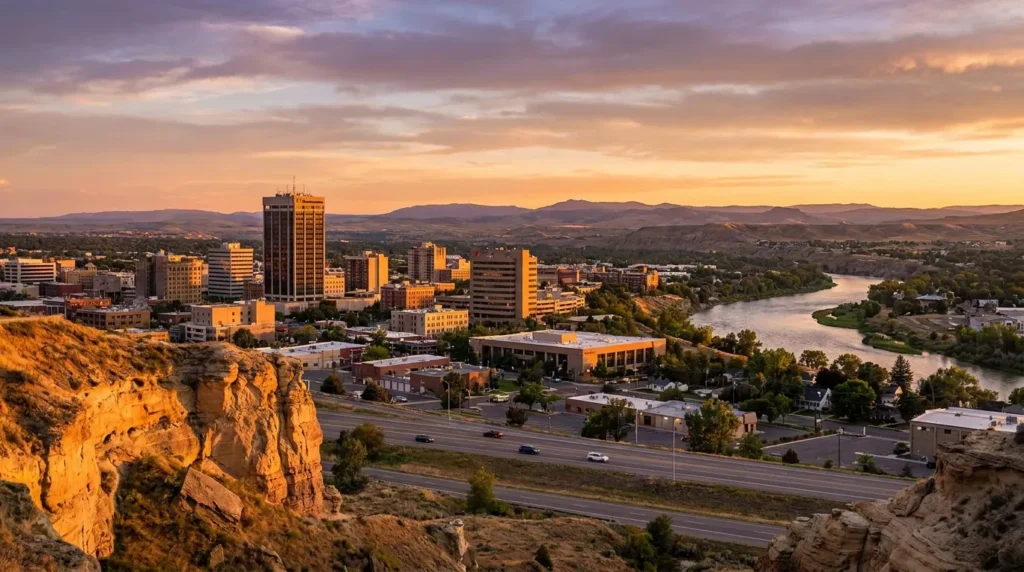
Billings is Montana's largest city, surrounded by sandstone cliffs called the Rims, with a cultural scene tied to the American West and access to Yellowstone National Park.

The Rimrocks form the sandstone ridge that encircles the north side of the city, with Swords Park and Zimmerman Park offering panoramic views and hiking trails. Pictograph Cave State Park, to the south, contains rock paintings estimated at 2,000 years old. The Western Heritage Center and the Yellowstone Art Museum, housed in historic downtown buildings, serve as cultural anchors.

Pompey's Pillar National Monument, about 30 miles out, preserves the only physical inscription made by William Clark of the Lewis and Clark Expedition. ZooMontana, the Moss Mansion, and DanWalt Gardens round out family-friendly options. The Downtown Billings district, centered on Montana Avenue, has craft breweries including Angry Hank's and Montana Brewing Company.

For outdoor access, Beartooth Highway, two hours away, ranks among the most scenic roads in the country and leads to Yellowstone's northeast entrance. Red Lodge, an alpine tourist town, is about an hour out. Coopers Park and Riverfront Park, within city limits, offer trails along the Yellowstone River. MetraPark hosts rodeos, the NorthernAg Expo, and concerts.

  1. 1["Pictograph Cave State Park"
  2. 2"ZooMontana"
  3. 3"Yellowstone Art Museum"
  4. 4"Western Heritage Center"
  5. 5"Moss Mansion Historic House Museum"
  6. 6"Pompeys Pillar National Monument"
Nightlife4.0 / 10
Parks & green spaces
  • ["Pioneer Park"
  • "Riverfront Park"
  • "Two Moon Park"
  • "Coulson Park"
  • "Lake Elmo State Park"
  • +1 more

Latest posts

Posts about Montana

Coverage and updates related to this destination.

Showing content from Montana, as there is no specific data for Billings yet.