Visto n' Visa
Blog
Notícias e artigos
Destinations
Careers
Immigrants

Want to live and work in Anaconda?

Personalized immigration plan with eligible visas, costs, and next steps for your goal!

If you are not eligible, you will know exactly why and what to do to improve your approval chances.

Save up to 12 hours in meetings

No pointless assessments.

Save up to 90%

Save money on vague or unfocused consultations

Avoid Fraud and Mistakes

One mistake can cost you your visa

Total Impartiality

Zero commercial bias

Decide with peace of mind

No toxic urgency

Fast and Accurate

Answers in minutes, no guesswork

Who Lives in Anaconda: Descendants of Industrial Workers, Retirees, and Few New Arrivals

Anaconda is predominantly white, with strong Irish, Italian, Serbian, and Eastern European heritage from former smelter workers. The population is aging, with some retirees who have returned to the city and few new arrivals.

Anaconda's demographics reflect a century of European immigration tied to the copper smelter. Irish, Italian, Serbian, Croatian, Finnish, and Polish immigrants formed their own neighborhoods at the city's peak, and their descendants maintain deep family ties to the city. Many local surnames trace directly to workers from the early 20th century.

The population is aging, with a strong presence of retirees and older adults. Many young people leave Anaconda to study and work in Bozeman, Missoula, or out of state. There is a small Native American community linked to nearby tribes and few Hispanic residents. Diversity is lower than in any other comparably sized city in Montana.

For immigrants, Anaconda is a traditional, Catholic, working-class city with a strong small-town identity. Catholic and Orthodox churches play a central role in social life. Integration tends to be slow for those without prior connections, though the small scale makes it easier to get to know neighbors. Spanish is rarely heard; English is practically a requirement.

Languages spoken
  • English
  • Italian (traces)
  • Serbian (traces)
  • Spanish
Main religions
  • Catholicism
  • Protestant Christianity
  • Orthodox Christianity (Serbian)
  • No declared religion

Cost of Living in Anaconda: Among the Lowest in Montana

Anaconda is one of the most affordable cities to live in within Montana. Home prices well below the state average attract retirees and remote workers. Food and services fall below the national average.

Anaconda is one of the most affordable places to live in Montana. The median home price sits well below the state average, and apartment rents fit comfortably within median wages. For immigrants in early stages of relocation or remote workers, it is one of the most cost-effective options in the state for housing.

Montana does not collect a state sales tax, which simplifies everyday purchases. Grocery stores such as Town Pump, Family Foods, and Safeway cover the basics. For larger shopping options, residents cross over to Butte. Local restaurants have very low prices, and the dining scene is modest.

Winter heating costs can be significant, especially in older homes, which are common in Anaconda. Electricity is stable, and gasoline follows the state average. Healthcare, as throughout the United States, represents a recurring and significant expense. For remote workers or retirees, Anaconda offers a rare balance between affordability and proximity to spectacular natural surroundings.

Anaconda

Housing in Anaconda: Affordable Historic Homes and Traditional Neighborhoods

The housing stock includes historic homes from the smelter era, bungalows in traditional neighborhoods, and few new developments. Buying is feasible on modest wages; maintenance on older homes and efficient heating are key considerations.

Anaconda features Victorian and Craftsman-style homes from the smelter era. Many of these structures require significant renovation but offer historic character at very accessible prices. To the east, toward Opportunity, traditional residential neighborhoods include homes from the 1940s and 1950s. New developments are rare and small.

For immigrants, renting before buying is the most common strategy, though the rental supply is limited given the city's size. Modest apartments scattered throughout the city meet demand. Leases generally require proof of income and references, but the market is far less competitive than in Bozeman or Missoula.

Buying a home in Anaconda is more accessible than in most of Montana. A pre-purchase inspection is essential for older homes, with attention to roof, foundation, plumbing, insulation, and windows. Environmental risks tied to the former smelter, monitored under the federal remediation program, warrant attention in certain neighborhoods. Local banks finance buyers with good credit.

Recommended neighborhoods
  • Historic Downtown Anaconda
  • East Anaconda
  • Opportunity (small neighboring community)
  • West Anaconda
  • Goosetown (historic Irish neighborhood)

Work in Anaconda: Tourism, Environmental Remediation, and Jobs in Butte

The local job market is limited and centers on tourism, hospitality, environmental remediation of former industrial sites, small retail, and municipal government. Many residents commute to Butte or hold seasonal positions.

Anaconda has a small local labor market. The main opportunities are in hospitality tied to Georgetown Lake, the Discovery Ski Area, and the Old Works Golf Course, designed by Jack Nicklaus on remediated former industrial grounds. Small retail, local restaurants, and the Anaconda-Deer Lodge County government round out the local employment base.

Environmental remediation of the former Anaconda Copper sites, funded through the federal Superfund program, employs specialists in environmental engineering, geology, and construction. Several firms are active in contaminant removal and land rehabilitation. Remediation research is a technically relevant niche for the region.

For many working-age residents, commuting to Butte (about 25 miles away) is the practical path. Qualified professionals in healthcare, education, and skilled trades may find positions there. Seasonal hospitality jobs open in summer and winter, particularly around Georgetown Lake and the Discovery Ski Area. English is required for nearly all formal positions.

Dominant sectors
  • Tourism and hospitality
  • Environmental remediation
  • Municipal government
  • Small retail
  • Seasonal employment (skiing and lake)
Major employers
  • Anaconda-Deer Lodge County
  • Anaconda Public Schools
  • Community Hospital of Anaconda
  • Discovery Ski Area (seasonal)
  • Old Works Golf Course
  • +1 more

Education in Anaconda: Small District and Higher Education in Butte

Anaconda Public Schools serves the city with small, traditional schools. For higher education, students generally travel to Butte (Montana Tech) or larger cities. The small scale can support more individualized attention to students.

Anaconda Public Schools serves the city with Anaconda Junior/Senior High School as its main facility, alongside elementary schools. Class sizes are small, and individualized student attention is often a noted strength. Advanced programs are limited by the district's size, but sports and extracurricular activities have a long tradition.

The private sector includes a small historic Catholic school. Families preferring religious education often choose this option, especially those connected to the city's Irish and Italian heritage. For young children, private, public, and community cooperative childcare programs are available, on a much smaller scale than in larger cities.

For higher education, students generally head to Montana Technological University in Butte, about 25 miles away. For broader university options, Missoula (University of Montana) and Bozeman (Montana State University) are the common choices. The nearest community college is also Highlands College of Montana Tech in Butte, offering accessible technical programs for adult immigrants.

Notable universities
  • Montana Technological University (in Butte, nearby)
  • Highlands College of Montana Tech

Healthcare in Anaconda: Community Hospital and Referrals to Butte or Missoula

Community Hospital of Anaconda provides basic care and some specialties. Complex cases are referred to Butte, Missoula, or Bozeman. The system is private, as throughout the United States, and requires an American health insurance plan.

Community Hospital of Anaconda is the main local facility, with a 24-hour emergency department, general clinical care, limited obstetrics, and some specialties. For complex cases, particularly in oncology, advanced cardiology, and neurosurgery, patients are referred to St. James in Butte or to larger hospitals in Missoula and Bozeman.

As throughout the United States, healthcare is private and plan-based. Employers such as the hospital, the school district, and municipal government offer coverage to employees. Self-employed individuals and recent arrivals can explore options at HealthCare.gov or through insurers such as Blue Cross Blue Shield of Montana, PacificSource, and Allegiance.

For immigrants in the early stages of relocation, community clinics in the region offer care on a sliding fee scale for low-income families. Pharmacies including Walgreens, Albertsons, and some local options cover prescriptions. Interpreters can be requested, though the range of languages available is more limited than in larger cities. Telemedicine has expanded access to distant specialists.

Healthcare index58.0 / 100
  • Life expectancyyears at birth
    78.4yrs
  • Doctors per 1kpracticing physicians
    3.7
  • Health spendper capita, per year
    $13,473
  • Public systemoverall quality rating
    Fair

Safety in Anaconda: A Quiet City with Environmental Considerations

Anaconda is considered safe, with low crime rates typical of small American cities. Violent crime is rare, and petty theft predominates. Environmental risks tied to the former smelter and harsh winters are the main points of attention.

By American standards, Anaconda is quiet and safe. Violent crime is infrequent, and property crime occurs at modest levels. Local law enforcement maintains a good relationship with the community, and the very small scale supports informal neighborhood monitoring. Vehicle break-ins and occasional burglaries are the most common incidents.

Residential neighborhoods tend to be quiet, with attentive neighbors. Some downtown areas with vacant buildings require more caution at night, though the issue is minor. Standard American urban precautions address most everyday concerns: locking vehicles, using reliable navigation, and avoiding isolated areas alone at night.

The primary real risk in Anaconda is environmental. The former smelter left contamination by arsenic, lead, and copper at several sites, monitored under the federal Superfund program. Before purchasing property, consulting remediation maps is important. Wildfires in July and August affect air quality; winter snowstorms are common. A family emergency plan and homeowner's insurance make a meaningful difference.

5.8
Homicides per 100k
per year
Safety index
62.0
Crime index
38.0
Safer neighborhoods
  • Historic downtown (Main Street)
  • East Side
  • West Side
  • Goosetown
  • Mill Creek area
  • Residential neighborhoods near Washoe Park
Areas to avoid
  • Industrial areas near the former smelter
  • Isolated sections near Old Works Golf Course after dark

Getting Around Anaconda: A Car Is Essential in This Isolated City

Anaconda requires a car for daily life and for reaching Butte, Missoula, or Bozeman. There is no urban bus system, and the nearest airport is in Butte with very limited service. I-90 and Highway 1 serve the region.

Those relocating to Anaconda need a car without exception. There is no meaningful urban bus system, and the distances between home, school, work, and grocery stores typically require driving daily. For nearly any larger service, residents cross over to Butte, approximately 25 miles away via I-90.

Highway 1, known as the Pintler Scenic Highway, connects Anaconda to Missoula through Philipsburg along a scenic route also popular with tourists. I-90 is accessible within a few minutes to the north. In winter, snow and ice can temporarily close roads; appropriate tires are essential.

The nearest airport is Bert Mooney Airport in Butte, with limited regional service. For direct flights to major cities, residents generally drive to Bozeman Yellowstone International Airport (approximately 2 hours away) or Missoula Montana Airport (also approximately 2 hours). Rideshare services operate with limited coverage; advance planning is necessary.

16 min
Avg commute
38
Walkability
Airports
  • BTM — Bert Mooney Airport (about 25 mi away, in Butte)
  • BZN — Bozeman Yellowstone International (about 109 mi away)

What the climate is like living in Anaconda

Anaconda has a continental mountain climate, with long, frigid winters, short and mild summers, and low humidity throughout the year.

Winters in Anaconda are severe and prolonged, with lows that frequently drop below -10 degrees Celsius between December and February. Snow covers the ground for much of the season and overcast skies are common during these months.

Summers are short, with comfortable highs between 25 and 30 degrees, long days, and cool nights that can fall below 10 degrees. Humidity is low and genuinely muggy days are rare.

Residents need robust heating, heavy coats, snow boots, and winter tires. Air conditioning is unnecessary in most homes, and both spring and fall pass quickly.

Sunny days / year200 days
Avg high (°F)
  • 22°J
  • 19°F
  • 27°M
  • 33°A
  • 43°M
  • 54°J
  • 66°J
  • 65°A
  • 57°S
  • 39°O
  • 28°N
  • 22°D
Avg low (°F)
  • J
  • F
  • 11°M
  • 16°A
  • 26°M
  • 33°J
  • 43°J
  • 44°A
  • 36°S
  • 22°O
  • 13°N
  • 10°D
Rainfall (")
  • 2"J
  • 3"F
  • 2"M
  • 3"A
  • 3"M
  • 4"J
  • 2"J
  • 2"A
  • 2"S
  • 3"O
  • 2"N
  • 2"D

Cultural Life in Anaconda: Working-Class Heritage, Ethnic Festivals, and the Outdoors

Local culture is anchored in the working-class and ethnic heritage of the smelter era. Catholic celebrations, events at the Washoe Theater, local breweries, and proximity to skiing and lakes define the social calendar.

The Washoe Theater, a restored Art Deco cinema, is one of the most beautiful historic movie houses in the United States and serves as a central cultural landmark. The Copper Village Museum and Arts Center documents the city's history and the smelter legacy. In July, the Smelter City BrewFest brings together regional breweries, and in September, the Anaconda Italian Heritage Festival celebrates the Italian community descended from the mining migration.

Local restaurants include pasties (Cornish-style meat pies), traditional pizza, Italian-American fare, and classic American dishes. Downtown bars maintain a small-town, working-class atmosphere. Breweries such as Smelter City Brewing enliven the downtown. Catholic and Orthodox churches hold festivals and masses on ethnic occasions, with traditional dishes served at community events.

Proximity to Georgetown Lake, the Discovery Ski Area, and the Anaconda-Pintler Wilderness Area defines outdoor life. Fishing, skiing, mountain biking, hiking, and hunting are common activities among residents. For immigrants, churches and sports clubs serve as important social anchors, and the very small scale of the city makes it easier to meet neighbors quickly.

Anaconda

What life is like in Anaconda, Montana's copper city

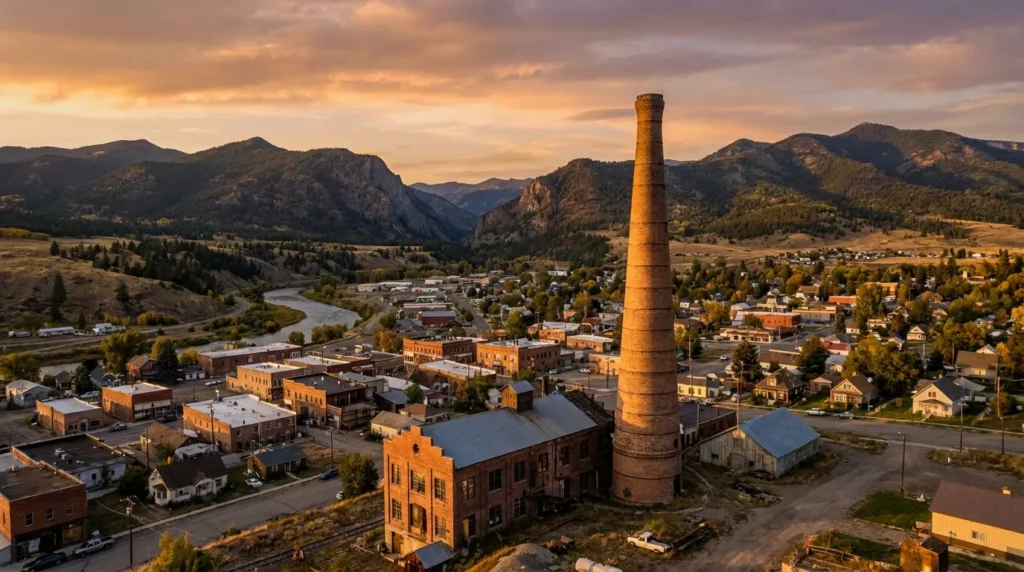
Anaconda sits in southwestern Montana, neighboring Butte, defined by the towering 1919 Anaconda Smelter Stack and a mining past that still shapes the city's identity.

The Anaconda Smelter Stack, standing 178 meters tall, is the city's most visible landmark and is listed as a Montana State Park, though the base remains closed due to contamination. Nearby, the Old Works Golf Course, designed by Jack Nicklaus atop the former smelting complex, has become a nationally recognized model of environmental remediation.

Washoe Park, designed in 1908, is home to the Washoe Park Trout Hatchery, a century-old trout nursery, and the Hearst Free Library, donated by Phoebe Hearst in 1898 and still in use today. The Copper Village Museum and Arts Center occupies the historic City Hall and chronicles the working-class history of the Anaconda Copper Mining Company.

For outdoor recreation, the Discovery Ski Area a few miles away and Georgetown Lake for fishing and sailing serve as the main escapes. The Anaconda Range, part of the Pintler Wilderness, offers trails including the Continental Divide Trail. The Club Moderne, a 1937 art deco bar that reopened after a fire, rounds out the city's character.

  1. 1["Anaconda Smoke Stack State Park (178-meter smokestack)"
  2. 2"Washoe Park (historic park)"
  3. 3"Old Works Golf Course (built on former smelting site)"
  4. 4"Copper Village Museum and Arts Center"
  5. 5"Anaconda Visitor Center"
  6. 6"Access to Pintler Wilderness and Lost Creek State Park"
Nightlife3.0 / 10
Parks & green spaces
  • ["Washoe Park"
  • "Lost Creek State Park"
  • "Anaconda-Pintler Wilderness (nearby)"
  • "Georgetown Lake area"
  • "Mount Haggin Wildlife Management Area"
  • +1 more

Latest posts

Posts about Montana

Coverage and updates related to this destination.

Showing content from Montana, as there is no specific data for Anaconda yet.