Visto n' Visa
Blog
Notícias e artigos
Destinations
Careers
Immigrants

Want to live and work in Springfield?

Personalized immigration plan with eligible visas, costs, and next steps for your goal!

If you are not eligible, you will know exactly why and what to do to improve your approval chances.

Save up to 12 hours in meetings

No pointless assessments.

Save up to 90%

Save money on vague or unfocused consultations

Avoid Fraud and Mistakes

One mistake can cost you your visa

Total Impartiality

Zero commercial bias

Decide with peace of mind

No toxic urgency

Fast and Accurate

Answers in minutes, no guesswork

Predominantly white population, with diversity growing at a gradual pace

Springfield is less diverse than other Missouri cities, with a predominantly white population. Latino, Asian, and African American communities are growing, though still on a modest scale.

The demographic profile reflects the rural history of the Ozarks. Most residents are of European descent, primarily German, Irish, English, and Scottish. The African American community is small compared to Kansas City or St. Louis, but growing, with concentrations in the downtown area and the north side.

The Latino community is growing steadily, with Mexicans making up the largest share. Mexican markets, taquerias, and bakeries have become visible across the city. Vietnamese residents, a long-established refugee community, also have a solid presence, with pho and banh mi restaurants popular among locals. Ukrainian refugees arrived in significant numbers after 2022.

Religiously, Springfield is one of the most religiously engaged cities in the United States. Evangelical and Baptist churches are a constant presence, and the Assemblies of God denomination has its world headquarters here. Catholics have a smaller historical footprint than in the rest of Missouri, but maintain active parishes. There is a mosque serving the Muslim community and a Vietnamese Buddhist temple.

Languages spoken
  • English
  • Spanish
  • Vietnamese
  • Ukrainian
  • Marshallese
Main religions
  • Christianity (evangelical, Baptist, Catholic)
  • No religion
  • Buddhism
  • Islam

One of the lowest costs of living for a city of Springfield's size

Springfield offers housing, food, and services well below the national average. It is a popular choice for retirement and for remote workers. Missouri state taxes apply normally.

The main draw is housing prices. Properties typically cost a fraction of what comparable homes go for in Denver or Chicago, and even compared to Kansas City and St. Louis, Springfield remains more affordable. Rent is also accessible, and one-bedroom apartments in good areas carry very attractive prices for newcomers.

Food and services fall below the national average. Price Cutter, Hy-Vee, Walmart, and Aldi cover the basics. International markets for Asian and Latino products exist, especially near Glenstone and Sunshine. Restaurants tend to be inexpensive, and locals place a high value on home-style cooking.

Healthcare costs are roughly average, with major regional hospitals that reduce the need for long-distance travel. Utilities and natural gas weigh more in winter, though less so than in Minnesota or Wisconsin. Missouri state taxes and a sales tax of around 8 percent on goods round out the picture. There is no additional city income tax, unlike Kansas City or St. Louis.

91Cost index (US = 100)9% below US average
CategorySingleCoupleFamily (2 + 2)
iHousing$1,179$1,361$1,723
iFood$345$689$1,252
iTransport$454$771$998
iHealthcare$254$508$952
iChildcare$1,651
iOther$771$1,388$1,950
Monthly total$3,003$4,717$8,526

Source: U.S. BLS Consumer Expenditure Survey 2023 + BEA Regional Price Parities 2023 · Estimates in USD, monthly.

Affordable homes, a mix of older tree-lined neighborhoods and newer suburbs

Springfield has a strong supply of homes in established neighborhoods like Rountree and Phelps Grove, with suburban expansion along Battlefield Road and toward Nixa and Republic.

Central neighborhoods have homes from the 1920s to the 1960s, many in Craftsman and bungalow styles. Rountree, Phelps Grove, and University Heights are popular among professionals and graduate students, with tree-lined streets and proximity to downtown. Prices are accessible by American standards, and inventory is reasonable.

For families with children, recent expansion to the south and southwest is the most common path. Areas like Battlefield Road, Republic, and Nixa have newer homes with large yards, two-car garages, and a classic suburban feel. The Nixa and Republic school districts are well rated, which leads many families to settle in those neighboring communities and commute to Springfield.

Renters will find options in apartment complexes spread across the city, especially near Missouri State University and along Battlefield and Glenstone. Students and young professionals make up the largest share of that market. Houses for rent also exist, particularly in central neighborhoods, and platforms like Zillow and Apartments.com show updated listings.

Recommended neighborhoods
  • Rountree
  • Phelps Grove
  • University Heights
  • Battlefield Road area
  • Galloway Village
  • +2 more

Job market driven by healthcare, retail, and higher education

Springfield has a solid regional economy, with Bass Pro Shops, the Mercy and CoxHealth hospital systems, and Missouri State University as its main pillars. Technology and logistics are growing gradually.

Healthcare is the largest employment sector. CoxHealth and Mercy Hospital Springfield are regional giants, with thousands of employees and specialized care serving all of southwest Missouri. Nurses, technicians, physicians, and administrators make up a considerable share of the working population, and demand is consistent.

Bass Pro Shops, the outdoor retail giant, is headquartered in Springfield. Its flagship store, Bass Pro Shops Outdoor World, doubles as a tourist attraction with a large aquarium. The company employs a substantial workforce in logistics, retail, and administration. O'Reilly Auto Parts, another Fortune 500 company based here, is a major employer in automotive logistics and retail.

Higher education generates jobs through Missouri State University, Drury University, and Ozarks Technical Community College. For immigrants, healthcare offers clear pathways through state licensing, while retail, construction, and food service have steady openings. Local networking is important, and the Chamber of Commerce organizes events that help newly arrived professionals.

Dominant sectors
  • Healthcare
  • Retail and logistics
  • Education
  • Light manufacturing
  • Tourism
Major employers
  • CoxHealth
  • Mercy Hospital Springfield
  • Bass Pro Shops
  • O'Reilly Auto Parts
  • Missouri State University
  • +1 more

A large public university and well-rated suburban school districts

Springfield is home to Missouri State University, Drury, and Ozarks Technical. The Springfield Public Schools district performs at an average level; neighboring districts like Nixa and Republic receive higher marks.

Missouri State University is the second-largest public university in the state, with strong programs in education, business, health, and the arts. Its main campus is in central Springfield and draws students from across the state. Drury University, a private institution with a tradition in architecture and the arts, is located nearby. Evangel University, affiliated with the Assemblies of God, serves a religiously oriented student body.

For K-12 schooling, Springfield Public Schools operates dozens of schools with average overall quality and variation by neighborhood. Families with children tend to research school zones carefully and, in many cases, choose to live in neighboring communities like Nixa and Republic, where the school districts are considered stronger. Private and charter schools also exist as alternatives.

For technical and vocational training, Ozarks Technical Community College (OTC) has a large campus in Springfield and offers programs in healthcare, manufacturing, technology, and construction. The programs have strong regional employability, affordable tuition, and work well for those seeking a career change or quick entry into the workforce.

Notable universities
  • Missouri State University
  • Drury University
  • Evangel University
  • Ozarks Technical Community College
  • Cox College
  • Baptist Bible College

Regional medical center for southwest Missouri, anchored by two major systems

Springfield is the medical reference point for the region, with Mercy Hospital Springfield and CoxHealth providing comprehensive coverage in emergency care, specialty services, and clinical research.

Mercy Hospital Springfield, part of the Catholic Mercy health system, is one of Missouri's largest hospitals, with emergency services, oncology, cardiology, and maternity care. CoxHealth is the other pillar, with Cox South and Cox North serving the metro area. The two systems compete and cooperate, maintaining a high level of care for a city of this size.

For primary care, family clinics are spread throughout the city, and both major systems have robust outpatient networks. Mental health services have expanded in recent years, with independent clinics and hospital-based programs. For the Hispanic community, Jordan Valley Community Health Center offers care with a bilingual staff and income-based fees.

Health insurance in the United States is essential and expensive. Legally resident immigrants can access the ACA marketplace, Medicaid in eligible cases, or employer-sponsored coverage. Without insurance, costs can quickly become significant debt. Comparing plans, understanding deductibles, and confirming that preferred providers are in-network before scheduling appointments is strongly recommended.

Healthcare index68.0 / 100
  • Life expectancyyears at birth
    78.4yrs
  • Doctors per 1kpracticing physicians
    3.7
  • Health spendper capita, per year
    $13,473
  • Public systemoverall quality rating
    Good

Property crime is a greater concern than interpersonal violence

Springfield has property crime rates above the national average, but violent crime is lower. Established residential neighborhoods are safe, with basic precautions against opportunistic theft recommended.

Theft, car break-ins, and petty larceny are the most common complaints. Statistics place Springfield above the national average in property crime, partly attributed to methamphetamine-related issues in the broader Ozarks region. Established residential neighborhoods like Rountree, Phelps Grove, and University Heights are considered safe for everyday life.

Violent crime exists but is less frequent, tending to concentrate in specific areas of downtown and the north side. Suburban neighborhoods like those along Battlefield Road and in Nixa and Republic have low rates and a calm family environment. Local law enforcement maintains a visible presence in commercial areas, and active neighborhood watch programs are in place.

The greatest regional risk is not crime but tornadoes and severe storms. The March-to-June season requires attention, and most homes have a basement or storm shelter. Public sirens sound when a confirmed threat is detected. Alerts via NOAA Weather Radio on mobile devices are essential. Localized flooding and winter ice also affect the region from time to time.

5.8
Homicides per 100k
per year
Safety index
42.0
Crime index
58.0
Safer neighborhoods
  • Rountree Historic District
  • University Heights
  • Phelps Grove
  • Southern Hills
  • Galloway Village
  • Greenwood area (near Missouri State University)
Areas to avoid
  • Sections of West Central Springfield at night
  • Isolated areas around Commercial Street late at night
  • Empty parking lots around Glenstone Avenue in the early morning

Car-dependent city with existing but limited public transit

In Springfield, a car is practically essential. City Utilities Transit operates buses, but frequency and coverage are limited. A relatively flat terrain makes walking and cycling practical in some areas.

The road network is straightforward and functional. The main arteries are I-44, which cuts through the city east to west, and US-65 along the eastern edge. Sunshine, Battlefield, Glenstone, and Kearney are the commercial streets that anchor daily life. Traffic is light by American standards, and free parking is nearly universal outside the historic downtown.

The City Utilities Transit system runs bus routes on radial lines covering parts of the city, with a central terminal at the Downtown Transit Center. It is useful for students and non-drivers, but low frequency limits its practicality. Most residents own at least one car per adult, with SUVs and pickup trucks dominating the local fleet.

Springfield-Branson National Airport offers direct flights to major hubs such as Atlanta, Chicago, Denver, and Dallas. International connections typically route through those hubs. Cycling works well on good-weather days, with trails like Galloway Creek and the Frisco Highline Trail. Walking is viable in central neighborhoods, but suburban distances are too long for most errands on foot.

18 min
Avg commute
40
Walkability
Airports
  • SGF — Springfield-Branson National Airport
  • Bike infrastructure

What the climate is like living in Springfield

A city on the Ozark Plateau with a humid continental climate: hot summers around 32 degrees Celsius, moderately cold winters with occasional snow.

Summers in Springfield are hot and humid, with highs between 31 and 33 degrees Celsius in July. Severe thunderstorms and tornado risk are common in spring and early summer, and air conditioning is standard.

Winters are cold but manageable, with lows between -6 and -2 degrees Celsius in January and snowfall accumulating around 16 inches per season. A medium-weight coat is sufficient.

Spring is the most unpredictable season, while fall is the most pleasant. Annual rainfall totals approximately 43 inches, peaking in summer.

Sunny days / year215 days
Avg high (°F)
  • 61°J
  • 66°F
  • 75°M
  • 78°A
  • 83°M
  • 94°J
  • 98°J
  • 99°A
  • 95°S
  • 88°O
  • 75°N
  • 66°D
Avg low (°F)
  • 12°J
  • F
  • 18°M
  • 28°A
  • 40°M
  • 53°J
  • 63°J
  • 59°A
  • 50°S
  • 29°O
  • 20°N
  • 15°D
Rainfall (")
  • 4"J
  • 3"F
  • 6"M
  • 5"A
  • 7"M
  • 3"J
  • 4"J
  • 4"A
  • 2"S
  • 6"O
  • 3"N
  • 2"D

A Route 66 city with a strong religious character and an active outdoor scene

Springfield blends Route 66 heritage, a strong evangelical culture, a passion for outdoor life, and a small but growing arts scene centered around downtown and the university.

The city takes pride in being the place where Route 66 was officially designated in 1926. A stretch of the historic street still preserves old signs, vintage motels, and diners from that era. For fans of classic American culture, it is a worthwhile stop. Events and festivals tied to Route 66 take place throughout the year.

The weight of evangelical and Baptist culture shapes much of social life. Large churches like James River Church draw thousands to weekend services. This is reflected in reduced Sunday business hours, the character of community events, and a more subdued nightlife compared to Kansas City or St. Louis. Bars and craft breweries do exist, primarily near downtown.

Outdoor life is a central part of local culture. Fishing, hunting, hiking, and camping in the Ozarks are part of the family calendar. Lakes like Table Rock and Stockton are a short drive away. Branson, with its country shows and theme parks, is an hour out. The dining scene is modest but offers solid examples of barbecue, Southern cooking, Vietnamese food, and rural Ozark cuisine.

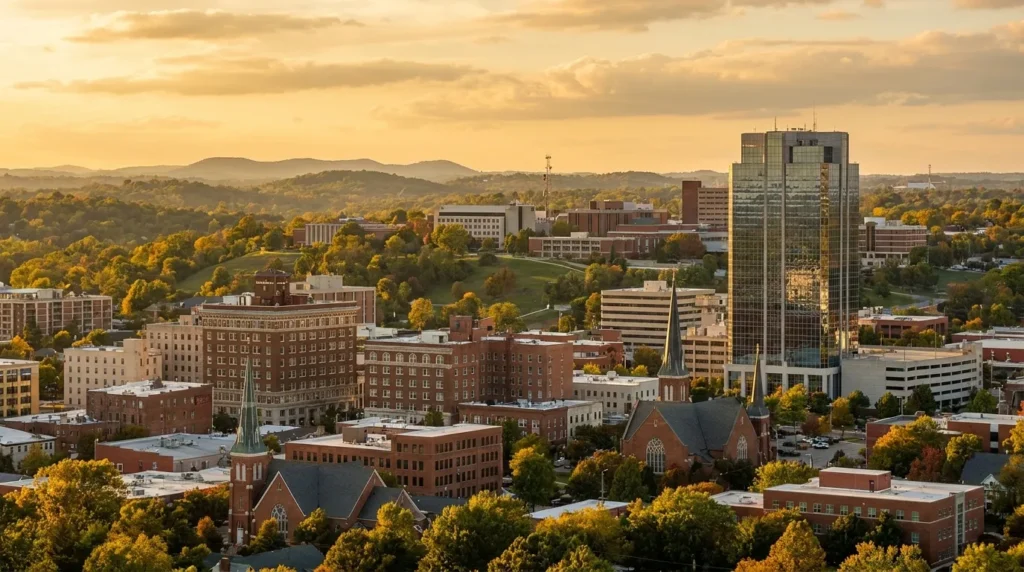
Springfield

Birthplace of Route 66 and gateway to the Ozark Mountains in Missouri

Missouri's third-largest city, the official starting point of the historic Route 66, home to the original Bass Pro Shops and the Wonders of Wildlife Museum, with Missouri State University at its core.

Springfield is known as the Birthplace of Route 66, officially named in the city in 1926. The historic downtown around Park Central Square still features signs, murals, and buildings that recall the highway's golden era. The History Museum on the Square documents local history, and the restored Gillioz Theatre serves as a cultural landmark with an active programming schedule.

The Wonders of Wildlife National Museum and Aquarium, connected to Bass Pro Shops, is one of the largest aquariums and natural history museums in the United States, with roughly 80,000 acres of tanks and exhibits. The original Bass Pro Shops Outdoor World, located adjacent, functions as a near-essential destination for regional families and stands as the city's commercial landmark.

The Springfield Conservation Nature Center, on the southeast edge, offers flat trails and a visitor center focused on Ozarks wildlife. Lake Springfield Park and the James River Greenway provide longer trails and cycling paths. Within thirty minutes, visitors reach Wilson's Creek National Battlefield and recreational areas in the Ozark Mountains. Missouri State University, situated downtown, gives the city a year-round university atmosphere.

  1. 1["Wonders of Wildlife National Museum and Aquarium (Bass Pro Shops)"
  2. 2"Bass Pro Shops Outdoor World (flagship store and tourist attraction)"
  3. 3"Springfield Art Museum"
  4. 4"Fantastic Caverns (the only drive-through cave in the US)"
  5. 5"Dickerson Park Zoo"
  6. 6"Discovery Center of Springfield"
Nightlife4.0 / 10
Parks & green spaces
  • ["Nathanael Greene/Close Memorial Park (with Mizumoto Japanese Stroll Garden)"
  • "Phelps Grove Park"
  • "Jordan Valley Park (downtown)"
  • "Sequiota Park"
  • "Lake Springfield Park"
  • +1 more

Latest posts

Posts about Missouri

Coverage and updates related to this destination.

Showing content from Missouri, as there is no specific data for Springfield yet.