Visto n' Visa
Blog
Notícias e artigos
Destinations
Careers
Immigrants

Want to live and work in Joplin?

Personalized immigration plan with eligible visas, costs, and next steps for your goal!

If you are not eligible, you will know exactly why and what to do to improve your approval chances.

Save up to 12 hours in meetings

No pointless assessments.

Save up to 90%

Save money on vague or unfocused consultations

Avoid Fraud and Mistakes

One mistake can cost you your visa

Total Impartiality

Zero commercial bias

Decide with peace of mind

No toxic urgency

Fast and Accurate

Answers in minutes, no guesswork

Diverse population by Missouri rural standards

Joplin is predominantly white and Christian, but has a growing Latino presence, a historic Vietnamese community, and a flow of students from Missouri Southern State University.

The city has around 50,000 residents, with the metropolitan area exceeding 180,000 when neighboring counties in Missouri and Kansas are included. Most of the population identifies as white, but the profile has shifted: Hispanics and Latinos now exceed 7% and continue to grow, primarily of Mexican and Guatemalan origin tied to work at regional meatpacking plants.

A Vietnamese community has been established since the 1970s, formed by refugees who settled through local churches. More recently, families from the Marshall Islands and Burma have arrived, drawn by industrial jobs and cost of living. Students from Missouri Southern and Ozark Christian College add temporary diversity.

English dominates daily life entirely, but Spanish now appears in commercial signage, health services, and some churches. The religious landscape is dominated by evangelical and Catholic Christian churches, with smaller presence of Baptists, Methodists, and a small Muslim community linked to healthcare professionals.

Languages spoken
  • English
  • Spanish
  • Vietnamese
  • Marshallese
  • Burmese
Main religions
  • Evangelical Christianity
  • Catholicism
  • Baptist Christianity
  • Methodist Christianity
  • Islam (minority)

One of the lowest costs among mid-size cities in the United States

Joplin consistently falls below the national average in housing, groceries, and services, making it feasible to own a home on a regional median salary.

The cost of living in Joplin is one of its central attractions. Rent for a one-bedroom apartment in a decent neighborhood falls well below regional capitals like Kansas City or St. Louis, and entire houses with yards appear at prices that would cover only a room in major metropolitan areas. Home purchase is accessible and local property taxes are moderate by American standards.

Groceries, gas, and basic utilities follow the same trend: Walmart, Aldi, and regional chain Woods Supermarket cover the essentials at competitive prices. Casual restaurants and fast food are inexpensive; dining at chains like Olive Garden or Texas Roadhouse fits a modest budget. The main expense is car dependency, since public transportation is minimal.

Healthcare services, internet, and utilities are at or below the Missouri average. Employer-sponsored health insurance is typically offered by the large local hospital networks. For families coming from large cities, the cost difference allows for more savings or debt repayment, provided the salary matches the regional market.

87Cost index (US = 100)13% below US average
CategorySingleCoupleFamily (2 + 2)
iHousing$1,132$1,307$1,654
iFood$331$661$1,202
iTransport$436$740$958
iHealthcare$244$488$914
iChildcare$1,585
iOther$740$1,332$1,872
Monthly total$2,883$4,528$8,185

Source: U.S. BLS Consumer Expenditure Survey 2023 + BEA Regional Price Parities 2023 · Estimates in USD, monthly.

Affordable houses with yards in quiet neighborhoods

The market is dominated by single-family homes priced well below the national average; apartments exist but are a minority, concentrated near the university and downtown.

Most of Joplin consists of single-family residential neighborhoods with yards, garages, and two or three bedrooms. Buying a modest home is realistic even for families with median income, and financing tends to be cheaper than long-term renting. New construction appeared after the 2011 tornado, especially in the south and east of the city.

Neighborhoods like South Joplin, Silver Creek, and the area near Mercy Hospital attract families and healthcare professionals for the quality of schools and tree-lined streets. Webb City, a town adjoining Joplin to the north, is considered one of the best options for families with school-age children, with a highly rated school system.

Apartments are concentrated near Missouri Southern State University, in the renovated downtown, and along Range Line Road. Those arriving for a first year typically rent in these areas before buying. Investment properties and short-term rentals exist, but the market is dominated by long-term housing.

Recommended neighborhoods
  • South Joplin
  • Silver Creek
  • Webb City
  • Redings Mill
  • Downtown Joplin
  • +2 more

Healthcare, manufacturing, and logistics sustain regional employment

The major employers are hospitals, meatpacking plants, regional manufacturers, and distribution centers; average salaries are modest, but the cost of living compensates.

Joplin's economy has three clear pillars: healthcare, manufacturing, and logistics. The Freeman Health System and Mercy Hospital Joplin networks employ thousands of people in nursing, technician, administrative, and physician roles. For healthcare professionals licensed in the United States, it is one of the mid-size cities with the most stable openings in the region.

In manufacturing, standouts include Eagle Picher Technologies, Leggett and Platt (headquartered in nearby Carthage), Schaeffler Group, La-Z-Boy, and several food processing plants. Walmart and Owens Corning distribution centers take advantage of the Interstate 44 location. Factory floor and logistics jobs are often the entry points for newly arrived immigrants.

Average salaries are below the national average, but the salary-to-cost ratio tends to be favorable for those renting or buying. For well-paid remote workers, Joplin has become an attractive destination, with large homes at low prices and fiber internet available. The market for highly specialized technology profiles is limited and generally requires accepting hybrid work with travel.

Dominant sectors
  • Healthcare
  • Manufacturing
  • Logistics and Distribution
  • Food Processing
  • Education
  • +1 more
Major employers
  • Freeman Health System
  • Mercy Hospital Joplin
  • Eagle Picher Technologies
  • Leggett & Platt
  • Schaeffler Group
  • +3 more

State public university and religious colleges anchor higher education

Missouri Southern State University is the main campus, with Ozark Christian College and Crowder College serving religious and technical training.

Missouri Southern State University is the heart of higher education in Joplin. A medium-sized public university, it offers degrees in healthcare, business, education, communications, and the arts, with tuition far lower than state universities in major centers. It attracts students from Missouri, Kansas, Arkansas, and Oklahoma, along with exchange programs.

For religious training, Ozark Christian College is nationally known among Christian denominations and draws students from various parts of the United States. Crowder College, headquartered in Neosho but with campuses in Joplin and Webb City, is the main community college option, with fast-track technical programs in nursing, mechanics, agriculture, and technology.

Basic education is divided between Joplin Schools, the public district that completely reorganized after the 2011 tornado with new school buildings, and neighboring districts like Webb City and Carl Junction, frequently listed among the best in the state. Catholic and Christian private schools complete the landscape for families seeking religious education.

Notable universities
  • Missouri Southern State University
  • Ozark Christian College
  • Crowder College
  • Kansas City University — College of Osteopathic Medicine (Joplin campus)

Regional healthcare hub for four states

Freeman Health System and Mercy Hospital Joplin serve patients from Missouri, Kansas, Arkansas, and Oklahoma, with broad specialty coverage.

Joplin is a regional healthcare reference. Freeman Health System operates Freeman Hospital West and Freeman Hospital East, offering emergency services, oncology, cardiology, neurology, pediatrics, and maternity care. It has a Level 2 trauma center, rare for a city of this size.

Mercy Hospital Joplin, completely rebuilt after being destroyed by the 2011 tornado, is a modern hospital operated by the Catholic Mercy network, present in multiple states. It offers high-complexity care, with robotic services and new facilities. The presence of Kansas City University College of Osteopathic Medicine ensures a steady flow of residents and physicians in training.

For primary care and family clinics, there is a good supply of private and federally qualified providers, including the Community Clinic of Joplin, which serves low-income populations on a sliding scale. Employer-sponsored health insurance is the most common path; those working in meatpacking or logistics typically have basic coverage through their employer.

Joplin

Safe city in residential neighborhoods, with attention to some central and commercial areas

Property crime is the main concern, concentrated in busy commercial corridors; family neighborhoods are considered quiet by residents.

Joplin has a security profile typical of a mid-size Midwest city: residential neighborhoods are quiet, with neighbors who know each other and low violent crime in daily life. The main local concern is property crime, especially vehicle theft, shoplifting, and garage break-ins, with rates above the national average for cities of similar size.

Safer areas include South Joplin, Silver Creek, Redings Mill, Loma Linda, and Webb City, with residential streets, well-rated schools, and regular patrols. Families with children tend to prioritize these neighborhoods. The renovated downtown and the area around Mercy Hospital are also considered safe for daytime and evening circulation.

Areas with more incidents are found along older commercial corridors, especially stretches of Main Street north of downtown and sectors near industrial parks and the railroad. These are not zones of open violence, but standard caution is warranted regarding unlocked cars and visible valuables. The region is also subject to tornadoes in spring, requiring a home shelter plan.

Safer neighborhoods
  • South Joplin
  • Silver Creek
  • Webb City
  • Redings Mill
  • Loma Linda
  • Renovated Downtown Joplin
Areas to avoid
  • Stretches of North Main Street
  • Areas near old industrial parks
  • Sectors adjacent to the railroad north of downtown

Car-dependent city with easy access to three interstates

No significant public transportation and no international airport in the city; mobility depends on a personal vehicle and direct connections to Tulsa, Kansas City, and Springfield via I-44 and US-71.

Joplin is a city designed for the car. Nearly all daily commutes, from work to the grocery store, require driving. Internal distances are short, with the city crossable in fifteen to twenty minutes, but reaching any point without a vehicle is difficult. Parking is easy and free almost everywhere.

Public transportation is limited to the Sunshine Lamp Trolley, a small bus system with limited routes through downtown and surrounding areas. It does not serve the entire city and has restricted hours. Ridesharing via Uber and Lyft exists, but availability is lower than in large cities and becomes more expensive outside business hours.

For travel, Interstate 44 cuts through the city connecting to Tulsa (1h30), Springfield (1h15), and St. Louis (4h30). US-71 heads south to Bentonville, Arkansas. The local Joplin Regional Airport operates regional flights, but most international passengers use Tulsa International (TUL) or Kansas City International (MCI) for connections.

Airports
  • JLN — Joplin Regional Airport
  • TUL — Tulsa International (1h30 drive)
  • XNA — Northwest Arkansas National (1h45 drive)
  • MCI — Kansas City International (3h drive)

Climate

Joplin

Midwest culture with Ozarks character and Route 66 history

Local identity blends Route 66 heritage, country and bluegrass music, community festivals, and cuisine typical of rural Missouri.

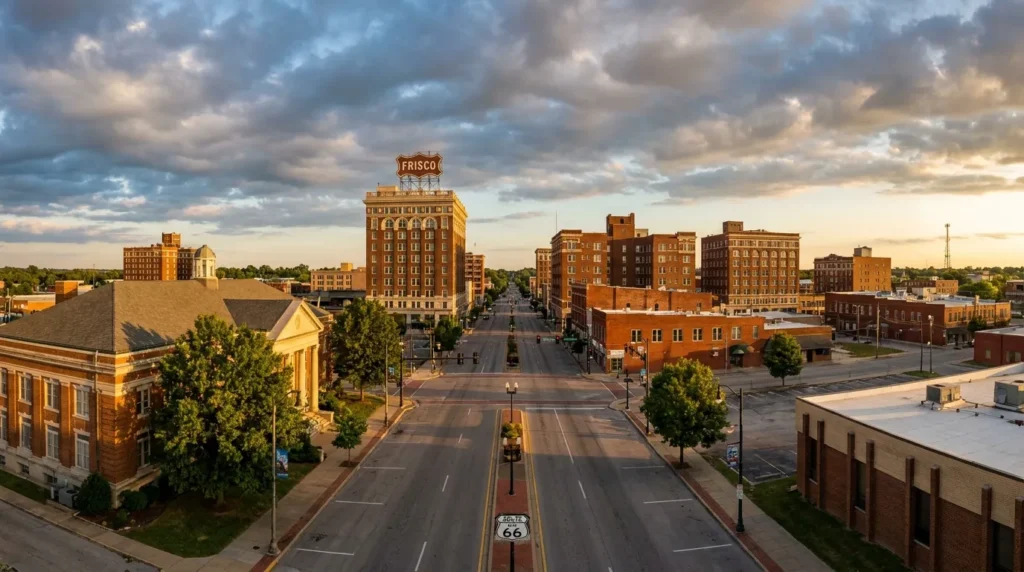
Joplin's culture has clear roots in Route 66, which crossed the city and is still celebrated with murals, a museum, and the historic stretch preserved along Main Street. Cultural life centers on community events, churches, school sports, and shows in the Cultural District revitalized after the 2011 tornado, with galleries, cafes, and the Joplin Little Theatre.

Local cuisine prizes Missouri-style barbecue, with sweet sauces and smoked red meats, along with pork ribs and fried chicken. Regional chains like Wilder's Steakhouse downtown are local institutions. Vietnamese and Mexican restaurants reflect the immigrant community and offer authentic food at accessible prices, especially along Main Street and 7th Street.

Annual events animate the city: Joplin Third Thursday downtown, the Boomtown Days music festival, the Maple Leaf Festival in neighboring Carthage, and shows at Downstream Casino in Quapaw, Oklahoma, just minutes from the border. Sports allegiances are divided among high school football, Missouri Southern Lions baseball, and fans of the Kansas City Chiefs and St. Louis Cardinals.

Notable dishes
  • Missouri-style barbecue
  • Burnt ends
  • Homemade fried chicken
  • Fried catfish
  • Toasted ravioli
  • +1 more
Annual events
  • Joplin Third Thursday
  • Boomtown Days
  • Joplin Pridefest
  • Route 66 Mural Tour Festival
  • Downtown Christmas Parade
  • +1 more

Attractions tied to Route 66, mining history, and Ozarks nature

Museums, Route 66 murals, regional parks, and Grand Falls offer programs for families and those seeking a historical or nature experience.

To understand Joplin's identity, a good starting point is the Route 66 Mural Park and the preserved stretch of the historic highway, with signs, restored facades, and the Joplin History and Mineral Museum, which chronicles the golden era of lead and zinc mining that gave rise to the city. The Bonnie and Clyde Garage Apartment, where the outlaw couple briefly lived, draws visitors interested in American history.

Grand Falls, the largest continuously flowing waterfall in Missouri, lies within the city limits and is the best-known natural landmark. For outdoor recreation, Wildcat Park offers easy trails, picnic areas, and access to Shoal Creek. On a larger scale, the Lake of the Ozarks area and Roaring River State Park are one to two hours away and attract residents on weekends.

The revitalized Cultural District concentrates galleries, the Joplin Little Theatre, independent restaurants, and cafes. For casino enthusiasts, the Downstream Casino Resort in Quapaw, Oklahoma, just minutes from the border, is a regional destination. Missouri Southern sports events, seasonal festivals, and the George A. Spiva Center for the Arts round out the local cultural calendar.

  1. 1Grand Falls
  2. 2Route 66 Mural Park
  3. 3Joplin History and Mineral Museum
  4. 4George A. Spiva Center for the Arts
  5. 5Joplin Empire Market
  6. 6Bonnie and Clyde Garage Apartment
Parks & green spaces
  • Wildcat Park
  • Schifferdecker Park
  • Mercy Park
  • Cunningham Park
  • Landreth Park
  • +1 more

Small but established immigrant communities around healthcare, meatpacking, and refuge

Latinos, Vietnamese, Marshallese, and Burmese form the core of the foreign-born population, with churches, markets, and support organizations spread across the city.

Joplin has a small immigrant population in absolute numbers, but with a visible presence in certain sectors. The largest community is Latino, primarily Mexican and Guatemalan, tied to meatpacking jobs in the region (including the neighboring city of Carthage) and construction. Latin markets, bakeries, restaurants, and Spanish-language Masses at Catholic parishes anchor community life.

The Vietnamese community established itself in the 1970s through refugee resettlement programs, with families now in the second and third generation. It maintains a Buddhist temple, traditional restaurants, and ties to larger communities in Kansas City and Oklahoma City. More recently, refugees from the Marshall Islands, Burma (Myanmar), and Congo have arrived through industrial work and federal programs.

For those arriving from abroad, support comes more from churches, schools, and regional nonprofits than from large consular networks. No foreign consulates are based in Joplin, and most consular services require travel to Kansas City, Oklahoma City, or Dallas. Organizations such as Catholic Charities of Southern Missouri and the Joplin Family YMCA offer a practical starting point for newly arrived families.

3,500
Foreign-born residents
estimated
Top countries of origin
  • Mexico
  • Guatemala
  • Vietnam
  • Marshall Islands
  • Burma (Myanmar)
  • Philippines
  • India
Foreign consulates
  • Mexican Consulate General in Kansas City
  • Mexican Consulate General in Little Rock
  • Guatemalan Consulate General in Oklahoma City
  • El Salvadoran Consulate General in Dallas
  • Honorary Vietnamese Consulate in Kansas City
Community organizations
  • Catholic Charities of Southern Missouri
  • Joplin Family YMCA
  • Crosslines Ministries
  • Watered Gardens Ministries
  • Lafayette House
  • Community Clinic of Joplin

Latest posts

Posts about Missouri

Coverage and updates related to this destination.

Showing content from Missouri, as there is no specific data for Joplin yet.