Visto n' Visa
Blog
Notícias e artigos
Destinations
Careers
Immigrants

Want to live and work in Florissant?

Personalized immigration plan with eligible visas, costs, and next steps for your goal!

If you are not eligible, you will know exactly why and what to do to improve your approval chances.

Save up to 12 hours in meetings

No pointless assessments.

Save up to 90%

Save money on vague or unfocused consultations

Avoid Fraud and Mistakes

One mistake can cost you your visa

Total Impartiality

Zero commercial bias

Decide with peace of mind

No toxic urgency

Fast and Accurate

Answers in minutes, no guesswork

A diverse city in demographic transition

Florissant has a significant mix of white and African American residents, with a growing presence of Latino and Asian families from other parts of the metropolitan area.

Florissant's population hovers around 50,000 and is divided in a relatively balanced way between white residents of European descent (German, Italian, Irish) and Black residents, many of whom relocated from neighborhoods in northern St. Louis over the past few decades. This demographic transition has given the city a more diverse character than other suburbs in the county.

English dominates daily life, but Spanish is commonly heard in markets and schools, especially among Mexican and Central American families who moved to the area attracted by housing costs. There are also smaller communities of Vietnamese, Bosnian (St. Louis has the largest Bosnian community in the United States), and South Asian residents scattered throughout the city.

The religious profile is predominantly Christian, with a strong Catholic presence (a legacy of French and German heritage) and several African American Baptist and Methodist congregations. Synagogues, mosques, and temples are found in the broader metropolitan area, accessible by car in 20 to 30 minutes.

Languages spoken
  • English
  • Spanish
  • Vietnamese
  • Bosnian
  • Arabic
Main religions
  • Catholicism
  • Protestantism (Baptist, Methodist)
  • Evangelical Christianity
  • Islam
  • Judaism

Low cost of living by American standards

Florissant is one of the most affordable options in greater St. Louis, with rents and home prices well below the national US average.

By American standards, Florissant is affordable. Three-bedroom homes with a garage and yard can be purchased at values far below those of coastal cities such as Boston, San Francisco, or New York. Two-bedroom apartment rents are also accessible, with a large supply available.

Basic utilities (electricity, gas, internet) follow the Midwestern American standard. Heating in winter and air conditioning in summer weigh more heavily than in mild-climate regions, so the monthly energy budget deserves attention. Municipal and St. Louis County property taxes are assessed annually based on home value.

Food and transportation also help: chains such as Schnucks, Aldi, and Walmart compete on price, gasoline is cheaper than the national average, and car insurance falls in an intermediate range. The major additional expense is vehicle ownership, which is practically required for working and taking children to school.

87Cost index (US = 100)13% below US average
CategorySingleCoupleFamily (2 + 2)
iHousing$1,132$1,307$1,654
iFood$331$661$1,202
iTransport$436$740$958
iHealthcare$244$488$914
iChildcare$1,585
iOther$740$1,332$1,872
Monthly total$2,883$4,528$8,185

Source: U.S. BLS Consumer Expenditure Survey 2023 + BEA Regional Price Parities 2023 · Estimates in USD, monthly.

Spacious homes at prices that surprise newcomers

Single-family homes from the 1950s to 1970s predominate in tree-lined subdivisions, with yards and garages, at very accessible prices.

Florissant's housing stock is dominated by single-family homes built in the post-World War II era, in the ranch (single-story, elongated) or split-level style. Many have a basement, two or three bedrooms, a one- or two-car garage, and front and back yards. It is the classic American suburb.

Neighborhoods such as Paddock Hills, Coachlight Park, Cross Keys, and the area around Florissant Valley Community College feature well-maintained homes and a strong sense of community. Old Town Florissant attracts those who prefer historic properties close to cafes and the civic center. Apartment complexes and townhouses are found along Lindbergh Boulevard and New Halls Ferry Road.

Buying tends to be more cost-effective in the long run than renting, since the down payment required by American banks is smaller than in expensive metros. Those newly arriving in the United States often rent for six to twelve months first, build a credit history, and then seek financing.

Recommended neighborhoods
  • Old Town Florissant
  • Paddock Hills
  • Coachlight Park
  • Cross Keys
  • Thunderbird

Work in the city or commute to greater St. Louis

The local economy revolves around healthcare, retail, and services, but most residents work in St. Louis or in the industries of the metropolitan region.

Florissant itself is not a strong economic hub. Shopping centers (Florissant Meadows, Crossings at Northwest), retail chains, restaurants, public schools, hospitals, and the municipal government serve as local employers. SSM Health DePaul Hospital, in neighboring Bridgeton, is one of the largest healthcare employers in the northern region.

Most residents commute to St. Louis, to Earth City Industrial Park, to Lambert Airport, and to factories and logistics centers throughout the region. Boeing has a major presence in St. Louis (defense and aerospace), as do Express Scripts, Edward Jones, Centene, and BJC HealthCare. Jobs in manufacturing, logistics, and healthcare services dominate the opportunities for those newly arriving.

For immigrants with developing English skills, positions are available in Amazon and FedEx warehouses, hospitals (housekeeping, kitchen, maintenance), and restaurants. Those bringing technical qualifications in IT, nursing, or engineering can find placement in St. Louis with competitive salaries relative to the local cost of living.

Dominant sectors
  • Healthcare
  • Retail
  • Logistics and warehousing
  • Manufacturing
  • Public education
  • +1 more
Major employers
  • SSM Health DePaul Hospital
  • Hazelwood School District
  • Florissant Valley Community College
  • Boeing (in St. Louis)
  • Amazon (regional logistics centers)
  • +1 more

Public schools, a community college, and nearby universities

Florissant is served by the Ferguson-Florissant and Hazelwood school districts, has a local community college, and is close to universities in St. Louis.

Public schools (free of charge) are divided by district: the Ferguson-Florissant School District serves most of the city, and the Hazelwood School District covers areas to the west and north. McCluer High and Hazelwood Central High are among the secondary schools in the area. Quality varies by school, and many families research the district before purchasing a home.

St. Louis Community College has its Florissant Valley campus within the city, offering technical, vocational, and lower-division college courses at accessible prices. It is a common entry point for immigrants who need to adapt a foreign degree or start a new career in the United States.

For four-year universities, residents have access to the University of Missouri-St. Louis (UMSL, just a few minutes away), Washington University in St. Louis (one of the most prestigious in the country), Saint Louis University, Webster University, and Maryville University. There are also private Catholic schools and several charter schools in the metropolitan area.

Notable universities
  • St. Louis Community College — Florissant Valley
  • University of Missouri-St. Louis (UMSL)
  • Washington University in St. Louis
  • Saint Louis University
  • Webster University

Hospitals and clinics within and around the city

Florissant has community clinics and is close to major hospitals in the St. Louis metropolitan area, with coverage through private plans and Medicaid.

The main local hospital is SSM Health DePaul Hospital, in neighboring Bridgeton, offering emergency services, maternity, oncology, and general surgery. Christian Hospital (BJC HealthCare), in northern St. Louis, is another nearby option for more complex cases. For pediatric cases, St. Louis Children's Hospital (in the Central West End) is a national reference.

Community clinics and family health centers serve residents without insurance or with Medicaid (the public program for low-income individuals). Affinia Healthcare and Family Care Health Centers have locations in the northern part of the county. Major pharmacies (Walgreens, CVS) are found in nearly every neighborhood, offering vaccinations and quick consultations.

The American system operates through private health insurance (paid by the employer or purchased individually on the ACA Marketplace), Medicaid for low-income individuals, and Medicare for seniors. Immigrants with a green card generally gain access after five years of residency. Before that point, religious communities and community centers often provide guidance on affordable clinics.

Florissant

Safety varies by neighborhood, with a dedicated police force

Florissant has its own police department, quiet residential areas, and busier pockets along commercial avenues.

Like many suburbs in the St. Louis metropolitan area, Florissant has significant variation in safety by neighborhood. Residential areas to the north and west (Paddock Hills, Coachlight Park, Cross Keys) are considered quiet, with active neighborhood associations and a low incidence of violent crime. Old Town is also well-patrolled.

Areas with the most incidents tend to be commercial corridors along New Halls Ferry Road, West Florissant, and areas near the border with Ferguson and Dellwood. Car theft, parking lot theft, and overnight break-ins are the most common complaints. Violent crime is rarer but does occur, and local statistics should be consulted on the municipal police department's website.

The Florissant Police Department maintains community programs, neighborhood watch, and a tip line. Basic precautions (not leaving belongings visible in the car, locking doors, lighting the entryway) cover most everyday situations.

Safer neighborhoods
  • Old Town Florissant
  • Paddock Hills
  • Coachlight Park
  • Thunderbird
  • Cross Keys
Areas to avoid
  • West Florissant Avenue corridor at night
  • Areas adjacent to the border with Dellwood and Ferguson after dark
  • Isolated commercial parking lots at night

A car-centric city with limited public transportation

A car is practically indispensable; Metro Transit buses connect Florissant to St. Louis, and MetroLink has a nearby station at Hanley.

Florissant was designed as a postwar suburb: wide streets, ample parking, supermarkets five minutes away by car. Without a personal vehicle, daily life becomes complicated. The road network includes Interstate 270, Lindbergh Boulevard, and several avenues that cross the city, connecting it to Hazelwood, Bridgeton, and downtown St. Louis.

Metro Transit operates bus lines that cross Florissant and connect residents to the North County Transit Center, MetroLink (the region's light rail system), and jobs in downtown and west St. Louis. For those working in a downtown office, combining bus and MetroLink is feasible, though the total travel time is longer than driving.

St. Louis Lambert International Airport (STL) is 15 minutes away by car, with domestic flights and some international connections (Mexico, Caribbean). Dedicated bike lanes within the city are scarce; cycling works better in parks and quiet residential streets than as a commuting option.

Airports
  • STL — St. Louis Lambert International
  • International airport

Climate

Florissant

French colonial heritage and Midwestern suburban identity

Florissant celebrates its French origins in festivals, maintains historic churches, and offers the everyday culture of backyard barbecues and college sports.

Florissant's cultural identity is built in layers: the French colonial layer, with the Old St. Ferdinand Shrine (one of the oldest churches in the Midwest) and the historic Taille de Noyer house; the German and Italian layer brought by 19th-century immigrants; and the African American culture that grew over recent decades with the arrival of families from northern St. Louis.

The cuisine follows the Midwestern and St. Louis regional standard: slow-cooked pork ribs, St. Louis-style pizza (thin crust, Provel cheese), gooey butter cake (a local specialty), and toasted ravioli (an appetizer invented in the city). Restaurants along Lindbergh and New Halls Ferry serve Mexican, Vietnamese, Italian, and Texas-style barbecue.

Events such as the Valley of Flowers Festival (an annual spring festival with a parade and concerts), the Old Town Partners Wine Walk, and year-end celebrations at the Florissant Civic Center mark the calendar. Professional sports (St. Louis Cardinals in baseball, Blues in hockey, City SC in soccer) are an important part of regional social life.

Notable dishes
  • St. Louis-style pizza with Provel cheese
  • Toasted ravioli
  • Gooey butter cake
  • Slow-cooked pork ribs (BBQ ribs)
  • Grilled pork steak
Annual events
  • Valley of Flowers Festival
  • Old Town Partners Wine Walk
  • Florissant Fall Festival
  • Independence Day Parade
  • Concerts in the Park (summer)

Colonial history, parks, and proximity to the Mississippi

Florissant offers French colonial historic sites, tree-lined municipal parks, and easy access to the cultural attractions of greater St. Louis.

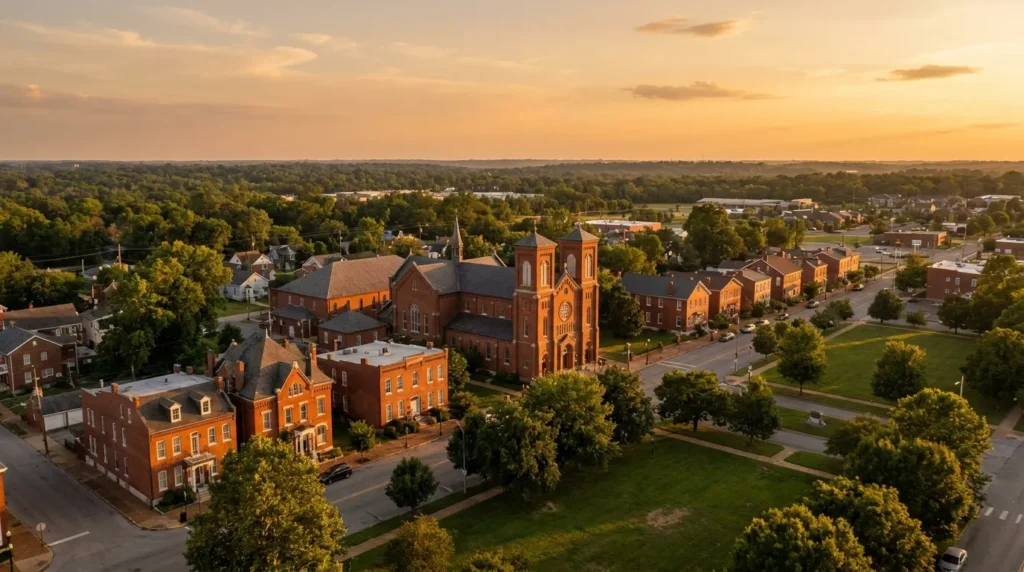
The city's tourist heart is Old Town Florissant, home to the Old St. Ferdinand Shrine (a Catholic church from 1821, one of the oldest west of the Mississippi), Taille de Noyer (an 18th-century historic house converted into a museum), and charming streets with antique shops and cafes. It makes for a short outing, ideal for a Saturday morning.

Municipal parks are well-used by residents: Koch Park, with a lake, trails, and the Knights of Columbus Sports Complex; St. Ferdinand Park, with a playground and courts; and the Florissant Sports Complex, with baseball and softball fields. The James J. Eagan Center offers an indoor pool, gymnasium, and activity programs for all ages.

The major advantage is proximity to St. Louis: the Gateway Arch (a national symbol), Forest Park (one of the largest urban parks in the United States, with a free zoo and museums), Missouri Botanical Garden, City Museum, the Anheuser-Busch Brewery, and Cardinals games at Busch Stadium are all 20 to 30 minutes away by car.

  1. 1Old St. Ferdinand Shrine
  2. 2Taille de Noyer Historic House
  3. 3Old Town Florissant
  4. 4Koch Park
  5. 5James J. Eagan Center
  6. 6Florissant Civic Center
Parks & green spaces
  • Koch Park
  • St. Ferdinand Park
  • Bangert Park
  • Sunset Park
  • Florissant Sports Complex

A diverse immigrant community connected to greater St. Louis

Florissant is home to residents born in many countries and connects to the immigrant networks of the metropolitan area, with a strong Bosnian, Vietnamese, Mexican, and African presence.

The foreign-born population in Florissant is modest in absolute numbers but plural in origins. Mexican and Central American families (from El Salvador, Guatemala, Honduras) arrived over the past two decades, attracted by low housing prices. There are also Vietnamese, Bosnian, Ethiopian, Somali, and South Asian residents scattered throughout the city.

The St. Louis metropolitan area is home to the largest Bosnian community in the United States, concentrated in Bevo Mill and Affton, with families spread across the northern county. The Vietnamese community has Buddhist temples and markets in University City and South St. Louis. Mexicans and Central Americans have a strong presence on Cherokee Street, with restaurants, markets, and festivals.

For consular services, immigrants generally travel to Chicago or Kansas City, where most general consulates are located. The International Institute of St. Louis is the main support organization: it provides assistance with refugee resettlement, English instruction, foreign diploma validation, professional training, and basic legal guidance for any nationality.

3,500
Foreign-born residents
estimated
Top countries of origin
  • Mexico
  • Bosnia and Herzegovina
  • Vietnam
  • India
  • Ethiopia
  • El Salvador
  • Philippines
  • China
Foreign consulates
  • Mexican Consulate General in Kansas City
  • Honorary Consulate of Bosnia in St. Louis
  • Consulate General of India in Chicago
  • Honorary Consulate of Italy in St. Louis
  • Honorary Consulate of Germany in St. Louis
Community organizations
  • International Institute of St. Louis
  • Hispanic Chamber of Commerce of Metropolitan St. Louis
  • Bosnian Chamber of Commerce
  • Catholic Charities of St. Louis
  • Vietnamese Community Association of Greater St. Louis

Latest posts

Posts about Missouri

Coverage and updates related to this destination.

Showing content from Missouri, as there is no specific data for Florissant yet.