Visto n' Visa
Blog
Notícias e artigos
Destinations
Careers
Immigrants

Want to live and work in Columbia?

Personalized immigration plan with eligible visas, costs, and next steps for your goal!

If you are not eligible, you will know exactly why and what to do to improve your approval chances.

Save up to 12 hours in meetings

No pointless assessments.

Save up to 90%

Save money on vague or unfocused consultations

Avoid Fraud and Mistakes

One mistake can cost you your visa

Total Impartiality

Zero commercial bias

Decide with peace of mind

No toxic urgency

Fast and Accurate

Answers in minutes, no guesswork

A young, international population driven by the university

Columbia has one of the youngest populations in Missouri, heavily influenced by roughly 30,000 students at the University of Missouri. Racial and ethnic diversity is greater than in neighboring cities.

The demographic profile stands out for its youth. University students, graduate students, faculty, and researchers make up a significant share of the population. This creates a more cosmopolitan atmosphere than might be expected in an inland Midwestern city. The international community includes Chinese, Indian, Korean, African, and Latino residents.

The African American community has a strong historical presence, rooted in the era before school racial integration. Neighborhoods like the Douglass High School area keep that history alive. Hispanics form a growing community, with Mexicans predominating. Refugees from the Democratic Republic of Congo, Eritrea, and Syria have arrived in recent years, supported by organizations such as City of Refuge.

Religiously, Columbia is more diverse than other Missouri cities. Protestant and Catholic Christian denominations predominate. There is an active synagogue, a Buddhist temple, a Hindu temple (Mid Missouri Hindu Society), and a mosque, the Islamic Center of Central Missouri. The university brings religious groups from many traditions, enriching the local spiritual landscape.

Languages spoken
  • English
  • Spanish
  • Chinese
  • Korean
  • Arabic
  • +1 more
Main religions
  • Christianity (Protestant and Catholic)
  • Judaism
  • Islam
  • Hinduism
  • Buddhism
  • +1 more

Low cost of living with high quality, attracting retirees and remote workers

Columbia has housing, food, and services below the national average. Hospitals and the university maintain high standards, creating a rare cost-to-quality ratio for a city of its size.

Housing is the main draw. Buying a decent property in Columbia costs a fraction of what it costs in coastal markets, and even less than in Kansas City or St. Louis. Rent is also affordable, though the market tightens during the academic year as students occupy a large share of the apartment inventory. Summer is the best time to move.

Food costs fall below the national average, with grocery options including Hy-Vee, Schnucks, Gerbes (a local chain), Aldi, and Trader Joe's. International markets carry Asian and Latino products. Restaurants range from local burger spots to sushi, Indian, Ethiopian, and Mexican dining. The university's influence means more variety than one would expect.

Missouri taxes apply, including a state income tax and a sales tax of around 8 percent on purchases. There is no additional municipal income tax. Healthcare costs are around the national average, with the Mizzou university health system and Boone Hospital Center nearby. Taken together, these factors make Columbia a popular choice for retirees and remote-work professionals looking to reduce costs without sacrificing infrastructure.

91Cost index (US = 100)9% below US average
CategorySingleCoupleFamily (2 + 2)
iHousing$1,179$1,361$1,723
iFood$345$689$1,252
iTransport$454$771$998
iHealthcare$254$508$952
iChildcare$1,651
iOther$771$1,388$1,950
Monthly total$3,003$4,717$8,526

Source: U.S. BLS Consumer Expenditure Survey 2023 + BEA Regional Price Parities 2023 · Estimates in USD, monthly.

A market split between students and families, with notable differences

Columbia has a two-track market: rental housing near the university is driven by students, while homes in suburban neighborhoods attract families and professionals. Buying tends to offer strong value given the prices.

Near the University of Missouri, the housing stock is dominated by student apartments, houses converted into shared rentals, and newer high-rise buildings. Rents rise in the months before the start of the academic year. For professionals without university ties, central neighborhoods like The District, Benton Stephens, and East Campus offer alternatives, though with a strong student character.

Families with children typically move to the south or east side of the city, in neighborhoods like Old Hawthorne, Bedford Walk, and around Stadium Boulevard. Newer homes with yards and double garages dominate these areas. School districts are generally well-regarded, with Rock Bridge High School and Hickman High School carrying strong academic reputations.

The purchase market offers inviting prices. Three-bedroom homes in desirable neighborhoods fall within accessible price ranges, and new developments in planned communities like Old Hawthorne offer options with community pools and walking trails. Platforms like Zillow and Realtor show available inventory, and local agents can help navigate differences between school districts.

Recommended neighborhoods
  • Old Hawthorne
  • The District (downtown)
  • Bedford Walk
  • Stadium Boulevard area
  • East Campus
  • +1 more

A market driven by the university, hospital, and insurance sectors

The three major employers are the University of Missouri, the MU Health Care system, and Shelter Insurance. Healthcare, education, and insurance dominate, with a small but growing tech scene.

The University of Missouri is the largest employer, with thousands of staff in teaching, research, administration, and operations. Professionals with academic backgrounds find opportunities through departments, research centers, and the broader university system. MU Health Care, the university hospital system, is the second-largest employer and attracts physicians, nurses, and clinical researchers.

Shelter Insurance, a regional insurance giant headquartered in Columbia, employs many people in office roles, information technology, and actuarial work. Boone Hospital Center adds jobs in the healthcare sector. Veterans United Home Loans, a mortgage company serving veterans, has grown rapidly and attracts young professionals in sales, marketing, and technology.

For immigrants, academic professionals, physicians, engineers, and scientists have clear pathways through the university and hospital. The international environment eases the transition. Demand also exists in construction, food service, retail, and other service industries. The international university community helps build useful professional networks.

Dominant sectors
  • Higher Education
  • Healthcare
  • Insurance
  • Financial Services
  • Technology
Major employers
  • University of Missouri
  • MU Health Care
  • Shelter Insurance
  • Boone Hospital Center
  • Veterans United Home Loans
  • +1 more

A top public research university and a solid K-12 school system

The University of Missouri is a Tier 1 public research university. Public K-12 schools are well-regarded overall, with Rock Bridge and Hickman High School leading the reputation.

The University of Missouri (Mizzou) is the state's flagship university, with strong programs in journalism (home to the world's first school of journalism), veterinary medicine, agriculture, law, and health sciences. It attracts students from across the state and country, along with a substantial international community. Stephens College, a private women's college, and Columbia College round out the higher education offerings.

For K-12 schooling, Columbia Public Schools has a reputation above the state average. Rock Bridge High School and Hickman High School are academically well-regarded, with AP programs, competitive sports, and varied extracurricular activities. Private options include Christian Fellowship School, and charter alternatives are also available.

For technical and professional training, Moberly Area Community College has a campus in Columbia. State Fair Community College also offers short-term programs. ESL programs for immigrant adults operate through the community college and organizations like City of Refuge and Centro Latino. Access to continuing education is facilitated by the broader university environment.

Notable universities
  • University of Missouri (Mizzou)
  • Stephens College
  • Columbia College
  • Moberly Area Community College
  • William Woods University (Fulton)

A regional medical hub with two major hospitals, one of them academic

Columbia is home to MU Health Care, an academic university system, and Boone Hospital Center, together providing broad regional coverage in emergency care, surgery, and complex specialties.

MU Health Care is the academic system affiliated with the University of Missouri School of Medicine. It includes University Hospital, Women's and Children's Hospital, Ellis Fischel Cancer Center, and several specialized clinics. As a teaching hospital, it receives complex cases from across the state, with active clinical research and a robust medical residency program.

Boone Hospital Center is the other major pillar, with a full emergency department, maternity unit, oncology, orthopedics, and cardiology services. Both systems maintain an extensive outpatient network, with primary care offices, specialists, and urgent care clinics distributed throughout the area. Mental health services have expanded in recent years, with private clinics and hospital-based programs.

As anywhere in the United States, health insurance is essential. Legally resident immigrants have access to ACA marketplace plans, employer-sponsored insurance, or Medicaid where eligible. Without coverage, costs rise quickly. For the international community, student or researcher insurance typically covers the basics, though understanding the in-network providers before scheduling appointments is strongly advisable.

Healthcare index72.0 / 100
  • Life expectancyyears at birth
    78.4yrs
  • Doctors per 1kpracticing physicians
    3.7
  • Health spendper capita, per year
    $13,473
  • Public systemoverall quality rating
    Good

A city considered safe, with a higher risk for property crime

Columbia is considered safe for its size. Violent crime is low compared to Kansas City or St. Louis. Bicycle theft, car break-ins, and opportunistic crimes are the most common complaints.

The university presence and diversified economy help keep the city calm. Residential neighborhoods like Old Hawthorne, Bedford Walk, and those around Stadium Boulevard are considered very safe. Children ride bikes through the streets, and homes generally have no bars on the windows. Local police maintain a visible presence in commercial and university areas.

Property crime is the main concern. Bicycle theft, car break-ins, and petty theft are common, especially near the university and in downtown bar parking areas. Locking cars and using sturdy chains for bicycles addresses most of the risk. Student neighborhoods see more noise complaints than incidents of violence.

The greater regional risk is not crime but tornadoes and severe storms. Between March and June, alerts are frequent. Most homes have a basement or shelter, and public sirens sound when a confirmed threat is detected. Apps like NOAA Weather Radio and official cell phone alerts help residents stay prepared. Localized flooding also occurs after heavy rains.

5.8
Homicides per 100k
per year
Safety index
60.0
Crime index
40.0
Safer neighborhoods
  • East Campus
  • Grasslands
  • Old Southwest
  • Country Club
  • Thornbrook
  • The District (downtown, during the day)
Areas to avoid
  • Parts of First Ward at night
  • Isolated areas around Providence Road late at night
  • Empty university parking lots in the early morning hours

A car-oriented city with active university transit and viable cycling

Columbia depends on the car for most activities. The GoCOMO system operates local buses; the university runs its own network. The city is bike-friendly, with trails like the MKT Trail.

The main access route is Interstate 70, which runs through Missouri connecting Kansas City to St. Louis. US-63 traverses Columbia on a north-south axis. Local traffic is light by American standards, and parking is easy outside of downtown. Most households have two cars, especially those in suburban areas.

The GoCOMO system operates local bus routes covering the main corridors, useful for trips between downtown and the university. The university runs its own free network (Tiger Line) for students. For young professionals without university affiliation, bus ridership is limited. Uber and Lyft provide good coverage during business hours and on evenings when student activity is high.

Columbia Regional Airport offers limited direct flights to hubs such as Chicago, Denver, and Dallas. For more options, many residents drive to Kansas City or St. Louis. A local strength is cycling culture. The MKT Trail and Katy Trail offer excellent routes, and the city continues to invest in bike lanes. Cycling to campus is common among students and staff.

18 min
Avg commute
50
Walkability
Airports
  • COU — Columbia Regional Airport
  • Bike infrastructure

What the Climate Is Like Living in Columbia

A university city in central Missouri with a humid continental climate: hot summers around 31 degrees Celsius, moderately cold winters with occasional snow.

Summers in Columbia are hot and humid, with highs between 30 and 32 degrees Celsius in July. Severe thunderstorms are common, and air conditioning is standard in homes and university housing.

Winters are cold but not extreme, with lows between -7 and -3 degrees Celsius in January and snowfall totaling around 45 cm per season. A medium-weight coat is sufficient, and natural gas heating is standard.

Spring brings severe thunderstorms and occasional tornadoes, while fall is the most pleasant season. Annual rainfall totals around 1,050 mm, peaking in summer.

Sunny days / year215 days
Avg high (°F)
  • 57°J
  • 64°F
  • 72°M
  • 81°A
  • 86°M
  • 95°J
  • 99°J
  • 99°A
  • 95°S
  • 88°O
  • 74°N
  • 66°D
Avg low (°F)
  • J
  • F
  • 14°M
  • 26°A
  • 39°M
  • 52°J
  • 62°J
  • 57°A
  • 48°S
  • 26°O
  • 19°N
  • 13°D
Rainfall (")
  • 2"J
  • 2"F
  • 4"M
  • 4"A
  • 5"M
  • 5"J
  • 4"J
  • 4"A
  • 2"S
  • 3"O
  • 2"N
  • 2"D

A rich cultural scene for its size, with the university driving the calendar

Columbia has an active cultural scene fueled by the university. Concerts, lectures, film festivals, college sports, and international cuisine coexist with the quieter pace of the Midwest.

The university drives much of the cultural programming. The Missouri Theatre and Jesse Hall host concerts, plays, and lectures year-round. The True/False Film Festival, held in February, is a nationally prestigious documentary event that draws filmmakers and audiences from across the United States. The Roots N Blues N BBQ Festival, in September, brings live music and regional food together.

College sports are central to life here. The Tigers in football fill Memorial Stadium during fall games. Men's basketball also commands a passionate following. The city revolves around the sports calendar, with bars, businesses, and even traffic adjusting for game days. Mizzou is the shared identity that spans generations.

The dining scene is a pleasant surprise. Restaurants like Sycamore, Beet Box, and Bleu Restaurant serve original cuisine. There are strong options for Indian, Ethiopian, Vietnamese, Mexican, and Thai food. Craft breweries like Logboat and Broadway Brewery round out the scene. Downtown, The District concentrates independent cafes, bookstores like Skylark Bookshop, and local art galleries.

Columbia

Columbia Attractions: University of Missouri City and State Center

Columbia is home to the University of Missouri (Mizzou) and sits in the center of the state, between Kansas City and St. Louis. Attractions combine university programming, vibrant local culture, and surrounding state parks.

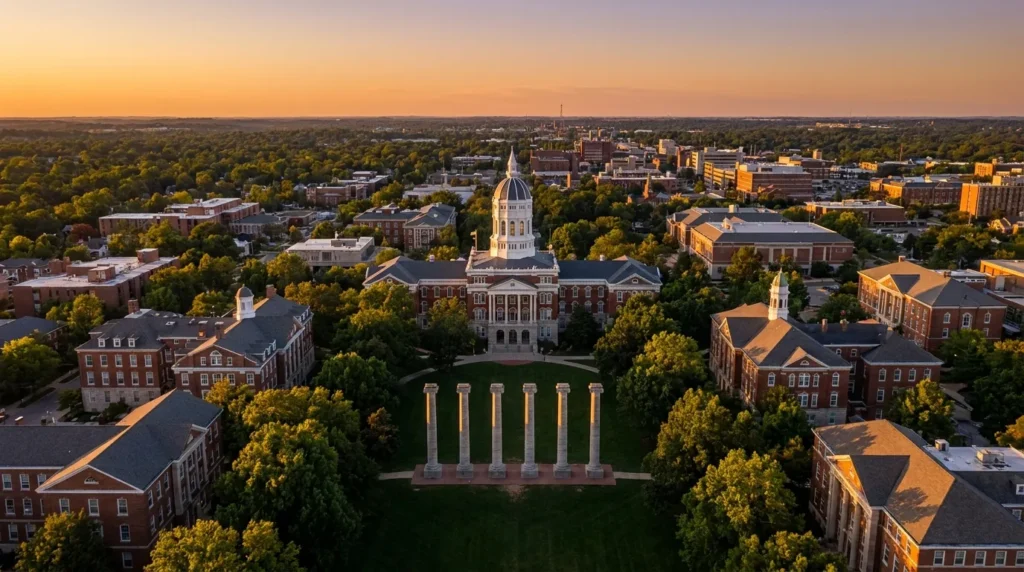
The Mizzou campus anchors cultural life, with the Museum of Art and Archaeology, the State Historical Society of Missouri, and Faurot Field, home of the Missouri Tigers in the SEC. Downtown Columbia Square concentrates restaurants, independent bookstores like Skylark Bookshop, and galleries such as Sager Reeves.

Stephens Lake Park and the MKT Nature and Fitness Trail, part of the statewide Katy Trail, are everyday anchors. The Roots N Blues Festival in October is one of the largest American music festivals in the Midwest, featuring national acts. The True/False Film Festival in March draws film enthusiasts from afar for its documentary curation.

Rock Bridge Memorial State Park and Three Creeks Conservation Area to the south offer caves, small waterfalls, and hiking trails. Thirty minutes away, Hartsburg on the Missouri River provides scenic rides on the Katy Trail and a pumpkin festival in October. Mark Twain National Forest and Lake of the Ozarks are about ninety minutes away.

  1. 1["University of Missouri (Mizzou) Columns and Francis Quadrangle"
  2. 2"Museum of Art and Archaeology"
  3. 3"Stephens Lake Park"
  4. 4"Shelter Gardens"
  5. 5"State Historical Society of Missouri"
  6. 6"Columbia Art League"
Nightlife6.0 / 10
Parks & green spaces
  • ["Stephens Lake Park"
  • "Cosmo Park"
  • "Rock Bridge Memorial State Park (nearby)"
  • "Shelter Gardens"
  • "Twin Lakes Recreation Area"
  • +1 more

Latest posts

Posts about Missouri

Coverage and updates related to this destination.

Showing content from Missouri, as there is no specific data for Columbia yet.