Visto n' Visa
Blog
Notícias e artigos
Destinations
Careers
Immigrants

Want to live and work in Cape Girardeau?

Personalized immigration plan with eligible visas, costs, and next steps for your goal!

If you are not eligible, you will know exactly why and what to do to improve your approval chances.

Save up to 12 hours in meetings

No pointless assessments.

Save up to 90%

Save money on vague or unfocused consultations

Avoid Fraud and Mistakes

One mistake can cost you your visa

Total Impartiality

Zero commercial bias

Decide with peace of mind

No toxic urgency

Fast and Accurate

Answers in minutes, no guesswork

Who Lives in Cape Girardeau

A city of around 40,000 residents, predominantly white, with a significant African American minority and a growing presence of Latino, Asian, and African immigrants drawn by the university and hospitals.

Cape Girardeau's population is around 40,000, with a predominantly white demographic and an established African American community representing approximately 10% of residents. The median age skews younger than typical rural Midwest standards, driven by students at Southeast Missouri State University.

English is the dominant language in daily life. Over the past two decades, a Hispanic community has grown, primarily of Mexican and Central American origin, visible in the Latino markets along William Street and at several Catholic churches. There are also smaller clusters of students and professionals from India, China, Nigeria, and Vietnam, connected primarily to Saint Francis Hospital and the university.

Religion plays a significant role in social life: Baptists, Catholics, and Lutherans form the majority, and several churches offer masses in Spanish. The city has a family-oriented and conservative character typical of southeast Missouri, but the university campus brings a more diverse and youthful atmosphere to the downtown area.

Languages spoken
  • English
  • Spanish
  • Vietnamese
  • Mandarin
  • Yoruba
Main religions
  • Southern Baptist
  • Roman Catholic
  • Lutheran
  • Methodist
  • Pentecostal
  • +1 more

Cost of Living in Cape Girardeau: Well Below the American Average

Rent, groceries, and gas are considerably below the United States average, making the city attractive for immigrants starting out or families seeking homeownership.

Cape Girardeau is one of the most affordable cities in the Midwest. A well-located one-bedroom apartment typically costs less than a shared room in St. Louis or Chicago, and three-bedroom homes in quiet neighborhoods still appear in the accessible price range for families with moderate incomes.

Food is a manageable budget item. Schnucks, Walmart Supercenter, and Aldi handle major grocery runs, while Latino markets such as El Sol and Casa Latina carry imported items. Local restaurants charge modest prices, and a lunch special remains a realistic option for downtown workers.

The biggest expenses tend to be a car and healthcare. There is no useful public transit, making a vehicle practically mandatory, with gas and insurance factoring into the monthly budget. Employer-sponsored health insurance is the norm, and those working at the hospital or university generally have solid coverage.

Cape Girardeau

Where to Live in Cape Girardeau

An affordable real estate market with tree-lined residential neighborhoods near the hospital and university and historic homes downtown. Renting and buying are realistic options for families.

The most sought-after neighborhoods are located around Saint Francis Hospital and the university campus. North Cape Girardeau and the Lexington Avenue area offer homes from the 1950s to 1980s on wide, tree-lined streets at favorable prices per square foot. Families with young children often target this range.

The historic downtown, around Broadway and Main Street, attracts young professionals and students looking for apartments in renovated buildings, lofts, and Victorian homes. Cape West and the Mount Auburn Road area concentrate newer condominiums with well-rated schools and proximity to West Park Mall.

Homeownership is achievable much sooner here than in larger cities. Long-term rentals typically require a one-year lease, a one-month security deposit, and proof of income equivalent to three times the monthly rent, standard American practice. Recent immigrants often start near the university and transition to homeownership within two or three years.

Recommended neighborhoods
  • North Cape Girardeau
  • Lexington Avenue
  • Cape West
  • Mount Auburn
  • Historic Downtown (Broadway/Main Street)
  • +1 more

Job Market: Healthcare, Education, and Light Industry

Hospitals, the university, and regional manufacturers sustain employment. Openings exist for healthcare professionals, technicians, educators, and informal work in construction and services.

Cape Girardeau's economy revolves around three pillars: healthcare, education, and manufacturing. Saint Francis Healthcare System and Mercy Southeast Hospital are the largest employers, with ongoing openings for nurses, technicians, physicians, attendants, and housekeeping and kitchen staff, many offering on-the-job training.

Southeast Missouri State University employs faculty, researchers, and hundreds of administrative staff. In industry, Procter and Gamble, TG Missouri (auto parts), and Buzzi Unicem (cement) offer operational positions with solid regional benefits, particularly for those willing to work shifts.

The services, hospitality, and logistics sectors absorb entry-level workers and newcomers. For immigrants, common entry points include construction, restaurants, hotel housekeeping, and industrial plants. Basic English proficiency helps significantly with career advancement, and the university offers English courses for adults.

Dominant sectors
  • Healthcare and hospitals
  • Higher education
  • Manufacturing (auto parts, cement, consumer goods)
  • Retail and services
  • Logistics and river transport
  • +1 more
Major employers
  • Saint Francis Healthcare System
  • Mercy Southeast Hospital
  • Southeast Missouri State University
  • Procter and Gamble
  • TG Missouri
  • +3 more

Education in Cape Girardeau

A mid-sized regional public university, solid public and private schools, and community college offerings. Good options for families with school-age children and adults seeking retraining.

Southeast Missouri State University, known as SEMO, is the academic heart of the city. It offers undergraduate and graduate programs in business, nursing, education, arts, and applied sciences, with tuition rates low by American standards and strong support for international students through the International Education and Services Office.

For technical training and short-term courses, the Cape Girardeau Career and Technology Center and Three Rivers College (regional campus) offer programs in welding, practical nursing, information technology, and business administration. The Cape Girardeau Public Schools system is considered solid, with Central High School standing out, and Catholic schools such as Notre Dame Regional High School round out the options.

Children of immigrants are automatically entitled to free public schooling, and the district provides English as a Second Language support for students learning the language. The university accepts F-1 visa students and has a small but active international community, with student associations from India, China, Nigeria, and Latin America.

Notable universities
  • Southeast Missouri State University (SEMO)
  • Three Rivers College — Cape Girardeau Campus
  • Cape Girardeau Career and Technology Center
  • Saint Francis School of Radiologic Technology

Healthcare in Cape Girardeau

A regional healthcare hub with two major hospitals serving all of southeast Missouri. Good access for emergencies and specialties, with longer wait times in some specific areas.

Cape Girardeau is a regional healthcare reference for more than half a million people. Saint Francis Healthcare System and Mercy Southeast Hospital handle emergency care, surgery, oncology, cardiology, and maternity services, with urban-center technology and specialized teams rarely found in smaller cities in the region.

Primary care options include private clinics, Cross Trails Medical Center locations (a federally qualified health center that serves uninsured patients on a sliding fee scale), and pharmacies such as CVS, Walgreens, and Walmart Pharmacy. Specialist appointments typically involve a wait of a few weeks, but emergency care is well handled at the emergency room.

Immigrants without health insurance should prioritize Cross Trails Medical Center and community health appointments for affordable costs. Saint Francis also has financial assistance programs for low-income patients. It is worth noting that in the United States, hospital treatment is expensive without coverage, and the first step for newcomers is to seek enrollment in a plan through employment or the Marketplace.

Cape Girardeau

Safety in Cape Girardeau

Considered safe by American standards in residential and university areas. Specific zones in the south and near downtown have higher rates, without significant impact on daily life for most residents.

Daily life in Cape Girardeau is peaceful. Violent crime exists but concentrates in specific pockets, and most residential neighborhoods allow walking, cycling with children, and leaving a car on the street overnight without major concern. The municipal police maintain a visible presence and short response times.

Areas such as North Cape, Cape West, and the university surroundings are perceived as safer. The southern perimeter, near Good Hope Street and parts of South Sprigg Street, records more property crime and drug activity, and walking alone at night in those areas is not recommended.

Those arriving from large cities will find Cape Girardeau quite calm. Those coming from small towns should apply the same basic awareness expected anywhere with foot traffic from strangers: lock the car, avoid leaving bags visible, stay alert near ATMs. Tornadoes are a greater concern than crime, and knowing the locations of emergency shelters is advisable.

Safer neighborhoods
  • North Cape Girardeau
  • Cape West
  • Mount Auburn
  • Lexington Avenue
  • SEMO campus area
  • Cape Rock
Areas to avoid
  • Good Hope Street at night
  • South Sprigg Street (southern stretches)
  • Isolated industrial areas after hours

Getting Around Cape Girardeau

A car-oriented city. Public transit is minimal, but the road network is efficient and I-55 connects easily to St. Louis and Memphis. Small regional airport with flights via Memphis or St. Louis.

A car is practically mandatory. Nearly all neighborhoods, grocery stores, schools, and workplaces are connected by wide avenues, and traffic rarely backs up outside the brief peak-hour congestion on Broadway and William Street. Interstate I-55 runs north-south through the city, connecting to St. Louis in two hours or Memphis in two and a half.

Public transit is limited to the Cape Girardeau County Transit Authority, with a few limited routes and demand-responsive service primarily serving seniors and students. Walking and cycling work within the historic downtown and around the university, but the city lacks a dedicated bicycle lane network.

Cape Girardeau Regional Airport offers limited flights via Contour Airlines to Nashville and St. Louis. For international flights, most residents drive to St. Louis Lambert (STL) or Memphis (MEM). Amtrak does not serve the city, but Greyhound and regional bus lines stop at the bus station.

Airports
  • CGI — Cape Girardeau Regional Airport
  • STL — St. Louis Lambert International (2-hour drive)
  • MEM — Memphis International (2.5-hour drive)

Climate

Cape Girardeau

Culture and Everyday Life in Cape Girardeau

A blend of Mississippi River culture, German and French heritage of southeast Missouri, a young university scene, and Midwest and Southern American culinary traditions.

Cape Girardeau breathes river history. The Mississippi River Tales Mural, the historic Old St. Vincent's Catholic Church, and the renovated downtown trace the city's trajectory from its founding by French colonists in the late 18th century. The Crisp Museum, on the university's River Campus, holds regional archaeology, art, and traveling exhibitions.

The cultural scene is driven by the university: concert seasons at the Show Me Center, performances at Bedell Performance Hall, jazz and independent film festivals. The SEMO District Fair, at the end of summer, is the major popular event, featuring rodeo, fair food, and country music shows. The Riverfest, in July, closes the downtown with live music along the riverfront.

The food scene blends Midwest and Southern traditions. Toasted ravioli (an Italian American legacy from St. Louis), pulled pork barbecue, Mississippi fried catfish, and St. Louis-style pizza (thin crust with provel cheese) appear on menus throughout the city. Restaurants like Broussard's Cajun Cuisine bring Louisiana influence, alongside solid Mexican, Vietnamese, and Indian options.

Notable dishes
  • Mississippi fried catfish
  • Toasted ravioli
  • St. Louis-style pizza with provel cheese
  • Pulled pork barbecue
  • Gooey butter cake
  • +1 more
Annual events
  • SEMO District Fair
  • Cape Riverfest
  • Tunes at Twilight (live music downtown)
  • Christmas in the Park (Capaha Park)
  • Shipyard Music Festival
  • +1 more

What to See in Cape Girardeau

Historic riverfront, murals, wooded parks, university museums, and fishing and boating routes on the Mississippi. A good weekend destination for families and river history enthusiasts.

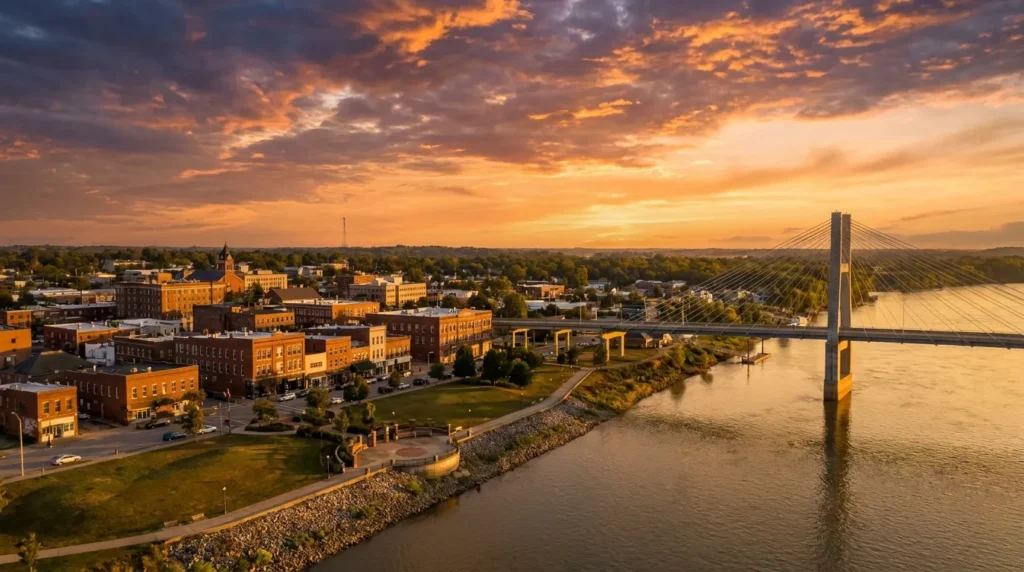
The landmark is the Mississippi River Tales Mural, twenty panels painted on the flood control wall that trace the region's history from indigenous peoples through the steamboat era. Just across, the Cape Riverfront offers a deck for viewing the river and watching barges pass.

The Crisp Museum, on the university's River Campus, holds regional archaeology, art, and traveling exhibitions. The Cape River Heritage Museum, housed in a former police station, presents local history in an intimate setting. For outdoor time, Capaha Park offers a lake, rose garden, playground, and walking trail, while Cape Rock Park provides one of the best elevated views of the Mississippi.

Trail of Tears State Park, 15 minutes away by car, offers trails through dense forest, river overlooks, and a memorial honoring the Cherokee people who crossed the region in the 19th century. For barbecue enthusiasts, university sports events, and festivals, the SEMO and Show Me Center calendar keeps the schedule active year-round.

  1. 1Mississippi River Tales Mural
  2. 2Cape Riverfront
  3. 3Crisp Museum (River Campus)
  4. 4Cape River Heritage Museum
  5. 5Capaha Park
  6. 6Cape Rock Park
Parks & green spaces
  • Capaha Park
  • Cape Rock Park
  • Arena Park
  • Kiwanis Park
  • Trail of Tears State Park (nearby)
  • +1 more

Immigrant Communities in Cape Girardeau

A small but diverse immigrant community, with a visible Latino presence in commerce, Asian and African professionals linked to the hospital and university, and international students at SEMO.

The immigrant presence in Cape Girardeau is modest but growing. The largest community is Hispanic, primarily Mexican and Central American workers in construction, restaurants, hospitality, and industrial plants. Markets such as El Sol and Casa Latina and local tortillerias serve this population, and Spanish-language masses are held at parishes including Old St. Vincent.

Another significant group comes from Asia: Indian, Chinese, Vietnamese, and Filipino professionals arrive primarily through Saint Francis Hospital, Mercy, and the university, as physicians, nurses, researchers, and graduate students. Vietnamese, Chinese, Thai, and Indian restaurants are scattered along William Street and around the campus, and international student associations are quite active at SEMO.

Newcomers can find support through organizations such as Catholic Charities of Southern Missouri, United Way of Southeast Missouri, and the university's International Education and Services Office, which provides guidance on visas, housing, and adjustment. Although no consulates are located in the city, several are within a two-to-three-hour drive in St. Louis and Memphis.

1,500
Foreign-born residents
estimated
Top countries of origin
  • Mexico
  • India
  • China
  • Vietnam
  • Philippines
  • Nigeria
  • Honduras
  • Guatemala
Foreign consulates
  • Mexican Consulate General in St. Louis
  • Honorary Japanese Consulate in St. Louis
  • Honorary German Consulate in St. Louis
  • Honorary French Consulate in St. Louis
  • Mexican Consulate General in Little Rock
  • +1 more
Community organizations
  • Catholic Charities of Southern Missouri
  • United Way of Southeast Missouri
  • SEMO International Education and Services Office
  • Cross Trails Medical Center
  • Salvation Army of Cape Girardeau
  • Safe House for Women

Latest posts

Posts about Missouri

Coverage and updates related to this destination.

Showing content from Missouri, as there is no specific data for Cape Girardeau yet.