Visto n' Visa
Blog
Notícias e artigos
Destinations
Careers
Immigrants

Want to live and work in Blue Springs?

Personalized immigration plan with eligible visas, costs, and next steps for your goal!

If you are not eligible, you will know exactly why and what to do to improve your approval chances.

Save up to 12 hours in meetings

No pointless assessments.

Save up to 90%

Save money on vague or unfocused consultations

Avoid Fraud and Mistakes

One mistake can cost you your visa

Total Impartiality

Zero commercial bias

Decide with peace of mind

No toxic urgency

Fast and Accurate

Answers in minutes, no guesswork

Predominantly white, family-oriented population with moderate growth

Blue Springs has a demographic profile typical of Midwestern suburbs: majority white, middle class, family-centered. Hispanic, African American, and Asian communities are growing slowly but remain minorities.

The ethnic composition is predominantly white, at around 80%, with an African American community of roughly 8% and Hispanic residents between 6% and 7%. The Asian population is small but present, with Indian and Vietnamese communities concentrated in specific areas. Foreign-born residents are fewer than in central Kansas City, and the pace of immigration is gradual.

The age profile is balanced, with a strong presence of families in their 30s and 50s and school-age children. The median household income exceeds the Missouri average, driven by residents who work in Kansas City. There is also a notable military community, connected to a recruitment center and veterans affiliated with Whiteman Air Force Base to the south.

For newcomers, the city lacks consolidated ethnic enclaves like Westside in Kansas City. Latin markets and churches exist but are dispersed. The Brazilian community is small and tends to circulate throughout the wider metropolitan area rather than concentrating in Blue Springs.

Languages spoken
  • English
  • Spanish
  • Vietnamese
  • Hindi
Main religions
  • Protestant Christianity
  • Catholicism
  • Latter-day Saints (LDS)
  • Unaffiliated

Cost of living below the national average, with a clear advantage in housing

Living in Blue Springs costs less than the national average. Rent, groceries, and basic utilities are more manageable than in coastal cities, though a car -- with its associated fuel and insurance costs -- is a necessary expense.

The overall cost of living index falls below the national average, with housing standing out as the main advantage. Spacious homes in residential neighborhoods come at prices that would be unthinkable in California or Massachusetts. Two-bedroom apartments in standard complexes are also more affordable than in Kansas City proper, though the supply of newer buildings is more limited.

Grocery chains such as Hy-Vee, Price Chopper, and Walmart offer competitive prices. Dining out is inexpensive at local chains and casual restaurants, and somewhat pricier at establishments in Independence or Lee's Summit. Utility bills spike in summer from air conditioning and in winter from heating, consistent with the Midwest's continental climate.

The major added expense is the car. Without one, daily life becomes impractical, which means loan payments, maintenance, fuel, and insurance. Missouri also charges an annual personal property tax on vehicles, which catches many newcomers off guard. Private health insurance, outside of employer coverage, is the heaviest cost for self-employed workers.

87Cost index (US = 100)13% below US average
CategorySingleCoupleFamily (2 + 2)
iHousing$1,132$1,307$1,654
iFood$331$661$1,202
iTransport$436$740$958
iHealthcare$244$488$914
iChildcare$1,585
iOther$740$1,332$1,872
Monthly total$2,883$4,528$8,185

Source: U.S. BLS Consumer Expenditure Survey 2023 + BEA Regional Price Parities 2023 · Estimates in USD, monthly.

Spacious homes at accessible prices, with limited vertical housing

Blue Springs is a city of houses, not apartments. Most of the housing stock consists of single-family homes in planned subdivisions, with yards, two-car garages, and basements. Rentals exist, but the market is clearly oriented toward ownership.

The housing stock is dominated by single-story and two-story homes in neighborhoods such as Adams Pointe, Woods Chapel, and Cassell Hills. Construction from the 1980s and 1990s coexists with newer subdivisions near MO-7. Three- to four-bedroom homes with two-car garages and yards are the standard, and prices still allow accessible entry for middle-class families.

Apartments are available in complexes such as Adams Pointe Apartments, Eagle Pointe, and Cassell Hills, typically two- to three-story units with pools and fitness centers. Studios and urban lofts are rare given the city's horizontal layout. Short-term rentals are more common near Lake Jacomo and Adams Pointe Golf Club than in the downtown area.

For those settling in, the typical path is to rent first in one of the complexes near I-70, then pursue a purchase once established. Inspecting the basement is standard practice: Missouri's soil requires attention to moisture intrusion and older foundations. Tornadoes are part of the regional reality, and nearly every home has a shelter or storm basement.

Recommended neighborhoods
  • Adams Pointe
  • Woods Chapel
  • Cassell Hills
  • Downtown Main Street
  • Lakewood
  • +1 more

Job market integrated with Kansas City, anchored by healthcare and education

Blue Springs alone does not have a robust economy, but it participates fully in the Kansas City labor market. Healthcare, education, retail, and logistics drive local employment, while skilled professionals commute via I-70 to the urban core.

The largest employers within the city are the St. Mary's Medical Center health system, the Blue Springs School District, and the municipal government. Retailers such as Walmart, Lowe's, and Hy-Vee also concentrate significant employment. For positions in finance, technology, engineering, or pharmaceuticals, the path leads to companies based in Kansas City or Overland Park on the Kansas side.

The Adams Dairy Parkway industrial corridor, near the Adams Dairy Landing shopping center, has become a hub for small manufacturers and distribution centers. The city offers incentives through TIF financing and tax abatements to attract employers. For skilled workers with professional credentials, opportunities in nursing, IT, mechanical engineering, and construction typically require commuting to Kansas City.

The market is considered stable, without major booms or downturns. Salaries fall below coastal averages but are offset by the lower cost of living. Workers with employment-based visas are generally sponsored by Kansas City-based companies and use Blue Springs as a place to live rather than work.

Dominant sectors
  • Healthcare
  • Public education
  • Retail
  • Logistics and distribution
  • Construction
  • +1 more
Major employers
  • St. Mary's Medical Center
  • Blue Springs School District R-IV
  • Walmart
  • Hy-Vee
  • Lowe's
  • +1 more

Strong school district and proximity to Kansas City universities

Education is one of the primary reasons families relocate to Blue Springs. The Blue Springs R-IV district is highly regarded, and the Kansas City metropolitan area offers solid options for higher education.

The Blue Springs R-IV district serves approximately 14,000 students across two large high schools, Blue Springs High School and Blue Springs South High School, along with several middle and elementary schools. State assessment scores consistently exceed the Missouri average, and the district invests in robotics, band, and athletics programs, with facilities considered above standard.

Private and religious schools are available, with St. John LaLande Catholic School being the most notable. For higher education, the nearest option is Metropolitan Community College, which operates a campus in Blue Springs offering technical programs, nursing, and two-year transfer tracks. Four-year institutions typically attended include UMKC, Park University, and the University of Central Missouri in Warrensburg.

For families with children, enrollment in public schools is straightforward, requiring proof of residence and vaccination records. The district offers ESL programs for students with limited English proficiency. Those pursuing graduate degrees or MBAs typically look to Rockhurst University or KU Edwards Campus in Overland Park.

Notable universities
  • Metropolitan Community College - Blue Springs
  • University of Missouri-Kansas City (UMKC)
  • University of Central Missouri
  • Park University
  • Rockhurst University

Solid local hospital with quick access to Kansas City's major medical systems

Blue Springs has its own hospital for emergencies and general care. For complex cases, major medical centers in Kansas City, such as Saint Luke's and the University of Kansas Health System, are within a half-hour drive.

Saint Mary's Medical Center in Blue Springs is the city's primary hospital, offering emergency services, maternity care, cardiology, and orthopedics. It is part of the Prime Healthcare system. Outpatient clinics and urgent care centers such as AdventHealth Centra Care and GoHealth handle non-emergency cases with extended hours and no prior appointment needed.

For specialized treatment, most residents travel to Kansas City. The University of Kansas Health System in Kansas City, Kansas, is a regional reference for oncology, transplants, and neurology. Saint Luke's Hospital near the Country Club Plaza is a leader in cardiology and research. Children's Mercy is the most important pediatric center in the region.

For newcomers, access to care depends almost entirely on employer-sponsored insurance. Without coverage, costs can be prohibitive. Community health centers such as Samuel U. Rodgers Health Center in Kansas City offer sliding-scale fees based on income. Pharmacies are widely available, with Walgreens, CVS, and Hy-Vee Pharmacy locations throughout Blue Springs.

Healthcare index70.0 / 100
  • Life expectancyyears at birth
    78.4yrs
  • Doctors per 1kpracticing physicians
    3.7
  • Health spendper capita, per year
    $13,473
  • Public systemoverall quality rating
    Good

Safety considered good by American metropolitan standards

Blue Springs is regarded as one of the safer cities in the Kansas City metropolitan area. Violent crime is rare, and the most common incidents involve property theft, particularly vehicle break-ins and items stolen from cars in parking lots.

Crime rates consistently fall below the averages for Kansas City and Independence, with rare homicides and low levels of violent crime. The local police maintain a visible presence in residential neighborhoods and commercial corridors near I-70. Auto theft and theft from vehicles are the most frequently reported incidents, particularly in the Adams Dairy Landing parking areas.

Severe weather is a real and serious risk. Blue Springs lies within Tornado Alley, with storm season concentrated between March and June. Warning sirens are tested regularly. Nearly every neighborhood has individual or community storm shelters, and the cell phone alert system is reliable.

Day to day, walking through residential neighborhoods at night is generally safe, though the absence of sidewalks in some areas reflects the car-centric design. Children typically move freely in older established neighborhoods. For newcomers, the adjustment to public safety tends to be smooth, with an overall sense of calm and low perceived urban risk.

5.8
Homicides per 100k
per year
Safety index
76.0
Crime index
24.0
Safer neighborhoods
  • Adams Pointe
  • Woods Chapel
  • Downtown Blue Springs
  • Stoneridge
  • South Blue Springs (near Pink Hill Park)
Areas to avoid
  • Isolated stretches along US 40 at night
  • Empty commercial areas after peak hours

Car ownership is essential; public transit is nearly nonexistent

Blue Springs is a city designed around the automobile. I-70 runs east-west through the city, and US-40 serves as an internal arterial road. Nearly every daily activity depends on personal vehicle access.

I-70 is the primary axis, connecting Blue Springs to Independence, Kansas City, and Columbia in the opposite direction. MO-7 extends south toward Lee's Summit. US-40 and Woods Chapel Road manage internal traffic flow. During peak hours, congestion tends to concentrate at the Adams Dairy Parkway exit and the MO-7 and I-70 interchange.

Public transit is minimal. RideKC operates bus lines connecting Blue Springs to Independence and downtown Kansas City, but service frequency is low and coverage does not reach most residential neighborhoods. There is no urban rail system. Rideshare services operate but with longer wait times than in denser areas.

Kansas City International Airport (MCI) is approximately 40 to 50 minutes by car, depending on traffic. For regional travel, many residents use Amtrak at the Independence or Lee's Summit stations. Cycling for errands is uncommon, though the Little Blue Trace Trail is popular for recreation.

24 min
Avg commute
22
Walkability
Airports
  • MCI, Kansas City International (about 50 km away)
  • Bike infrastructure

What the climate is like in Blue Springs

An eastern Kansas City suburb with a humid continental climate: hot and muggy summers around 32 degrees Celsius, moderately cold winters with occasional snow.

Summer in Blue Springs is hot and humid, with highs between 31 and 33 degrees Celsius in July. Strong thunderstorms are common and air conditioning is standard.

Winter is cold but not extreme, with lows between -6 and -2 degrees Celsius in January and snowfall totaling around 50 centimeters per season. Natural gas heating is standard and a medium-weight coat handles most days.

Spring brings occasional severe storms, and autumn is the most pleasant season. Annual rainfall totals around 1,000 mm, peaking in summer.

Sunny days / year215 days
Avg high (°F)
  • 57°J
  • 64°F
  • 74°M
  • 81°A
  • 85°M
  • 94°J
  • 97°J
  • 97°A
  • 94°S
  • 88°O
  • 74°N
  • 65°D
Avg low (°F)
  • J
  • F
  • 14°M
  • 25°A
  • 38°M
  • 52°J
  • 61°J
  • 58°A
  • 48°S
  • 26°O
  • 19°N
  • 15°D
Rainfall (")
  • 2"J
  • 1"F
  • 4"M
  • 3"A
  • 6"M
  • 5"J
  • 5"J
  • 4"A
  • 3"S
  • 3"O
  • 2"N
  • 2"D

Suburban life with a country touch and small-town community events

The culture of Blue Springs blends Midwestern suburban life, Missouri's rural heritage, and proximity to the Kansas City arts and entertainment scene. High school sports, barbecue, and community festivals are pillars of the social calendar.

The calendar centers on events such as the Blue Springs Fall Fun Festival in September, which fills Main Street with music, food trucks, and a parade. In summer, the Summer Music Series at Pink Hill Park draws families to outdoor concerts. The Fourth of July celebration, with fireworks at Adams Pointe, is among the most attended in the metropolitan area.

Sports are central. High school football games for the Blue Springs South Jaguars and Blue Springs Wildcats draw crowds on autumn Fridays. Twenty minutes west in Kansas City, Arrowhead Stadium (Chiefs) and Kauffman Stadium (Royals) are constants in residents' routines. Kansas City-style barbecue, with sweet sauce and smoked meats, is part of the local identity.

More sophisticated cultural offerings, such as museums, opera, and international performances, are found in Kansas City. Within Blue Springs, the focus is more community-oriented: churches, youth sports leagues, scouting, farmers markets, and chamber of commerce events. Nightlife is modest, with a handful of bars and local restaurants concentrated near downtown.

Blue Springs

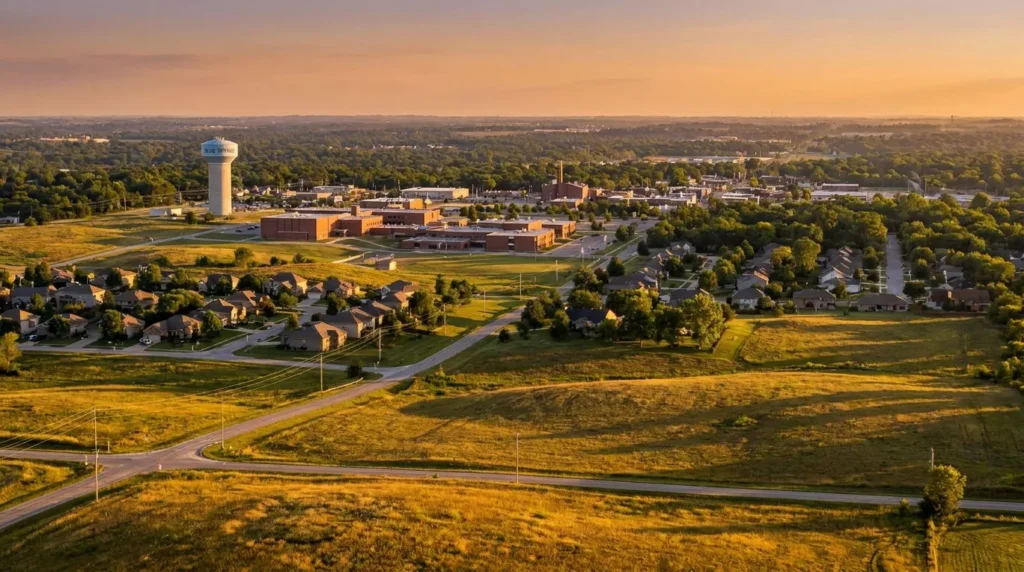
Blue Springs is an eastern Kansas City suburb with a lake and Adams Pointe

A Jackson County city east of Kansas City, Blue Springs features Blue Springs Lake, Adams Pointe Golf Club, and a revitalized Downtown. Suburban family living along I-70 and MO-7.

Blue Springs grew as a Kansas City suburb along the I-70 corridor and now boasts one of Missouri's top school networks through the Blue Springs School District. Downtown Blue Springs, centered on Main Street, has been revitalized with pubs, cafes, Vesper Hall for seniors, and the Blue Springs Farmers Market on Saturdays during the season.

Blue Springs Lake, within Fleming Park, is part of the same complex as Lake Jacomo, with marinas, an 11-mile trail, a ranger station, and camping. On weekends the lake fills with boats and barbecues. The Burr Oak Woods Conservation Nature Center, on the western side of the city, offers short trails and a free educational center run by the Missouri Department of Conservation.

Adams Pointe Golf Club, near Bass Pro Shops, and Adams Dairy Landing, a lifestyle center on Adams Dairy Parkway, anchor the commercial leisure scene. The Missouri Mavericks (now the Kansas City Mavericks) formerly played at the nearby Independence Events Center. Pink Hill Park and Hartman Heritage Center round out the suburban fabric.

  1. 1["Blue Springs Lake and Fleming Park"
  2. 2"Burr Oak Woods Conservation Nature Center"
  3. 3"Adams Pointe Golf Club"
  4. 4"Historic Downtown (Main Street Blue Springs)"
  5. 5"Missouri Town 1855 (living history park in Fleming Park)"
  6. 6"Blue Springs Family Aquatic Center"]
Nightlife3.0 / 10
Parks & green spaces
  • ["Fleming Park"
  • "Pink Hill Park"
  • "Burr Oak Woods"
  • "Ward Park"
  • "Hidden Valley Park"
  • +1 more

Latest posts

Posts about Missouri

Coverage and updates related to this destination.

Showing content from Missouri, as there is no specific data for Blue Springs yet.