Visto n' Visa
Blog
Notícias e artigos
Destinations
Careers
Immigrants

Want to live and work in Tupelo?

Personalized immigration plan with eligible visas, costs, and next steps for your goal!

If you are not eligible, you will know exactly why and what to do to improve your approval chances.

Save up to 12 hours in meetings

No pointless assessments.

Save up to 90%

Save money on vague or unfocused consultations

Avoid Fraud and Mistakes

One mistake can cost you your visa

Total Impartiality

Zero commercial bias

Decide with peace of mind

No toxic urgency

Fast and Accurate

Answers in minutes, no guesswork

A city divided between white and Black residents, with a growing Hispanic presence

Tupelo's population is divided between white and African American residents, with a growing Hispanic community tied to the automotive industry and construction. The Asian community is small, primarily Indian, and connected to the medical sector.

The ethnic composition is roughly 60% white, 33% African American, 4% Hispanic, and about 2% Asian. The African American community has deep roots in northeast Mississippi and is concentrated in areas such as Joyner, Carver, and South Tupelo. White residents are found in neighborhoods like Belden and the western part of the city.

The Hispanic community has grown the most over the past two decades, drawn by the Toyota Mississippi plant in Blue Springs (adjacent to Tupelo) and regional industries. There is a Mexican and Central American community with its own markets, Spanish-language evangelical churches, and restaurants. Asians, primarily Indians, are connected to North Mississippi Medical Center, with a presence in medicine and pharmacy.

For Brazilian immigrants, the community is very small. The Hispanic community is more established, with Latin markets such as El Mercadito and some Spanish-language churches. Established families dominate the age profile, with a strong presence of industrial working class and a middle class tied to the hospital. The age profile also includes retirees relocating for the low cost of living.

Languages spoken
  • English
  • Spanish
  • Hindi
  • Mandarin
Main religions
  • Protestant Christianity (Baptist, Methodist, Pentecostal)
  • Catholicism
  • AME Church
  • Hinduism

One of the lowest costs of living in the United States

Living in Tupelo is very affordable compared to the national average. Housing, food, and services are attractively priced. The main expenses are a car, air conditioning, and health insurance, common to any Southern city.

The overall index sits well below the US national average. Housing is the main draw, with spacious homes and yards at prices that would barely cover a studio apartment in coastal cities. A two-bedroom apartment rental is comfortable on local incomes, and most residents opt to buy.

Grocery stores such as Kroger, Walmart, Aldi, and Sam's Club maintain competitive prices. Dining out is affordable at chains along Main Street and Gloster Street, and more expensive at restaurants in the Fairpark District, the newer part of downtown. Gas prices rank among the lowest in the US, and property taxes are modest. Electric bills spike in summer due to air conditioning.

The major operating cost is a car, which is essential for nearly everything. Individual health insurance outside of employer coverage remains the heaviest expense for self-employed workers. For the middle class and industrial workers, Tupelo allows a comfortable lifestyle on a relatively modest income, with homeownership, a second car, and regular savings, something difficult to achieve in larger cities.

Tupelo

Historic homes, family neighborhoods, and new subdivisions along West Main

Tupelo's real estate market mixes historic homes near downtown, established family neighborhoods, and new subdivisions to the west and north. Rentals exist, but the market is predominantly owner-occupied.

Neighborhoods such as Belden, North Green, and Joyner Village feature homes from the 1960s and 70s on tree-lined streets, with good prices and a quiet lifestyle. Lawndale and Country Club Road concentrate more upscale homes, near the Tupelo Country Club. New subdivisions are growing to the west, toward Saltillo, with three- and four-bedroom brick homes.

Apartments are available in complexes such as The Reserve at Tupelo, The Eagles at Tupelo, and in smaller buildings near Main Street. Studios and urban lofts are rare, though the Fairpark District has some conversions. Short-term rentals via Airbnb are more common around the Elvis birthplace and during cultural events. For new professionals, condos near the Renasant Center are an option.

For immigrants, the most common path is renting first in complexes near Main Street or Gloster Street, then evaluating a purchase in subdivisions like Lawndale or in Saltillo. Inspection of foundations, roofing, and mold is essential given the hot and humid climate. Tornadoes are a serious reality, and nearly every home has a reinforced storm shelter area.

Recommended neighborhoods
  • Belden
  • Lawndale
  • North Green
  • Joyner Village
  • Saltillo
  • +1 more

Healthcare, automotive, and furniture drive employment

Tupelo's economy revolves around North Mississippi Medical Center, Toyota Mississippi's automotive operations, and the historic furniture sector. Retail, logistics, and banking round out the picture.

The largest employer is North Mississippi Medical Center, with more than five thousand employees, one of the largest non-metropolitan hospitals in the United States. Toyota Mississippi, in Blue Springs (20 minutes away), produces the Corolla and employs thousands, with suppliers such as Cooper Tire (now Goodyear) based in Tupelo. The furniture industry, though smaller than in the past, still employs workers at companies such as American Furniture and Lane Furniture.

Renasant Corporation, a bank headquartered in Tupelo, is one of the largest corporate employers. Cadence Bank, formerly BancorpSouth, was headquartered in Tupelo before the merger. Retail is strong at the Mall at Barnes Crossing and along Gloster Street. For immigrants, opportunities arise in healthcare, automotive engineering, manufacturing, IT, and financial services.

Wages in manufacturing and healthcare are competitive relative to the regional cost of living. Visa sponsorship is more common at North Mississippi Medical Center, Toyota, and medical technology companies. Self-employed professionals typically serve regional clients, with limited demand for creative freelance work compared to larger cities.

Dominant sectors
  • Healthcare
  • Automotive industry
  • Manufacturing (furniture and parts)
  • Financial services
  • Retail
  • +1 more
Major employers
  • North Mississippi Medical Center
  • Toyota Motor Manufacturing Mississippi (Blue Springs)
  • Renasant Corporation
  • Cooper Tire (Goodyear)
  • American Furniture
  • +1 more

A local community college and accessible universities within an hour

Tupelo has its own school district and Itawamba Community College in the area. For four-year higher education, Ole Miss in Oxford and Mississippi State in Starkville are approximately an hour's drive away.

Tupelo Public School District serves about eight thousand students, with average state ratings. Neighboring districts such as Lee County and Saltillo tend to have higher ratings. Private schools such as Tupelo Christian Preparatory School, North Mississippi Christian Academy, and All Saints Episcopal School are common alternatives for middle-class families.

Itawamba Community College has a campus in Tupelo, offering technical programs, nursing, and two-year transfer degrees. The University of Mississippi (Ole Miss) in Oxford is about an hour to the west and is the state's flagship university. Mississippi State University in Starkville is about an hour to the southeast. Mississippi University for Women in Columbus and Blue Mountain Christian University are regional alternatives.

For immigrants with children, enrollment in public schools is straightforward, with ESL programs available in the Tupelo district given the Hispanic presence tied to industry. For graduate work, MBAs, and doctorates, Ole Miss and Mississippi State are the typical choices. The University of Mississippi Medical Center in Jackson serves those pursuing medicine.

Notable universities
  • Itawamba Community College - Tupelo
  • University of Mississippi (Ole Miss)
  • Mississippi State University
  • Blue Mountain Christian University
  • Mississippi University for Women

North Mississippi Medical Center, one of the largest rural hospitals in the US

North Mississippi Medical Center is the largest non-metropolitan hospital in the United States and serves patients from across the region. It covers emergency care, oncology, cardiology, orthopedics, and maternity services.

North Mississippi Medical Center is the regional healthcare hub, with more than 600 beds, an emergency department, oncology, cardiology (including open-heart surgery), orthopedics, neurology, and maternity services. It serves patients from northeast Mississippi, west Alabama, and north Tennessee. The center is affiliated with medical residency programs and attracts physicians from diverse backgrounds.

Clinics and outpatient centers within the North Mississippi Health Services network are spread throughout the city, covering general medicine, pediatrics, gynecology, and specialties. Urgent care facilities such as Tupelo Urgent Care and Express Care handle non-emergency cases. For specialized treatment of rare cancers or advanced pediatric surgery, patients are referred to UMMC in Jackson or to Memphis.

For immigrants, employer-sponsored health insurance is essential. Community clinics offer income-based sliding-scale fees at specific locations. Pharmacies are available throughout all neighborhoods, including Walgreens, CVS, Kroger Pharmacy, and Walmart Pharmacy. Access to specialists is faster by state standards, given the concentration of professionals at NMMC.

Healthcare index62.0 / 100
  • Life expectancyyears at birth
    78.4yrs
  • Doctors per 1kpracticing physicians
    3.7
  • Health spendper capita, per year
    $13,473
  • Public systemoverall quality rating
    Fair

Reasonable safety for a Southern city, with variation by neighborhood

Tupelo's crime rates align with the average for mid-size Southern cities, with property crime being the most common type. Residential neighborhoods to the north and in Saltillo are quiet, and commercial areas call for ordinary precautions.

Property crimes such as theft, car break-ins, and shoplifting are the most common, particularly along Gloster Street, at the Mall at Barnes Crossing, and in commercial parking lots. Violent crime is isolated and concentrated in specific areas. Neighborhoods such as Belden, Lawndale, and Saltillo are considered safe and attract families and professionals.

Local policing is considered active, with a presence in schools and residential neighborhoods. Security cameras in condominiums and home alarm systems are common in upper-middle-class neighborhoods. For immigrants coming from Brazilian cities with high crime rates, Tupelo generally feels safer, with the ordinary precautions expected in a mid-size American city.

Severe weather is the primary concern. Tornadoes are a real threat, and Tupelo was devastated by an F5 tornado in 1936, one of the worst in American history. Tornadoes continue to occur every year, especially between March and June. Sirens and a cell phone alert system are reliable. For newly arrived immigrants, it is worth learning the alert system, identifying the reinforced area of the home, and having a basic emergency plan.

5.8
Homicides per 100k
per year
Safety index
62.0
Crime index
38.0
Safer neighborhoods
  • North Tupelo
  • Joyner
  • Highland Circle
  • Country Club area
  • Saltillo (neighboring city)
  • Downtown Tupelo (historic center)
Areas to avoid
  • Sections of South Gloster Street at night
  • Areas near Main Street with poor lighting
  • Industrial sectors along the railroad

A car-dependent city with a regional airport and the Natchez Trace nearby

Tupelo is entirely car-dependent. I-22 and Highway 45 organize traffic flow. The regional airport has limited flights, and the Natchez Trace Parkway offers a scenic route to Nashville and Jackson.

I-22 cuts through the city on an east-west axis, connecting Memphis to Birmingham. Highway 45 runs north-south, connecting to Columbus and Corinth. Main Street and Gloster Street are the main commercial corridors within the city. The Natchez Trace Parkway, a preserved national road, passes through the surrounding area and offers a scenic route to Jackson to the south and Nashville to the north.

There is no structured public transit within Tupelo. Uber and Lyft operate, with longer wait times in outlying neighborhoods. There is no urban rail. Cycling is feasible along sections of the Tanglefoot Trail, a 44-mile multi-use path connecting Tupelo to Houston, Mississippi. Walking for errands is rare outside the Fairpark District.

Tupelo Regional Airport (TUP) has limited flights to Atlanta via Contour Airlines. For more options, most travelers drive to Memphis International Airport (MEM), about an hour and a half away, or Nashville International Airport (BNA), about three hours away. Amtrak does not stop in Tupelo, but has a station in Memphis on the City of New Orleans line, connecting Chicago to New Orleans.

16 min
Avg commute
32
Walkability
Airports
  • TUP — Tupelo Regional Airport
  • MEM — Memphis International (approximately 106 miles away)
  • Bike infrastructure

What the Climate Is Like Living in Tupelo

Located in northern Mississippi, Tupelo has a humid subtropical climate with long, hot summers around 90 degrees Fahrenheit, mild winters, and frequent severe storms.

Summer in Tupelo is long and humid, with highs between 90 and 93 degrees Fahrenheit from June through September. Afternoon thunderstorms are common and air conditioning is essential.

Winter is short and mild, with lows between 32 and 39 degrees Fahrenheit in January. Frost is occasional and snow is rare but possible in January. A medium-weight coat is sufficient.

Spring is the most hazardous season, with real tornado risk in March and April, while fall is the most pleasant time of year. Annual rainfall totals around 57 inches, peaking in winter and spring.

Sunny days / year216 days
Avg high (°F)
  • 54°J
  • 58°F
  • 67°M
  • 72°A
  • 81°M
  • 88°J
  • 91°J
  • 90°A
  • 87°S
  • 75°O
  • 63°N
  • 58°D
Avg low (°F)
  • 37°J
  • 40°F
  • 47°M
  • 51°A
  • 61°M
  • 68°J
  • 73°J
  • 72°A
  • 67°S
  • 56°O
  • 43°N
  • 41°D
Rainfall (")
  • 6"J
  • 8"F
  • 7"M
  • 6"A
  • 3"M
  • 4"J
  • 5"J
  • 4"A
  • 2"S
  • 3"O
  • 3"N
  • 5"D

Elvis heritage, blues, festivals, and a live music scene

Tupelo's culture is shaped by Elvis Presley's musical heritage, North Mississippi blues, and Southern tradition. Year-round festivals, museums, and nightlife in the Fairpark District enliven the calendar.

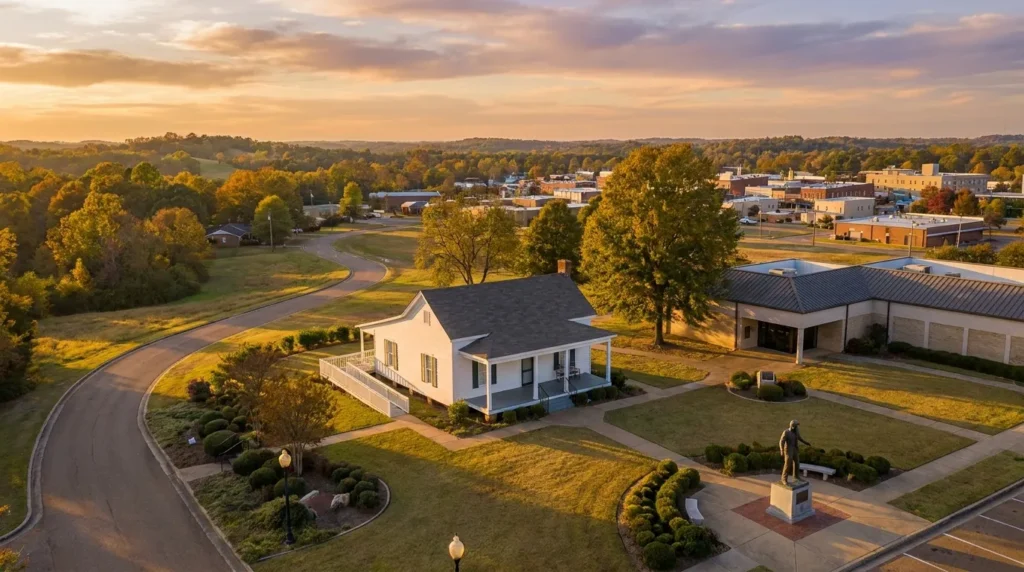
The Elvis Presley Birthplace is the main tourist attraction, featuring a museum, chapel, preserved home, and a statue of young Elvis. The Elvis Festival, held in June, is an annual event drawing fans from around the world. Tupelo Hardware, where Elvis's mother bought his first guitar, still operates as a store and is now a required stop for visitors. The Tupelo Automobile Museum houses a sizeable collection of classic cars.

Festivals such as the GumTree Festival in May, featuring art and music downtown, and the Tupelo Furniture Market, an industry trade event, anchor the calendar. The BancorpSouth Arena hosts national acts and sporting events. Ole Miss and Mississippi State university sports are an important part of the culture, with Oxford and Starkville a short drive away.

The dining scene mixes barbecue, soul food, Southern cuisine, and common American chains. Restaurants such as Vanelli's, Romie's Grocery, and Park Heights are local institutions. Mexican food has a strong presence in Latin markets and restaurants along Gloster Street. For a denser cultural scene, Memphis is about an hour and a half to the northwest.

Tupelo

What to Do in Tupelo Day to Day

Tupelo is the birthplace of Elvis Presley and the southern starting point of the Natchez Trace Parkway. Cultural life blends musical heritage, neighborhood parks, and festivals throughout the year.

The Elvis Presley Birthplace is the main tourist anchor, featuring the house where he was born, a museum, a chapel, and a bronze statue of the young boy with a guitar. A few blocks away stands the Tupelo Hardware Company, a store in operation since 1926 where Gladys Presley purchased her son's first guitar. The Oren Dunn City Museum covers the broader regional history, from the Chickasaw people to the furniture manufacturing era.

The Fairpark District serves as the civic center, home to city hall, the BancorpSouth Arena for concerts and college basketball games, and Tupelo Veterans Park. The Natchez Trace Parkway Visitor Center, at the city's northern entrance, marks the beginning of the 444-mile scenic road stretching to Nashville and draws cyclists year-round.

For everyday life, Veterans Memorial Park offers trails, lakes, and the Buffalo Park and Zoo. Ballard Park provides playgrounds and courts, and the Whiskey Run Creek Trail connects several neighborhoods. Events such as the Tupelo Elvis Festival, the Gum Tree Festival, and the Tupelo Honey Festival bring activity to Main Street on fixed dates.

  1. 1["Elvis Presley Birthplace and Museum"
  2. 2"Tupelo Automobile Museum"
  3. 3"Tupelo Buffalo Park and Zoo"
  4. 4"Oren Dunn City Museum"
  5. 5"Natchez Trace Parkway Visitor Center"
  6. 6"Healing Garden (downtown)"
Nightlife3.0 / 10
Parks & green spaces
  • ["Ballard Park"
  • "Veterans Memorial Park"
  • "Theron E. Nichols Park"
  • "Whitesides Park"
  • "Tupelo Buffalo Park"
  • +1 more

Latest posts

Posts about Mississippi

Coverage and updates related to this destination.

Showing content from Mississippi, as there is no specific data for Tupelo yet.