Visto n' Visa
Blog
Notícias e artigos
Destinations
Careers
Immigrants

Want to live and work in Pascagoula?

Personalized immigration plan with eligible visas, costs, and next steps for your goal!

If you are not eligible, you will know exactly why and what to do to improve your approval chances.

Save up to 12 hours in meetings

No pointless assessments.

Save up to 90%

Save money on vague or unfocused consultations

Avoid Fraud and Mistakes

One mistake can cost you your visa

Total Impartiality

Zero commercial bias

Decide with peace of mind

No toxic urgency

Fast and Accurate

Answers in minutes, no guesswork

Who lives in Pascagoula

Pascagoula has a small population, predominantly Anglo-American and African American, with a growing presence of Hispanic and Southeast Asian families tied to the shipyard and the fishing industry.

The demographic profile blends white families from the American South, a historically rooted African American community, and a significant Vietnamese contingent that arrived in the 1970s and 1980s to work in shrimping and shipbuilding. The Latino presence, mostly Mexican and Central American, has grown over the last two decades in construction, services, and seafood processing.

Most residents speak English at home, with pockets of Spanish and Vietnamese in local commerce and churches. Religion carries weight: Southern Baptists, Catholics, and Methodists dominate the religious landscape, with churches visible in nearly every neighborhood and strong community life centered on parishes.

It is a city of young families and industrial workers, with median wages supported by Ingalls. Social life happens in schools, churches, and shipyard events more than in urban cultural scenes, giving daily life a small-town tone.

Languages spoken
  • English
  • Spanish
  • Vietnamese
Main religions
  • Southern Baptist
  • Catholic
  • Methodist
  • Pentecostal
  • Buddhism (Vietnamese community)
Cost of living in Pascagoula

The cost of living in Pascagoula is well below the United States average, with cheap housing, affordable fuel, and low state taxes in Mississippi.

Pascagoula is one of the most affordable cities on the Gulf. Rent for a modest two- or three-bedroom house typically runs well below comparable prices in Mobile or Biloxi, and buying property is feasible for families with industrial middle-class income, especially outside the areas closest to the refinery.

Groceries, transportation, and utility bills sit below the national average, although electricity bills climb sharply in summer due to constant air conditioning. Mississippi has one of the lowest average costs of living in the country, which helps those relying on shipyard wages or service jobs.

The expensive side is home insurance: as a hurricane and flood zone, policies and flood coverage strain the household budget. A personal vehicle is practically mandatory, so fuel, maintenance, and auto insurance enter the monthly calculation of any family.

Pascagoula

Where to live in Pascagoula

Pascagoula offers affordable single-story homes in quiet residential neighborhoods, with more valuable options near the shoreline and alternatives in neighboring cities like Gautier and Ocean Springs.

Most of the housing stock consists of single-story homes with yards, built between the 1950s and the 1990s. Beach Park and the neighborhoods near Beach Boulevard concentrate the more valuable properties, with views or easy access to the Gulf. Areas like Gulf Hills and the surroundings of Singing River Hospital tend to be the favorites of families.

Those who work at Ingalls often prefer to live in Gautier, Ocean Springs, or Moss Point, neighboring cities with well-rated schools and a short commute. Rent is affordable, and the supply of homes for purchase with financing is large, with new subdivisions emerging northwest of the city.

Apartments are a minority: the local culture favors houses with a garage and a yard. Newcomers from big cities need to adjust to the absence of tall buildings, dependence on cars, and the requirement of flood insurance in much of the zone close to the river and the coast.

Recommended neighborhoods
  • Beach Park
  • Gulf Hills
  • Cherokee Forest
  • Pascagoula Historic District
  • Gautier (neighboring)
  • +1 more

Work and opportunities in Pascagoula

The job market revolves around Ingalls Shipbuilding, the Chevron refinery, fishing, and healthcare services, with strong demand for technical and industrial labor.

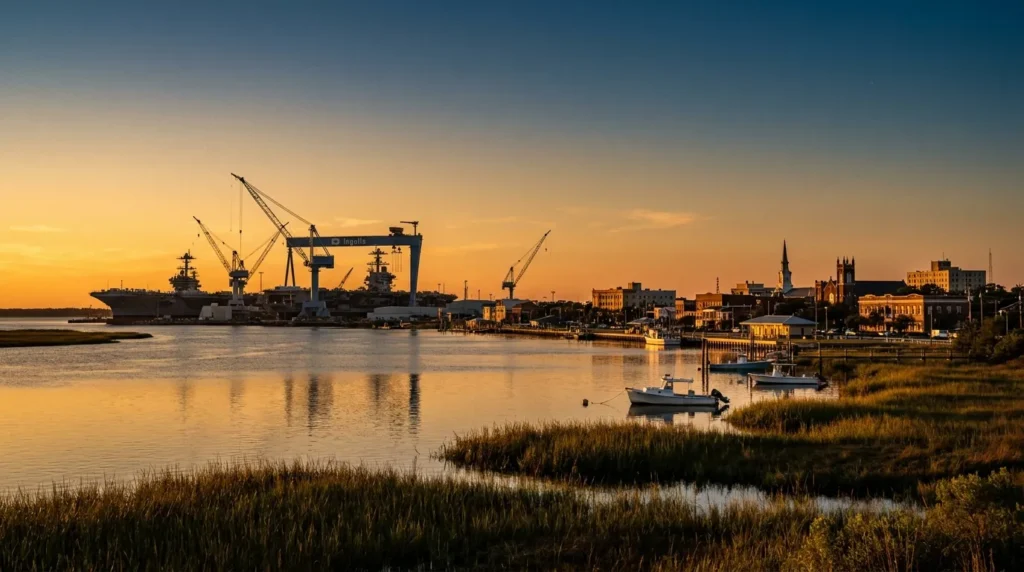
Ingalls Shipbuilding, part of HII, is the largest private employer in Mississippi and dominates the local market, hiring welders, electricians, industrial painters, engineers, and naval technicians at scale. The Chevron Pascagoula Refinery follows close behind, with openings in operations, maintenance, and engineering.

Singing River Health System concentrates healthcare jobs, including nursing, technicians, and administrative roles. Shrimping, seafood processing, maritime transport, and port logistics also support a considerable share of families, with a tradition of small boat owners and aquaculture operations in the bayous.

For immigrants with technical training, especially in welding, mechanics, and industrial processes, real demand exists. For those looking for office, technology, or creative jobs, the city is limited and Mobile, Alabama, tends to be the closest reference for those careers.

Dominant sectors
  • Shipbuilding
  • Petroleum refining
  • Fishing and seafood processing
  • Healthcare
  • Port logistics
  • +1 more
Major employers
  • Ingalls Shipbuilding (HII)
  • Chevron Pascagoula Refinery
  • Singing River Health System
  • Mississippi Export Railroad
  • Signal International
  • +1 more

Education in Pascagoula

Pascagoula has public state schools administered by the Pascagoula-Gautier School District and nearby access to community colleges and universities in Mobile and Hattiesburg.

Local public education is managed by the Pascagoula-Gautier School District, with elementary and middle schools and Pascagoula High School as the main reference. As across the American South, performance varies significantly between neighborhoods, and higher-income families sometimes choose private Catholic or Christian schools in the region.

Mississippi Gulf Coast Community College, with a campus in Jackson County, offers short technical courses closely aligned with the shipyard and the refinery: welding, industrial electricity, mechanics, nursing, and information technology. For adult immigrants, it is the most practical gateway to skilled jobs.

Full-cycle universities are located in Mobile (University of South Alabama), Hattiesburg (University of Southern Mississippi), and Starkville (Mississippi State). English as a second language and citizenship classes are usually offered through community programs, public libraries, and local churches.

Notable universities
  • Mississippi Gulf Coast Community College
  • University of South Alabama (Mobile)
  • University of Southern Mississippi (Hattiesburg)
  • William Carey University (Mobile campus)

Health and medical care in Pascagoula

The local health system is anchored by Singing River Health System, with a general hospital in Pascagoula, scattered clinics, and regional referral to Mobile and Biloxi.

Singing River Hospital, in Pascagoula, is the main hospital in Jackson County, with a 24-hour emergency room, maternity, cardiology, and general surgery. The Singing River network also operates primary care clinics, urgent care centers, and specialty centers throughout the city and in Ocean Springs and Gautier.

Those who work at Ingalls or Chevron usually have employer-sponsored health insurance, which makes access easier. For those without insurance, costs can be high, and Mississippi did not expand Medicaid, so adults without dependents have few public options. Federally Qualified Health Centers offer an alternative with income-based fee scales.

In complex cases, patients are often referred to larger hospitals in Mobile, especially USA Health University Hospital. Chain pharmacies like Walgreens, CVS, and Walmart are abundant, and telemedicine is increasingly used by families in more remote areas.

Pascagoula

Safety in Pascagoula

Pascagoula has the profile of a small city with average crime for the American South, with quiet residential neighborhoods and some industrial or run-down areas that require more attention.

Generally, Pascagoula is seen as a safe city by American standards, with crime driven by thefts, vehicle break-ins, and domestic incidents more than by random violent crimes. Residential neighborhoods like Beach Park, Cherokee Forest, and the surroundings of the hospital tend to be quiet, with strong police presence and active neighborhood watch.

Older areas near the port, certain parts of Moss Point (neighboring city), and industrial stretches near the refinery have a reputation for more incidents. They are not panic zones, but locals avoid walking alone there at night. Hurricanes and floods are the most relevant collective risk, with the need for an evacuation plan during the season.

For families arriving from elsewhere, the practical recommendation is to lock the car, install simple cameras, get to know the neighborhoods before renting, and respect National Weather Service alerts. The local police and the Mississippi Highway Patrol respond in reasonable times, and community life tends to support the sense of safety.

Safer neighborhoods
  • Beach Park
  • Cherokee Forest
  • Gulf Hills
  • Surroundings of Singing River Hospital
  • Pascagoula Historic District
Areas to avoid
  • Industrial stretches near the refinery at night
  • Run-down areas around the port
  • Older parts of Moss Point after dark

How to get around Pascagoula

Pascagoula is a car-oriented city, with access via Interstate 10 and a regional airport in Mobile, and almost no structured public transit network.

Residents of Pascagoula essentially need a car. I-10 cuts through southern Mississippi and quickly connects the city to Biloxi, Gulfport, Mobile, and New Orleans, while US-90 runs parallel to the coast through every neighboring town. Parking is abundant and free almost everywhere.

Local public transit is minimal, with few regional bus options through the Coast Transit Authority toward Biloxi and Gulfport. Ride-hailing apps work but with limited coverage outside business hours. Biking is feasible in residential areas, but the network of dedicated bike lanes is small.

For flights, the main regional airport is Mobile Regional Airport (MOB), about 45 minutes away. Gulfport-Biloxi International (GPT) is also an option, and international flights usually require a connection through Atlanta, Dallas, or Houston. The Port of Pascagoula is important for cargo, not for passengers.

Airports
  • MOB, Mobile Regional Airport (45 min)
  • GPT, Gulfport-Biloxi International (60 min)

Climate

Pascagoula

Culture and daily life in Pascagoula

Local culture blends traditions of the American South, Gulf Creole heritage, and the influence of the Vietnamese community, with a strong presence of outdoor festivals and seafood cuisine.

Pascagoula's identity is that of the Coastal South: Baptist and Catholic churches as social hubs, family dinners with fried fish and shrimp, and weekends devoted to fishing, college football, and backyard barbecues. The legend of the Singing River, tied to the indigenous Pascagoula people, is part of the local imagination.

The Creole and Cajun heritage of the Gulf appears in food and music, with gumbo, jambalaya, and po'boys available in diners and small restaurants. The Vietnamese community brought pho, banh mi, and Asian grocery stores in Biloxi, a few minutes by car, considerably expanding the region's culinary offerings.

The year has established events: the Mississippi Deep Sea Fishing Rodeo, seafood fairs, Mardi Gras parades during the Gulf Carnival season, and community festivals tied to the shipyard. Nightlife is discreet, concentrated in neighborhood bars and the Biloxi casinos for those looking for more action.

Notable dishes
  • Gulf shrimp
  • Pascagoula oysters
  • Gumbo
  • Shrimp po'boy
  • Fried catfish
  • +1 more
Annual events
  • Mississippi Deep Sea Fishing Rodeo
  • Mardi Gras Parade
  • Zonta Arts & Seafood Festival
  • Pascagoula Street Fair
  • Independence Day on the Beach

What to visit in Pascagoula

Pascagoula combines Gulf beaches, historic museums tied to the sea and the shipyard, fishing areas along the Pascagoula River, and easy access to the casinos and waterfront of Biloxi.

Beach Park is the main postcard image, with a sand strip, a short bike path, a pier, and a Gulf view. The Round Island Lighthouse, installed near the park, became a visual landmark of the city after being restored. La Pointe-Krebs House, from the 18th century, is considered one of the oldest buildings in the Mississippi valley and operates as a museum.

The Scranton Museum, housed in a former shrimping boat, tells the story of local fishing and naval industry. The Pascagoula River Audubon Center offers trails, canoe rides, and bird watching in one of the largest untouched bayou areas in the United States. For sports, Pascagoula High Stadium and school gyms concentrate weekend life.

Located in Coastal Mississippi, Pascagoula serves as a base to visit Biloxi (casinos, Beauvoir, aquarium), Ocean Springs (galleries, restaurants, Walter Anderson Museum), Gulf Islands National Seashore, and excursions to New Orleans and Mobile, both less than two hours by car.

  1. 1Beach Park
  2. 2Round Island Lighthouse
  3. 3La Pointe-Krebs House and Museum
  4. 4Scranton Museum & Nature Center
  5. 5Pascagoula River Audubon Center
  6. 6Lighthouse Park
Parks & green spaces
  • Beach Park
  • Lighthouse Park
  • Pascagoula River Audubon Center
  • Shepard State Park (nearby)
  • I.G. Levy Park

Immigrant communities in Pascagoula

The immigrant presence in Pascagoula is modest in absolute numbers, but with Vietnamese, Mexican, Filipino, and Central American communities relevant to the shipyard, fishing, and construction.

Historically, the Vietnamese community was the first major wave of non-European immigration to the region, arriving after 1975 and settling mainly around shrimping, in Pascagoula and neighboring Biloxi. Vietnamese Catholic churches, grocery stores, and restaurants still form the core of that community today.

More recently, Mexicans, Hondurans, and Guatemalans came for construction, seafood processing, and services, with small Hispanic grocery stores and Spanish-language Pentecostal churches throughout the city. Filipinos, Indians, and Nepalese appear in healthcare and engineering, especially at the hospital and in technical positions at Ingalls Shipbuilding.

Brazilians, Colombians, Venezuelans, and Europeans exist in small numbers, often tied to skilled positions at the shipyard and the refinery. For any immigrant, the most visible support network tends to be the church, complemented by organizations in Mobile and Biloxi and by state social assistance programs.

1,800
Foreign-born residents
estimated
Top countries of origin
  • Mexico
  • Vietnam
  • Honduras
  • Philippines
  • Guatemala
  • India
  • Brazil
Foreign consulates
  • Consulate General of Mexico in New Orleans (MS jurisdiction)
  • Honorary Consulate of Vietnam in New Orleans
  • Honorary Consulate of Honduras in New Orleans
  • Consulate General of Brazil in Atlanta (MS jurisdiction)
  • Consulate General of Japan in New Orleans
Community organizations
  • Catholic Charities of South Mississippi
  • Mississippi Coast Interfaith Disaster Task Force
  • Boat People SOS, Gulf Coast
  • Mississippi Immigrants Rights Alliance (MIRA)
  • El Pueblo Mississippi

Latest posts

Posts about Mississippi

Coverage and updates related to this destination.

Showing content from Mississippi, as there is no specific data for Pascagoula yet.