Visto n' Visa
Blog
Notícias e artigos
Destinations
Careers
Immigrants

Want to live and work in Meridian?

Personalized immigration plan with eligible visas, costs, and next steps for your goal!

If you are not eligible, you will know exactly why and what to do to improve your approval chances.

Save up to 12 hours in meetings

No pointless assessments.

Save up to 90%

Save money on vague or unfocused consultations

Avoid Fraud and Mistakes

One mistake can cost you your visa

Total Impartiality

Zero commercial bias

Decide with peace of mind

No toxic urgency

Fast and Accurate

Answers in minutes, no guesswork

City with an African American majority, Southern heritage, and military presence

Meridian has an African American majority, with a significant white population in northern neighborhoods. Hispanic and Asian communities are small but growing, connected to the air station and industry.

The ethnic composition is approximately 64% African American, 30% white, 3% Hispanic, and about 1% Asian. The ethnic divide reflects the city's Southern history, with historically segregated neighborhoods that persist in their composition. Northern neighborhoods such as Northwood and Ponta Drive are predominantly white, while central and southern areas are predominantly African American.

Naval Air Station Meridian brings military families from various backgrounds, with high turnover. The Hispanic community has grown over the past two decades, primarily of Mexican origin, connected to construction and services. A small Indian community is tied to medical professions. The age profile skews toward established families and retirees drawn by the cost of living and climate.

A Brazilian immigrant community is virtually nonexistent in Meridian. The Hispanic community is more organized, with some Latin markets and Spanish-language evangelical churches. Religious diversity is lower than in coastal cities, with a strong presence of Baptist and Methodist churches, and smaller Catholic and AME communities. The Muslim community is very small.

Languages spoken
  • English
  • Spanish
  • Tagalog
  • Hindi
Main religions
  • Protestant Christianity (Baptist, Methodist)
  • AME Church
  • Catholicism
  • No religion

One of the lowest costs of living in the country

Living in Meridian is very affordable. Large homes at prices unimaginable in major cities, light grocery and utility bills. The main expenses are the car, air conditioning, and health insurance, common to any Southern city.

The overall index ranks among the lowest in the United States. Housing is the most affordable item, with large homes in quiet neighborhoods at prices that would barely cover a studio apartment on the coasts. A two-bedroom apartment rental is comfortable relative to local income, and many residents purchase a home shortly after moving.

Supermarkets such as Kroger, Walmart, and Sam's Club maintain competitive prices. Dining out is inexpensive at chains along 8th Street and Frontage Road, and more expensive at restaurants in the historic downtown district. Gas is among the cheapest in the United States, and property taxes are modest.

The main operational cost is the car, which is indispensable for nearly everything. Individual health insurance outside of employment remains the heaviest expense for self-employed residents. Electricity bills spike in summer with air conditioning running almost around the clock. For the middle class, Meridian allows a comfortable lifestyle on relatively modest income, with homeownership, a second car, and savings, something difficult to achieve in major cities.

Meridian

Historic homes and established residential neighborhoods at very accessible prices

Meridian's real estate market features historic homes and established residential neighborhoods at very low prices. Neighborhood choice is decisive, given the decline of central areas and the significant variation between zones.

Neighborhoods such as Northwood, Pinehurst, and Ponta Drive concentrate middle- and upper-middle-class homes, with houses from the 1950s, 60s, and 70s that have been renovated. Highland Park and East End feature charming historic homes with porches and Southern architecture. Areas such as Lockhart, in the county, have newer suburban-style subdivisions. Mid-Town, with renovated Victorian homes, attracts buyers who value historic preservation.

Apartments are available in complexes such as The Park at North Hills and in smaller buildings near 22nd Avenue. Studios are rare, and denser urban housing stock is limited. Short-term rentals through Airbnb are more common around the MSU Riley Center and The MAX during events. Historic downtown homes are listed at very low prices, with strong restoration potential.

For immigrants, the practical recommendation is to start by renting in complexes near 8th Street or in Northwood apartments, and get to know the city before purchasing. Foundation, roof, plumbing, and mold inspections are essential. Tornadoes are a real risk, and nearly every home has a reinforced storm shelter area. Termites require regular treatment.

Recommended neighborhoods
  • Northwood
  • Pinehurst
  • Ponta Drive
  • Highland Park
  • East End
  • +1 more

Healthcare, the air station, and light industry drive employment

Meridian's economy is driven by Anderson Regional Health System, Naval Air Station Meridian, and industry. Retail, public education, and services complete the employment landscape.

The largest employers include Anderson Regional Health System, with more than a thousand employees, and Naval Air Station Meridian, in Marion, which hosts Navy and Air Force pilot training. Rush Health Systems is another important regional hospital network, with Rush Foundation Hospital in Meridian and clinics in several smaller cities.

Light industry has a presence through companies such as Peavey Electronics, a historic manufacturer of musical equipment founded in Meridian in 1965, and Structural Steel Services. Retail employs at Bonita Lakes Mall and along Frontage Road. Public education and construction complete the job offerings. For immigrants, opportunities appear most often in healthcare, engineering, manufacturing, and restaurant kitchens.

Salaries are modest for many positions, but the cost of living compensates. Visa sponsorship is rare outside the medical sector. International students are most commonly associated with military programs (NAS Meridian hosts pilots from allied countries) and medical residents at Anderson and Rush. Independent professionals tend to work remotely, serving clients across the South.

Dominant sectors
  • Healthcare
  • Defense and military sector
  • Manufacturing
  • Retail
  • Public education
  • +1 more
Major employers
  • Anderson Regional Health System
  • Naval Air Station Meridian
  • Rush Health Systems
  • Peavey Electronics
  • Meridian Public School District
  • +1 more

Local community college and state university two hours away

Meridian has a municipal school district, Lauderdale County schools, and Meridian Community College. For four-year higher education, Mississippi State University has a campus in Meridian, and the main campus in Starkville is two hours away.

The Meridian Public School District serves approximately five thousand students, with average state ratings. The Lauderdale County district, in the surrounding area, tends to have higher ratings. Private schools such as Lamar School, Russell Christian Academy, and St. Patrick Catholic School are traditional alternatives.

Meridian Community College, with approximately four thousand students, offers technical programs, nursing, and two-year transfer degrees. Mississippi State University Meridian (MSU Meridian) is an advanced campus for juniors, seniors, and graduate students, with programs in education, business, and community development. William Carey University has an osteopathic medicine campus in Hattiesburg, two hours away, a common option for those pursuing medicine.

For immigrants with children, public school enrollment is straightforward, with ESL programs available in the Meridian district. For full graduate programs, MBAs, and doctoral degrees, MSU in Starkville and Ole Miss in Oxford are the typical options, both about two hours away. International students typically enroll in Starkville or Hattiesburg, but living in Meridian while attending graduate classes at the advanced campus is a viable arrangement.

Notable universities
  • Meridian Community College
  • Mississippi State University - Meridian Campus
  • Mississippi State University (Starkville)
  • University of Mississippi (Ole Miss)
  • William Carey University - College of Osteopathic Medicine

Two hospital systems cover eastern Mississippi

Anderson Regional Health System and Rush Health Systems form Meridian's healthcare structure and serve the entire eastern region of the state. They cover emergency care, surgery, maternity, and common specialties.

Anderson Regional Medical Center is Meridian's largest hospital, with an emergency department, oncology, cardiology, orthopedics, and maternity services. Anderson Regional Medical Center North, the former Riley Hospital, complements the network. Rush Foundation Hospital, part of Rush Health Systems, handles emergency care, maternity, and general surgery, with clinics in several smaller cities in the region.

Urgent care clinics such as Anderson Urgent Care cover non-emergency cases. For specialized treatments such as transplants and rare cancers, patients travel to UMMC in Jackson or UAB Medicine in Birmingham, Alabama. The presence of NAS Meridian generates demand for military medical services, with Tricare covering military families and veterans.

For immigrants, employer-sponsored health insurance is essential. Community clinics offer income-based sliding-scale fees. Pharmacies are throughout the city, including Walgreens, CVS, Kroger Pharmacy, and Walmart Pharmacy. Military families have access to Tricare. Access to specialists is reasonable by regional standards, though some patients need to travel to Jackson or Birmingham.

Healthcare index60.0 / 100
  • Life expectancyyears at birth
    78.4yrs
  • Doctors per 1kpracticing physicians
    3.7
  • Health spendper capita, per year
    $13,473
  • Public systemoverall quality rating
    Fair

Safety varies by neighborhood, with above-average crime rates

Meridian has above-average crime rates compared to the national average, with marked differences between neighborhoods. Residential areas to the north and in Lauderdale County are quiet, while central and southern neighborhoods require more caution.

Property crimes such as theft, car break-ins, and shoplifting are the most common. Violent crime is concentrated in specific zones, mainly in the south and in parts of the city center. Neighborhoods such as Northwood, Pinehurst, Ponta Drive, and residential areas north of downtown are considered safe for family living.

Local policing is considered active, with a presence in schools and residential neighborhoods. Security cameras in residential complexes and home alarm systems are common in upper-middle-class neighborhoods. For residents in established residential neighborhoods, the general sense of safety is reasonable. Older downtown areas carry a higher perceived risk and warrant caution.

Severe weather is part of local reality. Tornadoes are a real risk, especially between March and June, with reliable sirens and alert systems in place. Severe storms with wind and hail are common in summer. For newly arrived immigrants, learning the weather alert system, identifying the reinforced area of the home, and having a basic emergency plan are worthwhile steps. Hurricanes rarely reach Meridian with significant force.

5.8
Homicides per 100k
per year
Safety index
40.0
Crime index
60.0
Safer neighborhoods
  • Northeast Meridian
  • Highland Park area
  • Bonita Lakes area
  • Poplar Springs Drive
  • Eastgate
  • Lakemont
Areas to avoid
  • Parts of downtown at night, outside of events
  • Areas near 5th Street with poor lighting
  • Industrial sectors along the railroad

Interstate crossroads and Amtrak on the Crescent line

Meridian sits at the intersection of I-20 and I-59, with easy access to Birmingham, Atlanta, Jackson, and New Orleans. Amtrak stops downtown on the Crescent line, connecting New Orleans to New York.

I-20 crosses Meridian on an east-west axis, connecting Jackson to Birmingham and Atlanta. I-59 runs north-south, linking New Orleans to Chattanooga. This intersection is uncommon in the South and gives the city a strategic position for logistics and travel. US-45 extends north-south toward Tupelo and Mobile. 8th Street and 22nd Avenue are the main internal arteries.

There is no structured public transportation within Meridian. The Meridian Transit System operates limited routes that see little ridership. Uber and Lyft are available, with longer wait times in peripheral neighborhoods. There is no urban rail system. Biking for errands is uncommon, though trails in Bonita Lakes Park are used for recreation.

Meridian Regional Airport (MEI) has limited flights to Dallas/Fort Worth via American Airlines. For more options, travelers use Jackson-Medgar Wiley Evers International Airport (JAN), about an hour and a half away, or Birmingham-Shuttlesworth International Airport (BHM), two hours away. Amtrak stops at Union Station, downtown, on the Crescent line, with direct service to New Orleans, Atlanta, Washington, and New York.

16 min
Avg commute
35
Walkability
Airports
  • MEI — Meridian Regional Airport (Key Field)

What the climate is like living in Meridian

Located in eastern Mississippi, Meridian has a humid subtropical climate with long, hot summers around 33 degrees Celsius, mild winters, and frequent severe storms.

Summers in Meridian are long and humid, with high temperatures between 32 and 34 degrees Celsius from June through September. Afternoon thunderstorms are common and air conditioning is essential.

Winters are short and mild, with lows between 2 and 6 degrees Celsius in January. Frost occurs occasionally and snow is rare. A light to medium coat is generally sufficient.

Spring brings severe storms with a real tornado risk, while fall is the most pleasant season. Annual rainfall totals around 1,450 mm, distributed fairly evenly throughout the year.

Sunny days / year217 days
Avg high (°F)
  • 58°J
  • 63°F
  • 70°M
  • 74°A
  • 83°M
  • 89°J
  • 91°J
  • 91°A
  • 87°S
  • 78°O
  • 66°N
  • 62°D
Avg low (°F)
  • 41°J
  • 44°F
  • 50°M
  • 54°A
  • 63°M
  • 70°J
  • 73°J
  • 73°A
  • 68°S
  • 58°O
  • 47°N
  • 44°D
Rainfall (")
  • 6"J
  • 6"F
  • 6"M
  • 6"A
  • 3"M
  • 5"J
  • 5"J
  • 6"A
  • 3"S
  • 4"O
  • 3"N
  • 4"D

Southern musical heritage and The MAX interactive museum

Meridian has a surprisingly rich cultural scene for a city its size. The legacy of Jimmie Rodgers, The MAX museum, and the historic MSU Riley Center create a small but lively cultural hub in eastern Mississippi.

The Mississippi Arts and Entertainment Experience (The MAX) is the standout attraction, a $50 million interactive museum opened in 2018, dedicated to artists, writers, athletes, and scientists born in Mississippi. It covers Elvis, B.B. King, Faulkner, Oprah, Walter Payton, and dozens of others. The Jimmie Rodgers Museum, in Highland Park, tells the story of the Father of Country Music.

The MSU Riley Center, a renovated historic theater inside the Grand Opera House of 1890, hosts national and regional shows throughout the year. The Threefoot Building, an Art Deco landmark from 1929, is a downtown icon, now renovated as a hotel. Festivals include the Jimmie Rodgers Music Festival in May and the Festival of Lights at year's end, with seasonal decorations at Bonita Lakes.

Local cuisine blends barbecue, soul food, catfish, and common American chains. Restaurants such as Weidmann's, founded in 1870, and Harvest Grill are traditional stops. Mexican food has a firm presence at El Sombrero and others. For a denser cultural scene, Birmingham (two hours) or Jackson (one and a half hours) are typical weekend destinations.

Meridian

Meridian: railroad heritage and home of the Mississippi Arts and Entertainment Experience

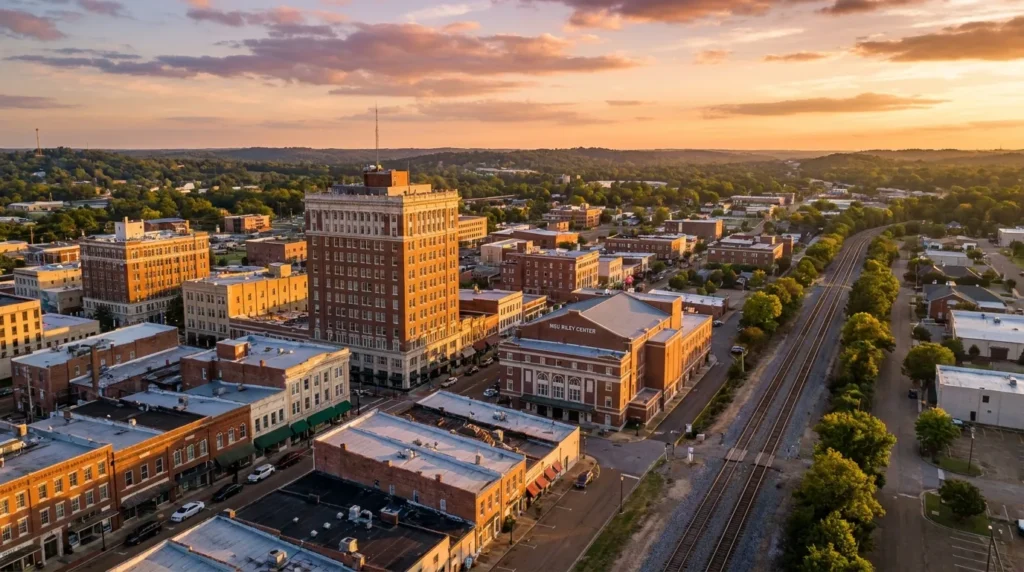
Meridian is a city in eastern Mississippi defined by historic architecture, country music heritage, and the acclaimed The MAX, the state's museum of arts and entertainment.

The Mississippi Arts + Entertainment Experience (The MAX) is the city's newest landmark, an interactive museum celebrating Mississippians such as Elvis Presley, B.B. King, Jim Henson, Faith Hill, and Morgan Freeman. Highland Park is home to the Dentzel Carousel, one of the last surviving bicentennial carousels still in operation in the world, and the Jimmie Rodgers Museum, dedicated to the father of country music, who was born in Meridian.

The Riley Center for Education and Performing Arts, restored and operated by Mississippi State University, hosts Broadway tours and national performances. The Mississippi Industrial Heritage Museum, housed at the Soulé Steam Feed Works, preserves industrial machinery. The Meridian Museum of Art, located in a historic library building, maintains a regional collection. Downtown Meridian features preserved Art Deco buildings and structures from the 1880s to 1920s.

For outdoor recreation, Bonita Lakes Park offers trails, a fishing lake, and a bike path. Bonita Lakes Mall is nearby. Okatibbee Lake, 15 minutes away, provides camping, a beach, and fishing. Dunn's Falls Water Park preserves a historic mill and waterfall. Naval Air Station Meridian, to the north, is a major military employer. Jackson, the state capital, is approximately 90 minutes to the west.

  1. 1["Mississippi Arts and Entertainment Experience (The MAX)"
  2. 2"Dentzel Carousel at Highland Park (one of the last in the world)"
  3. 3"Jimmie Rodgers Museum"
  4. 4"Meridian Railroad Museum"
  5. 5"Riley Center (restored theater)"
  6. 6"Merrehope (historic mansion)"
Nightlife3.0 / 10
Parks & green spaces
  • ["Bonita Lakes Park"
  • "Highland Park"
  • "Singing Brakeman Park"
  • "Velma Young Park"
  • "Pat Harrison Waterway District"
  • +1 more

Latest posts

Posts about Mississippi

Coverage and updates related to this destination.

Showing content from Mississippi, as there is no specific data for Meridian yet.