Visto n' Visa
Blog
Notícias e artigos
Destinations
Careers
Immigrants

Want to live and work in Jackson?

Personalized immigration plan with eligible visas, costs, and next steps for your goal!

If you are not eligible, you will know exactly why and what to do to improve your approval chances.

Save up to 12 hours in meetings

No pointless assessments.

Save up to 90%

Save money on vague or unfocused consultations

Avoid Fraud and Mistakes

One mistake can cost you your visa

Total Impartiality

Zero commercial bias

Decide with peace of mind

No toxic urgency

Fast and Accurate

Answers in minutes, no guesswork

African American majority and one of the Blackest cities in the United States

Jackson is approximately 80% African American, making it one of the largest U.S. cities with a Black majority. The white minority is more concentrated in northern neighborhoods, and the Latino and Asian populations are small but growing.

The ethnic composition is dominated by African Americans, who form the vast majority of the population and hold virtually all local political offices. White residents account for roughly 15% to 18%, with a strong concentration in northern neighborhoods such as Eastover and Fondren. Hispanics represent about 2% to 3%, and Asians, predominantly Vietnamese and Indian, form small but established communities.

Median income is low by American standards, with a significant poverty rate. There is, however, a historically important Black middle class, professional and tied to the university, churches, schools, and the public sector. Baptist and Methodist churches hold a central place in social life.

For Brazilian and Hispanic immigrants, the community is small and dispersed, with no consolidated ethnic neighborhoods. There are Latin markets along Highway 80 and a few Hispanic churches. International students are more visible at universities such as Jackson State and Millsaps. There is no diplomatic presence in the city; consular matters route through Memphis or Atlanta.

Languages spoken
  • English
  • Spanish
  • Vietnamese
  • Mandarin
Main religions
  • Protestant Christianity (Baptist, Methodist)
  • Catholicism
  • AME Church
  • No religion

One of the lowest costs of living in the United States

Living in Jackson is inexpensive compared to any coastal city or large metro area. Rent, housing, and groceries are affordable, but deteriorating infrastructure imposes indirect costs such as generators, water filters, and insurance.

The overall cost-of-living index sits well below the national average, with housing being the least expensive component. A three-bedroom house with a yard can be rented for amounts that would barely cover a studio apartment in other regions. Buying property is accessible, although depreciation in certain zones poses a real risk.

Groceries are affordable at chains such as Kroger, Walmart, and Aldi. Local restaurants, especially Southern cuisine, soul food, and barbecue, offer attractive prices. Dining at the Highland Village or Renaissance area in Ridgeland runs higher. Gasoline is among the cheapest in the country, and property taxes are moderate.

The hidden cost lies in public services. Jackson's water system has faced serious crises, and many residents filter tap water or rely on bottled water. Water pumps, generators for power outages, hurricane and tornado insurance, and private residential security are common expenses. For the self-employed, individual health insurance outside of employer coverage is the single largest budget item.

86Cost index (US = 100)14% below US average
CategorySingleCoupleFamily (2 + 2)
iHousing$1,121$1,293$1,638
iFood$328$655$1,190
iTransport$431$733$948
iHealthcare$241$483$905
iChildcare$1,569
iOther$733$1,319$1,853
Monthly total$2,854$4,483$8,103

Source: U.S. BLS Consumer Expenditure Survey 2023 + BEA Regional Price Parities 2023 · Estimates in USD, monthly.

Large, affordable homes, but quality varies sharply between neighborhoods

Jackson's real estate market is among the most accessible in the country, with spacious historic homes at low prices. Neighborhood selection is critical, as conditions can differ dramatically from one block to the next.

The housing stock is dominated by single-story homes and two-story houses, many built between the 1920s and 1970s. Belhaven, with Tudor and Craftsman-style homes, and Fondren, with renovated bungalows and a cultural scene, are valued areas sought by young professionals. Eastover is the most upscale neighborhood, featuring mansions and tree-lined streets.

Apartments are more common near downtown, in complexes such as Plaza Apartments and buildings in Belhaven, as well as in commercial corridors along County Line Road. Those who prefer new homes in gated communities typically relocate to the suburbs of Madison, Ridgeland, or Flowood. The difference in public service quality between Jackson and these suburbs is considerable.

For immigrants, the safest path is to rent first in Fondren, Belhaven, Eastover, or in Ridgeland complexes, and get to know the city before buying. Inspection of foundations, roof, plumbing, and mold is essential given the hot and humid climate. Hail, tornado, and flood insurance is the norm, not the exception.

Recommended neighborhoods
  • Fondren
  • Belhaven
  • Eastover
  • Northeast Jackson
  • Downtown
  • +1 more

Healthcare, government, and education drive employment in Jackson

Jackson's economy revolves around state government, the UMMC medical complex, and its universities. Private industry exists in logistics, energy, and services, but the public sector carries more weight here than in most state capitals.

The largest employer is the University of Mississippi Medical Center, which combines a hospital, medical school, and research operations with thousands of employees. Next are the Mississippi state government, with offices concentrated downtown, and city hall. Nissan has a plant in Canton to the north and employs many workers from the metro area, though it lies outside Jackson proper.

Relevant private sectors include energy, with Entergy and Atmos, telecommunications with C Spire, and financial services with Trustmark Bank, headquartered in Jackson. Logistics has grown with the presence of Continental Tire in the region and established rail infrastructure. For immigrants, opportunities appear most often in medicine, nursing, biomedical research, engineering, and IT.

Salaries fall below national averages for many positions, but the low cost of living offsets this. Local employers tend to be conservative about visa sponsorship, although UMMC and some multinationals offer support for H-1B and green card pathways. For independent professionals, the market is tight, without the startup dynamics found in larger metro areas.

Dominant sectors
  • Healthcare
  • State government
  • Higher education
  • Financial services
  • Energy and utilities
  • +1 more
Major employers
  • University of Mississippi Medical Center (UMMC)
  • State of Mississippi
  • Entergy Mississippi
  • Trustmark Bank
  • C Spire
  • +1 more

Historic universities and a regional medical complex of reference

Jackson is home to one of Mississippi's most important concentrations of higher education. Jackson State University, Millsaps College, and UMMC form the core, offering undergraduate programs, research, and top-tier medicine for the entire region.

Jackson State University is one of the most recognized HBCUs in the country, with strong programs in engineering, nursing, and African American studies. Millsaps College is a well-regarded private liberal arts college with deep community ties. Belhaven University, rooted in the Presbyterian tradition, is a regional reference for music and theater. Tougaloo College, located just to the north, is another historically significant HBCU.

The University of Mississippi Medical Center is the state's academic health complex, housing schools of medicine, dentistry, nursing, and health sciences. For technical education, Hinds Community College has a campus in Jackson serving thousands of students. Biomedical and public health research is intensive, supported by significant federal funding.

The Jackson Public Schools system faces chronic challenges in funding and infrastructure. Many families opt for private schools such as St. Andrew's Episcopal, Jackson Academy, or Jackson Prep, or relocate to the Madison and Rankin County districts, which post higher performance ratings. For immigrants with children, this is one of the most consequential factors when deciding whether to live in Jackson proper.

Notable universities
  • Jackson State University
  • Millsaps College
  • Belhaven University
  • University of Mississippi Medical Center (UMMC)
  • Tougaloo College
  • Hinds Community College

Academic medical complex among the best in the South

The presence of the University of Mississippi Medical Center positions Jackson as a medical reference point for the entire state and region. Private hospitals complete the network, covering virtually all specialties.

UMMC is the state's only teaching hospital, offering transplants, oncology, cardiology, pediatrics, and Level 1 trauma care. It also houses Batson Children's Hospital, the regional pediatric reference center. Complex patients from across Mississippi are referred to UMMC, and the academic environment attracts high-caliber physicians and researchers.

Private hospitals such as St. Dominic's on State Street and Baptist Medical Center downtown serve a large share of the population with general services, orthopedics, maternity care, and cardiology. Merit Health Central to the south rounds out the network. Urgent care centers and community clinics are spread across the city, particularly along Lakeland Drive and County Line Road.

For immigrants, the key factor is health insurance. Without coverage, emergency care is expensive, but community clinics such as the Jackson-Hinds Comprehensive Health Center offer income-based sliding-scale fees. Pharmacies are widely available, including Walgreens, CVS, and local chains. Access to specialists tends to be faster than in large metro areas.

Healthcare index62.0 / 100
  • Life expectancyyears at birth
    78.4yrs
  • Doctors per 1kpracticing physicians
    3.7
  • Health spendper capita, per year
    $13,473
  • Public systemoverall quality rating
    Fair

Safety is the biggest challenge, with stark differences between neighborhoods

Jackson has a historically high violent crime rate for a city of its size. Perception and reality vary widely by neighborhood: areas such as Eastover, Fondren, and Belhaven are relatively calm, while other zones require greater caution.

Jackson's homicide rates rank among the highest in the United States per capita, concentrated in specific zones, particularly in the southern and western parts of the city. Property crimes such as car theft, residential break-ins, and theft are common across many areas. Neighborhood selection is therefore more consequential here than in almost any other American city.

Areas such as Eastover, Belhaven, Fondren, and Northeast Jackson rely on private security and cameras, and residents generally report a sense of safety in daily life. Even there, locking the car and not leaving valuables visible is standard practice. The suburbs of Madison, Ridgeland, and Brandon, outside city limits, are considered considerably safer and attract families for that reason.

Severe weather is another factor. Tornadoes, thunderstorms, and hurricanes moving up from the Gulf affect Jackson. Flooding along the Pearl River has caused serious damage in low-lying neighborhoods. Newcomers need to learn the alert system, have a home emergency plan, and carry adequate insurance. Compared to other Southern capitals, greater attention to personal and property security is warranted.

5.8
Homicides per 100k
per year
Safety index
22.0
Crime index
78.0
Safer neighborhoods
  • Fondren
  • Belhaven
  • Eastover
  • Northeast Jackson
  • Broadmoor
  • Woodland Hills
Areas to avoid
  • West Jackson (certain stretches)
  • South Jackson after dark
  • Areas near Medgar Evers Boulevard at night
  • Isolated industrial sectors around I-220

A car-dependent city with few viable alternatives

Jackson is a car city. Interstates I-55 and I-20 intersect at the center, and nearly everything is organized around them. Public transit exists but is limited, and cycling is an option only in specific neighborhoods.

I-55 cuts through the city on a north-south axis, connecting Jackson to Memphis and New Orleans, while I-20 runs east-west toward Dallas and Atlanta. US-80, the old main highway, remains an important internal corridor. State Street and County Line Road organize daily life, with retail and restaurants spread along both routes.

JATRAN is the city bus operator, with limited coverage and reduced schedules; it sees little use among the middle class. There is no urban rail. Uber and Lyft function well in the northern zone and downtown, with longer wait times in other areas. Cycling is feasible in Fondren and Belhaven, but the bike lane network is small.

Jackson-Medgar Wiley Evers International Airport (JAN) is located to the east in Flowood, with flights to hubs including Atlanta, Dallas, Charlotte, and Houston. For international flights and more domestic options, many residents drive to Memphis, Birmingham, or New Orleans, all two to three hours away. Amtrak stops in Jackson on the City of New Orleans line, connecting Chicago and New Orleans.

22 min
Avg commute
42
Walkability
Airports
  • JAN — Jackson-Medgar Wiley Evers International Airport
  • International airport
  • Bike infrastructure

What the climate is like living in Jackson

Mississippi's capital has a humid subtropical climate: long, hot summers around 33 degrees Celsius, mild winters, and frequent severe storms.

Summer in Jackson is long and humid, with highs between 32 and 34 degrees Celsius from June through September. Late-afternoon thunderstorms are nearly daily, and air conditioning is essential in every home.

Winter is short and mild, with lows between 2 and 6 degrees Celsius in January. Frost is occasional and snow is rare. A light to medium coat is sufficient for the season.

Spring is the most hazardous season, with real tornado risk between March and May. Autumn is the most pleasant season. Annual rainfall totals around 1,400 mm, peaking in winter and spring.

Sunny days / year216 days
Avg high (°F)
  • 58°J
  • 63°F
  • 70°M
  • 74°A
  • 82°M
  • 89°J
  • 91°J
  • 91°A
  • 88°S
  • 78°O
  • 67°N
  • 62°D
Avg low (°F)
  • 40°J
  • 43°F
  • 50°M
  • 54°A
  • 63°M
  • 70°J
  • 73°J
  • 73°A
  • 68°S
  • 58°O
  • 46°N
  • 44°D
Rainfall (")
  • 6"J
  • 7"F
  • 6"M
  • 7"A
  • 5"M
  • 5"J
  • 6"J
  • 6"A
  • 3"S
  • 5"O
  • 3"N
  • 5"D

Birthplace of the blues, gospel heritage, and a living arts scene in select neighborhoods

Jackson carries a strong musical legacy in blues and gospel, with museums dedicated to civil rights and state history. Fondren is the cultural hub, with galleries, restaurants, and festivals throughout the year.

The Mississippi Civil Rights Museum and the Museum of Mississippi History, housed together downtown, are essential stops for understanding the South. The Mississippi Museum of Art holds a solid collection, and the Smith Robertson Museum chronicles local African American history. The home of Pulitzer Prize-winning author Eudora Welty is a national historic landmark.

Music is part of the city's DNA. Jackson State University hosts major gospel and marching band events. Fondren First Thursday, held on the first Thursday of each month, turns the neighborhood into an arts hub with open galleries and food trucks. Festivals such as Jubilee Jam and Mal's St. Paddy's Parade, a Mississippi-style Mardi Gras celebration, mark the annual calendar.

The food scene is strong in Southern cuisine, soul food, and barbecue. Institutions such as Big Apple Inn, Bully's Restaurant, and Walker's Drive-In have defined the local palate for generations. Catfish, fried chicken, collard greens, and biscuits are staples. A notable Vietnamese cuisine scene also exists in western neighborhoods, a legacy of immigration in the 1970s and 1980s.

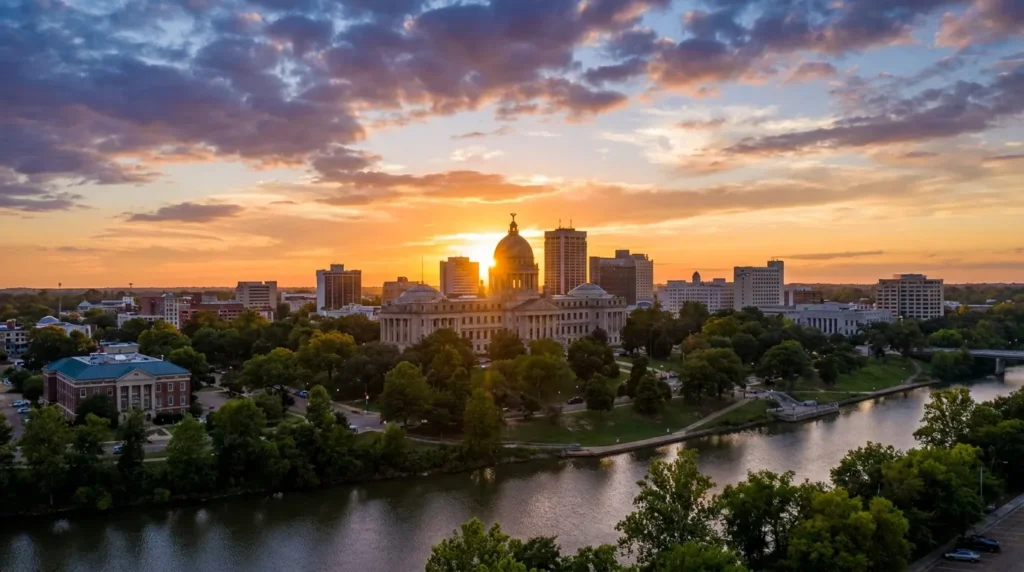
Jackson

Jackson, Mississippi's capital between the blues and the civil rights movement

Jackson is Mississippi's cultural capital, with museums dedicated to civil rights, Southern literature, and the blues, and a cultural life centered in the historic downtown.

The Mississippi Civil Rights Museum and the adjacent Museum of Mississippi History form one of the most important museum complexes in the South, telling the story of the civil rights struggle and the state's African American heritage. Nearby stands the Mississippi Old Capitol Museum, housed in the former State Capitol.

The Mississippi Museum of Art holds one of the largest art collections in the South, and the Eudora Welty House and Garden preserves the home of the Pulitzer Prize-winning author. LeFleur's Bluff State Park, located within the city, and the Mississippi Museum of Natural Science offer green space and scientific exhibits. The Jackson Zoo is one of the oldest in the state.

Festivals such as the Mississippi State Fair and the Crossroads Film Festival animate the calendar. The Mississippi Blues Trail, originating in the capital, connects landmarks of blues history across the state. The Natchez Trace Parkway, a scenic road, passes through the city and extends to Tennessee.

  1. 1["Mississippi Civil Rights Museum"
  2. 2"Museum of Mississippi History"
  3. 3"Mississippi Museum of Art"
  4. 4"Eudora Welty House and Garden"
  5. 5"Mississippi Children's Museum"
  6. 6"Mississippi Sports Hall of Fame and Museum"
Nightlife4.0 / 10
Parks & green spaces
  • ["LeFleur's Bluff State Park"
  • "Mississippi Petrified Forest (nearby)"
  • "Mynelle Gardens Arboretum and Botanical Center"
  • "Battlefield Park"
  • "Parham Bridges Park"
  • +1 more

Latest posts

Posts about Mississippi

Coverage and updates related to this destination.

Showing content from Mississippi, as there is no specific data for Jackson yet.