Visto n' Visa
Blog
Notícias e artigos
Destinations
Careers
Immigrants

Want to live and work in Greenville?

Personalized immigration plan with eligible visas, costs, and next steps for your goal!

If you are not eligible, you will know exactly why and what to do to improve your approval chances.

Save up to 12 hours in meetings

No pointless assessments.

Save up to 90%

Save money on vague or unfocused consultations

Avoid Fraud and Mistakes

One mistake can cost you your visa

Total Impartiality

Zero commercial bias

Decide with peace of mind

No toxic urgency

Fast and Accurate

Answers in minutes, no guesswork

A city with a strong African American majority and a historic Chinese presence

Greenville has a significant African American majority and a historic Chinese community nearly 150 years old, one of the first Chinese communities in the rural American South. White and Hispanic residents complete the demographic picture.

The ethnic composition is approximately 78% African American, 17% white, 3% Hispanic, and around 2% Asian. The African American community has deep roots in cotton agriculture and the civil rights movement. The Chinese community of the Delta, known as the Delta Chinese, arrived in the late nineteenth century and established small grocery stores throughout the region, with Greenville as the heart of that community.

The Chinese presence has diminished in recent decades, with families migrating to larger cities, but visible cultural markers remain, including Chinese cemeteries, restaurants (Lillo's, How Joy), and established families. The Hispanic population has grown alongside agribusiness and construction. A small Vietnamese community also maintains a presence.

A Brazilian immigrant community is virtually nonexistent. The Hispanic community has some Latin markets. Religious diversity is greater than it might appear, with a strong presence of Baptist and Methodist churches, a historic Catholic community tied to Italian and Irish immigration in the early twentieth century, a synagogue (Hebrew Union Temple, founded in 1879), and small Chinese Buddhist communities.

Languages spoken
  • English
  • Spanish
  • Mandarin
  • Cantonese
Main religions
  • Protestant Christianity (Baptist, Methodist, AME)
  • Catholicism
  • Judaism
  • No religion

One of the lowest costs of living in the United States

Greenville has one of the lowest costs of living in the country. Housing is particularly affordable, with charming historic homes at very low prices. Homeownership is attainable even on a modest income, though the market has its pitfalls.

The overall index ranks among the lowest in the United States. Housing is the main draw, with large homes at prices that would barely cover a room in a major city. Apartment rents are nominal by American standards. Dining out is affordable at local restaurants and chains along Highway 82.

Supermarkets such as Kroger, Walmart, and Save-A-Lot keep prices low. Historic Chinese-family markets from the Wong and Chow families have survived in some areas, serving specific demand. Gasoline is among the cheapest in the US, and property taxes are modest. Electric bills spike in summer, when air conditioning is essential.

The hidden cost lies in maintenance. Many older homes require investment in roofing, electrical systems, and plumbing. Homeowner's insurance includes flood coverage, given the proximity to the river and the levee. Individual health insurance is the heaviest expense for self-employed residents. Buying a very cheap home without a thorough inspection can lead to significant costs later on.

Charming historic homes at very low prices, with significant neighborhood variation

Greenville's real estate market features architecturally notable historic homes at very low prices. Neighborhood selection is critical, with large differences between areas and varying maintenance conditions.

Neighborhoods such as Stein Mart, Country Club Estates, and Lakeland Drive concentrate newer homes for upper-middle-class residents, with standard American suburban styling. Washington Park and Boulevard Heights have historic homes from the 1920s and 1930s, with porches, colonial revival architecture, and large trees. Some of these homes are listed at very low prices due to the city's declining population.

Apartments are available in complexes such as Wood Lake Village and in small buildings near Washington Avenue. Studios are rare, and denser urban housing options are limited. Short-term rentals via Airbnb are more common around the historic downtown. Homes in the historic center are listed at very low prices, with real restoration potential for those with capital and patience.

For immigrants, the practical approach is to start by renting in complexes near Highway 82 or Lakeland Drive, getting to know the city before buying. Inspections covering the foundation, roof, plumbing, electrical systems, and mold are absolutely essential. Tornadoes are a genuine hazard, and nearly every home has a reinforced storm shelter area. Localized flooding occurs in areas near the river.

Recommended neighborhoods
  • Country Club Estates
  • Lakeland Drive
  • Washington Park
  • Boulevard Heights
  • Stein Mart
  • +1 more

Healthcare, agribusiness, and government drive employment in the Delta

Greenville's economy depends on Delta Regional Medical Center, agribusiness, the river port, and local government. Textile and food processing industries round out the picture, within a relatively small market.

The largest employers include Delta Regional Medical Center, the Greenville Public School District, and the city government. Mid-Delta Regional Airport and the Port of Greenville, on the Mississippi River, generate jobs in logistics and river transportation. Companies such as Uncle Ben's Rice (part of Mars, in the process of closing), Faurecia (automotive parts), and Heartland Catfish (catfish processing) represent local industry.

Agribusiness is central to the regional economy, with cotton, soybeans, corn, and rice dominating the Delta. Large plantations employ workers both directly and indirectly. The financial sector includes Planters Bank and several agricultural credit cooperatives. For immigrants, opportunities arise in healthcare, agribusiness, manufacturing, construction, and education, within a relatively limited market.

Salaries are modest for most positions, and visa sponsorship is rare outside the medical sector. Self-employed professionals have difficulty finding a local client base, with more opportunities serving remote clients. Gradual population loss affects the market, though the healthcare and government sectors maintain a stable employment base.

Dominant sectors
  • Healthcare
  • Agribusiness
  • Manufacturing (parts and food)
  • Local government
  • River logistics
  • +1 more
Major employers
  • Delta Regional Medical Center
  • Greenville Public School District
  • Heartland Catfish Company
  • Faurecia
  • City of Greenville
  • +1 more

A local community college and universities an hour and a half away

Greenville has its own school district and Mississippi Valley State University 30 minutes away. For higher education, Delta State in Cleveland (45 minutes), Ole Miss in Oxford, and Mississippi State in Starkville are within reach.

The Greenville Public School District faces structural challenges and has low state ratings. Many families opt for private schools such as Washington School, Saint Joseph Catholic School, and Greenville Christian School. Neighboring districts, such as Western Line, tend to have better ratings.

Mississippi Valley State University, in Itta Bena (30 minutes away), is a public HBCU with a strong tradition in education, criminal justice, and African American studies. Delta State University, in Cleveland (45 minutes away), is a public university with programs in business, education, and nursing. Mississippi Delta Community College has a campus in Moorhead, nearby. Ole Miss and Mississippi State are about two hours away.

For immigrants with children, enrollment in public schools is straightforward, though the variable quality deserves attention. Private schools have tuition that is affordable by American standards. For graduate study, Delta State and Mississippi Valley State are regional options, with Ole Miss and MSU for more advanced programs. International students appear more frequently at Mississippi Valley State and Delta State.

Notable universities
  • Mississippi Valley State University (Itta Bena)
  • Delta State University (Cleveland)
  • Mississippi Delta Community College
  • University of Mississippi (Ole Miss)
  • Mississippi State University

Delta Regional Medical Center serves the entire Delta

Delta Regional Medical Center is the main hospital in the Mississippi Delta and serves patients from several smaller cities. For complex cases, patients travel to Jackson, Memphis, or Birmingham.

Delta Regional Medical Center, in Greenville, is the largest hospital in the Delta, with an emergency department, maternity ward, cardiology, oncology, and orthopedics. It serves patients from several small cities and rural areas throughout the Delta. Affiliated clinics are scattered across the region. The Greenville Surgery Center offers elective procedures.

For specialized treatments such as transplants, rare cancers, and advanced pediatric surgery, patients travel to the University of Mississippi Medical Center in Jackson, or to Memphis hospitals such as Methodist and Regional One. Access to specialists within Greenville can involve waiting lists, as many physicians travel between small Delta cities.

For immigrants, employer-provided health insurance is essential. Community clinics such as Aaron E. Henry Community Health Service Center offer income-based fee schedules in the Delta. Pharmacies are available in several neighborhoods, including Walgreens, CVS, and Walmart Pharmacy. The rural healthcare system of the Delta faces well-documented structural challenges, including a shortage of specialist physicians.

Healthcare index60.0 / 100
  • Life expectancyyears at birth
    78.4yrs
  • Doctors per 1kpracticing physicians
    3.7
  • Health spendper capita, per year
    $13,473
  • Public systemoverall quality rating
    Fair

Above-average crime rates, with marked differences by neighborhood

Greenville has crime rates above the national average, especially for property crimes. Residential neighborhoods to the north and in Country Club Estates are quiet, while central areas require more caution, especially at night.

Property crimes such as theft, vehicle break-ins, and shoplifting are the most common. Violent crime is concentrated in specific areas, primarily in central and southern parts of the city. Neighborhoods such as Country Club Estates, Lakeland Drive, Washington Park, and Stein Mart are considered safe for family living, with adequate policing.

Local law enforcement is active, with a presence in schools and residential neighborhoods. Security cameras in residential communities and home alarm systems are common in upper-middle-class neighborhoods. For residents of residential neighborhoods, the general sense of security is reasonable, with the usual precautions expected in a mid-sized city. Older areas in the downtown carry a higher perceived risk and warrant additional caution at night.

Severe weather is a real part of life here. Tornadoes are a genuine hazard, especially between March and June, with reliable sirens and alert systems. The Delta is flat and wind moves freely, intensifying storms. Localized flooding occurs near the river and in low-lying areas. For newly arrived immigrants, learning the weather alert system, identifying the reinforced area of the home, and having a basic emergency plan in place are worthwhile steps.

5.8
Homicides per 100k
per year
Safety index
35.0
Crime index
65.0
Safer neighborhoods
  • Greenville Cypress Preserve area
  • Residential neighborhoods around Lake Ferguson
  • Stoneville area
  • Greenville Country Club neighborhood
  • East Reed Road area
Areas to avoid
  • Sections of downtown at night
  • Areas around Nelson Street after business hours
  • Isolated industrial zones along the Mississippi River

A car-dependent city distant from interstates, with a river port and regional airport

Greenville relies on cars and is relatively far from interstates. US-82 and US-61 are the main routes. Mid-Delta Regional Airport has limited flights, and the river port handles freight navigation.

US-82 crosses Greenville on the east-west axis, connecting to Arkansas via the Greenville Bridge and continuing to Indianola and Starkville. US-61, the historic Blues Highway, runs north-south, parallel to the Mississippi River, linking Memphis to Vicksburg and New Orleans. The nearest interstate, I-20, is about an hour to the southeast, near Jackson and Vicksburg.

There is no structured public transit within Greenville. Uber and Lyft operate in a limited capacity. There is no urban rail or local Amtrak service (the nearest Amtrak stops are in Jackson or Memphis). Cycling is practical in parks and along the river levee for recreation, but the urban street network is small.

Mid-Delta Regional Airport (GLH) has limited flights to Memphis and serves primarily general aviation. For more options, most travelers use Memphis International Airport (MEM), about two and a half hours away, or Jackson-Medgar Wiley Evers International Airport (JAN), about an hour and a half away. The Port of Greenville is an important river freight hub, though it does not serve passengers.

15 min
Avg commute
35
Walkability
Airports
  • GLH, Mid Delta Regional Airport
  • JAN, Jackson-Medgar Wiley Evers International (about 200 km away)

What the Climate Is Like Living in Greenville

A Mississippi Delta city with a humid subtropical climate: long, hot summers around 91 degrees Fahrenheit, mild winters, and a risk of severe storms.

Summers in Greenville are long, hot, and humid, with highs between 90 and 93 degrees Fahrenheit from June through September. The humidity of the delta plain pushes the heat index well above 104 degrees, making air conditioning essential.

Winters are short and mild, with lows between 36 and 43 degrees Fahrenheit in January. Frost is occasional and snow is rare. A light to medium coat is sufficient.

Spring brings severe storms with tornado risk, and fall is the most pleasant season. Annual rainfall totals around 53 inches, peaking in winter and spring.

Sunny days / year215 days
Avg high (°F)
  • 56°J
  • 58°F
  • 68°M
  • 73°A
  • 82°M
  • 89°J
  • 91°J
  • 91°A
  • 87°S
  • 76°O
  • 64°N
  • 60°D
Avg low (°F)
  • 41°J
  • 42°F
  • 51°M
  • 56°A
  • 65°M
  • 73°J
  • 77°J
  • 76°A
  • 71°S
  • 60°O
  • 48°N
  • 45°D
Rainfall (")
  • 5"J
  • 7"F
  • 7"M
  • 6"A
  • 5"M
  • 4"J
  • 3"J
  • 4"A
  • 2"S
  • 4"O
  • 3"N
  • 4"D

Blues, Delta literature, and seasonal cultural festivals

Greenville's culture is rooted in blues music, Southern literature, and the history of the Delta. Year-round festivals, small museums, and regional cuisine give the city a cultural depth that surprises many visitors.

The Highway 61 Blues Museum, on Walnut Street, chronicles the history of Delta blues with instruments, photographs, and recordings. The Mississippi Delta Blues and Heritage Festival, held in September, is one of the oldest blues festivals in the world, featuring open-air performances. The Delta Hot Tamale Festival, in October, celebrates the distinctive Delta tamale, a local dish with strong Mexican and Italian heritage.

The literary legacy includes Walker Percy, Shelby Foote, and William Alexander Percy, all with roots in Greenville. The city has a historic bookstore (McCormick Book Inn) and the E.E. Bass Cultural Arts Center, a former school converted into a cultural center. The Greenville Writers' Festival celebrates the Delta's literary tradition.

The local cuisine blends barbecue, soul food, fried catfish, Delta hot tamales, and Chinese food adapted over generations by the Delta Chinese community. Restaurants such as Doe's Eat Place, founded in 1941, are nationally recognized institutions. Trying a Delta tamale at places like Doe's or Solly's is a cultural experience not to be missed. For a richer cultural scene, Memphis or Jackson make for good weekend destinations.

Attractions in Greenville, Mississippi, in the Delta

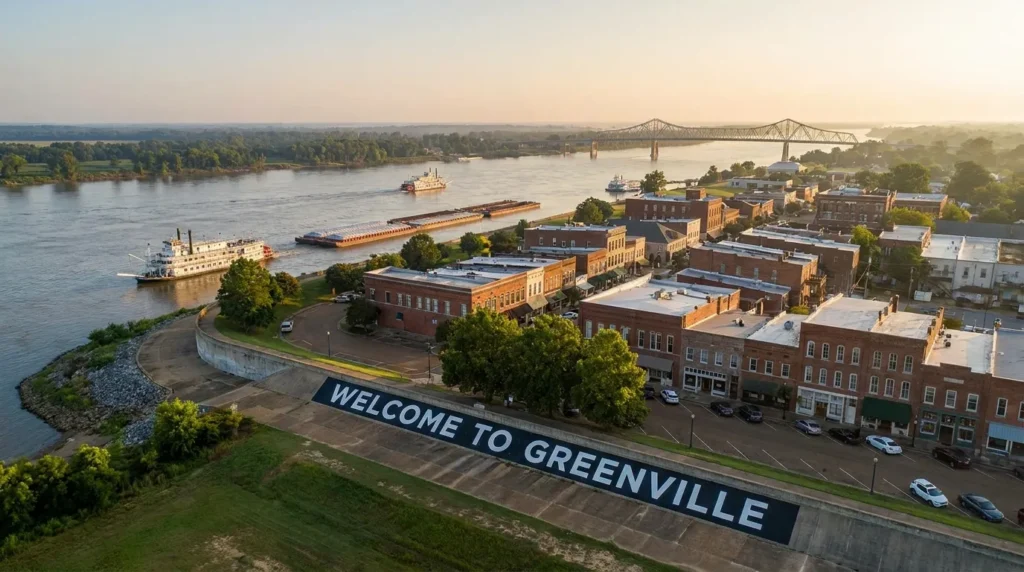
A Mississippi Delta port city and literary and blues capital, featuring Greenville Cypress Preserve, the B.B. King Mississippi Blues Trail, and a cultural scene tied to the river.

Greenville is the largest city in the Mississippi Delta, a flat alluvial plain that gave birth to Delta blues. The city has multiple stops along the Mississippi Blues Trail, with markers noting sites significant to Charley Patton, Willie Foster, Boogaloo Ames, and the historic Hodding Carter, who won a Pulitzer Prize for the Delta Democrat-Times. The E.E. Bass Cultural Arts Center hosts a regular schedule of music and theater performances.

The 1927 Flood Museum chronicles the great Mississippi River flood that destroyed old Greenville. Winterville Mounds, a Native American archaeological site with 12 earthen mounds from the Mississippian period, is an essential stop. The Greenville History Museum and Hebrew Union Temple, one of the oldest synagogues in the South, tell the city's multicultural story.

Lake Ferguson, a former channel of the Mississippi now closed off as an oxbow lake, is home to the Greenville Yacht Club and several marinas. Warfield Point Park, overlooking the confluence of the Mississippi and Arkansas rivers, is a popular destination. The Greenville Cypress Preserve protects centuries-old bald cypress trees and features an elevated boardwalk. The Delta Blues and Heritage Festival, held each September, is one of the oldest blues festivals in the country.

  1. 1["Greenville Cypress Preserve"
  2. 2"Mississippi River Heritage Museum"
  3. 3"1927 Flood Museum"
  4. 4"Winterville Mounds (pre-Columbian ceremonial site
  5. 5nearby)"
  6. 6"Greenville History Museum"
Nightlife3.0 / 10
Parks & green spaces
  • ["Greenville Cypress Preserve"
  • "Lake Ferguson"
  • "Warfield Point Park"
  • "Mike's Park"
  • "Buck Brown Park"
  • +1 more

Latest posts

Posts about Mississippi

Coverage and updates related to this destination.

Showing content from Mississippi, as there is no specific data for Greenville yet.