Visto n' Visa
Blog
Notícias e artigos
Destinations
Careers
Immigrants

Want to live and work in Biloxi?

Personalized immigration plan with eligible visas, costs, and next steps for your goal!

If you are not eligible, you will know exactly why and what to do to improve your approval chances.

Save up to 12 hours in meetings

No pointless assessments.

Save up to 90%

Save money on vague or unfocused consultations

Avoid Fraud and Mistakes

One mistake can cost you your visa

Total Impartiality

Zero commercial bias

Decide with peace of mind

No toxic urgency

Fast and Accurate

Answers in minutes, no guesswork

A mix of white, African American, Vietnamese, and military residents from across the country

Biloxi has a diverse demographic profile for a small Southern city. White, African American, and Vietnamese residents form the historical core, with steady military turnover bringing people from every state.

The ethnic composition is roughly 65% white, 20% African American, 6% Asian (primarily Vietnamese), and 6% Hispanic. The Vietnamese community, formed after the Vietnam War to work in shrimp and oyster fishing, has deep roots in Point Cadet and East Biloxi, with Buddhist temples, restaurants, and its own markets.

Keesler Air Force Base brings military families from across the country, with rotations every two to four years. This gives the city a more cosmopolitan profile than one would expect from a 49,000-person city in the rural South. The Hispanic population grew after Katrina, primarily through reconstruction work, with a visible Mexican and Central American presence.

The community is diverse, with Hispanic markets and some Spanish-language evangelical churches. Religious diversity is greater than in other cities in the state, with Catholics, Baptists, Methodists, Vietnamese Buddhists, and smaller Jewish and Muslim communities living side by side.

Languages spoken
  • English
  • Vietnamese
  • Spanish
  • Tagalog
Main religions
  • Protestant Christianity
  • Catholicism
  • Buddhism (Vietnamese)
  • No religion

Low cost of living with heavy coastal insurance costs

Biloxi has a cost of living well below the national average, particularly for food and services. The major additional expense is homeowner's insurance against hurricanes and flooding, which can double the monthly cost of owning a home.

The overall index ranks among the lowest in the United States. Fresh seafood, affordable casino buffets, and supermarkets such as Rouses, Walmart, and Winn-Dixie help keep budgets under control. Vietnamese markets like Hong Kong Market offer an economical alternative for vegetables, fish, and rice.

The major hidden cost is homeowner's insurance. Biloxi sits in a hurricane risk zone, and the National Flood Insurance Program is practically mandatory in several neighborhoods. Policies can cost thousands of dollars per year. Electricity bills are significant in the summer, with air conditioning running almost around the clock from May through September.

Buying a home is feasible for the middle class, especially in neighborhoods further north, outside the flood zones. Historic homes near the beach are attractive but more expensive to maintain and insure. Gasoline is cheap, and taxes are moderate. Individual health insurance outside of employer coverage remains the heaviest expense for self-employed residents.

Biloxi

Historic homes near the coast and newer subdivisions to the north

Biloxi's real estate market combines historic Southern-style homes near US-90 with post-Katrina subdivisions further north and in D'Iberville. Flood zone maps are an essential part of any housing decision.

Neighborhoods near US-90, such as Beauvoir and Old Biloxi, feature historic homes, some rebuilt after Katrina, with porches, Creole architecture, and proximity to the water. Point Cadet, on the eastern tip, is the heart of the Vietnamese community. North Biloxi and Woolmarket, further north, have newer subdivisions with brick homes and yards, outside the most critical flood zones.

Rentals are affordable, particularly in complexes such as Le Marin Apartments, The Bay at Biloxi, and smaller units along Cedar Lake Road. For military families at Keesler, the rental market is active, with real estate agencies specializing in PCS, the military relocation process. Studios and condos near the casinos are options for single professionals and hospitality workers.

For immigrants, the practical recommendation is to start by renting in North Biloxi, Woolmarket, or D'Iberville, outside the highest hurricane risk zones. Inspection of roofing, foundation, and electrical systems is standard practice. A home in FEMA flood zone AE or VE carries expensive insurance, which can significantly change the total cost of the property. Understanding the flood rating system is part of the home-buying process.

Recommended neighborhoods
  • North Biloxi
  • Woolmarket
  • Beauvoir
  • Old Biloxi
  • Cedar Lake
  • +1 more

Casinos, the military, and healthcare drive employment in Biloxi

Biloxi's economy runs on three engines: casinos along US-90, Keesler Air Force Base, and the healthcare sector. Construction, shrimp fishing, and coastal tourism round out the employment picture.

The largest employers include Keesler Air Force Base, with thousands of military and civilian personnel, and major casinos such as Beau Rivage, IP Casino, Hard Rock Biloxi, and Treasure Bay. Memorial Hospital at Gulfport, in the neighboring city, and Merit Health Biloxi serve healthcare demand. Singing River Health System, in Pascagoula, is another major regional employer.

Hospitality and food service are enormous sectors given the number of casinos and restaurants. Construction has steady demand due to post-hurricane rebuilding and residential growth. Shrimp and oyster fishing remains relevant, operated largely by Vietnamese families. For immigrants, opportunities appear in hospitality, healthcare, construction, building maintenance, and food service.

Wages are modest, especially in hospitality and food service. Visa sponsorship is less common than in large metropolitan areas, although hospitals, casino chains with international operations, and companies tied to federal military contracts occasionally sponsor H-1B visas. Independent professionals in IT, design, and marketing tend to work remotely, serving clients throughout the South and Midwest.

Dominant sectors
  • Casinos and hospitality
  • Defense and the military
  • Healthcare
  • Construction
  • Fishing and seafood
  • +1 more
Major employers
  • Keesler Air Force Base
  • Beau Rivage Resort & Casino
  • IP Casino Resort Spa
  • Hard Rock Hotel & Casino Biloxi
  • Memorial Hospital at Gulfport
  • +1 more

A local community college and accessible universities along the coast

Biloxi has its own school district and easy access to Mississippi Gulf Coast Community College. For four-year higher education, USM has a campus in Long Beach, and the main campus in Hattiesburg is about ninety minutes away.

The Biloxi Public School District serves around six thousand students, with average state ratings. Private schools such as St. Patrick Catholic High School, Notre Dame High School, and Mercy Cross Catholic are traditional and well-regarded alternatives. The military presence leads to high family turnover and school programs designed to accommodate frequent relocations.

Mississippi Gulf Coast Community College has campuses at Jefferson Davis (Gulfport), Perkinston, and Jackson County, offering technical programs, nursing, and two-year transfer degrees. The University of Southern Mississippi has a campus in Long Beach, about fifteen minutes away, with programs focused on marine science and hospitality. USM's main campus is in Hattiesburg.

For immigrant families with children, enrollment in public schools is straightforward, with ESL programs available in the district. For graduate school or an MBA, USM and Tulane University in New Orleans are the typical options. Marine science research is strong at the Gulf Coast Research Laboratory in Ocean Springs, affiliated with USM, attracting doctoral students from diverse backgrounds.

Notable universities
  • Mississippi Gulf Coast Community College - Jefferson Davis
  • University of Southern Mississippi - Gulf Coast
  • William Carey University - Tradition Campus
  • Tulane University (New Orleans)
  • University of South Alabama (Mobile)

Solid regional hospitals with referrals to Mobile and New Orleans

Biloxi has its own hospital, and the region relies on Memorial Hospital at Gulfport as a regional reference. For complex cases, patients travel to Mobile, New Orleans, or USA Health across the Alabama border.

Merit Health Biloxi and Memorial Hospital at Gulfport, in the neighboring city, are the main hospitals in the region. They cover emergency care, cardiology, oncology, orthopedics, and maternity services. Keesler Medical Center, located within the air force base, serves active military personnel, dependents, and veterans with full infrastructure, including surgery and maternity.

Singing River Health System has hospitals in Pascagoula and Ocean Springs, completing the regional network. Urgent care clinics such as Gulf Coast Urgent Care and MEA Medical cover non-emergency cases with extended hours. For specialized treatments such as transplants and rare cancers, the common destination is USA Health in Mobile, Ochsner Health, or Tulane Medical Center in New Orleans.

For immigrants, employer-sponsored health insurance is essential. Community clinics such as Coastal Family Health Center offer sliding-scale fees based on income. Military families have access to Tricare, which covers care within a broad network. Pharmacies are found throughout the city, with Walgreens, CVS, Rouses Pharmacy, and Walmart Pharmacy present in several neighborhoods.

Healthcare index64.0 / 100
  • Life expectancyyears at birth
    78.4yrs
  • Doctors per 1kpracticing physicians
    3.7
  • Health spendper capita, per year
    $13,473
  • Public systemoverall quality rating
    Fair

Reasonable safety, with attention to tourist zones and hurricanes

Biloxi has crime rates above the national average, particularly in tourist zones and near casinos. Violent crime is localized, and property crime is the most common type. Residential neighborhoods to the north are generally calm.

Property crimes such as theft, car break-ins, and pickpocketing in casino parking lots are the most common. Violent crime appears in specific areas, primarily in East Biloxi at night and near bars during late hours. Neighborhoods such as North Biloxi, Woolmarket, and Beauvoir are considered quiet for family living.

Police presence is strong in tourist areas and at the casinos, with cameras and private security supplementing the municipal police force. For residents in residential zones, the general sense of safety is reasonable, with typical precautions for a mid-size American city. Locking vehicles, keeping valuables out of sight, and staying alert in nighttime parking lots are common habits.

The real major risk is the weather. Gulf hurricanes are a reality, and Biloxi was devastated by Katrina in 2005. Every home requires an evacuation plan, an emergency kit, and adequate insurance. Hurricane season runs from June through November, peaking in August, September, and October. The NOAA and cell phone alert system is effective, and evacuation drills are part of the seasonal coastal routine.

5.8
Homicides per 100k
per year
Safety index
58.0
Crime index
42.0
Safer neighborhoods
  • Beauvoir and the historic area
  • Cedar Lake
  • Woolmarket
  • D'Iberville (neighboring city)
  • North Biloxi
  • Beachfront neighborhoods between Veterans Ave and Eisenhower
Areas to avoid
  • Isolated stretches of US 90 outside of peak season
  • Areas near casinos after peak hours when alone
  • Sections along Back Bay with poor lighting

Car-dependent city with Amtrak service and a nearby regional airport

Biloxi depends on a car for daily life. I-10 and US-90 organize traffic flow, Gulfport-Biloxi Airport handles regional flights, and Amtrak relaunched service to New Orleans and Mobile in 2023.

I-10 crosses Biloxi east to west, north of the city, connecting New Orleans to Mobile. US-90 runs along the coast, parallel to the beach, and is a scenic route. Major bridges connect Biloxi to Ocean Springs (Biloxi Bay Bridge) and to D'Iberville. US-49, in Gulfport, leads north toward Hattiesburg and Jackson.

Coast Transit Authority operates bus routes in Biloxi, with modest coverage and limited schedules. Uber and Lyft work well in the tourist zones, with longer wait times in residential neighborhoods. Cycling is feasible along stretches of US-90 and in parks, but the bike lane network is limited. Walking is practical only in the historic downtown and some casino areas.

Gulfport-Biloxi International Airport (GPT) is located in Gulfport and serves flights to Atlanta, Dallas, Charlotte, and a few other cities via American, Delta, and United. For more options, New Orleans Airport (MSY) is about ninety minutes by car. Amtrak relaunched the Mardi Gras Service connecting New Orleans to Mobile, with stops in Bay St. Louis, Gulfport, Biloxi, and Pascagoula.

20 min
Avg commute
40
Walkability
Airports
  • GPT, Gulfport-Biloxi International Airport
  • International airport
  • Bike infrastructure

What the climate is like living in Biloxi

A Gulf Coast city with a humid subtropical climate: long, hot summers around 33 degrees Celsius, mild winters, and real hurricane risk.

Summers in Biloxi are long, hot, and highly humid, with highs between 32 and 34 degrees Celsius from June through September. Proximity to the Gulf pushes the heat index well above 40 degrees Celsius, making air conditioning an absolute necessity in every home and vehicle.

Winter is short and mild, with lows between 5 and 10 degrees Celsius in January. Frost is rare and snow is virtually nonexistent. A light jacket is sufficient for the entire season.

Hurricane season runs from June through November, with the greatest risk concentrated between August and October. Annual rainfall totals roughly 1,600 mm, with the bulk falling in summer, often in the form of intense thunderstorms.

Sunny days / year216 days
Avg high (°F)
  • 62°J
  • 65°F
  • 71°M
  • 75°A
  • 82°M
  • 87°J
  • 87°J
  • 89°A
  • 86°S
  • 79°O
  • 69°N
  • 64°D
Avg low (°F)
  • 46°J
  • 50°F
  • 56°M
  • 60°A
  • 68°M
  • 74°J
  • 76°J
  • 76°A
  • 72°S
  • 64°O
  • 53°N
  • 50°D
Rainfall (")
  • 6"J
  • 5"F
  • 6"M
  • 6"A
  • 6"M
  • 8"J
  • 8"J
  • 9"A
  • 5"S
  • 6"O
  • 4"N
  • 5"D

A unique blend of Gulf Coast culture, Vietnamese heritage, and Mardi Gras

Biloxi has a more lively culture than expected for a city its size. Casinos, the coastal Mardi Gras, seafood festivals, and Vietnamese influence create a distinctive identity, separate from the rest of Mississippi.

The coastal Mardi Gras is an important part of the calendar, with parades in Biloxi and Gulfport between January and February. The Biloxi Seafood Festival and the Maritime and Seafood Industry Museum celebrate the fishing heritage. Lunar New Year is celebrated in February by the Vietnamese community in Point Cadet, with fireworks, lion dances, and traditional food.

The cuisine blends shrimp, oysters, catfish, and crab with Creole, Cajun, and Vietnamese recipes. Restaurants such as Mary Mahoney's, Half Shell Oyster House, McElroy's, and Le Bakery are traditional stops. Pho, banh mi, and bun bo hue are readily available at Le Bakery and Saigon Restaurant. Classic Southern food is also part of the dining scene.

Live music appears at casinos and bars along US-90, with frequent national acts. Beau Rivage and IP Casino bring major performers to their entertainment venues. The beach, though artificial and with murky water due to proximity to the Mississippi River delta, serves as a gathering spot. New Orleans, ninety minutes to the west, is a common weekend destination for a more intense cultural experience.

Biloxi

Biloxi on the Mississippi Gulf Coast — casinos, lighthouses, and Vietnamese heritage

A Gulf Coast city in Mississippi defined by casinos, shrimping traditions, French and Cajun heritage, and one of the largest Vietnamese communities in the American South.

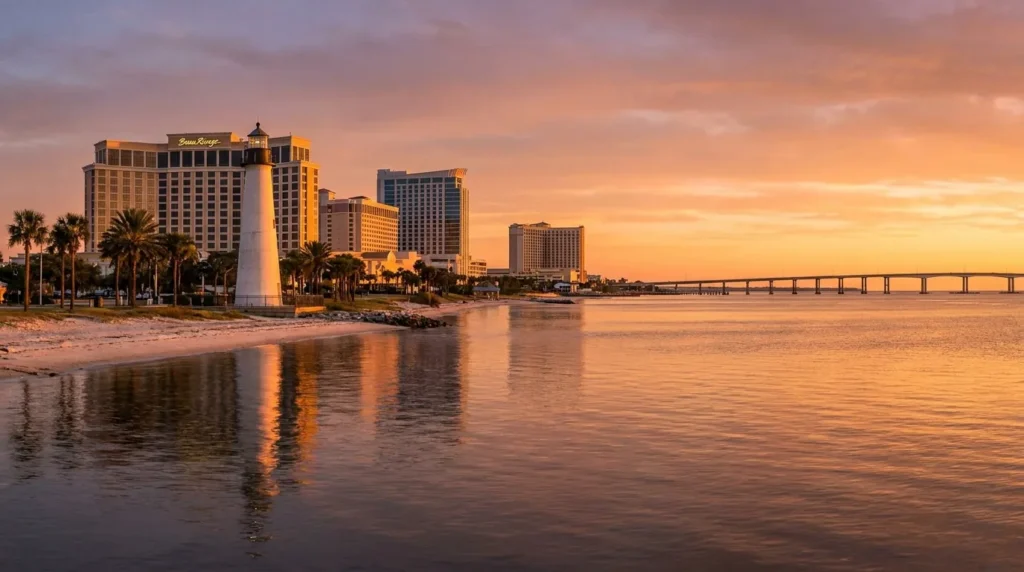
Biloxi spreads across a narrow peninsula between the Gulf of Mexico and Biloxi Bay on the Mississippi Gulf Coast. US 90 runs parallel to the beach along the entire city, with casinos such as Beau Rivage, Hard Rock, and IP Casino Resort lining the opposite side. The city was devastated by Hurricane Katrina in 2005 and spent years rebuilding, which explains stretches where new construction stands alongside older restored homes.

The Biloxi Lighthouse, a cast-iron structure erected in 1848, is the city's most recognizable landmark, positioned in the center median of US 90. Beauvoir, the last home of Jefferson Davis, operates as a museum and research center. The Maritime and Seafood Industry Museum documents the history of the shrimping and oystering fleets. The Ohr-O'Keefe Museum of Art, with architecture designed by Frank Gehry, adds an artistic dimension to the city's offerings.

For outdoor activity, a wide white-sand beach stretches along the entire municipal shoreline, with areas for swimming and fishing. Deer Island, located just offshore from downtown, is a natural sanctuary accessible by boat. The Mississippi Sound offers fishing and boat excursions to the barrier islands of Gulf Islands National Seashore. Annual events such as Mardi Gras and Cruisin' the Coast mark the local calendar.

  1. 1["Biloxi Lighthouse"
  2. 2"Beauvoir (the last home of Jefferson Davis)"
  3. 3"Maritime and Seafood Industry Museum"
  4. 4"Ohr-O'Keefe Museum of Art"
  5. 5"Biloxi Visitors Center"
  6. 6"Ship Island Excursions"
Nightlife6.0 / 10
Parks & green spaces
  • ["Biloxi Town Green"
  • "Veterans Memorial Park"
  • "Popp's Ferry Causeway Park"
  • "Biloxi Visitors Center grounds"
  • "Hiller Park"
  • +1 more

Latest posts

Posts about Mississippi

Coverage and updates related to this destination.

Showing content from Mississippi, as there is no specific data for Biloxi yet.