Visto n' Visa
Blog
Notícias e artigos
Destinations
Careers
Immigrants

Want to live and work in Plymouth?

Personalized immigration plan with eligible visas, costs, and next steps for your goal!

If you are not eligible, you will know exactly why and what to do to improve your approval chances.

Save up to 12 hours in meetings

No pointless assessments.

Save up to 90%

Save money on vague or unfocused consultations

Avoid Fraud and Mistakes

One mistake can cost you your visa

Total Impartiality

Zero commercial bias

Decide with peace of mind

No toxic urgency

Fast and Accurate

Answers in minutes, no guesswork

Demographic composition and immigrant profile in Plymouth

A historically white upper-middle-class base with Scandinavian roots, now overlaid by growing Indian, Chinese, Korean, and Eastern European communities drawn by the area's corporate and technology employment opportunities.

Plymouth was historically a white upper-middle-class suburb with Scandinavian, German, and Anglo-American roots. Today it remains majority white, but diversity has grown steadily. The presence of major corporate campuses, including Cargill and various technology firms, has attracted skilled professionals from around the world over the past two decades.

The Indian community is the largest visible minority, with a strong presence in neighborhoods such as Wayzata Hills, Greenwood, and Vicksburg Crossing. Hindu temples, Indian restaurants, and grocery stores like Patel Brothers serve this community well. Chinese, Korean, Vietnamese, and Filipino residents make up additional significant Asian layers, generally connected to engineering, information technology, and medicine.

Eastern Europeans, including Ukrainians, Russians, and Romanians, are growing in pockets across the city. The Hispanic community is smaller here than in other parts of the metro and trends more toward professional than working-class occupations. The overall age profile skews older than the state average, with many established families.

Languages spoken
  • English
  • Hindi
  • Mandarin
  • Korean
  • Russian
  • +2 more
Main religions
  • Lutheran Protestantism
  • Roman Catholicism
  • Hinduism
  • Buddhism
  • Orthodox Christianity
  • +1 more

Cost of living in Plymouth compared to the Twin Cities

Cost of living is clearly above the Minnesota average and higher than Minneapolis proper, particularly for housing. In return, residents receive excellent schools, well-maintained services, and first-rate urban infrastructure.

Plymouth ranks among the most expensive cities in the Twin Cities metro. Purchasing a home requires a comfortable budget, as houses from the 1990s and 2000s in desirable neighborhoods command prices well above those in Minneapolis or Brooklyn Park. Rental rates are also elevated for a suburb, with few genuinely affordable apartment complexes. Property values have appreciated consistently, and urban infrastructure is top-tier.

For groceries, Lunds & Byerlys (a local gourmet chain), Target, Cub Foods, and Trader Joe's cover everyday needs. Indian and Asian grocery stores like Patel Brothers, in Plymouth or nearby cities, serve the South and East Asian communities. Whole Foods in Maple Grove is about ten minutes away. Dining options include premium chains and some local spots such as Plymouth Roadhouse.

Natural gas heating through CenterPoint Energy adds meaningful cost in winter. Electricity via Xcel Energy runs at a reasonable rate. Property taxes in Hennepin County are considerable, especially in Plymouth, but the school quality justifies the expense for families who prioritize education. Auto insurance follows the standard state pattern. Overall, monthly costs exceed those of Minneapolis city, with the trade-off being higher quality of life and a strong sense of safety.

94Cost index (US = 100)6% below US average
CategorySingleCoupleFamily (2 + 2)
iHousing$1,228$1,417$1,795
iFood$359$718$1,304
iTransport$472$803$1,039
iHealthcare$265$529$992
iChildcare$1,719
iOther$803$1,446$2,031
Monthly total$3,127$4,913$8,880

Source: U.S. BLS Consumer Expenditure Survey 2023 + BEA Regional Price Parities 2023 · Estimates in USD, monthly.

Real estate market and recommended neighborhoods in Plymouth

Housing stock is dominated by homes built between 1980 and 2010, organized into well-planned subdivisions with curved streets and cul-de-sacs. Premium neighborhoods cluster around Medicine Lake, Bass Lake, and Parkers Lake. Rental inventory is limited and expensive by suburban standards.

Plymouth was built out primarily between 1980 and 2010, giving the city a newer, more uniform appearance than many other Twin Cities suburbs. Neighborhoods are organized into subdivisions featuring four- to five-bedroom homes, three-car garages, and large yards. Proximity to water is the strongest value driver: Medicine Lake, Bass Lake, Parkers Lake, and Gleason Lake all have premium neighborhoods on their shores.

Wayzata Hills, Greenwood, Glenwood, Hollydale, and Steeplechase are well-established and sought-after. The Reserve, Heritage Estates, and Spring Meadows represent newer developments. For renters, complexes such as At Home Apartments, Plymouth Pointe, and The Towers in Plymouth provide options, though prices are pushed up significantly by the Wayzata school district boundary.

The standard purchase is an upper-middle-class four-bedroom home. Property taxes are high but justified by the quality of Wayzata Public Schools, one of the top-ranked districts in Minnesota. Checking the school zone boundary before closing is strongly advisable. Plymouth is split between the Wayzata district and the Robbinsdale Armstrong district, a distinction that has a real impact on market demand and prices.

Recommended neighborhoods
  • Wayzata Hills
  • Greenwood
  • Hollydale
  • Steeplechase
  • Bass Lake
  • +3 more

Employment and key industries in Plymouth

Headquarters of several Fortune 500 companies and major corporations, including Mortenson Construction and Carlson Companies, along with significant operations from Honeywell and Boston Scientific. Information technology, engineering, and professional services are strong.

Plymouth sustains a robust corporate economy for its size. Mortenson Construction, one of the largest construction firms in the United States, is headquartered here. Carlson Companies, owner of multiple hospitality brands, also has its headquarters in Plymouth/Minnetonka. Honeywell maintains significant operations in the area. Boston Scientific runs a large medical device manufacturing plant in the city.

Bluestem Group, Toro Company (with formal headquarters in Bloomington but operations in Plymouth), Northern Tool and Equipment, and Pentair round out the corporate landscape. For technology, a range of smaller software, data, and fintech companies maintain offices in Plymouth or in neighboring Minnetonka and Maple Grove. Maple Grove Hospital serves as a regional healthcare employer as well.

For newly arrived immigrants, the entry-level job market in Plymouth is more limited than in Brooklyn Park or Minneapolis. Positions in residential construction, landscaping, commercial cleaning, food service, and retail exist but in smaller volumes. For skilled professionals with strong English fluency, roles in engineering, information technology, finance, and medicine are plentiful in Plymouth and along the I-394 corridor.

Dominant sectors
  • Commercial and residential construction
  • Hospitality and corporate services
  • Medical devices
  • Information technology
  • Specialized manufacturing
  • +1 more
Major employers
  • Mortenson Construction
  • Carlson Companies
  • Honeywell
  • Boston Scientific
  • Pentair
  • +3 more

Educational system in Plymouth

Served primarily by Wayzata Public Schools, one of Minnesota's top-ranked districts, and Robbinsdale Area Schools. Wayzata High School is a statewide benchmark. Higher education options are found in neighboring cities and Minneapolis.

Plymouth is divided between two main school districts. The majority of the city falls within Wayzata Public Schools (ISD 284), home to Wayzata High School, which is repeatedly listed among the best public high schools in the United States. Elementary and middle schools in the district also rank consistently well at the state level. The northern and northeastern sections of Plymouth fall within Robbinsdale Area Schools.

Several private and charter schools serve the area or operate nearby. Providence Academy, a classical Christian school, is a regional reference. Wayzata Christian School, Beacon Academy, and the Northeast Metro Intermediate School District for special education round out the options. Families in the South Asian community often look to charter schools focused on math and science in neighboring cities.

No university is located within Plymouth, but Hennepin Technical College has a campus in Brooklyn Park, North Hennepin Community College is nearby, and the University of Minnesota Twin Cities, Bethel University, University of St. Thomas, Hamline University, and Augsburg University are all within 20 to 30 minutes. Capella University, fully online, is headquartered in Minneapolis and attracts working professionals seeking graduate and executive education.

Notable universities
  • University of Minnesota Twin Cities
  • Bethel University
  • University of St. Thomas
  • Hennepin Technical College
  • North Hennepin Community College
  • Augsburg University
  • Capella University

Healthcare access in Plymouth

The city has no hospital within its boundaries but offers quick access to North Memorial Health Hospital in Robbinsdale, Maple Grove Hospital, and Methodist Hospital in St. Louis Park. Multiple clinics and urgent care centers operate within the city.

Plymouth lacks a hospital within the city limits, but three major facilities are 10 to 15 minutes away by car: North Memorial Health Hospital in Robbinsdale, a trauma center; Maple Grove Hospital, a modern facility with a strong maternity program; and Park Nicollet Methodist Hospital in St. Louis Park, known for cardiology and oncology. For rare specialized cases, M Health Fairview in Minneapolis and Mayo Clinic in Rochester are the regional references.

Primary care within the city is provided mainly through clinic networks affiliated with Park Nicollet, North Memorial, M Health Fairview, and Allina Health. Plymouth has several well-regarded clinics and urgent care centers. For immigrants without insurance coverage, Federally Qualified Health Centers such as NorthPoint in Minneapolis or Open Cities in St. Paul offer income-adjusted rates.

Health insurance is generally tied to employment. MNsure is the state marketplace for self-employed individuals and those without employer coverage. Pharmacy access is well covered by CVS, Walgreens, Lunds & Byerlys Pharmacy, and Target Pharmacy locations throughout the city. Given the corporate professional profile of the local population, employed residents typically carry robust employer-sponsored plans with comprehensive coverage.

Healthcare index78.0 / 100
  • Life expectancyyears at birth
    78.4yrs
  • Doctors per 1kpracticing physicians
    3.7
  • Health spendper capita, per year
    $13,473
  • Public systemoverall quality rating
    Good

Safety in Plymouth

One of the safest cities in Minnesota and in the United States overall. Violent crime is nearly nonexistent, with occasional property crime such as vehicle break-ins and residential burglaries. The police department is well-funded and response times are short.

Plymouth appears consistently on national lists of the safest large cities in the United States. Violent crime is extremely rare and, when it does occur, is almost always tied to domestic situations rather than street encounters. The municipal police department is well-funded through property tax revenue, and emergency response times are considered short. Officers maintain a visible presence in parks and residential neighborhoods.

The most common crimes are property-related: vehicle break-ins targeting items left in plain sight at shopping center or hotel parking lots, porch package theft (rising with the growth of online shopping), and residential burglaries during daytime hours when homes are unoccupied. Catalytic converter theft has also become a concern. Police recommend video doorbells, steering wheel locks, and never leaving bags or laptops visible in a parked vehicle.

For immigrant families arriving in Plymouth, the general atmosphere is one of very high calm. Children ride bikes through neighborhoods without significant concern. Municipal parks such as French Regional Park, Plymouth Creek Park, and Hilde Center are used without incident. Residential streets are largely quiet at night. Standard urban precautions are sufficient for any rare situation that may arise.

5.8
Homicides per 100k
per year
Safety index
82.0
Crime index
18.0
Safer neighborhoods
  • Wayzata Hills
  • Bass Lake area
  • Medicine Lake area
  • Hollydale
  • Plymouth Creek
  • Greenwood
Areas to avoid
  • Isolated commercial stretches along Highway 55 late at night
  • Empty corporate parking lots after business hours

Transportation and mobility in Plymouth

A fully car-dependent city with a strong road network including I-494, I-394, and Highways 169 and 55. The PlymouthMetrolink express bus system connects to downtown Minneapolis. No light rail runs within the city.

Plymouth is structurally a car-dependent suburb. I-494 cuts through the city from north to south. I-394 runs east-west through southern Plymouth and connects directly to downtown Minneapolis in roughly 20 minutes without traffic. Highway 169 heads south toward Bloomington and Eden Prairie, while Highway 55 cuts diagonally toward downtown.

The PlymouthMetrolink system operates express buses to downtown Minneapolis during commuter hours, with stops at Park-and-Ride lots throughout the city. For professionals working in the urban core, this is a practical and comfortable alternative, particularly during winter months. Local Metro Transit bus coverage is more limited for other destinations.

No light rail serves Plymouth, and no near-term extension is planned. Most households operate two vehicles as the standard. Minneapolis-Saint Paul International Airport is 25 to 30 minutes away via I-494 and I-35W. Cycling is viable in summer along the Luce Line Trail, French Regional Park paths, and the Medicine Lake loop. Winter conditions significantly restrict bicycle use.

26 min
Avg commute
28
Walkability
Airports
  • MSP, Minneapolis-Saint Paul International Airport (about 30 km)
  • Bike infrastructure

What the climate is like living in Plymouth

A northwest suburb of Minneapolis with a cold humid continental climate: warm summers around 82 degrees Fahrenheit, and long, severe winters with abundant snowfall.

Summer in Plymouth is warm and short, with highs between 81 and 84 degrees Fahrenheit in July. The area's lakes support water recreation, and air conditioning is standard in homes.

Winter is long and harsh, with lows between -2 and 7 degrees Fahrenheit in January and snowfall totaling around 53 inches per season. Natural gas heating, snow tires, and clothing rated for wind chills around -22 degrees Fahrenheit are essential.

Spring is brief and autumn is short but striking. Rain and snow combined total around 31 inches annually, with a wetter summer and drier winter.

Sunny days / year200 days
Avg high (°F)
  • 35°J
  • 41°F
  • 63°M
  • 76°A
  • 83°M
  • 91°J
  • 94°J
  • 94°A
  • 89°S
  • 80°O
  • 64°N
  • 44°D
Avg low (°F)
  • -24°J
  • -27°F
  • -1°M
  • 19°A
  • 31°M
  • 46°J
  • 52°J
  • 52°A
  • 40°S
  • 20°O
  • N
  • -9°D
Rainfall (")
  • 1"J
  • 1"F
  • 2"M
  • 4"A
  • 4"M
  • 3"J
  • 3"J
  • 4"A
  • 3"S
  • 3"O
  • 1"N
  • 2"D

Cultural life and daily living in Plymouth

A quiet, family-oriented city with leisure centered on municipal parks, lakes, amateur sports leagues, and quick access to Minneapolis's cultural scene. Indian and broader Asian dining and community offerings are expanding.

Cultural life in Plymouth revolves around its municipal parks and lakes. French Regional Park, Medicine Lake, and Parkers Lake form the core of outdoor recreation, offering trails, urban beaches, canoeing, fishing, and cross-country skiing in winter. The Hilde Performance Center hosts outdoor concerts throughout the summer. Plymouth Ice Center is a regional hub for hockey and figure skating.

The dining scene reflects the city's demographic diversity. Indian restaurants such as India Palace, Bawarchi Biryanis, and Saffron Indian Cuisine are frequently visited spots. Korean, Chinese, and Vietnamese options are also well represented in Plymouth and neighboring cities. For nightlife and upscale dining, residents typically drive to Minneapolis, about 20 minutes away, or to Wayzata, roughly 10 minutes.

Amateur sports form a core part of the community identity. Youth hockey, soccer, and baseball leagues engage entire families. Wayzata High School football functions as a local institution. For professional sports, the Minnesota Vikings (NFL), Twins (MLB), and Wild (NHL) play in downtown Minneapolis or St. Paul. Community festivals such as Plymouth on Parade, held each September, bring the city together.

Plymouth

What to do in Plymouth day to day

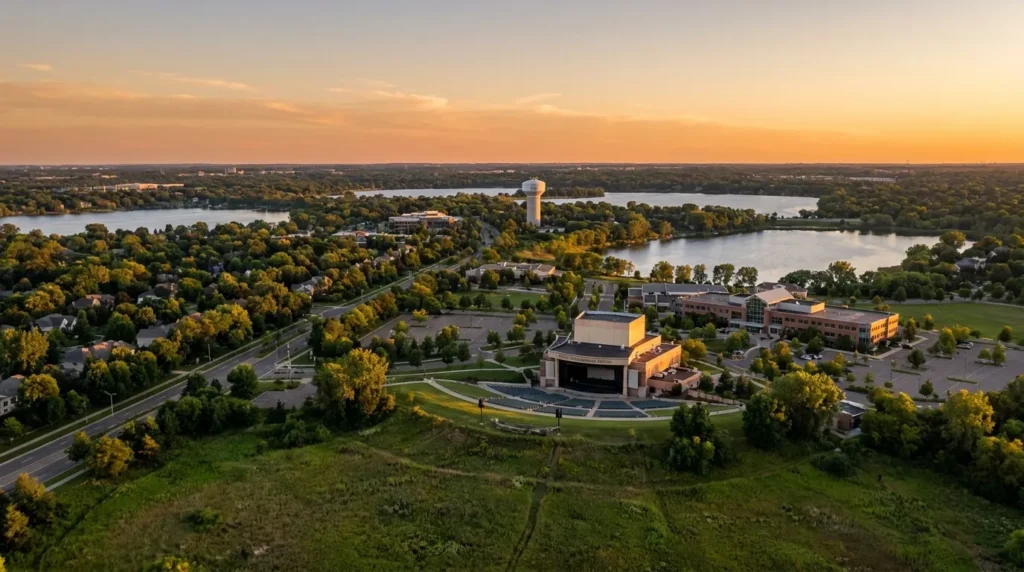
Plymouth is a northwest suburb of Minneapolis known for its lakes, parks, and neighborhood shopping centers. Life revolves around green spaces, trails, and the Hilde Performance Center.

The Hilde Performance Center, an outdoor amphitheater in Plymouth Creek Park, hosts free summer concerts and the Music in Plymouth event, which draws thousands of families. The Plymouth Ice Center has two public ice rinks, and Plymouth Creek Center brings together community activities ranging from the library to senior fitness classes.

The lakes define local leisure. Medicine Lake has French Regional Park, with a beach, kayak rentals, and paved bike trails. Parkers Lake offers a smaller, quieter beach, and Clifton E. French Regional Park connects the two areas via well-maintained bike paths. In winter, all of this becomes cross-country skiing and skating terrain.

For shopping and dining, The Shoppes at Arbor Lakes and Plymouth Place bring together chains and independent cafes. The Three Rivers Park District maintains Eagle Lake Regional Park, with golf and a mountain bike trail. Those seeking urban culture are a 25-minute drive from downtown Minneapolis and the Walker Art Center.

  1. 1["Plymouth Creek Center"
  2. 2"Plymouth Ice Center"
  3. 3"Hilde Performance Center (outdoor concerts)"
  4. 4"Plymouth Playhouse"
  5. 5"Plymouth Historical Society Museum"
  6. 6"Three Rivers Park trails"
Nightlife3.0 / 10
Parks & green spaces
  • ["Plymouth Creek Park"
  • "Medicine Lake Park"
  • "French Regional Park (at Medicine Lake)"
  • "Clifton E. French Regional Park"
  • "Bass Lake Playfield"
  • +1 more

Latest posts

Posts about Minnesota

Coverage and updates related to this destination.

Showing content from Minnesota, as there is no specific data for Plymouth yet.