Visto n' Visa
Blog
Notícias e artigos
Destinations
Careers
Immigrants

Want to live and work in Minnetonka?

Personalized immigration plan with eligible visas, costs, and next steps for your goal!

If you are not eligible, you will know exactly why and what to do to improve your approval chances.

Save up to 12 hours in meetings

No pointless assessments.

Save up to 90%

Save money on vague or unfocused consultations

Avoid Fraud and Mistakes

One mistake can cost you your visa

Total Impartiality

Zero commercial bias

Decide with peace of mind

No toxic urgency

Fast and Accurate

Answers in minutes, no guesswork

Demographic profile: white majority with growing Asian and Latino presence

Minnetonka has about 54,000 residents, predominantly white of European descent, with a growing presence of Indian, Chinese, Somali, and Latin American communities.

The city has a predominantly white population, rooted in the strong Scandinavian and German immigration that settled Minnesota in the 19th century. This heritage shows in Lutheran churches scattered across neighborhoods, surnames on school rosters, and summer festivities tied to Nordic traditions.

Over the past two decades, however, Minnetonka has diversified considerably. Indian and Chinese families arrived driven by opportunities in technology and healthcare at UnitedHealth, Optum, and other western corridor companies. The Somali community, one of the largest in the United States concentrated in Twin Cities, also has a presence in schools and local businesses. Hispanics, primarily Mexican and Central American, form another growing group.

The median age is higher than in neighboring Minneapolis, with many residents between 40 and 65. There are also younger clusters in condominiums near Ridgedale and along the Highway 7 corridor, drawn by the balance between a quiet lifestyle and proximity to the urban job market.

Languages spoken
  • English
  • Spanish
  • Somali
  • Hmong
  • Mandarin
  • +1 more
Main religions
  • Protestant Christianity (Lutheran, Methodist)
  • Roman Catholicism
  • Islam
  • Hinduism
  • Buddhism
  • +2 more

Cost of living above the Twin Cities average

Minnetonka costs more than Minneapolis to live in, but offers spacious neighborhoods, strong schools, and low crime in return for the higher price.

Living in Minnetonka costs noticeably more than in central Minneapolis neighborhoods or eastern suburbs such as Maplewood. The reason is straightforward: larger lots, well-ranked schools, and proximity to Lake Minnetonka push property prices up, whether buying or renting.

Basic expenses such as groceries, gas, and health insurance track close to the Minnesota average, which is already relatively high by Midwest regional standards. The state income tax is progressive and weighs heavily on high earners, something to keep in mind for professionals relocated by multinationals. There is no sales tax on clothing or basic food, which helps the monthly budget somewhat.

Winter heating is the expense that most surprises those coming from warm climates. Large homes in Minnetonka require substantial natural gas or electricity for six months of the year, with bills that can double in January and February. Air conditioning, by contrast, is used for relatively short periods.

94Cost index (US = 100)6% below US average
CategorySingleCoupleFamily (2 + 2)
iHousing$1,228$1,417$1,795
iFood$359$718$1,304
iTransport$472$803$1,039
iHealthcare$265$529$992
iChildcare$1,719
iOther$803$1,446$2,031
Monthly total$3,127$4,913$8,880

Source: U.S. BLS Consumer Expenditure Survey 2023 + BEA Regional Price Parities 2023 · Estimates in USD, monthly.

Spacious homes on wooded lots, with few apartment buildings

Single-family homes on large lots dominate, with neighborhoods built between the 1960s and 1990s; condominiums and apartments are concentrated near Ridgedale and the highway corridors.

Minnetonka's residential profile is defined by two-story single-family homes, typically on half-acre or larger lots, with generous lawns, two-car garages, and backyards backing onto woodlands or small ponds. Neighborhoods such as Glen Lake, Greenbriar, and Boulder Bridge exemplify this pattern.

For those who prefer an apartment or condominium, options are concentrated near Ridgedale shopping center and along I-394, where newer buildings with elevators, fitness centers, and underground parking have been developed. Two-bedroom rentals in well-located buildings are expensive, but come with the convenience of no snow removal or yard maintenance.

The inventory for buyers is tight and well-priced properties typically receive multiple offers within days. Neighboring areas such as Hopkins, Plymouth, and Minnetonka Mills are worth considering if the budget is stretched, while still offering access to the same highways and a comparable standard of living.

Recommended neighborhoods
  • Glen Lake
  • Greenbriar
  • Boulder Bridge
  • Burwell
  • Minnetonka Mills
  • +2 more

Corporate headquarters in healthcare, insurance, and agribusiness

Minnetonka concentrates major employers in healthcare, insurance, and agribusiness, led by UnitedHealth Group and Cargill, attracting skilled technical and administrative professionals.

The city's largest employer is UnitedHealth Group, headquartered in Minnetonka with thousands of employees across several local campuses, including Optum's operations. This presence generates openings for actuaries, data analysts, software engineers, clinical professionals, and health plan operations staff.

Cargill, the global agribusiness giant, also maintains its headquarters here, on a low-profile campus near Lake Minnetonka. For professionals in commodities, supply chain, finance, sustainability, and food research, it is a globally relevant hub. Smaller firms in consulting, legal services, and marketing orbit these two anchor employers.

The market is rounded out by positions in regional hospitals and clinics, Minnetonka Public Schools, and retail at Ridgedale. For those arriving on work visas in technology or healthcare, it is worth mapping not only Minnetonka but the entire western Twin Cities corridor, including Eden Prairie, Plymouth, and St. Louis Park.

Dominant sectors
  • Healthcare and insurance
  • Agribusiness and commodities
  • Information technology
  • Financial services
  • Retail
  • +1 more
Major employers
  • UnitedHealth Group
  • Cargill
  • Optum
  • Opus Group
  • Prime Therapeutics
  • +2 more

Well-ranked public schools and proximity to major universities

The Minnetonka Public Schools district is one of the most sought-after in the state, and the western Twin Cities area provides easy access to research universities such as the University of Minnesota and private institutions such as Saint Thomas.

Minnetonka Public Schools is one of Minnesota's most in-demand districts, with elementary and secondary schools that consistently rank among the state's best in mathematics and reading. Minnetonka High School in Excelsior serves students from most of the city and has strong programs in science, arts, and languages.

Families interested in bilingual education often look at the Mandarin Chinese and Spanish immersion programs offered by the district starting at the elementary level. Charter and private religious schools are also available in the area, along with Montessori and Waldorf schools nearby.

For higher education, the primary reference is the University of Minnesota Twin Cities, one of the largest research universities in the United States, about 25 minutes by car. Traditional private institutions such as the University of St. Thomas, Macalester, and Hamline are in Saint Paul. For shorter technical programs, Hennepin Technical College and Normandale Community College are accessible options.

Notable universities
  • University of Minnesota Twin Cities (Minneapolis)
  • University of St. Thomas (St. Paul/Minneapolis)
  • Hennepin Technical College
  • Normandale Community College (Bloomington)
  • Macalester College (St. Paul)
  • Hamline University (St. Paul)

Broad access to top-tier regional hospital systems

Minnetonka has robust local clinics and is close to excellence networks such as HealthPartners, Park Nicollet, and Hennepin Healthcare, with Mayo Clinic about an hour to the south.

The city is surrounded by one of the best healthcare networks in the United States. Methodist Hospital, part of the HealthPartners/Park Nicollet group, is in St. Louis Park just minutes away and serves as the reference hospital for emergencies and mid-complexity surgeries. Park Nicollet clinics throughout Minnetonka cover family medicine, pediatrics, and diagnostics.

Those requiring high-complexity care will find options in Minneapolis, including the University of Minnesota Medical Center and Hennepin Healthcare, the latter a leading trauma center. Mayo Clinic in Rochester, about 90 minutes by car, draws patients from around the world for rare conditions and second opinions.

Access depends heavily on the employer's health plan. Those relocating on work visas should verify whether the corporate plan covers HealthPartners, Allina, or another regional network, as physician and clinic preferences vary by insurance. Emergency care at hospitals is available to all, but comes with high out-of-pocket costs without adequate coverage.

Minnetonka

City considered safe, with low rates of violent crime

Minnetonka ranks among the safer suburbs in Twin Cities, with its own police department, low violent crime rates, and incidents concentrated in vehicle and residential burglaries.

Minnetonka's safety profile is that of a quiet suburb, with violent crime rates below the state average and well below those of Minneapolis. The municipal police maintain a visible presence in schools, parks, and neighborhoods, and response times to calls tend to be short.

The most common incidents are theft from unlocked vehicles, minor break-ins when homes are left vacant during trips, and drunk driving, particularly around marinas and bars in summer. Areas near Ridgedale shopping center and the highway corridors account for the majority of property crimes.

For newcomers, basic American suburb precautions apply: never leave bags, electronics, or documents visible in the car, lock doors even when visiting a neighbor, and install a motion sensor on the garage. In winter, extra caution is warranted on icy sidewalks and driveways, the leading cause of falls and fractures.

Safer neighborhoods
  • Glen Lake
  • Greenbriar
  • Boulder Bridge
  • Tonkawood
  • Burwell
Areas to avoid
  • Ridgedale parking lots after closing hours
  • Isolated spots along U.S. 12 at night
  • Remote unlit park areas at night

Car-dependent city: fast highways, limited public transit

Minnetonka relies heavily on the automobile, with I-394 and U.S. 12 connecting to downtown Minneapolis; regional buses exist but run infrequently, and MSP airport is about 35 minutes away.

Those moving to Minnetonka should plan on at least one car per adult. The main routes are I-394 and U.S. Highway 12 running east-west, and Highway 169 running north-south, all connecting to Minneapolis in 20 to 30 minutes outside peak hours. Traffic increases significantly during morning and late afternoon rush periods.

Public transit is provided by Metro Transit and SouthWest Transit, with express buses to downtown Minneapolis used primarily by those working in office towers. The planned Green Line Extension light rail is expected to serve Hopkins, Eden Prairie, and the surrounding area, improving the western region's connection to the light rail network.

Minneapolis-Saint Paul International Airport (MSP) is about 30 to 40 minutes by car, with direct flights to Europe, Asia, and most North American hubs. For short trips, bike paths exist in parks and on regional trails such as the Cedar Lake Trail and the Luce Line State Trail, but cycling to work is not practical for most residents.

Airports
  • MSP — Minneapolis-Saint Paul International (nearby, outside the city)
  • FCM — Flying Cloud Airport (general aviation in Eden Prairie)
  • Bike infrastructure

Climate

Minnetonka

Suburban culture with strong ties to lakes and Scandinavian traditions

Cultural life blends Scandinavian and German heritage with summer lake events, community festivals, and a dining scene that follows the Twin Cities standard.

Minnetonka's cultural identity rests on two pillars: the Scandinavian-German heritage of its early settlers and the relationship with water. In summer, Lake Minnetonka anchors much of social life, with marinas, waterside restaurants, regattas, and festivals in neighboring cities such as Excelsior and Wayzata, which connect to the local community.

The city has community theaters, music programming in parks, and seasonal events such as the Minnetonka Summer Festival. For a more robust scene of museums, opera, theater, and international dining, Minneapolis and Saint Paul are minutes away and offer nationally recognized options, including the Walker Art Center and the Guthrie Theater.

Local dining is dominated by family restaurants, American steakhouses, Midwest-style supper clubs, and cafes. Scandinavian culinary traditions appear in items such as lefse, krumkake, and hotdish, the last a classic weekend staple in local homes. The western region also has a strong craft brewery scene.

Notable dishes
  • Hotdish (Minnesota-style casserole)
  • Lefse
  • Walleye fish fry
  • Juicy Lucy (cheese-stuffed burger)
  • Wild rice soup
  • +1 more
Annual events
  • Minnetonka Summer Festival
  • Burwell House Heritage Days
  • Excelsior Apple Day (neighboring city)
  • Wayzata Art Experience (neighboring city)
  • Twin Cities Pride (Minneapolis)
  • +1 more

Lakes, trails, and regional parks as the main draw

The main attractions are natural: Lake Minnetonka, Purgatory Park, regional trails, and wooded parks, complemented by shopping centers, movie theaters, and the historic Burwell House.

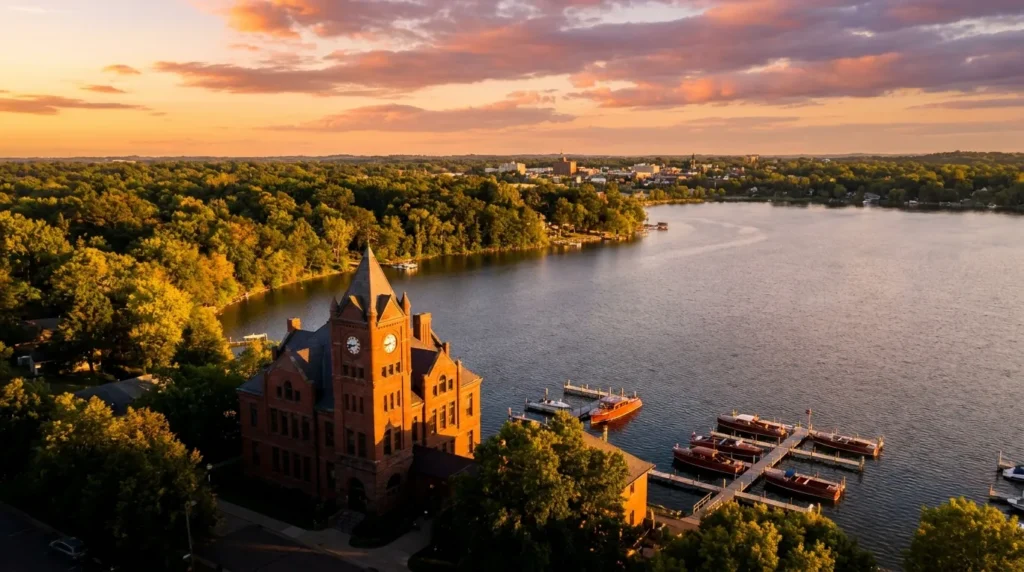
The primary draw is Lake Minnetonka itself, one of Minnesota's largest lakes, with over 125 miles of shoreline indented by bays. In summer, residents sail, jet-ski, fish, and frequent waterside restaurants. In winter, the lake freezes and becomes the setting for ice fishing, informal hockey, and skating crossings.

For hiking and cycling, Purgatory Park and Lone Lake Park offer trails through woodlands and wetlands, with birdwatching opportunities. Regional trails such as the Cedar Lake Trail and the Luce Line State Trail pass through or near the city, connecting to a wide network of paved bike paths.

Built attractions include the historic Burwell House, a 19th-century home with cultural programming; Ridgedale Center for shopping and movies; and the commercial area near Hopkins. For full museum experiences, theme parks, and professional sports, Minneapolis and the Mall of America in Bloomington are a short drive away.

  1. 1Lake Minnetonka
  2. 2Purgatory Park
  3. 3Lone Lake Park
  4. 4Burwell House
  5. 5Ridgedale Center
  6. 6Big Willow Park
Parks & green spaces
  • Purgatory Park
  • Lone Lake Park
  • Big Willow Park
  • Civic Center Park
  • Meadow Park
  • +1 more

Diverse immigrant communities within a traditional suburb

The Twin Cities metro concentrates large Somali, Hmong, Indian, Mexican, and Laotian communities, and Minnetonka has a growing presence of these groups supported by jobs in healthcare and technology.

Although traditionally white, Minnetonka is part of a metropolitan area with one of the largest Somali communities in the United States, significant Hmong and Lao populations that arrived as refugees in the 1970s and 1980s, and a recent influx of Indian and Chinese professionals in technology and healthcare. Mexican and Central American families also have a strong presence in schools and local businesses.

Main immigrant service hubs are in Minneapolis and Saint Paul, but Minnetonka has international grocery stores, Hindu and Buddhist temples nearby in Maple Grove and Edina, and mosques in Plymouth and Bloomington. Local Catholic churches offer Spanish-language Masses, and several district schools have bilingual staff to support newly arrived families.

For legal assistance, English language learning, and newcomer orientation, active regional nonprofits include the International Institute of Minnesota, the Confederation of Somali Community in Minnesota, and Hmong American Partnership. The Minnesota State Refugee and Immigration program also maintains services open to all nationalities.

7,000
Foreign-born residents
estimated
Top countries of origin
  • Mexico
  • India
  • Somalia
  • China
  • Vietnam
  • Laos
  • Ethiopia
  • South Korea
Foreign consulates
  • Mexican Consulate General (St. Paul)
  • Canadian Consulate General (Minneapolis)
  • Honorary Consulate of Brazil (Minneapolis)
  • Honorary Consulate of Germany (Minneapolis)
  • Honorary Consulate of Japan (Minneapolis)
  • +1 more
Community organizations
  • International Institute of Minnesota
  • Confederation of Somali Community in Minnesota
  • Hmong American Partnership
  • CLUES (Comunidades Latinas Unidas en Servicio)
  • Catholic Charities of St. Paul and Minneapolis
  • Asian Media Access

Latest posts

Posts about Minnesota

Coverage and updates related to this destination.

Showing content from Minnesota, as there is no specific data for Minnetonka yet.