Visto n' Visa
Blog
Notícias e artigos
Destinations
Careers
Immigrants

Want to live and work in Lakeville?

Personalized immigration plan with eligible visas, costs, and next steps for your goal!

If you are not eligible, you will know exactly why and what to do to improve your approval chances.

Save up to 12 hours in meetings

No pointless assessments.

Save up to 90%

Save money on vague or unfocused consultations

Avoid Fraud and Mistakes

One mistake can cost you your visa

Total Impartiality

Zero commercial bias

Decide with peace of mind

No toxic urgency

Fast and Accurate

Answers in minutes, no guesswork

Demographic profile of Lakeville

A predominantly white population of Scandinavian, German, and Irish descent. Racial diversity is lower than in other Twin Cities suburbs, though Asian and Hispanic families from neighboring areas are a growing presence.

Lakeville is demographically one of the least diverse suburbs in the Twin Cities. The historical base is strongly Scandinavian (Swedish and Norwegian), German, and Irish, a heritage from the family farming that dominated the area through the mid-twentieth century. Surnames like Anderson, Johnson, Olson, Schmidt, and O'Brien remain common in schools and community listings.

Diversity has grown over the past two decades, in parallel with job expansion in Dakota County and the migration of skilled professionals seeking newer homes at lower prices than in Apple Valley or Burnsville. An Indian community has been growing in neighborhoods near Lake Marion. Korean, Chinese, and Vietnamese communities are present in smaller numbers.

Mexican Hispanic residents are active in construction and services, without a defined ethnic neighborhood. African and African American communities are small in Lakeville. Brazilians are rare and scattered. The age profile is young for a suburb, with a strong concentration of families with school-age children. Public schools have full classrooms and are in constant expansion.

Languages spoken
  • English
  • Spanish
  • Hindi
  • Mandarin
  • Korean
  • +2 more
Main religions
  • Lutheran Protestantism
  • Roman Catholicism
  • Evangelical Protestantism
  • Hinduism
  • No religion

Cost of living in Lakeville compared to the Twin Cities

Moderate cost of living for a suburban standard, more affordable than Woodbury or Plymouth. Housing in newer neighborhoods offers value through home size and public school quality. Distance from downtown translates to higher gasoline costs and commute time.

Lakeville is considered a good value option for families willing to live farther from downtown. New four-bedroom homes with double garages in premium subdivisions cost less than comparable homes in Plymouth or Woodbury. Rents are also more accessible than in the western or eastern suburbs closer to the metro core. The added cost comes in gasoline and commute time.

For groceries, Cub Foods, Target, Walmart, Hy-Vee, and Aldi cover the basics. Costco is in Burnsville, about ten minutes away. Ethnic markets within Lakeville are limited, but Apple Valley, Burnsville, and Eagan have solid Indian, Asian, and Latino options a short drive away. Dining ranges from American chains to steakhouses and local Asian and Mexican options.

Gas heating through CenterPoint weighs on budgets from November through April. Electricity through Xcel Energy is reasonable. Property taxes in Dakota County are moderate by metro standards. Car insurance follows the state average. At the end of the month, total costs are lower than in Plymouth or Woodbury, with commute time as the primary trade-off.

94Cost index (US = 100)6% below US average
CategorySingleCoupleFamily (2 + 2)
iHousing$1,228$1,417$1,795
iFood$359$718$1,304
iTransport$472$803$1,039
iHealthcare$265$529$992
iChildcare$1,719
iOther$803$1,446$2,031
Monthly total$3,127$4,913$8,880

Source: U.S. BLS Consumer Expenditure Survey 2023 + BEA Regional Price Parities 2023 · Estimates in USD, monthly.

Housing market and recommended neighborhoods in Lakeville

Housing stock dominated by homes built between 2000 and 2020, with a strong presence of new subdivisions. Premium neighborhoods around Lake Marion, Orchard Lake, and Cedar Hills. Rental inventory is limited, with few newer apartment complexes.

Lakeville is one of the newest suburbs in the Twin Cities. The majority of homes were built between 1990 and the present, with wide subdivisions, curved streets, and cul-de-sacs typical of modern American planning. Neighborhoods such as Cedar Hills, Lake Marion, Spirit of Brandtjen Farm, Crystal Lake, and Orchard Lake are among the most sought after by families.

The newest neighborhoods are in the far south and west, with large homes on spacious lots built after 2010. Avonlea, Hosanna Highlands, and The Grove are examples of recent developments. Rental options are limited: complexes like Cherry Hill Apartments and Crossroads at Lakeville serve demand, but the housing stock is dominated by owner-occupied properties.

Buying a middle-class home with four bedrooms and a double garage is the local standard, with a median price lower than in Plymouth or Woodbury. Property taxes in Dakota County are moderate. The Lakeville Area Schools district (ISD 194) covers virtually the entire city and is considered a strong district statewide, making public school a compelling choice for families with children.

Recommended neighborhoods
  • Lake Marion
  • Orchard Lake
  • Cedar Hills
  • Crystal Lake
  • Spirit of Brandtjen Farm
  • +3 more

Employment and key sectors in Lakeville

An economy dominated by logistics, construction, retail, and manufacturing. Despatch Industries, Imagine! Print Solutions, and distribution centers along I-35 generate significant job volume. Most skilled professionals commute to the broader metro.

Lakeville has the mixed economy typical of a fast-growing suburb. Despatch Industries, a manufacturer of industrial ovens, is headquartered in Lakeville. Imagine! Print Solutions is a major local employer. Schneider Electric, FedEx Ground, and other distribution centers along I-35 provide volume in logistics, transportation, and warehousing.

For retail, the County Road 50 and Cedar Avenue corridor concentrates many operations. Residential construction is an important sector driven by the city's rapid growth, with builders such as Pulte Homes and D.R. Horton active in new neighborhoods. Small and mid-sized industrial firms along I-35 round out the picture.

For skilled professionals, the majority commute to jobs in the central metro. Companies in Burnsville, Eagan, and Apple Valley also employ Lakeville residents. For newcomers, entry-level openings exist in residential construction (in strong expansion), logistics, restaurants, retail, and services. Volume is lower than in Brooklyn Park or the city of Minneapolis.

Dominant sectors
  • Logistics and distribution
  • Residential construction
  • Specialized manufacturing
  • Retail
  • Healthcare (clinics and nursing)
  • +1 more
Major employers
  • Despatch Industries
  • Imagine! Print Solutions
  • Lakeville Area Schools
  • FedEx Ground
  • Schneider Electric
  • +3 more

Education system in Lakeville

Served by Lakeville Area Schools (ISD 194), a district considered one of the strongest in Minnesota, with Lakeville North and Lakeville South as the main high schools. Higher education is located in the central metro.

Lakeville is covered almost entirely by Lakeville Area Schools (ISD 194), with Lakeville North High School and Lakeville South High School as the two main campuses. The district performs consistently above the state average on standardized tests and offers robust AP and IB programs. Schools have been expanding steadily due to population growth.

Private options include All Saints Catholic School, Crossroads Elementary, and several evangelical Christian schools in the area. Charter options include Lakes International Language Academy in Forest Lake, which is farther away. ESL is offered at the elementary level in response to growing diversity.

There is no university within Lakeville. Dakota County Technical College in Rosemount, about 15 minutes away, offers ESL, technical programs, and transfer pathways. Inver Hills Community College in Inver Grove Heights is also nearby. For four-year degrees, the University of Minnesota Twin Cities, University of St. Thomas, and several others are 30 to 45 minutes away. Capella University, fully online, attracts professionals seeking executive education.

Notable universities
  • Dakota County Technical College
  • Inver Hills Community College
  • University of Minnesota Twin Cities
  • University of St. Thomas
  • Bethel University
  • Capella University
  • Concordia University St. Paul

Healthcare access in Lakeville

The city has no hospital of its own, with access provided by Fairview Ridges Hospital in Burnsville and Northfield Hospital in Northfield. Several clinics and urgent care centers within the city handle primary care demand.

Lakeville has no hospital within city limits, but Fairview Ridges Hospital in Burnsville, about 15 minutes via I-35, serves most regional needs. Northfield Hospital in Northfield, about 20 minutes south on I-35, is another option. For more complex cases, M Health Fairview University Medical Center in Minneapolis and the Mayo Clinic in Rochester, roughly 75 minutes away, are the main referral centers.

Primary care within the city is provided through clinics operated by M Health Fairview, Allina Health, HealthPartners, and Park Nicollet. Several clinics and urgent care centers are located along Cedar Avenue, County Road 50, and near Lake Marion. For uninsured residents, FQHCs in Apple Valley and Burnsville offer income-adjusted fees.

Insurance is generally tied to employment. MNsure is the state marketplace for the self-employed. CVS, Walgreens, Cub Pharmacy, and Target Pharmacy provide solid pharmacy coverage throughout the city. The Dakota County health department offers childhood vaccination, family planning, and tuberculosis prevention. Access is considered good for a city of this size.

Healthcare index78.0 / 100
  • Life expectancyyears at birth
    78.4yrs
  • Doctors per 1kpracticing physicians
    3.7
  • Health spendper capita, per year
    $13,473
  • Public systemoverall quality rating
    Good

Safety in Lakeville

One of the safest cities in Minnesota and frequently ranked among the safest in the United States. Violent crime is virtually nonexistent. Property crime is sporadic, occurring mainly in commercial parking lots and apartment complexes.

Lakeville consistently ranks among the safest large cities in the United States. Violent crime is extremely rare and, when it occurs, is almost always tied to domestic situations rather than street incidents. The municipal police department is well-funded, and emergency response times are considered short. The department maintains strong cooperation with the Dakota County Sheriff's Office.

The most common crime is property-related: car break-ins with items visible in commercial parking lots along County Road 50, package theft at residences (rising alongside online shopping), and daytime residential burglaries. Catalytic converter theft is a sporadic issue. Police recommend Ring cameras, steering wheel locks, and never leaving anything visible in parked vehicles.

For a family arriving from abroad, the general feeling is one of very high calm. Children ride bikes through neighborhoods without significant concern. Municipal parks such as Antlers Park, Aronson Park, and Casperson Park are used without incident. At night, residential streets are practically empty. Basic precautions are sufficient for any rare situation.

5.8
Homicides per 100k
per year
Safety index
82.0
Crime index
18.0
Safer neighborhoods
  • Crystal Lake area
  • Lake Marion
  • Spring Lake
  • Brackett's Crossing
  • Cedar Highlands
  • Foxborough
Areas to avoid
  • Isolated stretches of Cedar Avenue late at night
  • Industrial areas around Airlake Industrial Park after business hours

Transportation and mobility in Lakeville

A city entirely dependent on the car. I-35 is the main artery, with multiple exits. Express buses from the Minnesota Valley Transit Authority connect to downtown Minneapolis. No light rail.

Lakeville is structurally a car-dependent suburb at a greater distance from the core. I-35 runs through the city from north to south with several exits, and it is the only fast connection to the rest of the metro. Downtown Minneapolis is about 35 minutes away with no traffic, and 45 to 60 minutes during peak hours. Downtown St. Paul is 30 to 45 minutes via I-35E.

The Minnesota Valley Transit Authority (MVTA) operates express buses from Park-and-Ride lots in Lakeville, including Cedar Grove Transit Station and Kenrick Avenue Park and Ride, directly to downtown Minneapolis during business hours. For professionals working downtown, this is a viable alternative, especially in winter. Routes 478, 480, and 484 serve this commute.

There is no light rail in Lakeville. The Red Line bus rapid transit reaches neighboring Apple Valley. For most families, two cars are the standard. MSP airport is 25 to 30 minutes away via I-35 and Highway 77. Cycling is feasible in summer on the regional trail network, though distances between neighborhoods are large. Parking is plentiful.

30 min
Avg commute
22
Walkability
Airports
  • MSP — Minneapolis-Saint Paul International Airport (approximately 22 miles away)
  • LVN — Airlake Airport (general aviation)
  • Bike infrastructure

What the climate is like living in Lakeville

A suburb south of Minneapolis with a cold humid continental climate: warm summers around 28 degrees Celsius, long and severe winters with substantial snowfall.

Summer in Lakeville is warm and short, with highs between 27 and 29 degrees Celsius in July. The area's lakes provide recreational relief, and air conditioning is standard.

Winter is long and harsh, with lows between -19 and -14 degrees Celsius in January and snowfall totaling around 135 cm per season. Heavy clothing, snow tires, and natural gas heating are essential.

Spring is brief and autumn is short but striking. Combined rain and snow total roughly 800 mm annually, with a wetter summer and drier winter.

Sunny days / year200 days
Avg high (°F)
  • 25°J
  • 24°F
  • 42°M
  • 54°A
  • 68°M
  • 82°J
  • 83°J
  • 81°A
  • 74°S
  • 57°O
  • 43°N
  • 32°D
Avg low (°F)
  • J
  • F
  • 24°M
  • 35°A
  • 48°M
  • 62°J
  • 64°J
  • 63°A
  • 57°S
  • 42°O
  • 29°N
  • 17°D
Rainfall (")
  • 1"J
  • 2"F
  • 3"M
  • 3"A
  • 6"M
  • 3"J
  • 5"J
  • 5"A
  • 4"S
  • 3"O
  • 2"N
  • 2"D

Cultural life and daily living in Lakeville

A family-oriented city with leisure built around municipal parks, lakes, and amateur sports leagues. Limited local nightlife, with residents heading to the central metro for dining and cultural variety.

Cultural life in Lakeville is typically suburban and family-focused. Lake Marion, Orchard Lake, Lee Lake, and Crystal Lake form the central axis of summer recreation, with urban beaches, canoeing, fishing, sailing, and jet skiing. Antlers Park on Lake Marion is the city's most-used beach. Aronson Park and Casperson Park round out the offering. In winter, the lakes freeze and become skating rinks and ice fishing destinations.

The dining scene is dominated by American chains, alongside local options such as Brick and Bourbon, Crooked Pint Ale House, and Babe's Music Bar. Asian and Mexican restaurants are growing. For nightlife, premium dining, professional sports, and IMAX cinema, most residents drive to Burnsville, Apple Valley, or the central metro.

Amateur sport is central to local identity. Lakeville North and Lakeville South high schools maintain a traditional rivalry. Youth hockey, baseball, and soccer leagues bring entire families together. For professional sports, the Vikings (NFL), Twins (MLB), and Wild (NHL) are based in Minneapolis or St. Paul, with the Wild at Xcel Center in St. Paul about 30 minutes away. Pan-O-Prog, held in July, is the city's annual festival.

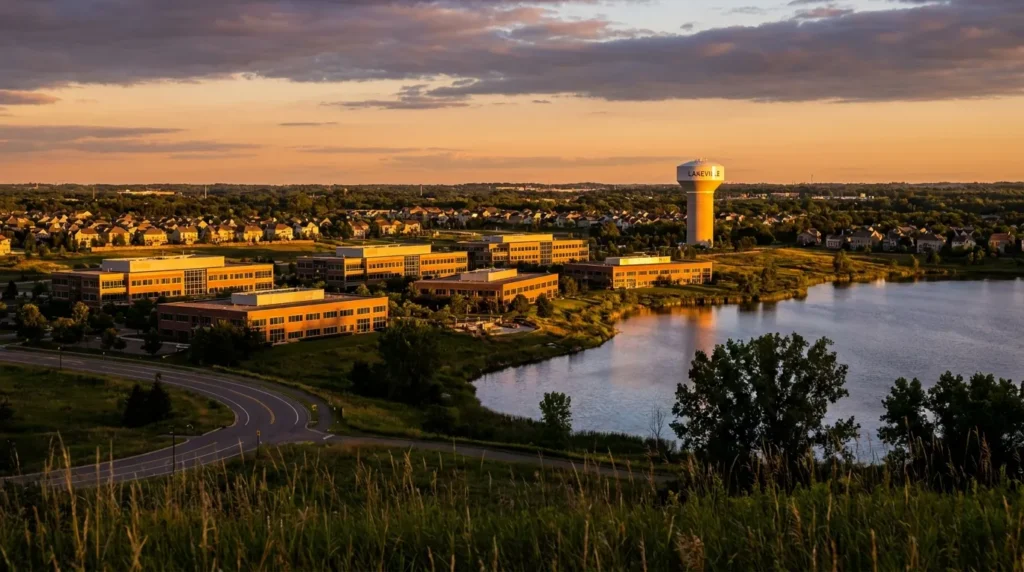
Lakeville

Life in Lakeville, southern suburb of Minneapolis-St. Paul

A Dakota County city south of the Twin Cities, with urban lakes (Marion, Orchard, Kingsley), the historic Heritage Center, and an extensive park system.

Lakeville is one of the fastest-growing suburbs in the Twin Cities, where the lifestyle blends lakes, parks, and spacious residential neighborhoods. The Lakeville Area Arts Center, located in historic Downtown Lakeville, features galleries and community theater, while Holyoke Avenue concentrates restaurants and the Lakeville Brewing Company. The Lakeville Heritage Center, housed in a historic building, hosts civic events.

Lakes define recreation here. Lake Marion, the largest, anchors Antlers Park with a beach, public marina, and trail, drawing sailors and walleye anglers. Orchard Lake, Kingsley Lake, and Lee Lake round out the system, each with public piers. Pan-O-Prog (Pan-O-Progress Festival), held in July, is the signature annual event, featuring a parade and activities at Antlers Park.

For larger natural areas, Murphy-Hanrehan Park Reserve, managed by Three Rivers Park District, and the Lake Marion Greenway offer trails for hiking, mountain biking, and cross-country skiing in winter. Cedar Avenue (Highway 77) connects quickly to Minneapolis-St. Paul International Airport (35 minutes) and the Mall of America (25 minutes) in Bloomington. Neighboring Apple Valley is home to the Minnesota Zoo.

  1. 1["Lakeville Area Arts Center"
  2. 2"Lakeville Heritage Center"
  3. 3"Buck Hill Ski Area"
  4. 4"Hyland Hills (nearby)"
  5. 5"Lakeville Brewing Company"
  6. 6"Antlers Park (with beach on Lake Marion)"
Nightlife2.0 / 10
Parks & green spaces
  • ["Antlers Park"
  • "Casperson Park"
  • "Aronson Park"
  • "Ritter Farm Park"
  • "King Park"
  • +1 more

Latest posts

Posts about Minnesota

Coverage and updates related to this destination.

Showing content from Minnesota, as there is no specific data for Lakeville yet.