Visto n' Visa
Blog
Notícias e artigos
Destinations
Careers
Immigrants

Want to live and work in Coon Rapids?

Personalized immigration plan with eligible visas, costs, and next steps for your goal!

If you are not eligible, you will know exactly why and what to do to improve your approval chances.

Save up to 12 hours in meetings

No pointless assessments.

Save up to 90%

Save money on vague or unfocused consultations

Avoid Fraud and Mistakes

One mistake can cost you your visa

Total Impartiality

Zero commercial bias

Decide with peace of mind

No toxic urgency

Fast and Accurate

Answers in minutes, no guesswork

Who lives in Coon Rapids

A predominantly white working-class city, with a growing presence of Asian, African, and Latino communities spread across newer neighborhoods.

Coon Rapids has the profile of a working-class middle suburb. Most residents are of European descent, particularly German, Norwegian, and Swedish, a historical legacy of the Upper Midwest. Families typically have school-age children, and the median age is similar to the state average.

Over the past two decades the city has become considerably more diverse. Visible communities of Vietnamese, Hmong, Somali, Ethiopian, Indian, and Mexican immigrants are present, with their own churches, markets, and restaurants spread along Coon Rapids Boulevard and the Riverdale area.

English is the predominant language, but Spanish, Somali, Hmong, and Vietnamese are commonly heard in public schools, businesses, and places of worship. Educational attainment is high by American standards, with a large share of adults having completed at least some post-secondary education, typically at regional community colleges.

Languages spoken
  • English
  • Spanish
  • Somali
  • Hmong
  • Vietnamese
Main religions
  • Lutheran Christianity
  • Catholicism
  • Evangelical Christianity
  • Islam
  • Buddhism

Affordable cost of living by Twin Cities standards

Less expensive than Minneapolis and Saint Paul, with moderate rent, chain grocery stores, and high heating bills in winter.

Coon Rapids is one of the more affordable options within the greater Twin Cities metropolitan area. One-bedroom apartment rent is well below what is paid in central Minneapolis neighborhoods, and single-family homes are significantly cheaper than in nearby suburbs such as Edina or Eden Prairie.

Groceries, gas, and services are in line with the Midwest average. Cub Foods and Aldi have a strong presence and help keep monthly expenses manageable. Dining out tends to be reasonably priced because most restaurants are chains or casual independents, not fine dining.

The major budget surprise is heating. From November through March, natural gas bills rise sharply due to extreme cold, and renters should confirm whether utilities are included. Property taxes are reasonable, and Minnesota charges a relatively high state income tax, something to factor into net take-home pay.

94Cost index (US = 100)6% below US average
CategorySingleCoupleFamily (2 + 2)
iHousing$1,228$1,417$1,795
iFood$359$718$1,304
iTransport$472$803$1,039
iHealthcare$265$529$992
iChildcare$1,719
iOther$803$1,446$2,031
Monthly total$3,127$4,913$8,880

Source: U.S. BLS Consumer Expenditure Survey 2023 + BEA Regional Price Parities 2023 · Estimates in USD, monthly.

Ranch houses, condos, and plenty of yard

Single-family homes of one or two stories with double garages predominate; apartment complexes are concentrated along the main corridors.

The housing stock in Coon Rapids is dominated by single-family homes built between 1960 and 1990, typically one-story ramblers or split-levels with finished basements. Large yards, double garages, and cul-de-sac residential streets are the norm. Purchasing a modest home remains attainable for a median-income family.

For renters, supply is concentrated in apartment complexes along Coon Rapids Boulevard, Foley Boulevard, and near Riverdale. These are two- or three-story buildings with parking and basic amenities such as a fitness center and seasonal pool. Studios and one-bedroom units are easier to find than three-bedroom rentals.

Neighborhoods such as Sand Creek, Riverview, and the area near Bunker Hills Regional Park tend to be most sought after by families. Those wanting better public transit or walkable access to shops often prefer the area around Northstar Commuter Rail in neighboring Anoka, or neighborhoods further south like Fridley and Columbia Heights.

Recommended neighborhoods
  • Sand Creek
  • Riverview
  • Crooked Lake
  • Northdale
  • Riverdale

Jobs in retail, healthcare, and light industry

Local employment in hospitals, retail, and logistics; many residents commute to Minneapolis or to the industrial corridor in Fridley and Blaine.

Coon Rapids has no major corporate headquarters, but concentrates employment in healthcare, retail, and light industry. Mercy Hospital, part of the Allina Health network, is one of the largest local employers, along with clinics, dental offices, and physical therapy centers throughout the city. The Riverdale area generates many positions in stores, restaurants, and grocery chains.

The region has a manufacturing tradition. Companies such as Cummins Power Generation in Fridley, and smaller manufacturers along Highway 10, draw technical positions in welding, maintenance, and production lines. Those working in technology, finance, or insurance typically commute to downtown Minneapolis or to corporate campuses in Bloomington and Plymouth.

Anoka-Ramsey Community College, located within the city, is a regional reference for technical training and workforce coursework. Recently arrived immigrants often start in logistics, food processing, hospitality, and elder care, all sectors with consistent demand across the metro.

Dominant sectors
  • Healthcare
  • Retail
  • Light manufacturing
  • Logistics
  • Education
Major employers
  • Mercy Hospital (Allina Health)
  • Anoka-Hennepin School District
  • Anoka-Ramsey Community College
  • Cub Foods
  • Target
  • +1 more

Large public schools and a community college in the city

The Anoka-Hennepin School District, one of the largest in the state, serves the city; higher education nearby through Anoka-Ramsey and the University of Minnesota.

K-12 education falls primarily under the Anoka-Hennepin School District, one of the largest in Minnesota, with schools such as Coon Rapids High School and Northdale Middle School serving the city. Charter, Catholic, and Lutheran school options are also available throughout the metropolitan area.

In higher education, Anoka-Ramsey Community College, located within the city, offers two-year programs, technical training, and transfer pathways to four-year universities. It is widely used by recently arrived immigrants and adults returning to study for professional retraining.

For full bachelor's, master's, and doctoral programs, the regional reference is the University of Minnesota Twin Cities, in Minneapolis and Saint Paul, approximately 30 minutes away. Other universities such as Bethel, Hamline, and Saint Thomas are within the same commute radius.

Notable universities
  • Anoka-Ramsey Community College (campus in Coon Rapids)
  • University of Minnesota Twin Cities (regional)
  • Hamline University (regional)
  • University of Saint Thomas (regional)
  • Bethel University (regional)

Regional hospital and a dense network of clinics

Mercy Hospital anchors local healthcare, complemented by Allina, M Health Fairview, and HealthPartners clinics throughout the city.

The main anchor of local healthcare is Mercy Hospital, part of the Allina Health network, a regional-scale hospital with an emergency room, maternity ward, oncology, and surgery. It serves as a reference for the entire north side of the metro and routinely treats patients from Anoka, Blaine, and Andover.

Surrounding the hospital is a network of clinics, dental offices, physical therapists, and laboratories. Networks such as M Health Fairview, HealthPartners, and Park Nicollet operate outpatient units in the city or in immediately neighboring areas. CVS, Walgreens, and in-store pharmacy counters are easy to find.

The system is private and insurance-based, as throughout the United States. Those employed full-time by a mid-size or large employer typically have employer-sponsored coverage. For those arriving without insurance, community health clinics and MNsure, the state's subsidized health plan marketplace, are available options.

Coon Rapids

Safety typical of a Midwest suburb

The city is generally considered safe, with occasional property crimes in commercial areas and quiet residential streets at night.

Coon Rapids has the typical profile of a middle-class Midwest suburb: violent crime rates well below the Minneapolis average, and property crimes concentrated in commercial areas. Children riding bikes in summer and residents walking at night on residential streets are common sights.

Areas of concern are typically parking lots at large stores and shopping centers, where vehicle thefts and sporadic break-ins occur. Sections of Coon Rapids Boulevard closer to the Fridley border have slightly higher rates of minor offenses. Local police maintain a direct reporting channel and predictable patrol patterns.

The main daily risk is traffic and weather conditions, not crime. Icy roads in winter and snowstorms cause more incidents than robberies. Switching to winter tires and observing city-issued road closures is strongly recommended.

Safer neighborhoods
  • Sand Creek
  • Riverview
  • Crooked Lake
  • Northdale
  • Bunker Hills Regional Park area
Areas to avoid
  • sections of Coon Rapids Boulevard near the Fridley border at night
  • isolated strip mall parking lots after closing time
  • industrial areas along Highway 10 outside business hours

A city designed around the car

No metro rail and limited bus service; a car is practically required, though the Northstar station in Anoka connects to Minneapolis.

Coon Rapids was planned in the automobile era, and that remains evident. Highway 10, Highway 610, and US-169 cut through or border the city, providing quick connections to Minneapolis, Saint Paul, and the airport. Nearly every adult resident drives, and owning a car is a practical requirement for work and everyday errands.

Public transit exists but is limited. Metro Transit operates several express routes to downtown Minneapolis during peak hours, primarily from park-and-ride facilities. The Northstar Commuter Rail station in neighboring Anoka offers daily trains to downtown Minneapolis with a travel time of around 40 minutes.

For cyclists, the city has connected regional trails, including the Rum River Regional Trail and segments of the Mississippi River Trail, though use is more recreational than for daily commuting. The region's primary airport, MSP, is approximately 40 minutes by car depending on traffic.

Airports
  • MSP — Minneapolis Saint Paul International (approx. 40 min by car)
  • ANE — Anoka County Janes Field (general aviation)
  • Bike infrastructure

Climate

Coon Rapids

Suburban life, lakes, and Scandinavian heritage

Upper Midwest suburban culture with Lutheran churches, summer farm fairs, and winter hockey, seasoned by immigrant community restaurants and festivals.

Local culture is that of the classic Upper Midwest suburb. Families spend summers on backyard decks, at barbecues, at lake cabins on weekends, and at farmers markets in the central area. In winter, the focus shifts to ice hockey, cross-country skiing, and bonfire festivals in parks.

Scandinavian and German heritage still surfaces in Lutheran and Catholic churches, in bakeries featuring wild rice bread, and in dishes such as hotdish, fried walleye, and wild rice soup. Community festivals, parades, and the traditional Coon Rapids Snowflake Days mark the civic calendar.

Diversity has brought new flavor to the city. Vietnamese restaurants with pho, Mexican markets with taquerias, Somali bakeries, and Vietnamese Buddhist temples operate alongside older institutions. Events such as the Minnesota State Fair, in neighboring Falcon Heights, are a late-summer fixture for the region.

Notable dishes
  • Fried walleye
  • Hotdish
  • Wild rice soup
  • Lutefisk (at Scandinavian events)
  • Vietnamese pho
  • +1 more
Annual events
  • Coon Rapids Snowflake Days
  • Anoka County Fair (in Anoka)
  • Minnesota State Fair (regional)
  • Riverfest
  • Bunker Beach summer concerts

Regional parks, the Mississippi dam, and Bunker Beach

The highlights are green and water spaces: Coon Rapids Dam, Bunker Hills, Bunker Beach Water Park, and trails along the Mississippi.

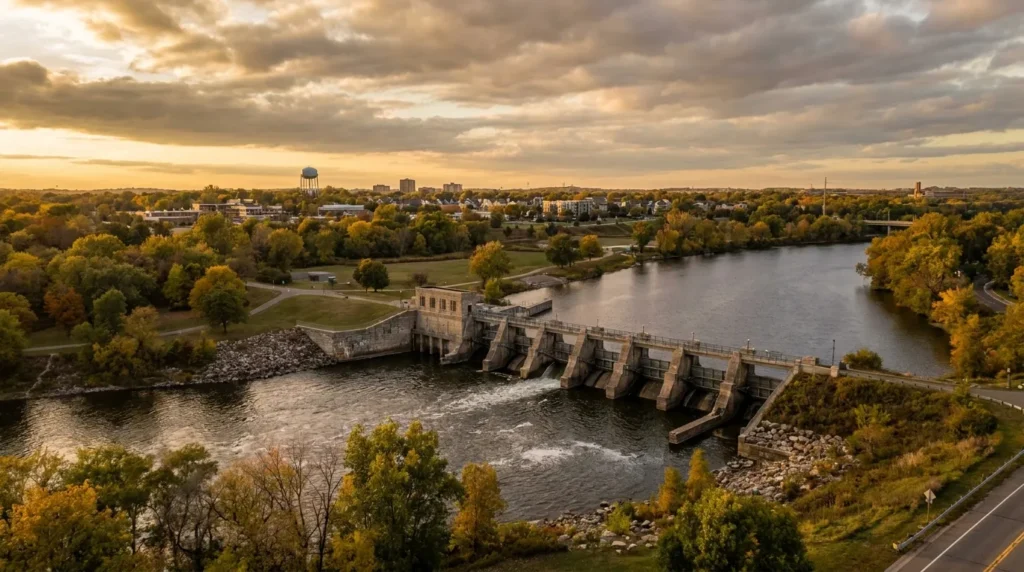
The main natural attraction is Coon Rapids Dam Regional Park, on the Mississippi River, featuring a walkway over the dam, overlooks, trails, and sport fishing. It is a traditional picnic destination in summer and a site for eagle and deer watching in winter. The Mississippi River is a central part of the local identity.

Bunker Hills Regional Park, along the northern border, offers a golf course, equestrian area, trails, a swimming lake, and Bunker Beach Water Park, a large water park that becomes a family gathering point in summer. Coon Rapids Ice Center concentrates local hockey life in winter.

Those seeking denser culture and urban life can drive 30 minutes south to Minneapolis, with museums such as the Walker Art Center, Mill City Museum, and Minneapolis Institute of Art, plus the Mall of America in Bloomington. The city's own appeal, however, lies in its parks and nearby lakes.

  1. 1Coon Rapids Dam Regional Park
  2. 2Bunker Hills Regional Park
  3. 3Bunker Beach Water Park
  4. 4Coon Rapids Ice Center
  5. 5Riverdale Village (open-air shopping center)
  6. 6Sand Creek Park
Parks & green spaces
  • Coon Rapids Dam Regional Park
  • Bunker Hills Regional Park
  • Sand Creek Park
  • Lions Coon Creek Park
  • Cenaiko Lake
  • +1 more

Growing immigrant communities

A city that has gained diversity over the past twenty years, with visible communities of Vietnamese, Hmong, Somali, Ethiopian, Indian, and Mexican residents.

Coon Rapids is part of one of the Twin Cities' largest demographic transformations: the arrival of immigrants from Southeast Asia, the Horn of Africa, South Asia, and Latin America. Vietnamese and Hmong communities settled in the region after the 1970s, establishing churches, Buddhist temples, and specialty markets across the greater metro.

The Somali and Ethiopian communities have grown more recently, with mosques, restaurants, and businesses spread across Coon Rapids, Fridley, and Brooklyn Park. Mexican, Ecuadorian, and Central American immigrants work in commerce, construction, food processing, and elder care. Indian and Filipino residents are strongly represented in healthcare and engineering.

For newcomers, neighborhood associations, churches, temples, and community centers typically serve as support networks for housing, employment, children's schooling, and adjustment to winter. Most government institutions offer translation services in multiple languages.

6,800
Foreign-born residents
estimated
Top countries of origin
  • Mexico
  • Vietnam
  • Laos (Hmong)
  • Somalia
  • Ethiopia
  • India
  • Philippines
  • China
Foreign consulates
  • Mexican Consulate General in Saint Paul
  • Honorary Consulate of Canada in Minneapolis
  • Honorary Consulate of Brazil in Minneapolis
  • Honorary Consulate of Germany in Minneapolis
  • Honorary Consulate of Sweden in Minneapolis
  • +1 more
Community organizations
  • Catholic Charities of Saint Paul and Minneapolis
  • International Institute of Minnesota
  • Hmong American Partnership
  • Confederation of Somali Community in Minnesota
  • CLUES (Comunidades Latinas Unidas En Servicio)
  • Anoka County Community Action Program

Latest posts

Posts about Minnesota

Coverage and updates related to this destination.

Showing content from Minnesota, as there is no specific data for Coon Rapids yet.