Visto n' Visa
Blog
Notícias e artigos
Destinations
Careers
Immigrants

Want to live and work in Burnsville?

Personalized immigration plan with eligible visas, costs, and next steps for your goal!

If you are not eligible, you will know exactly why and what to do to improve your approval chances.

Save up to 12 hours in meetings

No pointless assessments.

Save up to 90%

Save money on vague or unfocused consultations

Avoid Fraud and Mistakes

One mistake can cost you your visa

Total Impartiality

Zero commercial bias

Decide with peace of mind

No toxic urgency

Fast and Accurate

Answers in minutes, no guesswork

A city that grew more diverse over the past two decades

Burnsville was predominantly white through the 2000s, but today has growing communities from East Africa, Southeast Asia, and Latin America.

The city has roughly 64,000 residents, and while the majority is still non-Hispanic white, its composition has shifted considerably over the past two decades. There are now visible communities of Somali, Ethiopian, Hmong, Vietnamese, Mexican, and Ecuadorian origin, concentrated mainly in apartment complexes near County Road 42 and Nicollet Avenue.

English is the primary language, but it is common to hear Somali, Spanish, Hmong, and Amharic in markets and public schools. The District 191 school network offers English as a second language support and provides interpreters for recently arrived families at parent-teacher conferences, which eases integration.

In terms of religion, the city has several Lutheran and Catholic churches, reflecting the state's Scandinavian and German heritage, as well as smaller mosques serving the Somali community and Buddhist temples serving Southeast Asian families.

Languages spoken
  • English
  • Spanish
  • Somali
  • Hmong
  • Amharic
  • +1 more
Main religions
  • Lutheranism
  • Catholicism
  • Sunni Islam
  • Buddhism
  • Non-denominational Evangelical
  • +1 more

More affordable than Minneapolis, with good value for families

Burnsville is more accessible than the premium western Twin Cities suburbs, with lower rents and property taxes than Edina or Eden Prairie.

The cost of living in Burnsville falls below pricier suburbs like Edina, Minnetonka, and Eden Prairie, and is roughly comparable to neighbors like Apple Valley and Lakeville. One-bedroom apartment rents hover around the metropolitan average, and homes for purchase tend to cost less than on the other side of the river.

Food and services follow Twin Cities standards, with Cub Foods, Hy-Vee, and Aldi covering the basics, plus Trader Joe's and Target for more variety. The state sales tax is 6.875%, and Burnsville adds a small local levy, which becomes noticeable on larger purchases.

The biggest unexpected expense for those arriving from tropical countries is winter heating, which can double gas or electric bills between December and February. A car is practically mandatory, and auto insurance is a legal minimum requirement in Minnesota.

94Cost index (US = 100)6% below US average
CategorySingleCoupleFamily (2 + 2)
iHousing$1,228$1,417$1,795
iFood$359$718$1,304
iTransport$472$803$1,039
iHealthcare$265$529$992
iChildcare$1,719
iOther$803$1,446$2,031
Monthly total$3,127$4,913$8,880

Source: U.S. BLS Consumer Expenditure Survey 2023 + BEA Regional Price Parities 2023 · Estimates in USD, monthly.

Yards, new condos, and apartments near the shopping center

The housing stock ranges from family homes from the 1970s on tree-lined streets to modern apartment complexes along commercial corridors, with reasonable rents.

Burnsville's housing stock is typical of an American suburb: many single-story or two-story homes with finished basements, double garages, and yards, built between the 1970s and 1990s. The most desirable neighborhoods are around Crystal Lake and Sunset Pond, with homes on tree-lined streets and trail access.

For those who prefer to rent before buying, several apartment complexes are located near Burnsville Parkway, Nicollet Avenue, and Heart of the City, a revitalized area with new buildings, restaurants, and the Burnsville Performing Arts Center. These buildings typically accept 12-month leases and require a guarantor or security deposit.

The rental process requires a U.S. credit history, proof of income generally at three times the rent, and an employer reference. Newcomers without a credit score often need to pay a larger deposit or present a co-signer.

Recommended neighborhoods
  • Heart of the City
  • Crystal Lake
  • Sunset Pond
  • Burnhaven
  • Echo Park
  • +1 more

Retail, healthcare, logistics, and corporate offices drive local employment

The city combines retail jobs at Burnsville Center, regional hospitals, light industry, and professional services offices along commercial corridors.

Burnsville is not a heavy industrial hub, but it has a diversified economy for a suburb. Burnsville Center, along with stores and restaurants along County Road 42, generates thousands of retail and food service jobs. Fairview Ridges Hospital and several specialty clinics employ healthcare professionals from across the metropolitan area.

There is also a significant presence of light manufacturing, distribution, and construction companies in industrial parks along I-35W. For those who work in corporate offices, commuting by car to Bloomington, Minneapolis, or Eden Prairie is common, with travel times between 25 and 45 minutes depending on the time of day.

Qualified immigrants often find opportunities in healthcare, engineering, IT, and logistics. Workers in transition frequently start in retail, restaurants, cleaning, or elder care while validating credentials or developing professional-level English skills.

Dominant sectors
  • Healthcare
  • Retail
  • Light Manufacturing
  • Logistics and Distribution
  • Professional Services
  • +1 more
Major employers
  • Fairview Ridges Hospital
  • Burnsville Center
  • Independent School District 191
  • Northern Tool + Equipment
  • Cub Foods
  • +1 more

School District 191 and easy access to community colleges and universities

Burnsville is served by School District 191, with well-rated public schools, and is close to community colleges and the University of Minnesota.

Independent School District 191 covers Burnsville, Eagan, and Savage, with several elementary and middle schools and Burnsville High School. The schools are reasonably well rated and offer English as a second language programs for recently arrived families, with interpreters available at parent-teacher conferences.

For higher education, Dakota County Technical College is located in Rosemount, about 20 minutes away, offering short technical programs. Normandale Community College in Bloomington is another popular option for starting a degree at a low cost. For a four-year degree, the University of Minnesota (Twin Cities) is 30 minutes away via I-35W and holds one of the strongest reputations in the Midwest.

Several private religious and Montessori schools are also available in and around the city. Dakota County public libraries offer free adult English classes and citizenship assistance.

Notable universities
  • University of Minnesota Twin Cities (30 min away)
  • Normandale Community College (in Bloomington)
  • Dakota County Technical College (in Rosemount)
  • Inver Hills Community College
  • Minnesota State University Mankato (1.5 hrs away)

Fairview Ridges regional hospital and multiple neighborhood clinics

The city has its own hospital with an emergency room, family clinic networks, dental offices, specialty services, and easy access to major medical centers in the Twin Cities.

The city's main hospital is Fairview Ridges, part of the M Health Fairview network, with a 24-hour emergency room, maternity ward, surgery, and several specialties. It serves not only Burnsville but the entire southern metropolitan area. Smaller urgent care clinics are also scattered along the commercial corridors for less serious cases.

For highly specialized treatments, residents are typically referred to Mayo Clinic in Rochester (90 minutes south) or the University of Minnesota's academic medical center in Minneapolis. Health insurance is practically mandatory, and most employers offer it as a benefit.

Those who arrive without coverage can access community clinics with income-based sliding-scale fees, such as Open Cities Health Center, or enroll through MNsure, the state's health insurance marketplace, which includes programs like MinnesotaCare and Medical Assistance for lower-income families.

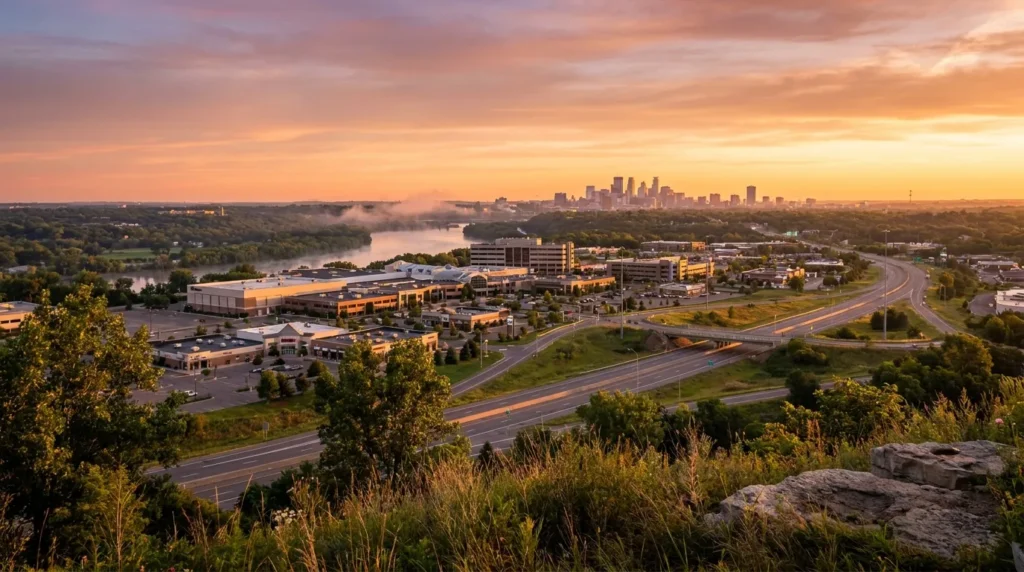
Burnsville

A safe city by midwestern American suburban standards

Burnsville has crime rates typical of a residential suburb, with quiet residential neighborhoods and extra caution advised in commercial areas at night.

Burnsville is considered a safe place to live, with crime rates lower than downtown Minneapolis or Saint Paul. Residential neighborhoods around the lakes and on cul-de-sacs are generally quiet, with active neighbors and regular patrols.

As in any American metropolitan area, incidents are more common in busy commercial zones: shopping center parking lots, gas stations, and fast-food corridors can see car break-ins or minor thefts, especially at night. Not leaving valuables visible in the car and keeping doors locked addresses most of the risk.

Local police respond promptly and maintain community outreach programs, including for immigrant communities. For emergencies, call 911. For non-urgent matters, the main station is on Civic Center Parkway.

Safer neighborhoods
  • Crystal Lake
  • Sunset Pond
  • Echo Park
  • Vista View
  • Heart of the City
Areas to avoid
  • Burnsville Center parking lots at night
  • Corridors along County Road 42 late at night
  • Industrial areas south of I-35W outside business hours

A car-dependent city with strong highway access and express buses to Minneapolis

Burnsville is designed around the car, but features MVTA express bus service to downtown Minneapolis and park-and-ride stations.

The interchange between I-35E and I-35W is located within Burnsville, providing quick access to Minneapolis to the north, Bloomington and the airport to the northwest, and the southern corridor toward Lakeville and Iowa. The main internal road is County Road 42, which cuts east-west through the city and concentrates commercial activity.

Public transit is operated by the Minnesota Valley Transit Authority (MVTA), with express bus lines connecting Heart of the City and the Burnsville Transit Station to downtown Minneapolis in about 25 minutes. Park-and-ride stations are also available, popular with those who work downtown and want to avoid traffic and parking costs.

Bike lanes and trails exist but are more oriented toward recreation than daily commuting. Minneapolis-Saint Paul International Airport (MSP) is about 20 minutes away by car via I-35W, with direct flights to Europe, Asia, Latin America, and the Caribbean.

Airports
  • MSP — Minneapolis-Saint Paul International (about 20 min north)
  • Bike infrastructure

Climate

Burnsville

A modest but active cultural life, with a strong outdoor calendar in summer

Cultural life centers on the Burnsville Performing Arts Center, summer community festivals, and culinary traditions from the Midwest and immigrant communities.

Burnsville's culture is that of a comfortable American suburb: summer community festivals, parks filled with families on weekends, and an events calendar centered on Heart of the City. The Burnsville Performing Arts Center hosts plays, concerts, and children's shows throughout the year.

The calendar includes events such as the Burnsville International Festival of the Arts, the Fire Muster (a fire department parade and festival), and I Love Burnsville Day, all with strong local family participation. Restaurants range from American steakhouses and cafes to Ethiopian, Mexican, Vietnamese, and Somali establishments, reflecting the city's growing diversity.

There are no UNESCO sites or international museums in the city, but the full cultural offerings of the metropolitan area are a 30-minute drive away: the Walker Art Center, the Minneapolis Institute of Art, and the Guthrie Theater are all within easy reach.

Notable dishes
  • Juicy Lucy (cheese-stuffed burger)
  • Hotdish (cream-based casserole with tater tots)
  • Fried lake walleye
  • Lefse (Norwegian potato flatbread)
  • Somali sambusa
Annual events
  • Burnsville International Festival of the Arts
  • Fire Muster Parade and Festival
  • I Love Burnsville Day
  • Burnsville Heart of the City Music in Kelleher Park
  • Winter Fest at Buck Hill

Lakes, trails, an urban ski slope, and a regional shopping center

The main attractions are natural and family-oriented: Buck Hill for skiing in winter, lakes for swimming and fishing in summer, and Burnsville Center as the commercial anchor.

Burnsville's best-known attraction is Buck Hill, a small ski area within the city that operates in winter with lit runs, a ski school, and tubing. In summer it becomes a park with a zip line, trails, and outdoor activities, making it one of the few urban ski resorts in the United States.

Crystal, Alimagnet, and Earley Lakes have swimming areas, fishing piers, and trails connecting several parks. Cliff Fen Park and Terrace Oaks Park offer more extensive trails through preserved woodland. For shopping, Burnsville Center remains the go-to mall for the southern metropolitan area.

Heart of the City, a revitalized area near Nicollet Avenue, concentrates restaurants, the Performing Arts Center, and summer events. For more cultural variety, the Mall of America in Bloomington is about 15 minutes away via I-35W.

  1. 1Buck Hill Ski and Snowboard
  2. 2Burnsville Center
  3. 3Burnsville Performing Arts Center
  4. 4Crystal Lake Beach
  5. 5Heart of the City
  6. 6Cliff Fen Park
Parks & green spaces
  • Cliff Fen Park
  • Alimagnet Park
  • Terrace Oaks Park
  • Crystal Beach Park
  • Lac Lavon Park
  • +1 more

Growing communities from East Africa, Southeast Asia, and Latin America

Burnsville has visible communities of Somalis, Ethiopians, Hmong, Vietnamese, Mexicans, and Ecuadorians, with regional organizations providing legal, linguistic, and cultural support.

The immigrant presence in Burnsville has grown considerably over the past two decades, following the broader Twin Cities pattern. Minnesota received large waves of Somali refugees beginning in the 1990s, Hmong refugees since the 1970s, and more recently Ethiopians, Eritreans, Ecuadorians, Venezuelans, and Nepalis. Burnsville absorbed part of that flow, particularly families seeking more affordable housing than Minneapolis.

Immigrant communities are concentrated in apartment complexes near County Road 42 and Nicollet Avenue, and frequent ethnic markets such as Karmel Mall (in Minneapolis) and Hmongtown Marketplace (in Saint Paul), both 20 to 30 minutes away. In Burnsville itself there are Latin grocery stores, Mexican bakeries, and Ethiopian, Somali, and Vietnamese restaurants.

Support for immigrants comes from regional organizations such as the International Institute of Minnesota, the Hispanic Advocacy and Community Empowerment through Research (HACER), the Confederation of Somali Community in Minnesota, and Comunidades Latinas Unidas en Servicio (CLUES), all with offices in the Twin Cities.

9,500
Foreign-born residents
estimated
Top countries of origin
  • Mexico
  • Somalia
  • Ethiopia
  • Vietnam
  • Laos (Hmong)
  • Ecuador
  • India
  • Philippines
Foreign consulates
  • Mexican Consulate in Saint Paul
  • Honorary Consulate of Ecuador in Minneapolis
  • Honorary Consulate of Vietnam in Minneapolis
  • Honorary Consulate of Ethiopia in Minnesota
  • Honorary Consulate of Canada in Minneapolis
  • +1 more
Community organizations
  • International Institute of Minnesota
  • Comunidades Latinas Unidas en Servicio (CLUES)
  • Confederation of Somali Community in Minnesota
  • Hmong American Partnership
  • Catholic Charities of Saint Paul and Minneapolis
  • African Career, Education and Resource

Latest posts

Posts about Minnesota

Coverage and updates related to this destination.

Showing content from Minnesota, as there is no specific data for Burnsville yet.