Visto n' Visa
Blog
Notícias e artigos
Destinations
Careers
Immigrants

Want to live and work in Blaine?

Personalized immigration plan with eligible visas, costs, and next steps for your goal!

If you are not eligible, you will know exactly why and what to do to improve your approval chances.

Save up to 12 hours in meetings

No pointless assessments.

Save up to 90%

Save money on vague or unfocused consultations

Avoid Fraud and Mistakes

One mistake can cost you your visa

Total Impartiality

Zero commercial bias

Decide with peace of mind

No toxic urgency

Fast and Accurate

Answers in minutes, no guesswork

Diverse and growing population, with a significant Asian presence

Blaine has grown from a small rural town to a suburb of more than 70,000 residents. Diversity increased rapidly, with Hmong, Indian, Latino, and East African communities now well established.

The local population has grown consistently. Much of the increase comes from young families leaving Minneapolis in search of larger homes, as well as immigrants drawn to the suburbs by the combination of schools and safety. The age profile is young by Minnesota standards, with many school-age children.

The Hmong community is one of the most visible in the metro area, and Blaine reflects this with Asian markets, Buddhist temples, and Hmong New Year celebrations. Somali, Ethiopian, Indian, and Mexican families are also present throughout the neighborhoods, particularly around University Avenue.

English is the dominant language in commerce and public services, though the school district provides multilingual support. Lutheran and Catholic churches maintain a strong presence, a legacy of the Scandinavian and German immigrants who settled the region in the 19th century. Mosques and Hindu temples are more concentrated in neighboring cities such as Coon Rapids.

Languages spoken
  • English
  • Hmong
  • Spanish
  • Somali
  • Hindi
Main religions
  • Christianity (Lutheran and Catholic)
  • Buddhism
  • Islam
  • Hinduism
  • No religion

Moderate cost by Twin Cities suburban standards

Blaine sits below Minneapolis in housing costs and close to the national average for food and services. Winter energy bills are typically the largest budget surprise.

Compared to older suburbs such as Edina or Minnetonka, Blaine is considered a reasonable value. Homes tend to be newer and still fit middle-class budgets, especially for those arriving from more expensive markets such as the West Coast.

The biggest driver of monthly expenses is heating. From December through February, natural gas and electricity bills can be substantial, and most homes rely on gas furnaces. Another expense that catches newcomers off guard is car insurance, which runs higher in Minnesota due to ice and winter accidents.

Food and services are close to the Midwest average. Grocery options are plentiful, ranging from Cub Foods and Hy-Vee to Aldi and Asian markets. State taxes are relatively high, with a progressive income tax and a sales tax of around seven percent on goods.

94Cost index (US = 100)6% below US average
CategorySingleCoupleFamily (2 + 2)
iHousing$1,228$1,417$1,795
iFood$359$718$1,304
iTransport$472$803$1,039
iHealthcare$265$529$992
iChildcare$1,719
iOther$803$1,446$2,031
Monthly total$3,127$4,913$8,880

Source: U.S. BLS Consumer Expenditure Survey 2023 + BEA Regional Price Parities 2023 · Estimates in USD, monthly.

Spacious suburban homes and a limited rental market

Blaine is dominated by single-family homes in planned subdivisions. Those who rent generally choose apartment complexes or townhouses in areas such as The Lakes.

The housing stock consists mainly of three- and four-bedroom homes with two-car garages and yards. Many were built in the 1990s and 2000s, during Blaine's largest period of real estate growth. Homeownership is the common path, and renters typically do so on a temporary basis while getting finances in order.

Those looking for apartments find more options near Northtown Mall and along Highway 10. Townhouses in communities such as The Lakes and Lexington Meadows offer a middle ground, with shared amenities and lawn maintenance included in HOA fees.

Families with children should verify which school district a home falls under. Part of Blaine belongs to the Anoka-Hennepin School District, and another section to Spring Lake Park Schools. The difference affects both home prices and daily school commutes, making that research worthwhile before signing a contract.

Recommended neighborhoods
  • The Lakes
  • Lexington Meadows
  • TPC Twin Cities area
  • Sunset Oaks
  • Northtown

Jobs driven by healthcare, manufacturing, and proximity to Minneapolis

Many residents commute to Minneapolis or St. Paul, but Blaine has its own employment centers in aerospace manufacturing, medical devices, and healthcare services.

The Minneapolis-St. Paul metropolitan area is one of the most diversified economies in the Midwest, with a strong presence of Fortune 500 companies. In Blaine, many residents work in downtown Minneapolis, commuting along I-35W in roughly 30 to 40 minutes, depending on traffic and snow conditions.

Within the city itself, manufacturing carries significant weight. Companies such as Aerospace Welding and medical device manufacturers tied to the Medtronic supply chain employ hundreds. The healthcare sector is also strong, with Allina Health clinics and Mercy Hospital nearby in Coon Rapids.

For those arriving, professional networks are valuable. Minnesota employers often expect local references, and platforms such as LinkedIn combined with job fairs at Anoka-Ramsey Community College can help newcomers get a foothold. Retail and construction offer consistent openings, particularly from spring through fall.

Dominant sectors
  • Healthcare
  • Aerospace manufacturing
  • Medical devices
  • Retail
  • Construction
Major employers
  • National Sports Center
  • Aerospace Welding
  • Mercy Hospital (Coon Rapids)
  • Cub Foods
  • Anoka-Hennepin School District

Good public schools and access to Twin Cities universities

Blaine falls primarily within the Anoka-Hennepin School District, one of the largest in Minnesota. Quality public and private higher education is a short drive away.

The Anoka-Hennepin district includes elementary, middle, and high schools with solid reputations. Blaine High School is one of the largest and offers International Baccalaureate programs, AP courses, and a range of extracurricular activities. Immigrant families frequently note positive experiences with ESL support in the elementary schools.

For higher education, the closest option is Anoka-Ramsey Community College, with a campus in Coon Rapids, well-suited for two-year programs and technical courses. Bethel University, a private Christian institution, is located in Arden Hills, a short drive away. For a large public university, the destination is the University of Minnesota Twin Cities in Minneapolis.

The area also offers technical and vocational schools with short programs in nursing, welding, mechatronics, and information technology. These programs tend to have strong employment rates and work well for those looking to enter the workforce quickly without completing a full bachelor's degree.

Notable universities
  • Anoka-Ramsey Community College
  • Bethel University
  • University of Minnesota Twin Cities
  • Hennepin Technical College
  • North Hennepin Community College

Solid healthcare network anchored by nearby regional hospitals

Blaine has no large hospital within city limits, but sits minutes from major systems including Mercy Hospital and Allina Health, with full coverage for emergency and specialty care.

The closest major hospital is Mercy Hospital in Coon Rapids, part of the Allina Health system. It includes an emergency department, maternity ward, ICU, and various specialty services. Another option is Unity Hospital in Fridley, also part of the Allina network. Those in western Blaine sometimes prefer the M Health Fairview and HealthPartners networks.

For outpatient care and family clinics, Blaine has several locations from the state's major health systems. Allina, HealthPartners, Park Nicollet, and Fairview operate offices throughout the city. Pediatricians, dentists, and mental health clinics are accessible, and most accept the most common private insurance plans in the state.

Health insurance in the United States is expensive and essential. Legal immigrants typically obtain coverage through an employer, the ACA marketplace, or state Medicaid, depending on income. Without insurance, a single emergency room visit can cost thousands of dollars. Verifying in-network providers before scheduling an appointment prevents billing surprises.

Healthcare index78.0 / 100
  • Life expectancyyears at birth
    78.4yrs
  • Doctors per 1kpracticing physicians
    3.7
  • Health spendper capita, per year
    $13,473
  • Public systemoverall quality rating
    Good

City considered safe, with crime rates below the metropolitan average

Blaine has a reputation as a quiet suburb with low violent crime. The most common reports involve garage thefts, scattered vandalism, and opportunistic crimes in parking lots.

Local police maintain a visible presence and respond quickly to calls. Homes generally have no bars or walls, and children ride bikes through residential neighborhoods without much concern. Compared to parts of Minneapolis and St. Paul, Blaine is seen as significantly safer.

Thefts from unlocked vehicles are the most common crime, particularly in shopping center parking lots and open garages. Police run regular campaigns reminding residents to lock their cars and avoid leaving valuables in plain sight. Violent crimes such as armed robbery and homicide are rare and tend to be concentrated in domestic incidents.

As across much of the Midwest, the greatest risk to residents is not crime but winter. Icy roads, snowstorms, and temperatures reaching twenty degrees below zero demand caution. Vehicles need appropriate tires, and slip-and-fall injuries on ice are a frequent cause of emergency room visits during the season.

5.8
Homicides per 100k
per year
Safety index
76.0
Crime index
24.0
Safer neighborhoods
  • Lakes area (north Blaine)
  • Lexington area
  • TPC Twin Cities area
  • Pine View
  • Sunset Oaks
  • Forest Meadows
Areas to avoid
  • Isolated stretches along University Avenue NE late at night
  • Empty commercial parking lots after business hours

Car-oriented city with limited public transit

A car is practically essential in Blaine. Public transit exists through Metro Transit, but is limited to express bus lines connecting the suburb to downtown Minneapolis.

Primary access is via Interstate 35W, which runs north-south through the city. Highway 65 and Highway 10 complete the road network. During peak hours, travel time to Minneapolis can double, and on heavy snowfall days the commute becomes challenging even for experienced drivers.

Metro Transit operates several express lines, primarily serving commuters heading downtown. Routes 850 and 854 are the most frequently used. Parking at Park and Ride locations such as Northtown and boarding the bus saves both time and the stress of driving during rush hour.

For longer trips, Minneapolis-Saint Paul International Airport is roughly 40 minutes away by car. Greyhound and Amtrak services operate from St. Paul. Cycling and walking are practical in summer thanks to trail networks such as the Rice Creek Regional Trail, but are largely off the table in winter.

28 min
Avg commute
28
Walkability
Airports
  • MSP — Minneapolis-Saint Paul International Airport (about 19 miles away)
  • ANE — Anoka County-Blaine Airport (general aviation)
  • Bike infrastructure

What the climate is like living in Blaine

Northern suburb of Minneapolis with a cold humid continental climate: warm summers around 28 degrees Celsius, long and severe winters with lows below -15 degrees Celsius.

Summer in Blaine is warm and relatively short, with highs between 27 and 29 degrees Celsius in July and occasional severe thunderstorms. Air conditioning is standard.

Winter is the dominant season, long and harsh, with lows between -18 and -14 degrees Celsius in January and snowfall totaling around 51 inches per season. Natural gas heating, snow tires, and clothing rated for wind chills down to -13 degrees Fahrenheit are essential.

Spring is brief and fall is short but spectacular. Rain and snow total around 31 inches annually, with a wetter summer and a drier winter.

Sunny days / year200 days
Avg high (°F)
  • 24°J
  • 25°F
  • 42°M
  • 54°A
  • 69°M
  • 82°J
  • 84°J
  • 81°A
  • 74°S
  • 57°O
  • 42°N
  • 32°D
Avg low (°F)
  • J
  • F
  • 23°M
  • 34°A
  • 48°M
  • 62°J
  • 65°J
  • 63°A
  • 57°S
  • 42°O
  • 29°N
  • 17°D
Rainfall (")
  • 1"J
  • 1"F
  • 2"M
  • 4"A
  • 4"M
  • 3"J
  • 4"J
  • 4"A
  • 3"S
  • 4"O
  • 2"N
  • 2"D

Suburban culture with a strong sports and outdoor identity

Blaine does not have an intense urban cultural scene, but makes up for it with sports, parks, and community festivals. Social life revolves around schools, churches, and outdoor activities.

The most prominent local landmark is the National Sports Center, which hosts tournaments year-round. Ice hockey is almost a religion in Minnesota, and Blaine develops many young athletes. In summer, soccer and cycling dominate the calendar, drawing competitors from across the country.

The dining scene is modest but includes solid family options and a range of ethnic restaurants. Vietnamese pho, Mexican food, Korean barbecue, and Hmong bakeries can be found at several locations. For a livelier nightlife scene, residents head to Minneapolis, particularly the Northeast and Uptown neighborhoods.

Events such as the Blaine Festival in summer and seasonal farmers markets shape the community calendar. Lakeside and Aquatore parks tend to fill up on pleasant days. Public libraries offer children's programming and adult ESL classes, serving as a resource for newly arrived immigrants.

Blaine

Attractions in Blaine, northern suburb of the Twin Cities in Minnesota

Northern suburb of the Minneapolis-Saint Paul metropolitan area, known for the National Sports Center and TPC Twin Cities. Leisure options center on amateur sports, professional sports, parks, and easy access to downtown.

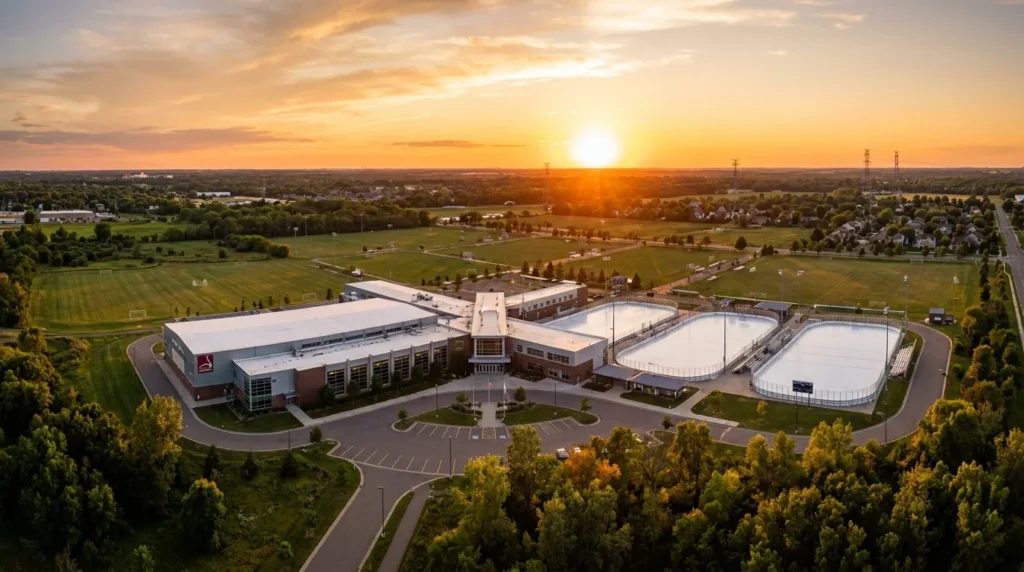
The National Sports Center, at the heart of Blaine, is the largest amateur sports complex in the United States, featuring 52 soccer fields, an indoor velodrome, and the Schwan Super Rink, the world's largest hockey arena with eight sheets of ice. It hosts the USA Cup, the largest youth soccer tournament in the Western Hemisphere. TPC Twin Cities hosts the PGA Tour's 3M Open annually.

Several lakes, including Laddie Lake, Sunrise Lake, and Lochness Lake, are scattered throughout the city, with Aquatore Park, Lakeside Commons Park, and Lochness Park offering beaches, fishing, and trails. Coon Rapids Dam Regional Park on the Mississippi River is minutes to the west, and Bunker Hills Regional Park, with its wave pool and camping, is located in adjacent Andover. In winter, all these areas become cross-country skiing and snowshoeing trails.

Northtown Mall in Blaine and the Anoka County Fair in July are community landmarks. For a broader cultural experience, Minneapolis is a half hour away via I-35W, home to the Walker Art Center, Guthrie Theater, and Target Field. Saint Paul, with the Science Museum of Minnesota and Xcel Energy Center, is about forty minutes away. MSP airport is fifty minutes out.

  1. 1["National Sports Center (largest amateur sports complex in the US)"
  2. 2"TPC Twin Cities (professional golf)"
  3. 3"Schwan Super Rink"
  4. 4"Northtown Mall (nearby)"
  5. 5"Centennial Lakes Park (nearby)"
  6. 6"Blaine Wetland Sanctuary"
Nightlife3.0 / 10
Parks & green spaces
  • ["Aquatore Park"
  • "Lakeside Commons Park"
  • "Pioneer Park"
  • "Blaine Wetland Sanctuary"
  • "Sunrise Park"
  • +1 more

Latest posts

Posts about Minnesota

Coverage and updates related to this destination.

Showing content from Minnesota, as there is no specific data for Blaine yet.