Visto n' Visa
Blog
Notícias e artigos
Destinations
Careers
Immigrants

Want to live and work in Lansing?

Personalized immigration plan with eligible visas, costs, and next steps for your goal!

If you are not eligible, you will know exactly why and what to do to improve your approval chances.

Save up to 12 hours in meetings

No pointless assessments.

Save up to 90%

Save money on vague or unfocused consultations

Avoid Fraud and Mistakes

One mistake can cost you your visa

Total Impartiality

Zero commercial bias

Decide with peace of mind

No toxic urgency

Fast and Accurate

Answers in minutes, no guesswork

A diverse city for its size, with Latino, Asian, and refugee communities

Lansing has approximately 112,000 residents, with a white majority, a significant African American population, a growing Latino community, and established refugee communities of Sudanese, Somali, Bangladeshi, Hmong, and Vietnamese origin.

Lansing's demographics are more diverse than expected for a mid-sized Midwestern city. The non-Hispanic white majority shares space with a significant African American population, concentrated in traditional neighborhoods to the east and north of the city. The Latino community, predominantly Mexican, continues to grow and has a strong presence on the south side.

Over recent decades, Lansing has received several waves of refugees through active state programs. Hmong, Vietnamese, Sudanese, Somali, and Iraqi communities are well established, with their own churches, mosques, and temples. Neighboring East Lansing adds a large international profile, with Michigan State students arriving from more than 130 countries.

Religiously, the city includes historic Protestants, Catholics, African American evangelicals, Sunni Muslims, Buddhists, Hindus, Sikhs, and a high proportion of religiously unaffiliated residents, particularly in East Lansing. The environment is generally tolerant, politically progressive, and open to intercultural marriages and religious diversity.

Languages spoken
  • English
  • Spanish
  • Arabic
  • Vietnamese
  • Bengali
  • +3 more
Main religions
  • Protestantism
  • Catholicism
  • No religion
  • Islam
  • Buddhism
  • +1 more

Affordable cost of living, below the U.S. national average

Lansing has an affordable cost of living by American standards, with low rental and home purchase prices. Salaries from state government, GM, and the university support a comfortable standard of living.

Lansing is one of the most affordable state capitals in the United States. One-bedroom apartment rents are well below the national average, and homes for purchase are accessible in nearly every neighborhood. East Lansing, near campus, is more expensive, but still reasonable compared to Ann Arbor or Grand Rapids.

Grocery shopping is dominated by Meijer, Kroger, and Aldi, with Latino markets on the south side and along Grand River Avenue. Asian markets serve the Vietnamese, Hmong, and Bangladeshi communities. Restaurants offer good value, especially ethnic establishments. Dining spots along Michigan Avenue and in REO Town anchor a rising culinary scene.

Michigan's state income tax is flat, and Lansing levies its own municipal income tax. Property taxes are reasonable. Car insurance is high across Michigan, but cheaper than in Detroit. For immigrants employed by state government, GM, Michigan State University, or the regional hospitals, the salary-to-cost-of-living equation tends to be favorable.

94Cost index (US = 100)6% below US average
CategorySingleCoupleFamily (2 + 2)
iHousing$1,217$1,404$1,778
iFood$356$711$1,292
iTransport$468$796$1,030
iHealthcare$262$524$983
iChildcare$1,704
iOther$796$1,432$2,012
Monthly total$3,099$4,867$8,799

Source: U.S. BLS Consumer Expenditure Survey 2023 + BEA Regional Price Parities 2023 · Estimates in USD, monthly.

Historic homes downtown, residential neighborhoods, and new construction near MSU

Options range from historic homes in Old Town and Eastside to classic residential neighborhoods and new construction near Michigan State University. The market is affordable compared to the rest of Michigan.

Old Town is Lansing's most charming area, with restored historic buildings, independent shops, bars, restaurants, and nearby historic homes. Eastside features large-porch houses on tree-lined streets, popular with young professionals and families. Neighborhoods such as Westside and Moores Park offer family-friendly options at accessible prices.

The REO Town district, former site of Ransom E. Olds's REO plant, has been revitalized and attracts new residents. In East Lansing, near campus, there are student-oriented apartments alongside condominiums for faculty and professionals. Prices near Grand River Avenue at MSU fluctuate with the academic calendar, with better deals available outside enrollment season.

For immigrants, exploring neighborhoods with established communities from their own background can ease the transition: Latinos are concentrated on the south side, and refugee communities cluster around churches and mosques in various areas. Renting first allows time to understand the winters, schools, and community before committing to a purchase. Lower-priced homes in revitalizing areas can represent a solid opportunity for patient buyers.

Recommended neighborhoods
  • Old Town
  • Eastside
  • REO Town
  • Moores Park
  • Westside
  • +3 more

State government, GM Lansing Grand River, MSU, and insurance

The economy revolves around state government, General Motors, Michigan State University, regional hospitals, and insurance companies. It is a stable market with several large institutional employers.

Michigan state government is the capital's largest employer, with thousands of civil servants spread across numerous agencies. General Motors operates the Lansing Grand River Assembly and Lansing Delta Township Assembly, producing Cadillacs and Chevrolets, with suppliers spread throughout the region. The automotive industry continues to drive demand for skilled workers.

Michigan State University, in East Lansing, employs tens of thousands in teaching, research, and administration. McLaren Greater Lansing, Sparrow Hospital, and E.W. Sparrow are major healthcare employers. Companies such as Auto-Owners Insurance, Jackson National Life, and Accident Fund have headquarters or significant operations in the city.

For qualified immigrants, opportunities exist in healthcare, engineering, university research, IT, finance, and government. Professionals with fluent English and technical credentials find steady demand. Average salaries are moderate but align well with the affordable cost of living. Ethnic small businesses thrive, particularly in food, retail, and community services.

Dominant sectors
  • State government
  • Automotive industry
  • Higher education
  • Healthcare
  • Insurance
  • +1 more
Major employers
  • State of Michigan
  • Michigan State University
  • General Motors Lansing Grand River
  • Sparrow Health System
  • McLaren Greater Lansing
  • +3 more

Michigan State University at the center, with an uneven public school system

Michigan State University dominates the academic ecosystem. Lansing's public schools are uneven, but East Lansing has a top reputation. Lansing Community College offers affordable technical training.

Michigan State University, founded in 1855 as the first land-grant university in the United States, is one of the largest public universities in the country, with approximately 50,000 students. It has top programs in veterinary medicine, agriculture, education, business, computer science, and social sciences, attracting students from around the world.

Lansing Public Schools faces challenges typical of mid-sized American cities, but schools such as Eastern High and various magnet programs offer strong options. East Lansing Public Schools, however, has a top reputation, with East Lansing High School consistently ranked among the best in Michigan. Families with children often prioritize living in East Lansing.

Lansing Community College is one of the largest community colleges in the state, with a downtown campus and technical programs in healthcare, manufacturing, and IT. It is an accessible option for immigrants seeking retraining. Cooley Law School, affiliated with Western Michigan University, and Davenport University round out the ecosystem. Catholic and charter schools provide private alternatives.

Notable universities
  • Michigan State University
  • Lansing Community College
  • Western Michigan University Cooley Law School
  • Davenport University
  • Great Lakes Christian College

Sparrow, McLaren, and MSU Health concentrate care in the region

Sparrow Hospital and McLaren Greater Lansing are the main hospitals. Michigan State University has human and osteopathic medical schools that enrich the healthcare ecosystem.

E.W. Sparrow Hospital, in central Lansing, is the region's main hospital, with a level-one emergency department, inpatient care, and multiple specialties. McLaren Greater Lansing, in Lansing Township, is the other major network, with recent expansion in oncology, orthopedics, and cardiology. Both have academic ties to Michigan State.

Michigan State University College of Human Medicine and the College of Osteopathic Medicine train physicians in the region, with affiliated clinics open to the public. There are also specialized hospitals in pediatrics and mental health, community clinics, and Cristo Rey Community Center serving Hispanic families and low-income refugees.

As throughout the United States, health insurance is central. State employees, GM workers, MSU staff, and hospital employees have strong coverage. Michigan offers Medicaid and the Healthy Michigan Plan for low-income residents. For newly arrived immigrants, organizations such as the Refugee Development Center provide guidance on plans, hospitals, and basic rights within the American healthcare system.

Healthcare index70.0 / 100
  • Life expectancyyears at birth
    78.4yrs
  • Doctors per 1kpracticing physicians
    3.7
  • Health spendper capita, per year
    $13,473
  • Public systemoverall quality rating
    Good

Reasonable safety, with significant variation by neighborhood and East Lansing

Lansing's safety varies: downtown and East Lansing are quiet, but some northern and southern neighborhoods have higher rates. Overall, it is safer than Detroit and comparable to other state capitals.

Daily life in Lansing varies considerably by neighborhood. Old Town, Eastside, Moores Park, REO Town, and East Lansing are consistently identified as safe, with families walking at night, well-used parks, and low rates of violent crime. Streets near the Capitol and hospitals have regular police presence.

Some areas on Lansing's north and south sides see higher rates of theft, particularly vehicle break-ins and minor property crimes. The Lansing Police Department runs community programs and maintains partnerships with churches, nonprofits, and immigrant associations to build trust. East Lansing Police covers the university area with a focus on student safety.

For immigrants coming from large cities in Latin America or the Middle East, the general atmosphere tends to feel calm. Basic precautions, such as locking cars, keeping valuables out of sight, and staying alert in late-night parking areas, are sufficient. The 911 system functions well, and victim assistance programs are available in multiple languages through the Refugee Development Center.

5.8
Homicides per 100k
per year
Safety index
50.0
Crime index
50.0
Safer neighborhoods
  • Old Town
  • Westside Neighborhood
  • Moores River Drive
  • Eastside Neighborhood
  • Groesbeck
  • Lansing Country Club area
Areas to avoid
  • stretches of South Cedar Street late at night
  • areas near the River Trail after dark
  • isolated parking lots along Michigan Avenue after business hours

A car-dependent city, with CATA bus service and a regional airport

Lansing relies on cars, but has a reasonable CATA bus system, especially between Lansing and East Lansing. Capital Region Airport offers flights to major hubs. Detroit and Grand Rapids are about an hour away.

The car is the primary mode of transportation in Lansing. Interstates I-96, I-69, and US-127 cross the region, connecting it to Detroit, Grand Rapids, Flint, and northern Michigan. Downtown parking is reasonable, with low prices compared to other American state capitals. Traffic is light relative to larger metro areas.

The Capital Area Transportation Authority (CATA) operates urban bus routes with reasonable coverage, particularly between Lansing and East Lansing, serving the Michigan State campus and major commercial corridors. For students, it is a real alternative to owning a car. The city has been investing in bike lanes, and Old Town and East Lansing are walkable.

Capital Region International Airport offers direct flights to Chicago, Detroit, Minneapolis, and Atlanta, with connections to the rest of the world. For international travelers, Detroit Metropolitan Airport, roughly one hour and twenty minutes away by car, is the primary option. Amtrak's Blue Water line stops in East Lansing with daily departures to Chicago and Port Huron, on the Canadian border.

20 min
Avg commute
48
Walkability
Airports
  • LAN — Capital Region International Airport
  • International airport
  • Bike infrastructure

What the Climate Is Like Living in Lansing

Michigan's capital has a humid continental climate: warm summers around 27 degrees Celsius, with long cold winters and regular snowfall.

Lansing summers are warm and humid, with highs between 26 and 28 degrees Celsius in July. Afternoon thunderstorms are common and air conditioning is standard in homes.

Winters are long and cold, with lows between -12 and -7 degrees Celsius in January and snowfall totaling around 130 cm per season. Natural gas heating, snow tires, and heavy coats are part of the routine.

Spring is brief and autumn is short but notable, with foliage peaking in September and October. Annual rainfall totals around 850 mm, distributed fairly evenly throughout the year.

Sunny days / year178 days
Avg high (°F)
  • 33°J
  • 35°F
  • 47°M
  • 57°A
  • 69°M
  • 80°J
  • 83°J
  • 81°A
  • 74°S
  • 61°O
  • 47°N
  • 40°D
Avg low (°F)
  • 20°J
  • 18°F
  • 29°M
  • 38°A
  • 49°M
  • 59°J
  • 65°J
  • 63°A
  • 57°S
  • 46°O
  • 33°N
  • 29°D
Rainfall (")
  • 2"J
  • 3"F
  • 3"M
  • 3"A
  • 4"M
  • 3"J
  • 3"J
  • 3"A
  • 3"S
  • 4"O
  • 2"N
  • 2"D

State capital culture, MSU sports, and a growing dining scene

Local culture blends state capital life, Michigan State University sports, ethnic festivals, historical museums, and a rising culinary scene. East Lansing adds a vibrant university atmosphere.

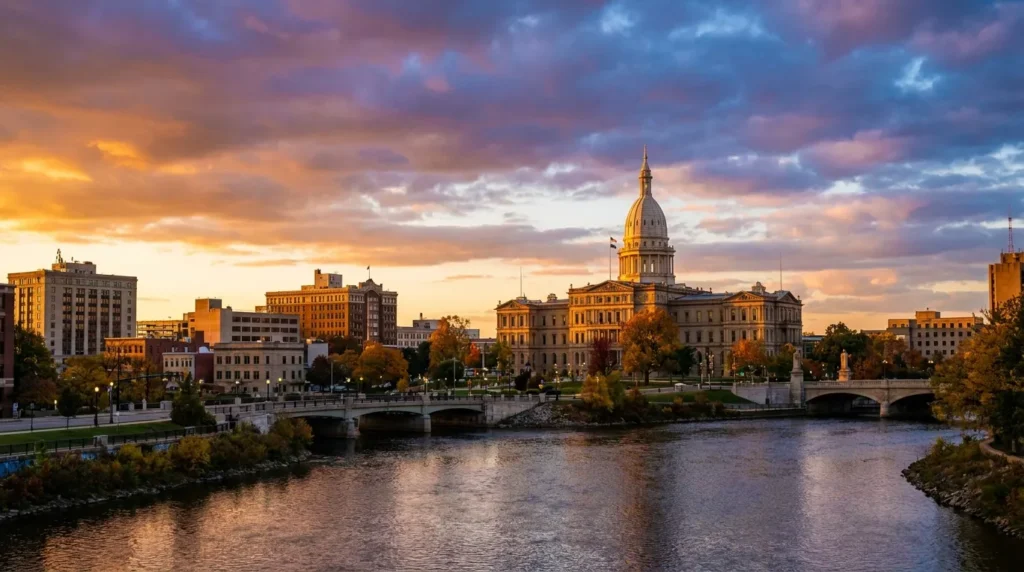
Michigan's neo-Renaissance Capitol building is the city's landmark and offers guided tours. The Michigan History Center covers the history of the state, and Impression 5 Science Center serves families with children. The R.E. Olds Transportation Museum preserves the region's pre-Detroit automotive heritage, including REO and Oldsmobile history.

Michigan State University sports bring East Lansing to a standstill: Spartans football and basketball games at Spartan Stadium and Breslin Center draw tens of thousands of fans. Nightlife is concentrated along Grand River Avenue near campus, with bars, pizzerias, and cafes. In Lansing, Old Town and REO Town host craft beer bars and chef-driven restaurants.

The Lansing Lugnuts, a Single-A baseball team, play at Jackson Field downtown and draw families throughout the summer. Ethnic festivals such as the Festival of the Sun, Lansing JazzFest, Common Ground Music Festival, and celebrations by Vietnamese, Hmong, and Latino communities fill the calendar. The culinary scene includes Vietnamese, Sudanese, Mexican, and gastropub restaurants.

Lansing

What to See in Lansing, Michigan's Capital and Industrial City

Lansing is the capital of Michigan, home to the state Capitol and General Motors. Neighboring East Lansing is the seat of Michigan State University. The city offers a quiet pace and civic culture.

The Michigan State Capitol, a neoclassical structure from 1879, serves as the historic and administrative center. The Michigan History Center traces the state's story from the Anishinaabe people through the automotive era. The R.E. Olds Transportation Museum showcases the legacy of Oldsmobile, founded in Lansing in 1897. Impression 5 Science Center is a popular destination for families.

Adjacent East Lansing is home to the Michigan State University campus, one of the largest universities in the United States. The MSU Broad Art Museum, designed by Zaha Hadid, stands out as an architectural landmark. Spartan Stadium, the Breslin Center, and the formal gardens of the W.J. Beal Botanical Garden anchor the campus. Old Town Lansing, centered around Turner Street, concentrates local galleries and restaurants.

The Grand River and Red Cedar River converge in Lansing, connected by the 21 km Lansing River Trail linking parks throughout the area. Potter Park Zoo is reachable within 30 minutes. Detroit is 90 minutes away via I-96 and Grand Rapids is 70 minutes out. Daily life is shaped by the capital's character: lobbyists, state employees, MSU students, and workers at GM's Lansing Grand River plant set the rhythm.

  1. 1["Michigan State Capitol"
  2. 2"Michigan History Center"
  3. 3"Impression 5 Science Center"
  4. 4"R.E. Olds Transportation Museum"
  5. 5"Potter Park Zoo"
  6. 6"Old Town district"
Nightlife5.0 / 10
Parks & green spaces
  • ["Potter Park"
  • "Hawk Island Park"
  • "Lansing River Trail"
  • "Frances Park"
  • "Riverfront Park"
  • +1 more

Latest posts

Posts about Michigan

Coverage and updates related to this destination.

Showing content from Michigan, as there is no specific data for Lansing yet.