Visto n' Visa
Blog
Notícias e artigos
Destinations
Careers
Immigrants

Want to live and work in Kalamazoo?

Personalized immigration plan with eligible visas, costs, and next steps for your goal!

If you are not eligible, you will know exactly why and what to do to improve your approval chances.

Save up to 12 hours in meetings

No pointless assessments.

Save up to 90%

Save money on vague or unfocused consultations

Avoid Fraud and Mistakes

One mistake can cost you your visa

Total Impartiality

Zero commercial bias

Decide with peace of mind

No toxic urgency

Fast and Accurate

Answers in minutes, no guesswork

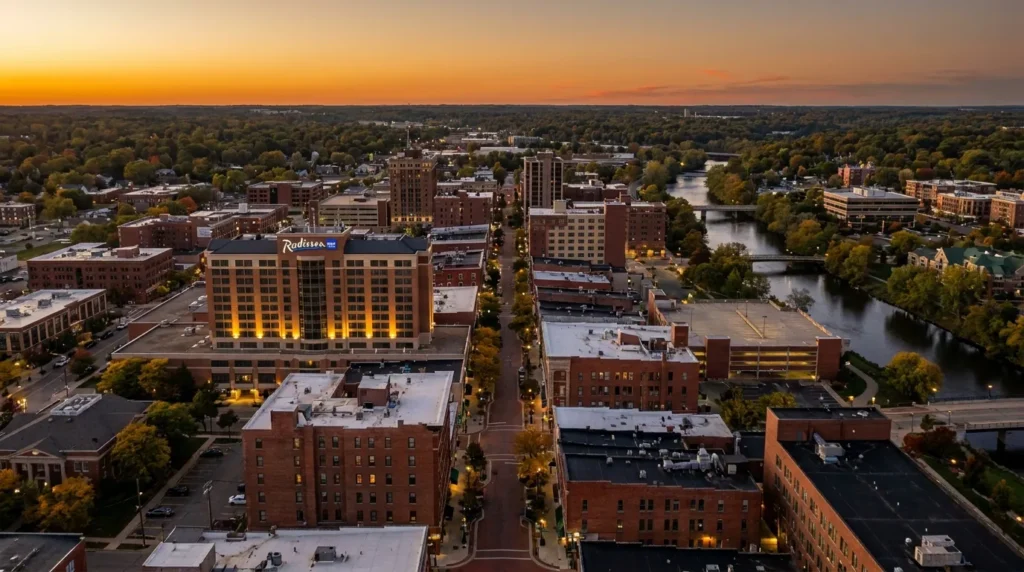
Diverse population driven by universities and the healthcare industry

Approximately 72,000 residents within city limits and more than 260,000 in the metropolitan area. A mix of students, research professionals, industrial workers, and both long-established and recent immigrant communities.

Kalamazoo has an official population of around 72,000 within city limits, and the metropolitan region, which includes Portage and nearby Battle Creek, exceeds 260,000. The ethnic composition is notably varied for a Midwest city of its size: a white majority, a significant African American community, a growing Latino population, and an Asian presence tied to the universities.

English is the dominant language, but Spanish is frequently heard in retail settings and public schools. Nepalese, Congolese, Burmese, and Bosnian communities have been established through refugee resettlement programs over the past several decades. International students at WMU bring Arabic, Mandarin, Hindi, and Korean into everyday life.

Religiously, Protestant and Catholic Christian denominations predominate, with an active mosque, a synagogue, and Hindu and Buddhist temples serving the academic diaspora. The city has a reputation for tolerance and political moderation within Michigan, which helps newcomers feel welcomed.

Languages spoken
  • English
  • Spanish
  • Arabic
  • Swahili
  • Nepali
  • +1 more
Main religions
  • Protestant Christianity
  • Catholicism
  • Islam
  • Hinduism
  • Buddhism
  • +1 more

Cost of living well below the national American average

Kalamazoo ranks among the most affordable cities in the United States. Rent, food, and services are significantly below the national average, attracting students, young families, and retirees.

Those relocating from large cities notice immediately: a one-bedroom apartment near downtown costs a fraction of what comparable units run in Chicago or on the East Coast. Homes for purchase are also affordable, with traditional neighborhoods offering brick houses from the 1920s at prices unthinkable in competitive markets.

Grocery chains like Meijer and Harding's keep prices competitive. Dining out downtown is inexpensive, with lunch at a brewpub or diner running a modest amount. Gas prices tend to stay below the national average, which matters given that car dependence is high outside the downtown core.

The costs that add up are winter energy bills due to heating, and health insurance, a standard American expense. Michigan taxes are moderate, and the Kalamazoo Promise, a program that covers public college tuition for graduates of Kalamazoo Public Schools, is a significant benefit for families relocating with children.

90Cost index (US = 100)10% below US average
CategorySingleCoupleFamily (2 + 2)
iHousing$1,168$1,348$1,707
iFood$342$683$1,240
iTransport$449$764$989
iHealthcare$252$503$944
iChildcare$1,636
iOther$764$1,375$1,932
Monthly total$2,975$4,673$8,448

Source: U.S. BLS Consumer Expenditure Survey 2023 + BEA Regional Price Parities 2023 · Estimates in USD, monthly.

A mix of historic homes, university neighborhoods, and newer developments

Kalamazoo offers traditional brick houses, apartments near the campuses, and newer condominiums in Portage. Rents are affordable and homeownership remains within reach for middle-income households.

The Vine neighborhood, near Kalamazoo College, features charming wood-frame and brick homes, popular with faculty and young families. Westnedge Hill is more residential and tree-lined, with well-regarded schools. The Stuart Neighborhood, in the historic Victorian district, attracts those who appreciate older architecture and proximity to downtown.

For lower rents, areas surrounding Western Michigan University, such as West Main and Knollwood, offer a large supply of student-oriented apartments. Portage, the neighboring city integrated into the metro area, is more suburban, with newer homes, retail centers, and quality schools, drawing professionals from Stryker and Pfizer.

Buying a home is feasible for many income levels, and the market is less competitive than in major metropolitan areas. Pre-purchase inspections are essential given older foundations and the need to assess heating systems and insulation, both critical in the harsh Midwest winter.

Recommended neighborhoods
  • Vine Neighborhood
  • Westnedge Hill
  • Stuart Neighborhood
  • Winchell
  • Oakwood
  • +3 more

Healthcare, pharmaceuticals, education, and manufacturing anchor employment

Pfizer, Stryker, Bronson Healthcare, and two universities are the largest employers. Growing sectors include pharmaceutical research, medical devices, higher education, and logistics.

Kalamazoo is unusual for a city its size: it has two globally significant employers headquartered locally. Pfizer operates one of the world's largest pharmaceutical manufacturing plants here, a legacy of Upjohn, which was founded in the city in the nineteenth century. Stryker, a giant in orthopedic implants and surgical equipment, maintains its world headquarters in Kalamazoo and continues to expand year after year.

The Bronson Healthcare system and Ascension Borgess employ thousands in nursing, technical, and administrative roles. Western Michigan University, Kalamazoo College, and Kalamazoo Valley Community College generate positions in teaching, research, and support services. Paper manufacturing, automotive supply, and food processing also have a longstanding industrial presence.

Openings for technical professionals in engineering, pharmaceutical science, and healthcare are often filled through national recruiting. In sectors such as hospitality, construction, landscaping, and practical nursing, the market is consistently active. Functional English is important; Spanish is an advantage in healthcare and customer-facing roles.

Dominant sectors
  • Pharmaceuticals and biotechnology
  • Medical devices
  • Hospital healthcare
  • Higher education
  • Paper manufacturing
  • +1 more
Major employers
  • Pfizer
  • Stryker Corporation
  • Bronson Healthcare Group
  • Ascension Borgess Hospital
  • Western Michigan University
  • +3 more

Two universities, a community college, and the Kalamazoo Promise

Western Michigan University, Kalamazoo College, and Kalamazoo Valley Community College form a strong educational cluster. The Kalamazoo Promise covers public college tuition for graduates of the local public school system.

Western Michigan University is one of Michigan's largest research universities, with more than 17,000 students and well-known programs in aviation, speech-language pathology, engineering, and business. It attracts international students and offers support services for newcomers, including a global student affairs office.

Kalamazoo College, founded in 1833, is a small, selective liberal arts institution with a strong study-abroad program. Kalamazoo Valley Community College serves those seeking technical training, vocational credentials, or a two-year associate degree before transferring, at low tuition rates.

The distinguishing feature is the Kalamazoo Promise, announced in 2005, which covers up to the full tuition at Michigan public colleges and universities for any student who graduates from Kalamazoo Public Schools. For immigrant families with children, this represents a concrete reason to consider the city.

Notable universities
  • Western Michigan University
  • Kalamazoo College
  • Kalamazoo Valley Community College
  • Western Michigan University Homer Stryker M.D. School of Medicine

Regional reference hospitals and a recently established medical school

Bronson Methodist Hospital and Ascension Borgess Hospital are regional leaders across southwest Michigan, with trauma, cardiology, and oncology services. The WMU Homer Stryker M.D. School of Medicine has been training physicians since 2014.

Bronson Methodist Hospital, located downtown, is the largest hospital in the region and a designated Level 1 trauma center, with transplant, advanced cardiology, and neonatal units. It serves patients from numerous surrounding communities. Ascension Borgess is the other major hospital, with strong cardiology and neuroscience programs.

Primary care and specialty clinics are distributed throughout the city, and the Family Health Center, a nonprofit, serves uninsured or underinsured patients on a sliding fee scale, including dental and mental health services. It sees a significant number of immigrants and refugees.

As throughout the United States, having health insurance is essential. Immigrants with legal status may access the ACA Marketplace or Michigan Medicaid depending on income level. Costs without coverage can be prohibitive, making insurance a priority upon arrival.

Kalamazoo

Mixed safety by neighborhood, with a calm downtown and university area during the day

Kalamazoo has a crime rate above the Michigan average, concentrated in specific areas. Residential neighborhoods and the university campus are generally quiet. Nighttime awareness is advisable, as in any mid-sized American city.

Like many post-industrial Midwest cities, Kalamazoo has notable disparities by neighborhood. Areas near downtown, around Kalamazoo College, and neighborhoods such as Vine and Westnedge Hill are perceived as safe, with regular police presence and consistent foot traffic. Portage, the neighboring city, has even lower crime rates.

Areas such as Northside and Edison have a historical reputation for higher rates of theft and property crime, particularly at night. That does not mean they should be avoided entirely, but it is worth researching before renting. Locking vehicles, not leaving belongings visible, and remaining alert in nighttime parking lots address most of the risk.

The Western Michigan University campus has its own patrol and a campus emergency system accessible by mobile phone. For women, older adults, and families, neighborhoods such as Winchell, Oakwood, and Westnedge Hill are frequently recommended as first choices for their balance of cost and safety.

Safer neighborhoods
  • Vine Neighborhood
  • Westnedge Hill
  • Winchell
  • Oakwood
  • Portage
  • Oshtemo Township
  • Texas Township
Areas to avoid
  • Parts of Northside at night
  • Edison Neighborhood (isolated areas after dark)
  • Empty parking lots outside downtown at night

Car-dependent, with a regional airport and Amtrak rail service

A car is practically required outside downtown. A regional airport in Portage serves domestic flights, Amtrak connects to Chicago and Detroit, and Metro Transit covers the city with bus service.

Kalamazoo Battle Creek International Airport, in Portage, serves domestic flights to Chicago, Detroit, Minneapolis, and Charlotte via American, Delta, and United. For international travel, most passengers connect through Chicago O'Hare, roughly two and a half hours west on I-94, or Detroit Metro, about two and a half hours to the east.

Amtrak stops at the historic downtown station on the Wolverine line, which runs between Chicago and Detroit, and the Blue Water line to Port Huron. It is a popular option for those who prefer not to drive to Chicago. Kalamazoo Metro Transit operates buses throughout the city and Portage, adequate for basic commuting, though frequency drops in the evenings and on weekends.

Within the city, cycling is practical for part of the year, and bike lane infrastructure continues to expand. Winter snow and ice make a car nearly indispensable from November through March. Downtown parking is inexpensive and plentiful compared to larger metropolitan areas.

Airports
  • AZO — Kalamazoo Battle Creek International Airport
  • BTL — W. K. Kellogg Airport (Battle Creek, nearby regional)
  • International airport
  • Bike infrastructure

Climate

Kalamazoo

Craft beer city, festival hub, and independent arts scene

Kalamazoo is a nationally recognized craft beer destination, home to Bell's Brewery and dozens of microbreweries. The city has a vibrant music scene, seasonal festivals, and well-regarded museums for a city of its size.

Bell's Brewery, one of the pioneers of American craft beer, was founded in Kalamazoo in the 1980s and still operates the Eccentric Cafe downtown. Dozens of microbreweries have grown up around it, forming what is known as the Kalamazoo Beer Trail. Visiting taprooms on weekends has become a fixture of local culture.

The arts scene is disproportionately large for a city this size. The Kalamazoo Institute of Arts maintains a respected collection and offers classes. The Gilmore International Keyboard Festival, held every two years, draws world-class pianists. The State Theatre, a restored art deco venue, hosts concerts and independent cinema. The Kalamazoo Symphony Orchestra has a long-standing tradition.

Local food blends Midwest classics with a strong farm-to-table scene that draws on nearby farms. Common dishes include Michigan-style Coney dogs, meat pies, and blueberries grown in the region. Ribfest, Taste of Kalamazoo, and Art Hop, held on the first Friday of each month, anchor the social calendar.

Notable dishes
  • Michigan-style Coney dog
  • Michigan blueberries
  • Olive Burger sandwiches
  • Bell's craft beers
  • Local maple syrup
  • +1 more
Annual events
  • Kalamazoo Ribfest
  • Art Hop (monthly)
  • Gilmore International Keyboard Festival
  • Taste of Kalamazoo
  • Kalamazoo Pride
  • +2 more

Museums, parks, breweries, and a downtown farmers market

Kalamazoo offers an impressive number of museums for its size, expansive parks, a busy farmers market, and the pedestrian Kalamazoo Mall. Nearby lakes draw visitors for swimming and kayaking in summer.

The Kalamazoo Valley Museum, free of charge, is a highlight for families, featuring a planetarium and interactive exhibits. The Air Zoo, on the south side, displays historic aircraft including World War II planes, with flight simulators that are popular with visitors of all ages. The Kalamazoo Institute of Arts holds a respected American and European collection.

Bronson Park, in the heart of downtown, hosts festivals and features a historic fountain. The Kalamazoo Nature Center, with trails and an educational center, is a must for those who enjoy the outdoors. The Kalamazoo River Valley Trail extends for dozens of miles for cycling and walking, connecting parks throughout the city.

The Bank Street Farmers Market, running through summer, is a regional landmark, with producers from surrounding farms selling directly to visitors. The Bell's Brewery Eccentric Cafe is a tourist destination in its own right. In summer, lakes such as Gull Lake and Eagle Lake, a short drive away, attract swimmers, sailors, and anglers.

  1. 1Kalamazoo Valley Museum
  2. 2Air Zoo Aerospace & Science Experience
  3. 3Kalamazoo Institute of Arts
  4. 4Bell's Eccentric Cafe
  5. 5Kalamazoo Mall
  6. 6Bronson Park
Parks & green spaces
  • Bronson Park
  • Milham Park
  • Kalamazoo Nature Center
  • Kal-Haven Trail (trailhead)
  • Asylum Lake Preserve
  • +1 more

Established refugee communities and international students

Kalamazoo has hosted refugee resettlement programs for decades, with Nepalese, Congolese, Bosnian, and Burmese communities well established. International students at WMU add to the city's diversity.

Samaritas, Bethany Christian Services, and other resettlement agencies have operated in Kalamazoo for decades, bringing families from Nepal, Bhutan, the Democratic Republic of Congo, Myanmar, Bosnia, and more recently Afghanistan, Syria, and Ukraine. Several neighborhoods have a strong concentration of these communities, with ethnic grocery stores and religious services conducted in their respective languages.

The Latino population, with roots in Mexico, Guatemala, and more recently Venezuela and Colombia, is present primarily in construction, landscaping, food processing, and healthcare. Local Spanish-language media, Spanish Masses at Catholic parishes, and monthly community gatherings serve this population.

International students at Western Michigan University bring communities from India, China, South Korea, Saudi Arabia, and Nigeria, with active student associations. For those seeking specific networks, the Hispanic American Council, the Refugee Outreach Collective, and the WMU international student office are useful starting points.

5,500
Foreign-born residents
estimated
Top countries of origin
  • Mexico
  • India
  • China
  • Nepal
  • Democratic Republic of Congo
  • Myanmar
  • Bosnia and Herzegovina
  • Guatemala
Foreign consulates
  • Mexican Consulate General in Detroit (jurisdiction)
  • Canadian Consulate General in Detroit (jurisdiction)
  • Japanese Consulate General in Detroit (jurisdiction)
  • Italian Consulate General in Detroit (jurisdiction)
  • German Honorary Consulate in Detroit (jurisdiction)
Community organizations
  • Hispanic American Council of Kalamazoo
  • Samaritas Refugee Services
  • Bethany Christian Services
  • Refugee Outreach Collective
  • Catholic Charities Diocese of Kalamazoo
  • Kalamazoo Islamic Center

Latest posts

Posts about Michigan

Coverage and updates related to this destination.

Showing content from Michigan, as there is no specific data for Kalamazoo yet.