Visto n' Visa
Blog
Notícias e artigos
Destinations
Careers
Immigrants

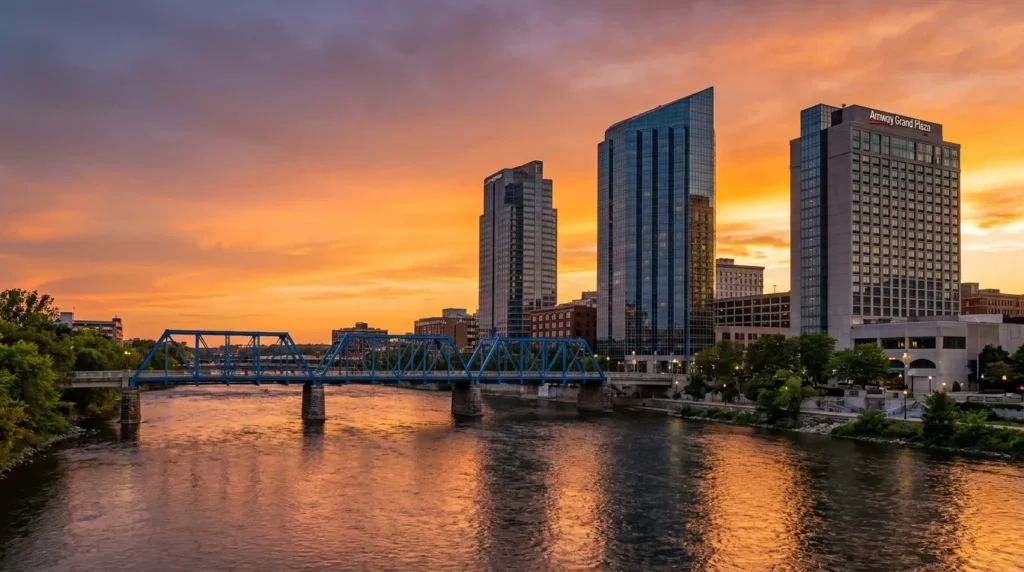
Want to live and work in Grand Rapids?

Personalized immigration plan with eligible visas, costs, and next steps for your goal!

If you are not eligible, you will know exactly why and what to do to improve your approval chances.

Save up to 12 hours in meetings

No pointless assessments.

Save up to 90%

Save money on vague or unfocused consultations

Avoid Fraud and Mistakes

One mistake can cost you your visa

Total Impartiality

Zero commercial bias

Decide with peace of mind

No toxic urgency

Fast and Accurate

Answers in minutes, no guesswork

White majority with strong Dutch heritage, with significant Latino and African American populations

Grand Rapids has approximately 200,000 residents, a white majority with Dutch roots. Latinos represent an important share of the city, alongside African Americans, Vietnamese, Bosnians, and African refugees.

Dutch heritage is prominent throughout western Michigan, reflected in surnames, Reformed churches, and festivals. Although the majority of the population is non-Hispanic white, diversity has been increasing. Latinos, especially of Mexican origin, form a large and established community, with a strong presence on the southwest side.

African Americans make up the second-largest racial group, with traditionally Black neighborhoods such as Madison Park and the south side. There are communities of Vietnamese, Bosnian, Congolese, Burundian, and South Sudanese refugees, organized through entities such as Bethany Christian Services. Neighborhoods on the west side receive Hispanic families at a growing pace.

Religiously, the Christian Reformed Church and the Reformed Church in America carry historical weight, alongside strong Catholicism among Latino and Polish communities, African American evangelical churches, and newer mosques and Buddhist temples serving recent immigrant communities.

Languages spoken
  • English
  • Spanish
  • Vietnamese
  • Bosnian
  • Swahili
  • +1 more
Main religions
  • Protestantism
  • Catholicism
  • No religion
  • Islam
  • Buddhism

Cost below the national average, but rising with growing popularity

Grand Rapids remains less expensive than major American metros, but rents have risen considerably over the past decade. Groceries, utilities, and services remain comfortable for median incomes.

The cost of living in Grand Rapids is below the national average, but the pace of increase has been strong over the past decade. Rent for a one-bedroom apartment in the center or desirable neighborhoods has risen considerably, though it remains noticeably below Chicago, Boston, or Minneapolis. Buying a home requires patience and finding the right listing.

Grocery shopping is dominated by Meijer, Michigan's retail giant, along with Aldi, Kroger, and Whole Foods. Latin markets on Bridge Street and Eastern Avenue, as well as halal butchers, help immigrants maintain familiar diets at reasonable prices. Restaurants span a wide range, from inexpensive food truck meals to fine dining at Downtown Market.

Michigan's state income tax is flat, and the city levies its own municipal income tax. State auto insurance remains high, though lower than Detroit. Property tax is reasonable, and winter heating weighs on the budget, with most homes using natural gas supplied by DTE Energy or Consumers Energy.

94Cost index (US = 100)6% below US average
CategorySingleCoupleFamily (2 + 2)
iHousing$1,217$1,404$1,778
iFood$356$711$1,292
iTransport$468$796$1,030
iHealthcare$262$524$983
iChildcare$1,704
iOther$796$1,432$2,012
Monthly total$3,099$4,867$8,799

Source: U.S. BLS Consumer Expenditure Survey 2023 + BEA Regional Price Parities 2023 · Estimates in USD, monthly.

Charming historic neighborhoods, Dutch-style homes, and new downtown buildings

Grand Rapids has preserved historic neighborhoods, wooden Dutch-style homes, and new downtown developments. The rental market is accessible but prices have risen in the most sought-after areas.

Heritage Hill, near the center, is one of the most charming neighborhoods, with more than a thousand historic homes from the late 19th and early 20th centuries. Eastown and East Hills are popular among young professionals, with cafes, independent shops, and preserved architecture. Heritage Hill also offers solid rental options in old divided townhouses.

To the northwest, neighborhoods such as Creston and North Park attract families with medium-sized homes and yards. The southwest concentrates the Latino community, with Bridge Street and its surroundings serving as the commercial and cultural heart. East Grand Rapids, an independent suburb adjacent to the city, has a reputation for excellent schools and higher home prices.

Downtown gained new residential buildings over the past decade, attracting recent graduates, healthcare professionals from the Medical Mile, and those who prefer to walk to work. For newly arrived immigrants, renting first, exploring two or three neighborhoods, and only then considering a purchase is advisable, given the dynamic pace of the market.

Recommended neighborhoods
  • Heritage Hill
  • Eastown
  • East Hills
  • Downtown
  • Creston
  • +3 more

Healthcare, furniture, advanced manufacturing, biotechnology, and craft brewing

The economy revolves around healthcare, furniture, manufacturing, biotechnology, and craft beer. Corewell Health, Steelcase, MillerKnoll, and Amway dominate, with strong opportunities for skilled immigrants.

The healthcare sector is the largest employer, driven by Corewell Health, formerly Spectrum Health, with the Medical Mile near the Van Andel Research Institute, a biotechnology hub. Mercy Health and Pine Rest Christian Mental Health complete the network. There is consistent demand for nurses, physicians, technicians, therapists, and hospital administrators.

Steelcase, MillerKnoll, Haworth, and dozens of suppliers make the region a global hub for corporate furniture. Amway, headquartered in Ada, and Meijer employ thousands. Automotive manufacturing, plastics, food, and beverages have a strong presence. The craft beer industry, with Founders, nearby Bell's, and dozens of smaller breweries, generates jobs in the hospitality sector.

For immigrants, openings exist in engineering, design, data science, biotechnology, and construction. Speaking Spanish is an advantage in healthcare, education, and social services. Average salaries are moderate but align well with the cost of living. The supply of skilled jobs has grown quickly, especially in technology and life sciences.

Dominant sectors
  • Healthcare
  • Furniture Manufacturing
  • Biotechnology
  • Food and Beverage
  • Education
  • +1 more
Major employers
  • Corewell Health
  • Steelcase
  • MillerKnoll
  • Amway
  • Meijer
  • +3 more

Grand Valley, Calvin, and Aquinas, with strong charter, Catholic, and Christian Reformed schools

The region has several universities, with Grand Valley State, Calvin, Aquinas, and Davenport standing out. Public schools are uneven, but strong charter, Catholic, and Christian Reformed options exist.

Grand Valley State University, with campuses in Allendale and downtown, serves approximately 22,000 students and has recognized programs in healthcare, engineering, and business. Calvin University, affiliated with the Christian Reformed Church, is a reference in the humanities, and Aquinas College is a smaller Catholic institution with a strong liberal arts program.

Davenport University focuses on business and technology, and Western Michigan University, based in Kalamazoo with a regional presence, rounds out the options. The Michigan State College of Human Medicine has a medical campus in the city, connected to the Medical Mile, attracting medical talent and biomedical research.

At the primary and secondary level, Grand Rapids Public Schools face challenges typical of mid-size American cities, but there are strong magnet and charter schools, such as City High Middle. The East Grand Rapids system has a top reputation, and Catholic schools such as Catholic Central High School and Reformed institutions such as Grand Rapids Christian Schools serve many families.

Notable universities
  • Grand Valley State University
  • Calvin University
  • Aquinas College
  • Davenport University
  • Michigan State University College of Human Medicine

The Medical Mile concentrates top-tier hospitals and research centers

The Medical Mile is a nationally significant healthcare corridor. Corewell Health, Mercy Health, and the Van Andel Institute form one of the strongest medical infrastructures in the American Midwest.

The Medical Mile, along Michigan Street, concentrates Butterworth Hospital, Helen DeVos Children's Hospital, Lemmen-Holton Cancer Pavilion, and the Van Andel Research Institute. Corewell Health dominates the regional ecosystem, with hospitals and clinics throughout western Michigan. For complex cases, the infrastructure is comparable to major metropolitan areas.

Mercy Health Saint Mary's, a Catholic institution, is the other major hospital network with a downtown location. Pine Rest provides reference mental health services. Community clinics such as Cherry Health serve uninsured or underinsured populations, and there are ethnic clinics for the Latino community and refugees.

As throughout the United States, health insurance is essential, and most families receive coverage through an employer. Michigan has Medicaid for low-income households and the Healthy Michigan Plan. Healthcare professionals trained abroad find strong demand, and credentialing programs are available at Grand Valley State and Michigan State College of Human Medicine.

Healthcare index72.0 / 100
  • Life expectancyyears at birth
    78.4yrs
  • Doctors per 1kpracticing physicians
    3.7
  • Health spendper capita, per year
    $13,473
  • Public systemoverall quality rating
    Good

Considered a safe city, with rates below the average for comparable cities

Grand Rapids has a reputation for safety relative to its size. Violent crime is concentrated in specific areas, and central neighborhoods as well as suburbs tend to be calm in daily life.

Daily life in neighborhoods such as Heritage Hill, Eastown, East Hills, East Grand Rapids, Creston, and Alger Heights tends to be quiet. People walk at night downtown, and the city invests in community policing, lighting, and urban revitalization. The presence of families, students, and healthcare professionals keeps streets active.

Some areas have higher crime rates, particularly parts of the southeast and southwest, but even in those neighborhoods there are safe blocks and organized communities. The Grand Rapids Police Department has community relations programs and partnerships with churches, nonprofits, and immigrant associations to build trust.

For immigrants, the general sense is one of safety, especially compared with large Latin American capitals. Basic precautions regarding vehicles, housing, and belongings are sufficient. Emergency services respond in reasonable time, and programs such as the Latin American Services offered by the Hispanic Center help families with safety concerns, abuse, and mediation.

5.8
Homicides per 100k
per year
Safety index
58.0
Crime index
42.0
Safer neighborhoods
  • East Hills
  • Heritage Hill
  • Eastown
  • Ada (suburb)
  • Forest Hills
  • Cherry Hill
  • Creston
Areas to avoid
  • stretches of South Division Avenue late at night
  • industrial areas around Madison Square after business hours
  • isolated portions of Black Hills at night

Car-dependent city, with The Rapid bus system and a solid regional airport

Grand Rapids relies heavily on the car, but has The Rapid bus system, a growing network of bike lanes, and Gerald R. Ford Airport with flights to major hubs. Detroit is about two and a half hours away.

The car remains the primary option, with I-96, I-196, and US-131 crossing the region. Downtown parking is plentiful and reasonably priced. Traffic congestion exists during peak hours, but nothing comparable to Chicago or Detroit. Several residential areas are 10 to 15 minutes from the center.

The Rapid operates urban bus routes, with the Silver Line BRT connecting downtown to the southeast and the Laker Line serving Grand Valley State University. The system is reasonable for a city of this size, but living without a car outside downtown is challenging. The city has been investing in bike lanes, and Heritage Hill and Eastown are walkable.

Gerald R. Ford International Airport, east of the city, offers direct flights to Chicago, Detroit, Atlanta, Dallas, Minneapolis, Newark, and other hubs. For international travel, most connections go through Chicago or Detroit. Greyhound and Indian Trails bus routes also link the city to other Michigan cities and the broader Midwest.

22 min
Avg commute
54
Walkability
Airports
  • GRR — Gerald R. Ford International Airport
  • International airport
  • Bike infrastructure

What the Climate is Like Living in Grand Rapids

A western Michigan city with a humid continental climate: warm summers around 28 degrees Celsius, and snowy winters heavily influenced by Lake Michigan.

Summers in Grand Rapids are warm and humid, with highs between 27 and 29 degrees Celsius in July and frequent afternoon thunderstorms. Air conditioning is standard in all homes.

Winters are long and snowy, with lake-effect snow off Lake Michigan accumulating between 180 and 200 cm per season. Lows range from -10 to -6 degrees Celsius, snow tires are a practical necessity, and natural gas heating is standard.

Spring is brief and fall is spectacular, with peak foliage in October. Annual rainfall totals around 950 mm, and overcast skies dominate the winter months from November through February.

Sunny days / year170 days
Avg high (°F)
  • 32°J
  • 34°F
  • 46°M
  • 56°A
  • 69°M
  • 80°J
  • 83°J
  • 82°A
  • 74°S
  • 60°O
  • 47°N
  • 40°D
Avg low (°F)
  • 20°J
  • 18°F
  • 29°M
  • 37°A
  • 48°M
  • 59°J
  • 65°J
  • 63°A
  • 57°S
  • 46°O
  • 34°N
  • 29°D
Rainfall (")
  • 2"J
  • 3"F
  • 4"M
  • 3"A
  • 4"M
  • 4"J
  • 3"J
  • 4"A
  • 3"S
  • 4"O
  • 2"N
  • 3"D

ArtPrize, craft breweries, live music, and easy access to Lake Michigan

Local culture blends ArtPrize, dozens of craft breweries, live music, museums, and easy access to Lake Michigan beaches. The culinary and independent arts scene has grown significantly.

ArtPrize, an open-air art festival that takes over the city each autumn, placed Grand Rapids on the American cultural map. Frederik Meijer Gardens & Sculpture Park combines botanical gardens with international sculptures. The Grand Rapids Art Museum, the Gerald R. Ford Presidential Museum, and the Public Museum add significant cultural heritage.

The region has more than 80 craft breweries, with Founders, HopCat, Brewery Vivant, Perrin, and Creston Brewery among the standouts. The culinary scene follows suit, with independent restaurants and Downtown Market bringing together local producers. Live music can be found at the Pyramid Scheme, Listening Room, Intersection, and festivals at Calder Plaza.

Connection with nature is part of daily life. Lake Michigan beaches in Grand Haven, Holland, and Muskegon are less than an hour away. In winter, skiing is available at Cannonsburg and Pando. For immigrants, events such as the Festival of the Arts, the Hispanic Festival, and Asian celebrations bring communities together and offer a cultural entry point.

Grand Rapids

Grand Rapids Attractions and the DeVos-Van Andel Culture

Michigan's second-largest city, on the state's western side, once the national furniture capital, now known for craft beer, the annual ArtPrize festival, and the Meijer Gardens botanical sculpture park.

Frederik Meijer Gardens & Sculpture Park, featuring works by Henry Moore, Auguste Rodin, and Anish Kapoor across 158 acres, is the signature destination. The Gerald R. Ford Presidential Museum, on the Grand River waterfront, documents the presidency of this city's native son. The Grand Rapids Art Museum (GRAM) was the world's first major LEED Gold-certified museum.

Grand Rapids is Beer City USA: more than 80 breweries in the metro area, with Founders Brewing, Brewery Vivant, HopCat, and Grand Rapids Brewing Company among the standouts. ArtPrize, an open-entry art festival that takes over the entire downtown in September and October, is a defining local event.

For everyday culture, Van Andel Arena hosts minor league NHL and concerts, the Public Museum features an original exhibition on the furniture industry, and the West Side Italian neighborhood preserves immigrant heritage. John Ball Zoo and Riverside Park are family stops, and the Grand River runs through it all.

  1. 1["Frederik Meijer Gardens and Sculpture Park"
  2. 2"Grand Rapids Art Museum"
  3. 3"Gerald R. Ford Presidential Museum"
  4. 4"Grand Rapids Public Museum"
  5. 5"John Ball Zoo"
  6. 6"Van Andel Arena"
Nightlife6.0 / 10
Parks & green spaces
  • ["Frederik Meijer Gardens"
  • "Riverside Park"
  • "John Ball Park"
  • "Aman Park"
  • "Millennium Park"
  • +1 more

Latest posts

Posts about Michigan

Coverage and updates related to this destination.

Showing content from Michigan, as there is no specific data for Grand Rapids yet.