Visto n' Visa
Blog
Notícias e artigos
Destinations
Careers
Immigrants

Want to live and work in Detroit?

Personalized immigration plan with eligible visas, costs, and next steps for your goal!

If you are not eligible, you will know exactly why and what to do to improve your approval chances.

Save up to 12 hours in meetings

No pointless assessments.

Save up to 90%

Save money on vague or unfocused consultations

Avoid Fraud and Mistakes

One mistake can cost you your visa

Total Impartiality

Zero commercial bias

Decide with peace of mind

No toxic urgency

Fast and Accurate

Answers in minutes, no guesswork

Majority African American city with strong Arab and Latino communities

Detroit is one of the most predominantly Black large cities in the United States, with roughly 77% African American residents. There are historic Arab communities, growing Latino populations in Southwest Detroit, and white residents returning to revitalized areas.

Detroit's population is predominantly African American, a legacy of the Great Migration from the rural South during the 20th century, drawn by the automobile factories. This heritage shapes the city's culture, from music to political activism, and gives Detroit a distinct character among major American cities.

The metropolitan area is home to one of the largest Arab communities in the United States, concentrated primarily in Dearborn but with significant presence in parts of Detroit as well. Latinos, predominantly of Mexican origin, form the heart of Southwest Detroit, with Mexicantown serving as a cultural and culinary landmark.

The number of white residents has grown again in downtown and in neighborhoods like Corktown and Midtown, with young professionals and students leading the way. Religiously, Black Protestant churches play a central role, alongside strong Catholic, Muslim, and Orthodox communities that reflect the diversity of the metropolitan area.

Languages spoken
  • English
  • Spanish
  • Arabic
  • Bengali
  • French
Main religions
  • Protestantism
  • Catholicism
  • Islam
  • No religion
  • Eastern Orthodoxy

One of the most affordable major cities in the United States

Detroit offers a cost of living well below comparable cities. Rents and home prices are accessible, though revitalized neighborhoods have been rising quickly in recent years.

Compared to Chicago, Boston, or New York, Detroit is significantly more affordable. Rents in downtown and Midtown have climbed considerably but remain below the average for other major metros. In more outlying neighborhoods, it is possible to find entire houses at prices that would seem unthinkable in other American cities, though many properties require renovation.

Grocery shopping is anchored by Kroger, Meijer, and Aldi, with strong ethnic markets in Hamtramck, Dearborn, and Mexicantown that help keep costs down. Restaurants offer good value, especially in immigrant neighborhoods. Utility bills vary widely with the harsh winters, and car insurance in Detroit is well known for being among the highest in the country.

Michigan state taxes are moderate, and the city levies its own municipal income tax. Property taxes in Detroit have historically been high relative to actual home values, but recent reforms have addressed many of those distortions. For residents with stable employment, the ratio of wages to cost of living tends to be favorable.

77Cost index (US = 100)23% below US average
CategorySingleCoupleFamily (2 + 2)
iHousing$998$1,151$1,458
iFood$292$583$1,059
iTransport$384$653$845
iHealthcare$215$430$806
iChildcare$1,397
iOther$653$1,174$1,650
Monthly total$2,542$3,991$7,215

Source: U.S. BLS Consumer Expenditure Survey 2023 + BEA Regional Price Parities 2023 · Estimates in USD, monthly.

From downtown lofts to affordable fixer-uppers in historic neighborhoods

Detroit offers everything from high-end downtown lofts to whole houses at low prices in recovering neighborhoods. The choice of neighborhood defines much of the experience of living in the city.

Downtown and Midtown concentrate the supply of apartments and lofts in restored historic buildings, with rents that are high by local standards. Corktown, near the Michigan Central Station reopened by Ford, has become a favorite for new residents, with bars, restaurants, and well-preserved brick architecture.

Established neighborhoods such as Indian Village, Boston-Edison, and Palmer Woods offer grand historic homes at prices that seem unrealistic to anyone coming from another major metro. For Arab and Latino newcomers, Southwest Detroit and the border area with Dearborn offer an established community, ethnic groceries, and nearby mosques or churches.

Transitional areas like Jefferson Chalmers, North End, and Bagley mix renovated homes with vacant lots. A personal visit, conversations with neighbors, and checking the exact block are all worthwhile, since the contrast from one street to the next can be significant. Renting before buying is the safest strategy for recent arrivals.

Recommended neighborhoods
  • Downtown
  • Midtown
  • Corktown
  • Indian Village
  • Boston-Edison
  • +3 more

Automotive, healthcare, automotive technology, and regional logistics

The economy is still driven by the automotive industry, but healthcare, technology, finance, and logistics are generating growing numbers of jobs. Rocket Companies and Ford are leading the labor market revival.

Ford, General Motors, and Stellantis remain pillars of the regional economy, with factories, engineering centers, and research facilities focused on electric and autonomous vehicles. Ford's reopening of Michigan Central transformed Corktown into a mobility hub. Automotive suppliers spread across metro Detroit employ hundreds of thousands of people.

Rocket Companies, connected to Dan Gilbert, concentrates financial technology jobs downtown. Hospitals such as Henry Ford Health, Detroit Medical Center, and Beaumont, now Corewell Health, are major healthcare employers. Wayne State University adds positions in research, education, and administration.

For newcomers, there is demand in mechanical engineering, software development, data science, nursing, medicine, logistics, and construction. Speakers of Spanish, Arabic, or Bengali have an advantage in community services and outreach roles. Average salaries are lower than in Chicago or Boston, but that is offset by the significantly lower cost of living.

Dominant sectors
  • Automotive industry
  • Healthcare
  • Financial technology
  • Logistics
  • Higher education
  • +1 more
Major employers
  • Ford Motor Company
  • General Motors
  • Stellantis
  • Rocket Companies
  • Henry Ford Health
  • +3 more

Wayne State at the center, community colleges, and challenges in public schools

Wayne State University is the city's academic core. Accessible community colleges and neighboring universities in Ann Arbor serve the region. The public school system faces ongoing challenges, but charter schools provide additional options.

Wayne State University, in Midtown, is one of the state's leading public universities, with strong programs in medicine, law, engineering, and social sciences. The University of Detroit Mercy is a traditional Jesuit institution in the city, and the College for Creative Studies trains designers for the automotive industry and beyond.

For community college options, Wayne County Community College operates accessible campuses throughout the city, offering technical programs and a pathway for transfer to four-year universities. The University of Michigan in Ann Arbor and Michigan State in East Lansing, both with international reputations, are less than an hour away by car.

The Detroit Public Schools Community District went through decades of difficulty and is still rebuilding its reputation. Many families opt for charter schools, magnet schools like Cass Technical, or Catholic and private schools. For newcomers with children, researching the specific school and neighborhood carefully before settling is strongly recommended.

Notable universities
  • Wayne State University
  • University of Detroit Mercy
  • College for Creative Studies
  • Wayne County Community College
  • Marygrove College

Major hospital networks and leading academic medical centers

Detroit has three major hospital networks: Henry Ford Health, Detroit Medical Center, and Corewell Health. High-acuity care is strong, and free community clinics operate in several neighborhoods.

Henry Ford Hospital in New Center is a reference in cardiology and oncology and serves as a teaching hospital. The Detroit Medical Center, in Midtown, encompasses Detroit Receiving, Harper, Hutzel Women's, and the Children's Hospital of Michigan, one of the largest pediatric hospitals in the Midwest, affiliated with Wayne State University.

The Corewell Health network, formerly Beaumont, and Ascension have a strong presence in the suburbs and the city. Clinics such as Western Wayne Family Health Center and other community organizations serve uninsured or underinsured populations. Access to specialists is generally good, with wait times that are reasonable compared to other major U.S. cities.

As elsewhere in the country, having health insurance through an employer or through the Affordable Care Act Marketplace is essential. Michigan has its own Medicaid program for lower-income households, with specific eligibility rules. Recent arrivals should verify in-network providers and understand copay structures before scheduling routine appointments or tests.

Healthcare index68.0 / 100
  • Life expectancyyears at birth
    78.4yrs
  • Doctors per 1kpracticing physicians
    3.7
  • Health spendper capita, per year
    $13,473
  • Public systemoverall quality rating
    Fair

Safety has improved considerably, but varies significantly by neighborhood

Detroit once had a reputation as one of the most dangerous cities in the United States. Crime rates have improved substantially, but safety continues to vary block by block. Downtown and revitalized areas are calm in day-to-day life.

Detroit's tough image belongs to the recent past. Crime has fallen consistently over the last decade, driven by investments in policing, public lighting, and urban revitalization. Downtown, Midtown, Corktown, Indian Village, and Palmer Woods are considered quite safe, with visible police presence and healthy pedestrian activity.

That said, parts of the city still have elevated rates of violent crime, particularly in some East Side and West Side neighborhoods with high concentrations of abandoned properties. For newcomers, the approach is straightforward: research neighborhoods, talk to residents, avoid purchasing property on emptied-out blocks, and take basic precautions with vehicles and belongings.

Policing is handled by the Detroit Police Department, which runs active community programs. The 911 emergency service has seen improved response times in recent years. At night, rideshare apps are the most common choice among residents, and walking between downtown, Midtown, and Corktown is generally safe.

5.8
Homicides per 100k
per year
Safety index
22.0
Crime index
78.0
Safer neighborhoods
  • Downtown
  • Midtown
  • Corktown
  • Indian Village
  • Boston-Edison
  • Palmer Woods
  • Lafayette Park
Areas to avoid
  • sections of the East Side near abandoned buildings after dark
  • industrial areas around Delray
  • vacant portions of Brightmoor at night
  • isolated parking lots along Gratiot Avenue

A car city, with the QLine, DDOT buses, and easy access to Canada

Detroit is built around the car. The QLine streetcar runs along the Woodward corridor, DDOT and SMART buses cover the city and suburbs, and a large international airport serves the region. The crossing to Windsor, Canada, is quick by bridge or tunnel.

The car remains the central mode of transportation, and having a personal vehicle makes daily life considerably easier, especially outside downtown. Interstates I-75, I-94, and I-96 cut through the city and connect to the suburbs. Parking downtown is plentiful and inexpensive compared to other major American metros.

The QLine runs along Woodward Avenue connecting downtown to New Center through Midtown, and the People Mover is a short elevated loop in the city center. DDOT buses serve the city and SMART buses cover the suburbs, though frequencies vary and the overall system remains limited for those who rely exclusively on public transit.

Detroit Metropolitan Wayne County Airport, in Romulus, is a Delta hub with direct flights to Europe, Asia, and Latin America. The Ambassador Bridge and the Detroit-Windsor Tunnel allow crossings to Windsor, Canada, in minutes. Amtrak train service to Chicago departs from the New Center station.

1
Metro lines
13
Metro stations
26 min
Avg commute
56
Walkability
Airports
  • DTW — Detroit Metropolitan Wayne County Airport
  • DET — Coleman A. Young Municipal Airport
  • International airport
  • Bike infrastructure

What the Climate Is Like Living in Detroit

A major Midwestern city with a humid continental climate: warm summers around 28 degrees Celsius, and long, cold winters with abundant snowfall.

Summer in Detroit is hot and humid, with highs between 27 and 29 degrees Celsius from June through August. Summer storms and humidity from the Detroit River make the air heavy, and air conditioning is standard.

Winter is the dominant season: lows between -10 and -6 degrees Celsius in January, strong winds from Lake Erie, and snowfall totaling around 110 cm per season. Snow tires, heavy coats, and natural gas heating are essential.

Spring is short and fall is striking, with foliage peaking in October. Annual rainfall totals around 850 mm, well distributed throughout the year, and the freeze-thaw cycle in winter defines much of daily life in the city.

Sunny days / year183 days
Avg high (°F)
  • 34°J
  • 36°F
  • 47°M
  • 56°A
  • 68°M
  • 79°J
  • 83°J
  • 81°A
  • 75°S
  • 62°O
  • 48°N
  • 41°D
Avg low (°F)
  • 22°J
  • 20°F
  • 30°M
  • 38°A
  • 49°M
  • 61°J
  • 66°J
  • 65°A
  • 59°S
  • 48°O
  • 35°N
  • 30°D
Rainfall (")
  • 2"J
  • 3"F
  • 3"M
  • 4"A
  • 3"M
  • 4"J
  • 4"J
  • 4"A
  • 3"S
  • 4"O
  • 2"N
  • 2"D

Birthplace of Motown, techno, professional sports, and a vibrant food scene

Detroit is a global reference in music, with strong Motown, techno, and jazz traditions. It has professional teams in all major leagues, world-class museums, and a diverse and growing culinary scene.

Music is central to the city's identity. Motown was born here at Hitsville USA, and the Motown Museum preserves that legacy. Detroit is also the birthplace of techno, with festivals like Movement at Hart Plaza drawing international audiences. The jazz, blues, and hip-hop scenes, shaped by artists such as Eminem and J Dilla, remain active.

The Detroit Tigers at Comerica Park, Detroit Lions at Ford Field, the Detroit Pistons, and the Detroit Red Wings at Little Caesars Arena make the city one of the rare American metros with franchises in all four major professional leagues in the same district. The Detroit Institute of Arts holds Diego Rivera's famous murals and a globally respected collection.

The food scene blends African American Southern cooking, high-quality Arab cuisine in Dearborn, tacos in Mexicantown, Detroit-style pizza at places like Buddy's, and the iconic coney dogs at American and Lafayette. The bar scene in Corktown and the Eastern Market, especially on Saturday mornings, is a fixture in residents' lives.

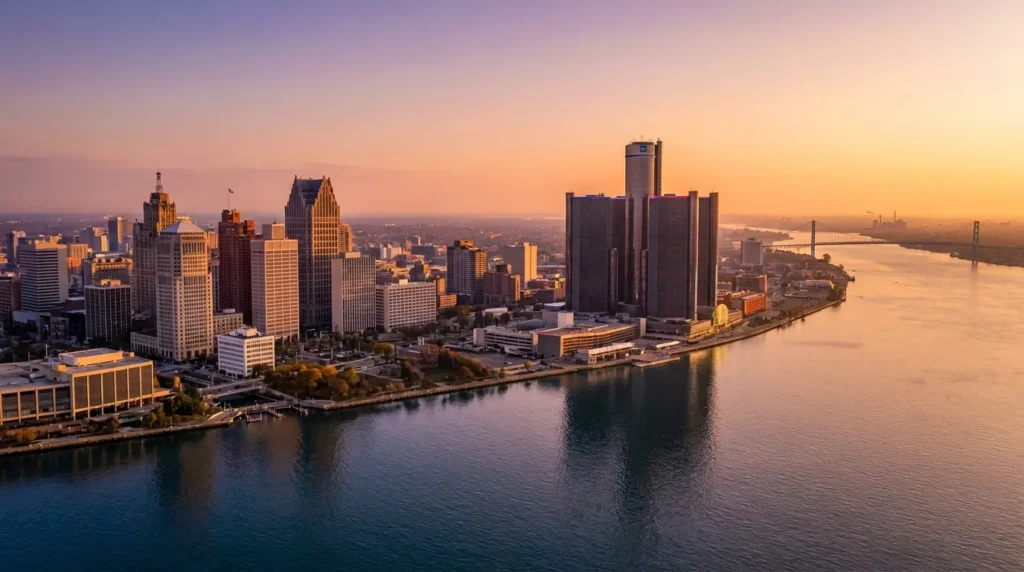
Detroit

What to See and Do While Living in Detroit

Detroit is the birthplace of Motown, the American automotive capital, with urban renewal in Downtown and Midtown, iconic museums, and neighborhoods such as Corktown, Mexicantown, and Greektown.

The Detroit Institute of Arts (DIA) houses Diego Rivera's Detroit Industry Murals, considered his masterpiece. The Motown Museum, located in the original Hitsville USA building, tells the story of Stevie Wonder, The Supremes, and Marvin Gaye. The Charles H. Wright Museum of African American History is the largest in the world dedicated to the African diaspora.

The Detroit Riverwalk connects downtown to Belle Isle Park, with views of Windsor, Canada. Greektown features a casino and restaurants, while Mexicantown in Southwest Detroit offers the best Mexican food in the Midwest. Corktown, a former Irish neighborhood, has become a hub for new restaurants around Michigan Central Station, recently restored by Ford. Eastern Market, a farmers market, operates on Saturdays.

Comerica Park (Tigers), Ford Field (Lions), and Little Caesars Arena (Red Wings, Pistons) are the centers of sports activity. The Henry Ford Museum in Dearborn and Greenfield Village together form one of the largest museum complexes in the United States. Detroit Metropolitan Airport (DTW), a Delta hub, connects to nearly anywhere in the world.

  1. 1["Detroit Institute of Arts"
  2. 2"Motown Museum"
  3. 3"Henry Ford Museum (Dearborn)"
  4. 4"Belle Isle Park"
  5. 5"Eastern Market"
  6. 6"Detroit Riverwalk"
Nightlife7.0 / 10
Parks & green spaces
  • ["Belle Isle Park"
  • "Campus Martius Park"
  • "Detroit Riverwalk"
  • "Palmer Park"
  • "Rouge Park"
  • +1 more

Latest posts

Posts about Michigan

Coverage and updates related to this destination.

Showing content from Michigan, as there is no specific data for Detroit yet.