Visto n' Visa
Blog
Notícias e artigos
Destinations
Careers
Immigrants

Want to live and work in Dearborn?

Personalized immigration plan with eligible visas, costs, and next steps for your goal!

If you are not eligible, you will know exactly why and what to do to improve your approval chances.

Save up to 12 hours in meetings

No pointless assessments.

Save up to 90%

Save money on vague or unfocused consultations

Avoid Fraud and Mistakes

One mistake can cost you your visa

Total Impartiality

Zero commercial bias

Decide with peace of mind

No toxic urgency

Fast and Accurate

Answers in minutes, no guesswork

The quintessential Arab American city, with historic Polish and Italian roots

Dearborn has approximately 109,000 residents and the highest concentration of Arab Americans in the United States. Lebanese form the historic core, with Yemeni, Iraqi, and Palestinian populations growing steadily. Polish and Italian heritage is also present.

Dearborn's population is classified as predominantly white under the U.S. Census, which places Arab Americans in that category. In everyday reality, roughly half of residents trace their ancestry to the Arab world, with Lebanese as the historic group, followed by strong Syrian, Palestinian, and Yemeni presences, and Chaldean Iraqi Christians distributed across the area.

The first wave of Arab immigrants arrived in the early twentieth century to work at Ford. Polish, Italian, Romanian, and Ukrainian communities contributed to the broader immigrant heritage. The African American population within the city's core is small, while Bangladeshi, Pakistani, and rural Yemeni communities are growing. Neighboring Dearborn Heights adds further demographic diversity.

Religiously, Dearborn holds one of the largest Muslim concentrations in the United States, with both Sunni and Shia mosques, including the Islamic Center of America, one of the largest in North America. Maronite, Chaldean Catholic, Melkite, and Antiochian Orthodox Christian communities are well established. Roman Catholicism and various Protestant denominations round out the religious landscape.

Languages spoken
  • English
  • Arabic
  • Bengali
  • Urdu
  • Polish
  • +1 more
Main religions
  • Islam
  • Catholicism
  • Maronite Catholicism
  • Chaldean Catholicism
  • Eastern Orthodoxy
  • +1 more

Moderate costs, with housing more affordable than in whiter suburbs

Dearborn offers a moderate cost of living, with housing more accessible than in nearby suburbs such as Birmingham or Bloomfield Hills. Inexpensive Arab food is a significant advantage for immigrant families.

Compared to wealthier northern Detroit suburbs like Birmingham, Royal Oak, or Bloomfield Hills, Dearborn is considerably more affordable. One-bedroom apartment rents fall in a reasonable range, and single-family homes on residential streets are competitively priced. East Dearborn, with its deep Arab heritage, tends to be the most affordable area.

A standout advantage is food costs for immigrant families. Markets such as Greenland Market, Super Greenland, and Westborn Fruit Market carry Middle Eastern products, fresh produce, spices, halal meats, and sweets at low prices. Bakeries serving fresh khubz and manakish, along with budget-friendly Lebanese and Yemeni restaurants, round out the food scene.

Michigan's state income tax rate is flat, and Dearborn levies its own municipal income tax. Property taxes are reasonable. Car insurance in Dearborn is high, as it is throughout southeast Michigan, but lower than inside Detroit proper. For immigrants employed at Ford or in Arab-owned small businesses, the balance of wages to cost of living is generally favorable.

94Cost index (US = 100)6% below US average
CategorySingleCoupleFamily (2 + 2)
iHousing$1,217$1,404$1,778
iFood$356$711$1,292
iTransport$468$796$1,030
iHealthcare$262$524$983
iChildcare$1,704
iOther$796$1,432$2,012
Monthly total$3,099$4,867$8,799

Source: U.S. BLS Consumer Expenditure Survey 2023 + BEA Regional Price Parities 2023 · Estimates in USD, monthly.

Single-family homes, low-rise buildings, and neighborhoods organized by community

The housing stock is dominated by mid-century brick single-family homes, older bungalows, and low-rise apartment buildings. East Dearborn is the center of the Arab community, while West Dearborn offers more spacious and expensive neighborhoods.

Dearborn divides broadly between East Dearborn, with older homes, denser streets, and a strong Arab presence, and West Dearborn, with wider lots, larger Tudor and Colonial-style houses, and a more spacious residential character. East Dearborn, centered around Warren Avenue, concentrates markets, restaurants, and mosques, with lower rents and home prices.

West Dearborn includes more valued areas such as Snow Woods, with large historic homes, and neighborhoods near Greenfield Village and The Henry Ford. Tree-lined streets, well-maintained parks, and proximity to the western commercial downtown characterize the area. Apartments are concentrated along Michigan Avenue, Warren Avenue, and Ford Road.

For Arab immigrants, it is common to start in East Dearborn near family and community, close to mosques, markets, and schools with Arabic programs, and later move to West Dearborn or Dearborn Heights as economic circumstances improve. Renting first is a common strategy, given the competitive pace of the market in the most sought-after areas.

Recommended neighborhoods
  • East Dearborn
  • West Dearborn
  • Snow Woods
  • Springwells
  • Warren Avenue corridor
  • +3 more

Ford Motor Company, automotive suppliers, and ethnic small businesses

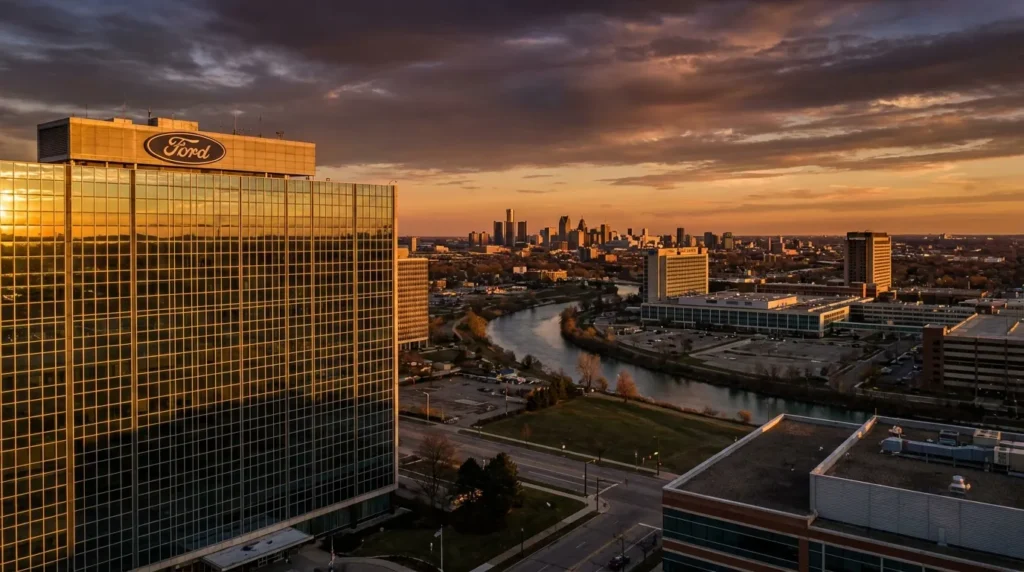
Ford is the economic backbone of Dearborn, with its world headquarters and the Rouge Plant. Automotive suppliers, hospitals, ethnic retail, and professional services round out the labor market.

Ford Motor Company is the city's largest employer, with its world headquarters, engineering and design centers, electric and autonomous vehicle research facilities, and the historic Rouge Plant where the F-150 is manufactured. Surrounding Ford, dozens of suppliers, including Lear, Magna, Adient, and others, employ factory workers, engineers, and technicians. AECOM, Yazaki, and Roush further populate the automotive ecosystem.

Hospitals such as Corewell Health Beaumont Dearborn are major healthcare employers, alongside Henry Ford Medical Center. The University of Michigan Dearborn and Henry Ford College add education-sector jobs. Arab-owned commerce constitutes its own economic sector, with chains of markets, restaurants, gas stations, agencies, and law firms generating thousands of positions.

For Arab immigrants, a dense business support network exists through chambers of commerce, associations, and investors. Starting a small business is a well-worn path. Engineers, designers, IT professionals, and healthcare workers find consistent demand at Ford and its suppliers. Arabic fluency is a genuine advantage in sales, customer service, and professional services.

Dominant sectors
  • Automotive industry
  • Engineering and design
  • Ethnic retail
  • Healthcare
  • Higher education
  • +1 more
Major employers
  • Ford Motor Company
  • Corewell Health Beaumont Dearborn
  • Henry Ford Medical Center
  • AAA Michigan
  • University of Michigan Dearborn
  • +3 more

Public schools with strong Arabic programs and the University of Michigan Dearborn

Dearborn Public Schools feature strong programs for Arab American students, including Arabic-language classes and bilingual support. The University of Michigan Dearborn and Henry Ford College offer accessible higher education options.

Dearborn Public Schools is one of the most notable school districts in the United States for its adaptation to local demographics. Schools such as Fordson High, Edsel Ford High, and Dearborn High offer Arabic as a second language, support for newly arrived students with limited English, and curricula that acknowledge Arab American cultural heritage.

The University of Michigan Dearborn is a regional campus of the University of Michigan at Ann Arbor, enrolling approximately 8,000 students in engineering, business, and social sciences programs. Tuition is more accessible than at the main Ann Arbor campus, and it serves many local students. Henry Ford College is one of the largest community colleges in the state, offering low-cost technical and transfer programs.

Private Islamic schools such as Crescent Academy and Riverside Academy provide full curricula with religious studies. Maronite and Chaldean Catholic schools serve Arab Christian families. For younger children, bilingual Arabic-English preschool programs are widely available and play an important role in preserving the language across generations born in the United States.

Notable universities
  • University of Michigan Dearborn
  • Henry Ford College
  • Wayne State University
  • Lawrence Technological University
  • Davenport University

Beaumont Dearborn, Henry Ford, and clinics staffed by Arabic-speaking professionals

Corewell Health Beaumont Dearborn and Henry Ford Medical Center serve the region. The large Arab population has produced a dense network of physicians, dentists, and pharmacists who provide care in Arabic, which is critical for older residents.

Corewell Health Beaumont Dearborn, formerly Oakwood Hospital, is the city's main hospital, offering a level-one emergency department, inpatient care, and a range of specialties. Henry Ford Medical Center operates outpatient facilities in Dearborn with broad ambulatory services. For complex cases, Detroit Medical Center, Henry Ford Hospital, and Corewell Beaumont in Royal Oak are nearby.

The Arab American healthcare professional network is one of the densest in the United States. Physicians, dentists, pharmacists, physical therapists, and nurses who speak Arabic practice in offices throughout East and West Dearborn. This is especially vital for elderly immigrants with limited English, who can describe symptoms in their native language.

Community clinics such as the ACCESS Community Health and Research Center serve uninsured populations and provide services in Arabic, Spanish, and Bengali. As throughout the U.S., health insurance is central. Ford employees and workers at large firms typically have strong coverage. Michigan offers Medicaid and the Healthy Michigan Plan for lower-income residents.

Healthcare index70.0 / 100
  • Life expectancyyears at birth
    78.4yrs
  • Doctors per 1kpracticing physicians
    3.7
  • Health spendper capita, per year
    $13,473
  • Public systemoverall quality rating
    Good

A city considered safe, supported by strong community cohesion

Dearborn has a reasonable safety reputation for its size and location, bolstered by strong community cohesion. Violent crime is rare, and police maintain an active presence in both West and East Dearborn.

Daily life in Dearborn is calm across most of the city. Families walk to mosques and markets at night, parks are well used, and community cohesion creates a genuine sense of security. West Dearborn, particularly neighborhoods such as Snow Woods and Aviation Sub, is especially safe. East Dearborn has more foot traffic but low violent crime rates.

The Dearborn Police Department is proportionally staffed for the city's size and invests in community policing, with Arabic-speaking officers serving the Arab majority. Relationships with mosques and churches have been built over decades. The most common offenses are vehicle thefts, minor property crimes, and traffic violations on busy corridors.

For Arab immigrants from conflict regions such as Iraq, Syria, Lebanon, and Yemen, the sense of safety in Dearborn is one of its most important draws. Active community work against Islamophobia, especially during periods of international tension, is part of the civic fabric. Emergency response times are short, and ACCESS provides victim support services in Arabic.

5.8
Homicides per 100k
per year
Safety index
58.0
Crime index
42.0
Safer neighborhoods
  • Dearborn Hills
  • Springwells Park
  • Aviation Subdivision
  • Snow Woods
  • Camelot
  • Ford Woods
Areas to avoid
  • stretches near the Michigan Avenue commercial corridor late at night
  • industrial areas around the former Rouge Plant facilities
  • isolated parking lots along Schaefer Road after business hours

Car-dependent city with SMART bus service and Amtrak connections to Chicago

Dearborn is a car-dependent city with wide arterials and abundant parking. SMART bus routes, Amtrak service to Chicago and Detroit, and proximity to Detroit Metropolitan Airport a few minutes away round out transportation options.

A car is essential in Dearborn. Michigan Avenue, Warren Avenue, Ford Road, and Telegraph are the main arterials. Interstates I-94, I-75, and M-39 Southfield Freeway are minutes away, connecting to Detroit, Ann Arbor, Toledo, and the airport. Parking is plentiful near markets, mosques, and commercial centers. Traffic is heavy on corridors like Michigan Avenue during peak hours.

SMART buses operate along Michigan Avenue, Warren Avenue, Ford Road, and other arterials, linking Dearborn to Detroit, Westland, Wayne, and the airport. Detroit's People Mover does not extend here. Amtrak's Wolverine route stops at the attractive John D. Dingell Transit Center near The Henry Ford Museum, with daily departures to Chicago and Detroit.

Detroit Metropolitan Wayne County Airport in Romulus is about 20 minutes to the west, a Delta hub with nonstop service to Middle Eastern destinations including Amman and Doha via Royal Jordanian and Qatar Airways, a major advantage for Arab immigrants visiting family. Uber, Lyft, and local Arabic-owned car services operate throughout the city.

24 min
Avg commute
55
Walkability
Airports
  • DTW — Detroit Metropolitan Wayne County Airport (nearby, 15 km)
  • International airport
  • Bike infrastructure

What the Climate Is Like Living in Dearborn

A historic Detroit suburb with a humid continental climate: warm summers around 82 degrees Fahrenheit, and long, cold winters with regular snowfall.

Summers in Dearborn are warm and humid, with highs between 81 and 84 degrees Fahrenheit from June through August. Summer thunderstorms are common, and air conditioning is standard in all homes.

Winters are long and cold, with lows between 14 and 21 degrees Fahrenheit in January and snowfall accumulating roughly 39 inches per season. Natural gas heating is the norm, and snow tires are recommended.

Spring is brief and autumn is short but striking, with foliage peaking in October. Annual rainfall totals around 33 inches, distributed fairly evenly throughout the year, and the Rouge River defines the city's northern boundary.

Sunny days / year183 days
Avg high (°F)
  • 34°J
  • 36°F
  • 48°M
  • 57°A
  • 69°M
  • 80°J
  • 84°J
  • 82°A
  • 75°S
  • 62°O
  • 49°N
  • 42°D
Avg low (°F)
  • 22°J
  • 20°F
  • 30°M
  • 38°A
  • 49°M
  • 60°J
  • 66°J
  • 64°A
  • 58°S
  • 48°O
  • 34°N
  • 30°D
Rainfall (")
  • 2"J
  • 3"F
  • 3"M
  • 3"A
  • 3"M
  • 4"J
  • 4"J
  • 4"A
  • 3"S
  • 4"O
  • 2"N
  • 2"D

Vibrant Arab American culture, The Henry Ford Museum, and world-class Middle Eastern cuisine

Dearborn is a cultural destination for its Arab American vitality, historic mosques, The Henry Ford Museum, Greenfield Village, and a Middle Eastern food scene with a worldwide reputation.

The Henry Ford Museum of American Innovation and Greenfield Village form one of the largest American history museum complexes in the country, housing Rosa Parks' bus, Edison's laboratory, and the Wright Brothers' workshop. The Ford Rouge Factory Tour offers a close-up view of F-150 production. The Arab American National Museum is the only institution of its kind in the United States.

Warren Avenue in East Dearborn is a slice of Beirut in the middle of Michigan: Lebanese restaurants such as Al Ameer, markets, bakeries with fresh baklava, modest clothing shops, Arab teahouses, and cultural festivals throughout the year. The cuisine is a reference point: kibbeh, shawarma, hummus, mansaf, maqluba, and much more. The Arab American Festival is one of the largest ethnic festivals in the region.

The Islamic Center of America, one of the largest mosques in the U.S., draws thousands for Friday sermons. Maronite and Chaldean Catholic churches host vibrant liturgical celebrations. The Ford Community and Performing Arts Center brings theater and concerts to the city. For Arab immigrants, Dearborn is one of the few American cities where life can be lived fully in Arabic.

Dearborn

What to Do in Dearborn, from The Henry Ford to Warren Avenue

Dearborn is the birthplace of Ford Motor Company and home to the largest Arab-American concentration in the United States. The city combines industrial heritage, iconic Arab cuisine, and well-preserved neighborhoods.

The Henry Ford complex is Michigan's most important cultural destination, divided into three main parts. The Henry Ford Museum of American Innovation houses the limousine in which Kennedy was assassinated, the bus where Rosa Parks refused to give up her seat, and the chair in which Lincoln was shot, along with industrial machinery and the Edison laboratory. Greenfield Village reconstructs a historic American village using original buildings transported from across the country. The Ford Rouge Factory Tour offers a look at the F-150 assembly line in operation.

Warren Avenue, in southern Dearborn, is the Arab-American heart of the city and the nation. Restaurants such as Al-Ameer (a James Beard Award winner), Shatila Bakery (nationally recognized for its baklava), and Hashems Roastery draw visitors from across the Midwest. The Arab American National Museum, opened in 2005, is the only museum in the United States dedicated to the Arab-American experience and hosts an active cultural calendar. The Islamic Center of America is one of the largest mosques in the country.

For a look at the industrial and residential side of Dearborn, the Henry Ford Estate (Fair Lane), the Ford family mansion, is under restoration but open for tours and features extensive gardens. The Edsel and Eleanor Ford House, located nearby in Grosse Pointe Shores, is equally impressive. The Dearborn Historical Museum operates three period buildings, including the Commandant's Quarters. For shopping, Fairlane Town Center is the primary mall. Detroit is just 20 minutes away via Michigan Avenue.

  1. 1["Henry Ford Museum of American Innovation"
  2. 2"Greenfield Village"
  3. 3"Arab American National Museum"
  4. 4"Ford Rouge Factory Tour"
  5. 5"Fair Lane (Henry Ford Estate)"
  6. 6"Dearborn Historical Museum"
Nightlife4.0 / 10
Parks & green spaces
  • ["Ford Field Park"
  • "Camp Dearborn"
  • "Hemlock Park"
  • "Levagood Park"
  • "Cherry Hill Park"
  • +1 more

Latest posts

Posts about Michigan

Coverage and updates related to this destination.

Showing content from Michigan, as there is no specific data for Dearborn yet.