Visto n' Visa
Blog
Notícias e artigos
Destinations
Careers
Immigrants

Want to live and work in Ann Arbor?

Personalized immigration plan with eligible visas, costs, and next steps for your goal!

If you are not eligible, you will know exactly why and what to do to improve your approval chances.

Save up to 12 hours in meetings

No pointless assessments.

Save up to 90%

Save money on vague or unfocused consultations

Avoid Fraud and Mistakes

One mistake can cost you your visa

Total Impartiality

Zero commercial bias

Decide with peace of mind

No toxic urgency

Fast and Accurate

Answers in minutes, no guesswork

A young, cosmopolitan, and highly educated city

Ann Arbor has approximately 120,000 residents, with a young and highly educated profile shaped by the university. The majority is white, with large Asian, African American, Latino, and Arab communities.

Ann Arbor's demographics differ from most Michigan cities: the majority is white, but with a high percentage of Asian residents, particularly Chinese, Indian, and Korean individuals connected to the university. African Americans represent an important share of the population, with a historic community and traditional neighborhoods.

The presence of Iranians, Arabs, Latinos, and Africans continues to grow, tied to academic programs, medical research, and technology companies. The transient population, which moves in and out with the academic calendar, gives the city a dynamic character, and it has one of the highest rates of graduate-degree holders in the United States.

Religiously, Ann Arbor is more secular than the Michigan average, with a large share holding no affiliation. There are significant liberal Protestant, Catholic, and Jewish communities, as well as mosques, Buddhist temples, Hindu temples, and Baha'i communities. The environment is tolerant, politically progressive, and open to intercultural relationships and declared atheism.

Languages spoken
  • English
  • Mandarin
  • Spanish
  • Korean
  • Arabic
  • +3 more
Main religions
  • No religion
  • Protestantism
  • Catholicism
  • Judaism
  • Islam
  • +2 more

Cost of living well above the Michigan average, driven primarily by housing

Ann Arbor is one of Michigan's most expensive cities, particularly for rentals and home purchases. Other costs such as food and services are moderate, and academic and professional salaries help offset the difference.

The cost of living in Ann Arbor is significantly above the Michigan average and slightly above the national average, driven primarily by housing. Apartment rentals downtown and near the main campus are high, comparable to mid-sized cities on the East Coast. Purchasing a home requires a substantial budget, especially in more desirable neighborhoods.

For immigrants, food, restaurants, and services remain accessible compared to New York, Boston, or San Francisco. Markets such as Whole Foods, Trader Joe's, Kroger, Meijer, and ethnic markets on Stadium and Plymouth Road offer varied options. Original restaurants typically provide excellent value for the price.

Michigan's state income tax is flat, and Ann Arbor carries a considerable property tax. State car insurance remains high, though lower than in Detroit. For those arriving on graduate stipends, housing will consume a significant portion of income, making alternatives such as neighboring Ypsilanti, which is considerably more affordable, worth considering.

99Cost index (US = 100)1% below US average
CategorySingleCoupleFamily (2 + 2)
iHousing$1,278$1,474$1,867
iFood$374$747$1,357
iTransport$491$836$1,082
iHealthcare$275$550$1,032
iChildcare$1,789
iOther$836$1,504$2,113
Monthly total$3,254$5,111$9,240

Source: U.S. BLS Consumer Expenditure Survey 2023 + BEA Regional Price Parities 2023 · Estimates in USD, monthly.

Historic neighborhoods near campus, single-family homes, and new construction

The housing stock includes historic townhouses near campus, classic residential neighborhoods, modern condominiums, and new buildings. Proximity to the university drives higher prices, and family-oriented neighborhoods such as Burns Park are highly sought after.

Neighborhoods such as Old West Side, Old Fourth Ward, and Burns Park feature Victorian and early-twentieth-century homes, tree-lined streets, and proximity to downtown and campus. These areas are highly sought after by faculty, researchers, and established families. Prices are high, but the character and quality of life are notable. Water Hill is another charming, music-oriented neighborhood.

Modern apartments are concentrated downtown and near the central campus, with new high-rise buildings and renovated loft-style structures. Undergraduate students favor areas such as State Street and South University. Researchers and young professionals tend to seek out Kerrytown, Germantown, and zones north of Michigan Avenue.

For families with children, neighborhoods such as Burns Park, Bryant, Pattengill, and areas west of the city offer single-story homes and duplexes on quiet streets near parks and schools. Neighboring Ypsilanti offers considerably more affordable prices with easy access to Ann Arbor via AAATA bus and car along US-12 and I-94.

Recommended neighborhoods
  • Old West Side
  • Burns Park
  • Kerrytown
  • Old Fourth Ward
  • Water Hill
  • +3 more

University of Michigan, university hospital, biotech, and technology

The University of Michigan and Michigan Medicine are the largest employers. There is a strong biotechnology, software, automotive, startup, and information technology sector connected to the university.

The University of Michigan is the engine of the local economy, employing tens of thousands in teaching, research, and administration. Michigan Medicine, the university health system, is one of the largest academic hospitals in the United States. Together, they form a world-class hub of skilled employment.

University-connected software and technology companies thrive: Duo Security, now part of Cisco, is a reference in cybersecurity. There are startups in AI, biotechnology, autonomous mobility, and the automotive industry in the surrounding area. Toyota, Hyundai, and automotive research companies maintain technical centers in Ann Arbor or nearby cities such as Ypsilanti and Plymouth.

For qualified immigrants, there is demand in research, medicine, engineering, data science, biotechnology, university finance, and academic administration. Healthcare professionals with advanced training have strong opportunities. Speaking additional languages is an advantage in international academic environments. Salaries tend to be higher than in the rest of Michigan.

Dominant sectors
  • Higher education
  • University healthcare
  • Biotechnology
  • Information technology
  • Automotive research
  • +1 more
Major employers
  • University of Michigan
  • Michigan Medicine
  • Trinity Health Ann Arbor
  • Veterans Affairs Medical Center
  • Toyota Technical Center
  • +3 more

University of Michigan at the center, with public schools among the best in the state

Ann Arbor is anchored by the University of Michigan, a global top research institution. Ann Arbor Public Schools consistently ranks among the best in the state and the American Midwest.

The University of Michigan, founded in 1817, is one of the leading public universities in the United States, with top programs in medicine, engineering, law, business, computer science, arts, and humanities. It attracts students from around the world and maintains a complete ecosystem of cutting-edge research. The Ross School of Business and the Law School hold global prestige.

Ann Arbor Public Schools has an excellent reputation, with schools such as Pioneer High, Huron High, and Skyline High offering advanced programs, sports, and robust extracurricular activities. Charter and private schools are also available, including Greenhills, Father Gabriel Richard Catholic, and international bilingual schools.

Eastern Michigan University, in Ypsilanti, and Washtenaw Community College are accessible options for immigrants seeking undergraduate education or professional retraining. Concordia University and Cleary University round out the ecosystem. For children, a variety of preschool programs are available, including Montessori and bilingual options in Mandarin, Spanish, and French.

Notable universities
  • University of Michigan
  • Eastern Michigan University
  • Washtenaw Community College
  • Concordia University Ann Arbor
  • Cleary University

Michigan Medicine among the best hospital systems in the United States

Michigan Medicine is one of the largest and most respected academic hospital systems in the United States. Trinity Health St. Joseph Mercy and the Veterans Affairs system complete the city's healthcare coverage.

Michigan Medicine, also known as University of Michigan Health, operates University Hospital and Mott Children's Hospital, repeatedly listed among the best in the United States. It offers world-class programs in transplantation, cardiology, oncology, and pediatrics. Clinical research is one of the pillars of the university health system.

Trinity Health Ann Arbor, formerly St. Joseph Mercy, is the other major hospital network, offering emergency care, inpatient services, and broad specialties. The VA Ann Arbor Healthcare System serves military veterans. Community clinics such as Packard Health serve uninsured or low-income populations at multiple locations throughout the city.

As throughout the United States, health insurance is central. Students have coverage through the university, and employees of Michigan Medicine, the University, and local companies have strong coverage. Michigan offers Medicaid and the Healthy Michigan Plan for low-income residents. For immigrants, access to world-class medicine is one of the city's major attractions.

Healthcare index76.0 / 100
  • Life expectancyyears at birth
    78.4yrs
  • Doctors per 1kpracticing physicians
    3.7
  • Health spendper capita, per year
    $13,473
  • Public systemoverall quality rating
    Good

One of the safest large cities in the United States

Ann Arbor is consistently cited as one of the safest cities of its size in the United States. Violent crime is rare, and the well-maintained university environment makes the city a genuinely peaceful place to live.

Daily life in Ann Arbor is genuinely calm. Students walk at night, families use parks without concern, and bicycles are left locked on the street. Neighborhoods such as Burns Park, Old West Side, Kerrytown, and Water Hill are exemplary in terms of safety, with active community life and strong bonds among residents.

Policing is shared between the Ann Arbor Police Department and the University of Michigan Police, covering the campus and surrounding areas. The most common crimes are minor thefts in campus parking lots, stolen bicycles, and occasional incidents related to alcohol near nightlife areas. Violent crime is extremely rare for a city of its size.

For international immigrants, especially those arriving from countries with high crime rates, the contrast is striking. Basic precautions such as using quality locks on bicycles, not leaving laptops visible in parked cars, and remaining aware when leaving bars on weekends are sufficient. The 911 system operates with short response times throughout the city.

5.8
Homicides per 100k
per year
Safety index
72.0
Crime index
28.0
Safer neighborhoods
  • Burns Park
  • Old West Side
  • Kerrytown
  • Water Hill
  • Eberwhite
  • Lower Burns Park
  • Ann Arbor Hills
Areas to avoid
  • isolated stretches of State Street and South University late at night after bars close
  • poorly lit parking structures near Briarwood Mall after business hours
  • industrial areas around South Industrial Highway

Walkable downtown, AAATA bus service, and Amtrak to Chicago

Ann Arbor is one of Michigan's few walkable cities, with a dense downtown, bike lanes, and AAATA buses. Amtrak service connects to Chicago and Detroit, and the Detroit metropolitan airport is nearby.

Downtown Ann Arbor is unusual for Michigan: walkable, dense, and with active street life. Students and researchers often manage without a car. The AAATA buses, known as TheRide, cover the city well and connect to Ypsilanti. Bike lanes have been expanding, and the city is cyclist-friendly for most of the year.

The Amtrak Wolverine stops at Ann Arbor station with several daily departures to Chicago and Detroit/Pontiac, offering a comfortable, traffic-free journey. Greyhound and Megabus also operate to Chicago and other cities. US-23, I-94, and M-14 provide quick road connections to Detroit, Lansing, and Toledo, Ohio.

Detroit Metropolitan Wayne County Airport, in Romulus, is a 25-minute drive away and serves as a Delta hub with direct flights to Europe, Asia, and Latin America. For international immigrants, this is a significant advantage. Rideshare apps such as Uber and Lyft operate reliably. In winter, the city manages snow well, keeping streets and bus routes running.

22 min
Avg commute
62
Walkability
Airports
  • ARB — Ann Arbor Municipal Airport
  • DTW — Detroit Metropolitan Wayne County Airport (nearby, 30 km)
  • Bike infrastructure

What the climate is like living in Ann Arbor

A university city in southern Michigan with a humid continental climate: warm summers around 28 degrees Celsius, and long, cold winters with abundant snowfall.

Summers in Ann Arbor are warm and humid, with highs between 27 and 29 degrees Celsius from June through August. Summer thunderstorms are frequent, and air conditioning is standard in homes and classrooms.

Winters are long and cold, with lows between -12 and -7 degrees Celsius in January and seasonal snowfall totaling 39 to 51 inches (100 to 130 cm). Natural gas heating is the norm, and snow tires are a practical investment.

Spring is brief, while fall is spectacular, with the foliage of the campus's mature trees lighting up the city in September and October. Annual rainfall totals approximately 35 inches (900 mm), distributed fairly evenly throughout the year.

Sunny days / year184 days
Avg high (°F)
  • 34°J
  • 35°F
  • 47°M
  • 57°A
  • 69°M
  • 79°J
  • 83°J
  • 81°A
  • 74°S
  • 61°O
  • 47°N
  • 41°D
Avg low (°F)
  • 21°J
  • 19°F
  • 29°M
  • 37°A
  • 49°M
  • 60°J
  • 65°J
  • 63°A
  • 57°S
  • 47°O
  • 33°N
  • 29°D
Rainfall (")
  • 2"J
  • 3"F
  • 3"M
  • 3"A
  • 3"M
  • 4"J
  • 4"J
  • 3"A
  • 3"S
  • 4"O
  • 2"N
  • 3"D

A city of festivals, bookstores, jazz, university sports, and original cuisine

Ann Arbor has an intense cultural life: the Ann Arbor Art Fair, Folk Festival, Michigan Theater, jazz clubs, and University of Michigan teams filling large arenas. Its original culinary scene has grown considerably over recent decades.

The Ann Arbor Art Fair, held in July, is one of the largest art festivals in the American Midwest, taking over downtown for four days. The Ann Arbor Folk Festival, Top of the Park, and ethnic festivals fill the calendar. The Michigan Theater preserves an art deco gem with an independent film program, and Hill Auditorium hosts high-level classical concerts.

University sports are a central part of city culture. Michigan Stadium, known as The Big House, is the largest stadium in the United States with over 107,000 seats, and Wolverines football games bring the city to a standstill. Basketball, hockey, and track and field round out the schedule. For immigrants, participating in game day is a unique cultural experience.

The culinary scene includes Zingerman's Deli, a local institution, craft breweries, high-quality Asian restaurants, and original cuisine at places such as Frita Batidos, Mani Osteria, and Miss Kim. Independent bookstores such as Literati and Nicola's Books, jazz at the Blue Llama, and lively cafes complete a daily cultural ecosystem that is strongly community-oriented.

Ann Arbor

What to do in Ann Arbor, Michigan's university city

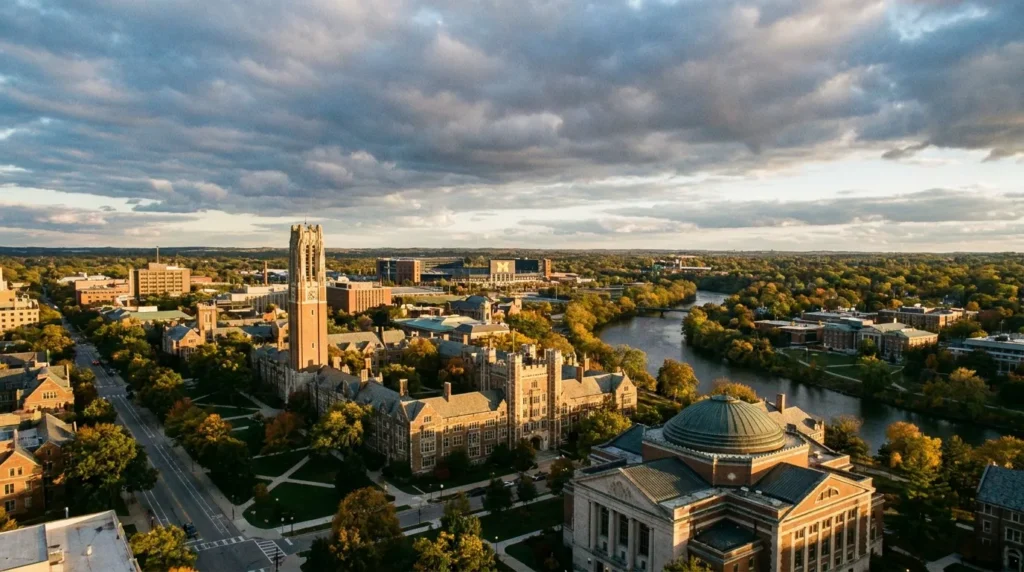
Ann Arbor is home to the University of Michigan and serves as a showcase for everything a Big Ten university can radiate: culture, sports, dining, bookstores, and a thriving tech scene.

The University of Michigan campus dominates the landscape. Michigan Stadium ('The Big House'), with capacity for 107,000 people, hosts college football games that draw fans from across the state. The University of Michigan Museum of Art (UMMA), the Kelsey Museum of Archaeology, and the Museum of Natural History are all free and open to the public.

Downtown, the Main Street District and the Kerrytown Historic District are home to restaurants, bookstores such as the beloved Literati Bookstore, the Ann Arbor Farmers Market, and Zingerman's Delicatessen, an iconic deli that grew into a regional culinary network. The Michigan Theater and State Theatre offer art-house cinema. Festivals mark the calendar throughout the year: the Ann Arbor Art Fair, Top of the Park (summer), the Folk Festival, and Hash Bash in April.

For outdoor life, Nichols Arboretum and Matthaei Botanical Gardens are affiliated with the university and offer urban trails. The Huron River runs through the city, with metropolitan parks such as Gallup Park and Bandemer Park offering canoeing, kayaking, and cycling. Detroit is 45 minutes away via I-94, and Chicago is about 4 hours.

  1. 1["University of Michigan Museum of Art"
  2. 2"Matthaei Botanical Gardens"
  3. 3"Michigan Stadium (The Big House)"
  4. 4"Kelsey Museum of Archaeology"
  5. 5"Nichols Arboretum"
  6. 6"Hands-On Museum"
Nightlife7.0 / 10
Parks & green spaces
  • ["Nichols Arboretum"
  • "Gallup Park"
  • "Bird Hills Nature Area"
  • "Matthaei Botanical Gardens"
  • "County Farm Park"
  • +1 more

Latest posts

Posts about Michigan

Coverage and updates related to this destination.

Showing content from Michigan, as there is no specific data for Ann Arbor yet.