Visto n' Visa
Blog
Notícias e artigos
Destinations
Careers
Immigrants

Want to live and work in Plymouth?

Personalized immigration plan with eligible visas, costs, and next steps for your goal!

If you are not eligible, you will know exactly why and what to do to improve your approval chances.

Save up to 12 hours in meetings

No pointless assessments.

Save up to 90%

Save money on vague or unfocused consultations

Avoid Fraud and Mistakes

One mistake can cost you your visa

Total Impartiality

Zero commercial bias

Decide with peace of mind

No toxic urgency

Fast and Accurate

Answers in minutes, no guesswork

Who lives in Plymouth: a family profile and growing diversity

The population is predominantly white with Irish, Italian, and Portuguese roots, alongside growing numbers of Latinos, Cape Verdeans, and Asians attracted by proximity to Boston.

Plymouth has roughly 62,000 residents and a predominantly residential, family-oriented profile. Most of the population is white, with strong ties to earlier European immigration, particularly Irish, Italian, and Portuguese. Portuguese surnames appear frequently in schools, businesses, and local clubs, reflecting migration waves from the early twentieth century.

Over the past two decades the city has grown more diverse. There has been a rise in Hispanic families, primarily Puerto Rican and Dominican, along with Cape Verdean immigrants from the Brockton and New Bedford areas. Neighborhoods closer to the downtown and commercial corridors concentrate a portion of these communities.

Like much of Massachusetts, Plymouth is an aging city: many retirees stay for the quality of life and proximity to the ocean. At the same time, there is a steady flow of younger families seeking larger homes outside Boston. The public schools are well regarded and draw much of this internal migration.

Languages spoken
  • English
  • Portuguese
  • Spanish
  • Cape Verdean Creole
Main religions
  • Roman Catholic
  • Protestant (Congregational, Episcopal, Baptist)
  • Unaffiliated
  • Judaism

Cost of living in Plymouth: cheaper than Boston, but far from cheap

Housing is the largest expense and is above the US national average, though well below Boston and Cape Cod. A car is practically essential, adding a fixed ongoing cost.

Plymouth is considered expensive relative to the US national average but relatively affordable within Massachusetts. Housing is the biggest budget item. Buying or renting a home costs considerably less than in Boston, Cambridge, or Cape Cod towns, and that gap is the main draw for families relocating from outside the area.

Groceries, electricity, and car insurance track Massachusetts's high averages. Electricity is among the most expensive in the country because of the regional grid and climate. Dining out is costly at tourist-oriented restaurants near the harbor, and more reasonable in residential neighborhoods and chain options along Route 44.

Those working in Boston can use the Kingston Line commuter rail and avoid parking fees and tolls, though a monthly pass costs several hundred dollars. Families with young children face the weight of childcare and extracurricular activities, which rank among the most expensive in the country.

106Cost index (US = 100)6% above US average
CategorySingleCoupleFamily (2 + 2)
iHousing$1,370$1,581$2,003
iFood$400$801$1,454
iTransport$527$896$1,160
iHealthcare$295$590$1,107
iChildcare$1,918
iOther$896$1,613$2,267
Monthly total$3,488$5,481$9,909

Source: U.S. BLS Consumer Expenditure Survey 2023 + BEA Regional Price Parities 2023 · Estimates in USD, monthly.

Housing in Plymouth: single-family homes, condominiums, and coastal villages

Single-family wood-frame homes on generous lots dominate the market. Newer condominiums are found near Route 3, while properties near the beach and historic downtown command premium prices.

Plymouth's residential stock is dominated by Cape Cod-style and colonial single-family homes, many on wooded lots. Neighborhoods like Manomet, Cedarville, and Chiltonville are home to classic family houses. Areas such as The Pinehills offer planned condominium communities with golf infrastructure, trails, and retail within the neighborhood.

Rental apartments are scarce and tend to cluster near the downtown or in newer complexes along Route 44. Most people arriving from Boston come to buy rather than rent. Studios and shared rooms are rare and generally found in private residences.

The coastal strip, especially around White Horse Beach and Manomet, includes summer cottages that have become year-round residences. Prices vary considerably based on beach proximity, school district quality, and year of construction. Historic homes in the downtown require expensive maintenance.

Recommended neighborhoods
  • The Pinehills
  • Manomet
  • Chiltonville
  • Cedarville
  • Historic Downtown
  • +1 more

Job market in Plymouth: healthcare, tourism, retail, and Boston commuters

The local economy is driven by healthcare, education, retail, and historical tourism. A large share of professional residents commutes daily to Boston and the South Shore by train or car.

Plymouth has a mixed economy. The largest local employer is the BID Plymouth (Beth Israel Deaconess) health system, followed by the municipal government, public schools, and county agencies. Tourism and hospitality generate seasonal employment from May through October, particularly in hotels, harbor restaurants, and historical museums.

Retail is concentrated along Route 44 and in centers like Colony Place. The Pilgrim nuclear power station was decommissioned in 2019, and its ongoing decommissioning still provides technical jobs. Small marine businesses, marinas, commercial fishing, and residential construction round out the economy.

A significant share of skilled professionals work in Boston or on the South Shore (Quincy, Braintree) and live in Plymouth for the quality of life. The commute is manageable: roughly one hour by car outside rush hour, or via the Kingston Line of the MBTA Commuter Rail with a connection at South Station.

Dominant sectors
  • Healthcare
  • Tourism and hospitality
  • Retail
  • Public education
  • Residential construction
  • +1 more
Major employers
  • BID Plymouth Hospital
  • Plymouth Public Schools
  • Town of Plymouth
  • Stop & Shop
  • Plimoth Patuxet Museums
  • +1 more

Education in Plymouth: well-regarded public schools and proximity to Boston universities

A strong municipal public school system with two high schools, charter schools, and easy access to Boston and South Shore universities for higher education.

Plymouth operates one of the largest municipal public school systems in Massachusetts, with multiple elementary schools, two middle schools, and two high schools, Plymouth North and Plymouth South. The schools are well ranked in state assessments and attract families relocating from denser areas in search of smaller class sizes and better facilities.

Charter and private Catholic schools are also available, along with regional vocational programs. Plymouth South Technical High School offers career and technical education across a range of fields, from oceanographic to automotive.

For higher education, the city has no large university of its own, but sits about an hour from Boston, where Harvard, MIT, Boston University, Northeastern, and dozens of other institutions are located. Massasoit Community College has a Plymouth campus, and Bridgewater State University is about 40 minutes away.

Notable universities
  • Massasoit Community College (Plymouth campus)
  • Bridgewater State University (nearby)
  • Curry College
  • Quincy College

Healthcare in Plymouth: a local hospital with referrals to Boston

BID Plymouth serves the region with emergency care and general services. For complex cases, Boston hospitals are about an hour away.

The city's main hospital is Beth Israel Deaconess Hospital Plymouth (BID Plymouth), part of the Beth Israel Lahey Health network. It serves emergencies, maternity, general surgery, and orthopedics for the broader South Shore region, including Kingston, Carver, and Plympton.

Outpatient clinics, private practices, and pharmacies are distributed throughout the city. Atos Health Center and Manomet Medical are go-to options for primary care. Dental and ophthalmological care is available through private offices that broadly accept major insurance plans.

For complex, oncological, or specialized surgical cases, patients are referred to Boston hospitals: Massachusetts General, Brigham and Women's, Boston Children's, and Dana-Farber. Access is practical by car via Route 3 or through coordinated ambulance transfer with BID Plymouth.

Plymouth

Safety in Plymouth: a quiet city with some localized concerns

Considered safe by American standards. Property crime is the main concern, particularly in tourist areas during the summer.

Plymouth is regarded as a quiet city by state and national standards. Most residential neighborhoods have low rates of violent crime, and the municipal police maintain a consistent presence. Families are comfortable with children out in the neighborhood, especially in planned communities like The Pinehills.

The most common incidents involve car break-ins, bicycle theft, and minor garage intrusions, especially in summer when there is heavy tourist traffic and seasonal homes sit empty during the off-season. Tourist areas near the harbor call for the usual awareness expected in crowded spaces.

Neighborhoods such as North Plymouth carry a historically mixed reputation, though they remain within ranges considered safe compared to larger urban centers. Substance use and overdoses linked to New England's opioid crisis are a regional concern. For most residents, daily life is calm with basic precautions in place.

Safer neighborhoods
  • The Pinehills
  • Chiltonville
  • Manomet (residential area)
  • Cedarville
  • Downtown near the harbor
Areas to avoid
  • Isolated stretches of North Plymouth at night
  • Beach parking areas in the off-season

Transportation in Plymouth: car-dependent, with train access to Boston and no local airport

The city is spread out and car-dependent. The MBTA Kingston Line reaches Boston in about an hour. International airports are in Boston (Logan) and Providence.

Plymouth is a geographically large, spread-out city, so a car is virtually essential for daily life. The main roads are Route 3, connecting the city to Boston and Cape Cod; Route 44, cutting through the western side toward Providence; and Route 3A, which winds along the coast.

The MBTA Commuter Rail Kingston/Plymouth Line has stations in Plymouth and Kingston and reaches South Station in downtown Boston in just over an hour. This is the most efficient option for those working in the capital. GATRA operates limited local bus service, adequate for short trips within the city.

There is no commercial airport in Plymouth. Logan International (BOS) in Boston is the main international hub, about an hour away by car. T.F. Green (PVD) in Providence, Rhode Island, is an alternative for domestic flights. Bike lanes exist on some stretches, but cycling infrastructure remains limited overall.

Airports
  • BOS — Logan International (Boston, ~1h)
  • PVD — T.F. Green International (Providence, ~1h)
  • PYM — Plymouth Municipal (general aviation)
  • Bike infrastructure

Climate

Plymouth

Culture in Plymouth: colonial history, the sea, and Portuguese traditions

The city's identity revolves around Mayflower history and its relationship with the Atlantic. Portuguese traditions and community celebrations fill the cultural calendar.

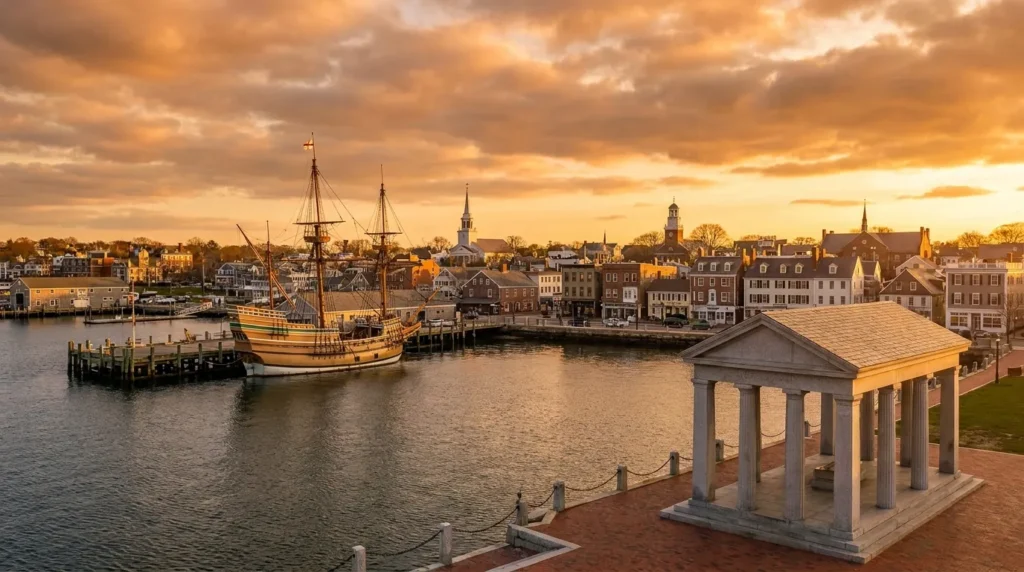
Plymouth presents itself as America's Hometown and lives its Mayflower heritage throughout the year. Plimoth Patuxet Museums recreates the 1627 colonial village and the Wampanoag native community, offering one of the most immersive historical experiences in New England. The Mayflower II, a replica of the original ship, is moored at the harbor.

Local cuisine is dominated by seafood: lobster rolls, clam chowder, fried fish, and Cape Cod oysters appear on nearly every menu. Portuguese heritage also makes its mark, with linguiça, malasadas, and salt cod found in bakeries and specialty markets, particularly in North Plymouth.

The cultural calendar includes the America's Hometown Thanksgiving Parade in November, the Plymouth Harbor Folk Festival, the Portuguese Festival in June, and numerous historical reenactments. Small galleries, independent bookshops, and venues like the Spire Center for Performing Arts sustain cultural life beyond the tourist season.

Notable dishes
  • Clam chowder
  • Lobster roll
  • Fried clams
  • Portuguese linguiça
  • Malasadas
  • +2 more
Annual events
  • America's Hometown Thanksgiving Parade
  • Plymouth Harbor Folk Festival
  • Portuguese Festival of Plymouth
  • Plymouth Waterfront Festival
  • Plimoth Patuxet Living History Programs

Attractions in Plymouth: living history, beaches, and nature

The city combines Pilgrim landing sites with Atlantic beaches, forest trails, and coastal villages.

The signature landmark is Plymouth Rock, symbol of the Pilgrims' landing in 1620, sheltered by a classical portico in Pilgrim Memorial State Park. Alongside it, the Mayflower II allows visitors to board a faithful replica of the original ship. Plimoth Patuxet Museums recreates seventeenth-century life with actors in character and a Wampanoag village.

Beaches are central to the city. Plymouth Long Beach is the most well known, a narrow strip of sand stretching along the harbor. White Horse Beach in Manomet is a family favorite. Myles Standish State Forest offers ponds, trails, camping, and mountain biking across one of the largest state forests in Massachusetts.

The historic downtown has narrow streets lined with preserved colonial buildings, independent shops, ice cream parlors, and small museums like Pilgrim Hall Museum, the oldest public museum in the United States in continuous operation. The harbor is a departure point for fishing trips, whale-watching excursions, and cruises to Provincetown.

  1. 1Plymouth Rock
  2. 2Mayflower II
  3. 3Plimoth Patuxet Museums
  4. 4Pilgrim Hall Museum
  5. 5Plymouth Long Beach
  6. 6Myles Standish State Forest
Parks & green spaces
  • Myles Standish State Forest
  • Brewster Gardens
  • Nelson Memorial Park
  • Morton Park
  • Stephens Field
  • +1 more

Immigrant communities in Plymouth: Portuguese, Cape Verdeans, and Latinos

The most visible immigrant presence is Portuguese, with deep historical roots. Cape Verdeans, Dominicans, and Puerto Ricans form smaller but active communities.

Plymouth has had an established Portuguese community for more than a century, rooted in families from the Azores and mainland Portugal who came to work in fishing, factories, and construction. North Plymouth holds much of that heritage, visible in bakeries, markets, churches, and the Portuguese American Athletic Club.

Cape Verdeans form an active community, part of the large Cape Verdean presence across southern Massachusetts (Brockton, New Bedford, Boston). Latinos, especially Dominicans and Puerto Ricans, have grown over the past two decades, alongside Hispanic families of varied backgrounds who relocated from East Boston and Brockton.

Brazilians have a smaller presence, mostly connected to services, construction, and cleaning work, with strong ties to larger communities in Framingham and Boston. Newer European immigrants, mainly Irish and British, arrive primarily through Boston universities and companies. Community support comes through churches, Catholic Charities South Shore, and regional organizations.

5,800
Foreign-born residents
estimated
Top countries of origin
  • Portugal
  • Cape Verde
  • Dominican Republic
  • Brazil
  • United Kingdom
  • Mexico
  • China
  • Haiti
Foreign consulates
  • Consulate General of Portugal (Boston)
  • Consulate General of Cape Verde (Boston)
  • Consulate General of Brazil (Boston)
  • Consulate General of the Dominican Republic (Boston)
  • Consulate General of Mexico (Boston)
  • +1 more
Community organizations
  • Catholic Charities South Shore
  • Portuguese American Athletic Club of Plymouth
  • Cape Verdean Association of Boston
  • MassHire South Shore Career Center
  • Plymouth Area Coalition for the Homeless

Latest posts

Posts about Massachusetts

Coverage and updates related to this destination.

Showing content from Massachusetts, as there is no specific data for Plymouth yet.