Visto n' Visa
Blog
Notícias e artigos
Destinations
Careers
Immigrants

Want to live and work in Lowell?

Personalized immigration plan with eligible visas, costs, and next steps for your goal!

If you are not eligible, you will know exactly why and what to do to improve your approval chances.

Save up to 12 hours in meetings

No pointless assessments.

Save up to 90%

Save money on vague or unfocused consultations

Avoid Fraud and Mistakes

One mistake can cost you your visa

Total Impartiality

Zero commercial bias

Decide with peace of mind

No toxic urgency

Fast and Accurate

Answers in minutes, no guesswork

Lowell's demographics with a strong Cambodian, Hispanic, and Brazilian presence

Lowell has a highly diverse population, with the second-largest Cambodian community in the United States after Long Beach, along with significant Hispanic, Brazilian, Indian, Vietnamese, Ghanaian, and resettled African populations.

Lowell is one of Massachusetts' most diverse cities. The Cambodian community, which arrived largely after the Khmer Rouge regime in the 1970s, is one of the largest in the country. Cambodian restaurants, Buddhist temples, bakeries, and markets fill neighborhoods such as Lower Highlands and parts of the Acre. Festivals like the Cambodian New Year take place every year.

The Hispanic presence is significant, with Puerto Ricans, Dominicans, and Central Americans. Brazilians have an active community, with evangelical churches, bakeries, and markets along Westford Street and in other parts of the city. There are Indian, Vietnamese, Laotian, Ghanaian, Liberian, Congolese, and Arab communities, many with their own institutions.

Irish, French-Canadian Quebecois, Greek, Polish, and Portuguese heritage is also present. Lowell was a destination for European immigrants in the 19th and early 20th centuries, and some parishes and cultural clubs remain active. The result is a city where multiple languages coexist in schools, public transit, and public services.

Languages spoken
  • English
  • Khmer
  • Spanish
  • Portuguese
  • Vietnamese
  • +3 more
Main religions
  • Roman Catholic
  • Theravada Buddhist
  • Evangelical Protestant
  • Hindu
  • Muslim
  • +1 more

Cost of living in Lowell compared to Boston suburbs

Lowell is one of the most affordable alternatives for those working in the greater Boston metropolitan area, with significantly lower rents and home prices than nearby cities such as Burlington, Lexington, or Cambridge.

The cost of living in Lowell often surprises those coming from Boston's direct suburbs. One- or two-bedroom apartments in older downtown buildings or in Highlands triple-deckers are considerably cheaper than in Watertown, Arlington, or Medford. Single-family homes in neighborhoods like Belvidere or Pawtucketville are affordable by state standards.

Supermarkets such as Market Basket, Stop & Shop, Hannaford, and Demoulas serve the area, with Market Basket being the local favorite. Ethnic markets carry Southeast Asian ingredients along Branch Street and surrounding areas. Dining out is one of the clear advantages: Cambodian, Vietnamese, Brazilian, and Portuguese restaurants offer inexpensive and filling meals.

Massachusetts levies a state income tax, and winter heating bills through National Grid can be substantial in older, poorly insulated homes. Those commuting to Boston by Commuter Rail on a Zone 6 pass pay a relatively high fare, but the overall equation of living in Lowell and working in Boston still works out cheaper than paying rent closer to the city center.

110Cost index (US = 100)10% above US average
CategorySingleCoupleFamily (2 + 2)
iHousing$1,427$1,647$2,086
iFood$417$834$1,515
iTransport$549$933$1,208
iHealthcare$307$615$1,153
iChildcare$1,998
iOther$933$1,680$2,361
Monthly total$3,633$5,709$10,321

Source: U.S. BLS Consumer Expenditure Survey 2023 + BEA Regional Price Parities 2023 · Estimates in USD, monthly.

Neighborhoods and real estate in Lowell, with a mix of lofts, triple-deckers, and historic homes

Lowell's housing stock combines converted mill buildings turned into loft apartments, triple-deckers in historic neighborhoods, large Victorian homes in Belvidere, and quieter residential areas like Pawtucketville and Highlands.

Downtown Lowell has become a reference for industrial building conversions. Developments like Boott Mills, Appleton Mills, and Massachusetts Mills offer high-ceiling lofts, large windows, and locations close to bars, restaurants, and the Commuter Rail. They attract young professionals, UMass Lowell students, and car-free residents.

Belvidere, on the east side of the city, is home to Victorian and Georgian mansions from the mid-19th century, with wide streets and generous lawns. Pawtucketville and Highlands offer affordable triple-deckers and semi-detached homes, with a strong immigrant community presence. Centralville, on the other side of the river, has a mix of houses and small apartment buildings. South Lowell and Sacred Heart retain an old-neighborhood feel.

The real estate calendar is partly tied to the academic year: UMass Lowell drives rental market activity in June and September. Platforms like Zillow, Apartments.com, and local real estate agencies provide solid coverage of the city. It is worth paying attention to lead paint in homes built before 1978, heating costs in poorly insulated houses, and flood history in low-lying areas near the Merrimack.

Recommended neighborhoods
  • Belvidere
  • Highlands
  • Pawtucketville
  • Downtown
  • Centralville
  • +3 more

Lowell's job market in healthcare, education, defense, and light industry

Lowell has a diversified economy anchored in healthcare, higher education, defense, light industry, retail, and logistics, centered on hospitals like Lowell General, UMass Lowell, and technology companies along the Route 3 corridor.

Healthcare leads the local economy. Lowell General Hospital, part of the Tufts Medicine network, is the largest employer, with facilities at two city locations, affiliated clinics, and specialized centers. Around it orbit medical offices, laboratories, and home care providers. Large healthcare employers are also found in neighboring Burlington and Bedford, a short drive away.

Higher education drives significant employment. The University of Massachusetts Lowell, with approximately 18,000 students and strong programs in engineering, computer science, and nursing, employs academics, technical staff, and administrators. Middlesex Community College, with campuses in Lowell and Bedford, rounds out the sector. Defense has a long-standing presence, with Hanscom Air Force Base and military technology suppliers nearby.

Light industry and technology are concentrated along the Route 3 corridor, with companies such as MACOM, Wynn Resorts (administrative office), Mercury Systems, Kronos, and several smaller firms. For immigrant professionals, technology companies in the Route 128 belt and area hospitals frequently sponsor visas. Logistics and wholesale operations run along the I-495 corridor, with warehouses and distribution centers throughout.

Dominant sectors
  • Healthcare
  • Higher education
  • Light industry and defense
  • Technology
  • Logistics
  • +1 more
Major employers
  • Lowell General Hospital
  • UMass Lowell
  • MACOM Technology Solutions
  • Mercury Systems
  • Saints Memorial Hospital
  • +2 more

Education in Lowell with UMass Lowell as the anchor and a diverse public school system

Lowell has UMass Lowell as a regional reference in engineering, computer science, and nursing, along with Middlesex Community College, magnet schools, and a multilingual municipal public school network serving immigrant populations.

The University of Massachusetts Lowell is the primary institution of higher education. It has north, south, and downtown campuses, with approximately 18,000 students in undergraduate and graduate programs. Engineering, computer science, nursing, business, and music are strong areas. It serves many first-generation college students and has competitive scholarship programs. Middlesex Community College offers technical and transfer-track courses.

The municipal public system, Lowell Public Schools, is large and multilingual, with bilingual programs in Khmer, Spanish, and Portuguese. Schools such as Lowell High School, one of the oldest in the United States, offer advanced coursework. There are magnet schools, charter schools like Lowell Community Charter Public School, and private Catholic schools such as Greater Lowell Catholic. For adult immigrants, English language courses are available at community centers, the International Institute of New England, and Middlesex Community College.

A short distance toward Boston, other major universities can be found, including Tufts in Medford, Boston College in Chestnut Hill, and Boston University. For children with special needs and vocational programs, Greater Lowell Technical High School in Tyngsborough is known for competitive technical programs.

Notable universities
  • University of Massachusetts Lowell
  • Middlesex Community College
  • Greater Lowell Technical High School

Lowell's healthcare system with Lowell General Hospital as the regional anchor

Lowell's healthcare system revolves around Lowell General Hospital, part of Tufts Medicine, with multilingual community clinics serving immigrant populations and easy access to specialized hospitals in Boston.

Lowell General Hospital, with two facilities in the city, is the primary regional hospital. It offers emergency care, maternity services, surgery, oncology, orthopedics, and intensive care. It belongs to the Tufts Medicine network, affiliated with Tufts University School of Medicine, which brings academic ties and a medical residency program. For complex cases, patients are frequently referred to Boston hospitals such as Massachusetts General or Brigham and Women's.

Community clinics play a central role. Lowell Community Health Center, with a multilingual staff, provides services in several languages and has extensive work with refugees and immigrants. Greater Lowell Health Alliance coordinates public health programs. Primary care physicians are distributed throughout the city, with wait times that vary depending on the insurance plan.

Access depends on health insurance. MassHealth covers those who qualify in Massachusetts, with coverage considered among the most generous in the country. The Health Connector offers subsidized plans for middle-income ranges. CVS, Walgreens, and Rite Aid pharmacies operate extended hours. In an emergency, 911 or direct access to the Lowell General emergency room are the options. The biggest barrier for immigrants is navigating paperwork and language, and Lowell Community Health Center provides assistance with both.

Healthcare index72.0 / 100
  • Life expectancyyears at birth
    78.4yrs
  • Doctors per 1kpracticing physicians
    3.7
  • Health spendper capita, per year
    $13,473
  • Public systemoverall quality rating
    Good

Public safety and risk perception in Lowell, with notable differences between neighborhoods

Lowell has crime rates above the Massachusetts average, with marked differences between neighborhoods. Residential areas like Belvidere are considered safe, while parts of downtown and the Acre require greater attention.

Lowell appears in rankings with crime rates above the state average, partly due to concentration in specific areas and its density as a mid-size city. Belvidere, most of Pawtucketville, and suburban neighborhoods near Route 3 are quiet. Centralville, Sacred Heart, and South Lowell fall in between. The Acre, parts of downtown, and some sections of Highlands show higher rates.

Property crimes lead the statistics: theft from unlocked vehicles, package theft, break-ins at unalarmed residences, and bicycle theft. Violent crimes against strangers are not common in commercial and cultural areas, but exercising caution when walking alone in downtown late at night is advisable. Financial fraud targeting newly arrived immigrants is also worth being aware of.

The Lowell Police Department patrols the city with specialized units, supplemented by State Police on highways. The main practical day-to-day safety concern involves traffic: narrow streets in downtown, aggressive drivers, winter ice, and dangerous intersections require extra attention from pedestrians and cyclists. For newly arrived immigrants, a good starting point is speaking with neighbors and staff at Lowell Community Health Center.

5.8
Homicides per 100k
per year
Safety index
58.0
Crime index
42.0
Safer neighborhoods
  • Belvidere
  • Highlands (western portions)
  • South Lowell residential area
  • Pawtucketville north
Areas to avoid
  • Downtown Acre late at night
  • Centralville on isolated streets after dark
  • Lower Highlands stretches

Public transit and commuting in Lowell with a fast Commuter Rail connection to Boston

Lowell has LRTA bus service, a direct Commuter Rail link to Boston's North Station in about 45 minutes, access to Route 3, I-495, and I-93, and a walkable downtown centered on Lowell National Historical Park.

The Lowell Regional Transit Authority operates buses throughout the city and into some suburbs, with a central hub at Gallagher Terminal, adjacent to the Commuter Rail station. Routes cover the main neighborhoods, though frequency drops in the evenings and on weekends. UMass Lowell runs its own shuttles connecting the campuses.

The MBTA Commuter Rail, on the Lowell Line, connects the city to Boston's North Station in approximately 45 minutes, with several stops along the way. It is the most practical option for those who work in Boston and live in Lowell. Express bus services from companies such as Vamoose and LimoLiner also serve some regional destinations. Logan International Airport is about an hour away by car via Route 3 and I-93.

A car remains important for most daily trips. Route 3 runs through the city, connecting to I-495 and Route 128 around the greater Boston metropolitan area. I-93 is a short distance away for those heading north toward Manchester, New Hampshire. For those looking to live car-free, downtown and neighborhoods close to the Commuter Rail are viable options, especially with a bicycle.

32 min
Avg commute
60
Walkability
Airports
  • BOS — Boston Logan International
  • MHT — Manchester-Boston Regional Airport
  • Bike infrastructure

What the climate is like living in Lowell

Lowell, in the Merrimack Valley about 40 km from Boston, has a humid continental climate with four distinct seasons and cold winters with abundant snowfall.

Summer in Lowell runs from June through September, with highs between 26°C and 29°C and moderate humidity. Brief heat waves push past 33°C in July. Nights drop to around 15°C to 18°C. Afternoon thunderstorms are common in summer. Air conditioning is useful but not needed year-round. The Merrimack Valley runs somewhat warmer than Boston due to its distance from the coast.

Winters are more severe than on the coast. From December through March, highs range between 0°C and 4°C, with lows reaching -12°C. Snow accumulates between 130 cm and 160 cm per year, with frequent nor'easters. A heavy coat, waterproof boots, and thermal layers are essential. Streets become icy after snowstorms.

Fall brings spectacular foliage in October. Spring is short. For those settling here, plan for expensive heating costs (oil or gas), an ice scraper, and a heavy wardrobe. Lowell has a strong Cambodian, Brazilian, and Portuguese community. Access to Boston is available via the Commuter Rail (Lowell Line) or US-3. The rehabilitated historic industrial downtown and the University of Massachusetts Lowell are central to city life.

Sunny days / year200 days
Avg high (°F)
  • 38°J
  • 40°F
  • 48°M
  • 57°A
  • 68°M
  • 78°J
  • 84°J
  • 83°A
  • 74°S
  • 63°O
  • 51°N
  • 43°D
Avg low (°F)
  • 22°J
  • 22°F
  • 29°M
  • 39°A
  • 48°M
  • 58°J
  • 66°J
  • 64°A
  • 57°S
  • 48°O
  • 35°N
  • 28°D
Rainfall (")
  • 4"J
  • 3"F
  • 3"M
  • 5"A
  • 3"M
  • 4"J
  • 6"J
  • 4"A
  • 5"S
  • 5"O
  • 3"N
  • 5"D

Culture, festivals, and food in Lowell, shaped by industrial heritage and immigrant diversity

Lowell has an active cultural scene for a city its size, featuring Lowell National Historical Park, a folk festival considered one of the best in the country, a thriving arts community, and diverse cuisine from immigrant communities.

Lowell National Historical Park occupies a section of downtown and tells the story of the American Industrial Revolution, with a museum, canal boat tours, the historic Boott Mills open to visitors, and a year-round events calendar. The Lowell Folk Festival, held in July, is regarded as one of the largest free folk festivals in the country, bringing together music, dance, and food from many traditions.

The cultural scene includes the Lowell Memorial Auditorium for concerts and musicals, the Merrimack Repertory Theatre, several art galleries in converted downtown buildings, and the Whistler House Museum of Art, dedicated to painter James McNeill Whistler, who was born in the city. UMass Lowell maintains an active cultural programming calendar open to the public.

Food is the great gift of local diversity. Cambodian restaurants such as Simply Khmer and Heng Lay serve amok and prahok ktiss. Vietnamese, Thai, Indian, Portuguese, Brazilian, Mexican, and Lebanese options are available across various neighborhoods. Long-established Italian restaurants, poutine spots inherited from Quebecois French settlers, and Irish pubs round out the offerings. The Lowell Beer Works occupies a converted mill building.

Lowell

Lowell: national industrial heritage park, canals, and a major Cambodian community

A city on the banks of the Merrimack River in northeastern Massachusetts, featuring a national historical park dedicated to the Industrial Revolution, preserved canals, and the second-largest Cambodian community in the United States.

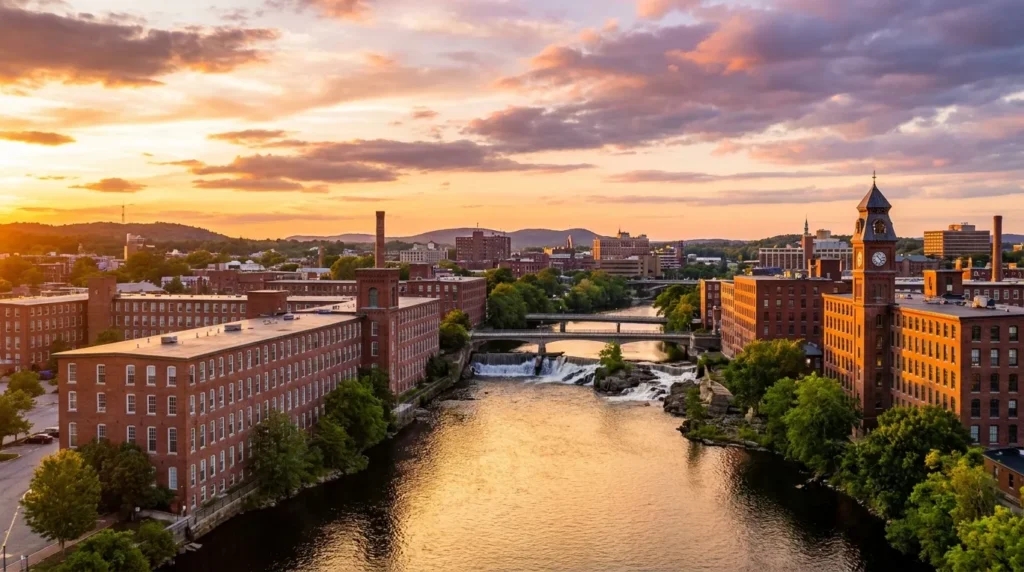
Lowell was conceived in the early nineteenth century as a planned textile city, with canals drawn from the Merrimack River that powered enormous mills. That past is the heart of Lowell National Historical Park, managed by the National Park Service, with the Boott Cotton Mills Museum, the Suffolk Mill Turbine, and boat tours through the canals. Downtown, centered on Merrimack Street and Market Street, still showcases restored industrial brick architecture.

The city is home to the University of Massachusetts Lowell, which spans three campuses and carries significant weight in engineering and science. For the arts, the Whistler House Museum of Art, birthplace of painter James McNeill Whistler, and the New England Quilt Museum are both located downtown. The Tsongas Center hosts concerts and UMass Lowell games, and the Merrimack Repertory Theatre is a regional theater reference.

The Lowell Folk Festival in July is one of the largest free folk festivals in the United States, with stages spread throughout downtown. For outdoor recreation, the Concord River Greenway and sections of the Bruce Freeman Rail Trail depart from the city center. Lowell sits approximately 50 km from Boston, with MBTA Commuter Rail service on the Lowell Line connecting directly to North Station.

  1. 1["Lowell National Historical Park"
  2. 2"Boott Cotton Mills Museum"
  3. 3"American Textile History Museum collection"
  4. 4"New England Quilt Museum"
  5. 5"Tsongas Center (Lowell Devils)"
  6. 6"Merrimack Repertory Theatre"
Nightlife5.0 / 10
Parks & green spaces
  • ["Lowell Heritage State Park"
  • "Rogers Fort Hill Park"
  • "Shedd Park"
  • "LeLacheur Park area"
  • "Merrimack River trails"]

Latest posts

Posts about Massachusetts

Coverage and updates related to this destination.

Showing content from Massachusetts, as there is no specific data for Lowell yet.