Visto n' Visa
Blog
Notícias e artigos
Destinations
Careers
Immigrants

Want to live and work in Lawrence?

Personalized immigration plan with eligible visas, costs, and next steps for your goal!

If you are not eligible, you will know exactly why and what to do to improve your approval chances.

Save up to 12 hours in meetings

No pointless assessments.

Save up to 90%

Save money on vague or unfocused consultations

Avoid Fraud and Mistakes

One mistake can cost you your visa

Total Impartiality

Zero commercial bias

Decide with peace of mind

No toxic urgency

Fast and Accurate

Answers in minutes, no guesswork

Predominantly Latino population, with a strong Dominican presence

Lawrence is one of the most Latino cities in the United States, with a Dominican and Puerto Rican majority, Spanish spoken in nearly every public service, and a small but established Brazilian community.

Lawrence's ethnic composition is unusual in the American Northeast. Latinos make up roughly eighty percent of residents, with a strong Dominican majority, followed by Puerto Ricans. There are also smaller communities of Cubans, Guatemalans, and Salvadorans. Non-Hispanic whites are now a minority, concentrated in some northern neighborhoods and adjacent areas like Methuen.

Spanish is the everyday language in bakeries, salons, auto shops, health clinics, and parts of the public school system. The city government maintains bilingual services, and several churches offer mass in Spanish. For those arriving with limited English, this reduces initial friction, though proficiency in English remains essential for better employment opportunities.

The Brazilian community is not as large as in Framingham or Everett, but it exists, particularly among those from Minas Gerais and Espírito Santo, drawn by relatives already in the area. The dominant religions are Catholicism, partly in the Caribbean tradition, and various evangelical and Pentecostal churches, many conducting services in Spanish and some in Portuguese.

Languages spoken
  • English
  • Spanish
  • Portuguese
  • Haitian Creole
Main religions
  • Catholic
  • Evangelical
  • Pentecostal
  • No religion

Cost of living well below Boston, but with growing pressure

Rent, groceries, and services in Lawrence cost less than in Boston and the wealthy surrounding suburbs, but the metropolitan area's real estate pressure has arrived and prices have been rising year over year.

Compared to Boston, Cambridge, or even Andover, Lawrence offers a noticeable difference. A basic apartment, utilities, groceries at stores like Market Basket, and essential services cost visibly less. This has made the city a natural destination for working families who need to stay in the Route 495 corridor without paying suburban prices.

That landscape, however, has changed in recent years. Boston's real estate pressure has pushed investors into the Merrimack Valley, and older buildings near downtown have undergone renovation and repositioning. Annual rent increases have been steep, particularly in areas close to the train station, and short-term leases have become common.

Car insurance remains expensive due to the city's statistical risk profile. Public transit, combining MVRTA buses and the MBTA commuter rail, helps contain expenses for those working in Boston. For an immigrant family, the overall cost calculation tends to be favorable compared to the more expensive surrounding suburbs.

106Cost index (US = 100)6% above US average
CategorySingleCoupleFamily (2 + 2)
iHousing$1,370$1,581$2,003
iFood$400$801$1,454
iTransport$527$896$1,160
iHealthcare$295$590$1,107
iChildcare$1,918
iOther$896$1,613$2,267
Monthly total$3,488$5,481$9,909

Source: U.S. BLS Consumer Expenditure Survey 2023 + BEA Regional Price Parities 2023 · Estimates in USD, monthly.

Housing in old buildings, triple-deckers, and well-defined neighborhoods

Renters in Lawrence typically live in wooden triple-deckers or older brick buildings from the factory era, with neighborhoods that vary considerably in character and price.

Lawrence's housing stock is dominated by three-story wooden triple-deckers, typical of New England, and older brick buildings near the river. Single-family homes with yards appear more frequently to the north, toward Methuen, or in parts of Tower Hill. Apartments in newer buildings remain scarce, concentrated in conversions of former textile mills.

Neighborhoods like Prospect Hill and Tower Hill are commonly cited as more residential and stable, with single-family homes and quieter streets. South Lawrence, across the river, is more mixed, with good access to Route 114 and Andover. The area around downtown, near Common Street, offers lower prices but warrants careful evaluation street by street.

Finding housing typically involves combining searches on Zillow or Apartments.com with community referrals. Many Lawrence properties are managed by local owners without large management companies, so talking to neighbors and visiting at night is helpful. Requesting references from previous tenants and confirming the presence of central heating is standard practice in this Massachusetts market.

Recommended neighborhoods
  • Tower Hill
  • Prospect Hill
  • South Lawrence
  • Mount Vernon
  • Colonial Heights

Jobs in healthcare, light manufacturing, logistics, and services

Lawrence's job market relies on hospitals, schools, light manufacturing in the surrounding area, and services, with ample opportunity in operational roles and moderate growth for bilingual professionals.

The largest local employer is the healthcare system, centered on Lawrence General Hospital, along with regional networks that maintain clinics and laboratories in the city. The public schools and the Lawrence school district also concentrate thousands of positions, from teachers to bilingual support staff, with constant demand for Spanish speakers.

Light manufacturing remains relevant, with industrial parks along Route 495 and in neighboring municipalities such as North Andover and Methuen. Logistics, warehouses, and distribution centers have expanded with e-commerce growth, and food processing and equipment companies continue hiring operators and technicians. Commerce, Latino food service, and personal services sustain much of the informal employment sector.

For qualified professionals, Lawrence often serves as an affordable base for jobs in Boston, Burlington, or the Cambridge technology corridor, accessible by train or Route 93. Licensed professions such as nursing require credential validation, but the region offers transition programs and grants aimed at the immigrant community.

Dominant sectors
  • Healthcare
  • Public Education
  • Light Manufacturing
  • Logistics
  • Commerce and Services
Major employers
  • Lawrence General Hospital
  • Lawrence Public Schools
  • Northern Essex Community College
  • New Balance
  • Market Basket

Public schools in recovery, a community college, and universities nearby

Lawrence has a challenging but improving public school system, a community college in the heart of downtown, and several universities within an hour, creating accessible pathways for immigrant students and adults.

The Lawrence school district serves tens of thousands of students and has historically faced difficult indicators, with a large proportion of English language learners. In recent years, tutoring programs, charter schools, and university partnerships have been driving scores upward. Some schools, like the Lawrence High School in its newer facility, offer technical and college preparatory tracks.

Northern Essex Community College has a campus within the city, in the heart of downtown, with professional, technical, and transfer programs for four-year colleges. It is the most accessible entry point for adult immigrants, offering bilingual support, ESL courses, and grants. The Lawrence Public Library also provides free language programs.

Within an hour's reach are larger institutions such as UMass Lowell, Merrimack College in North Andover, and the universities of Boston and Cambridge. Many residents study at one of these while keeping Lawrence as their base due to lower costs. This connects the city, in practice, to the broader academic ecosystem of Greater Boston.

Notable universities
  • Northern Essex Community College
  • Merrimack College
  • UMass Lowell
  • Cambridge College

Local hospital, community clinics, and quick referral access in Boston

The city has its own general hospital, an extensive network of bilingual community clinics, and facilitated access, within about an hour, to Boston's major referral centers, covering everything from routine care to complex cases.

Lawrence General Hospital is the primary local healthcare facility, with an emergency department, inpatient care, maternity services, and multiple specialties. Most urgent care for residents begins there. Affiliated clinics and specialists' offices surrounding it form the day-to-day care network, with Spanish-language service as a standard in many front offices.

The Greater Lawrence Family Health Center is an extensive community network with multiple locations throughout the city. It handles family medicine, pediatrics, mental health, dentistry, and prenatal care, with income-adjusted fees and support for the uninsured. For many newly arrived immigrants, it serves as the first point of entry into the healthcare system, before the hospital is ever needed.

More complex cases, such as advanced oncology, rare surgeries, and transplants, are typically referred to Boston hospitals such as Mass General and Brigham and Women's, or to Lahey Hospital in Burlington. The distance is manageable, particularly via Route 93. MassHealth plans and state marketplace insurance cover most of these referral pathways.

Healthcare index70.0 / 100
  • Life expectancyyears at birth
    78.4yrs
  • Doctors per 1kpracticing physicians
    3.7
  • Health spendper capita, per year
    $13,473
  • Public systemoverall quality rating
    Good

City with unequal neighborhoods, extra caution needed in some areas

Lawrence has crime rates above the Massachusetts average, but conditions vary considerably by neighborhood, with calm residential areas and others that call for more caution at specific times.

Compared to adjacent Andover or North Andover, Lawrence shows higher rates of theft, robbery, and interpersonal violence incidents. These figures, however, conceal significant internal variation. Neighborhoods like Tower Hill, Prospect Hill, and parts of South Lawrence function as relatively calm residential areas, particularly where stable homeownership and good lighting prevail.

The area around downtown, near Common Street, and some streets close to the river require extra caution, especially at night. Cars parked on the street should have no visible valuables, and entrances to older buildings deserve attention. Generally, incidents are linked to drug activity and localized disputes rather than random crime against ordinary residents.

The relationship between residents and the police department is the focus of community outreach programs, with bilingual officers and school partnerships. Newcomers tend to adapt quickly by learning the local geography, avoiding specific streets at certain hours, and using neighborhood networks, common in Latino communities, as a practical safety reference.

5.8
Homicides per 100k
per year
Safety index
48.0
Crime index
52.0
Safer neighborhoods
  • Tower Hill
  • Mount Vernon
  • South Lawrence East residential area
  • Prospect Hill (upper portions)
  • Colonial Heights
Areas to avoid
  • Essex Street downtown late at night
  • Arlington near Broadway at night
  • isolated stretches of Lowell Street after dark

Rail to Boston, regional buses, and car dependency

Lawrence has direct rail service to Boston via the Haverhill Line, a regional MVRTA bus network, and easy highway access via interstates 495 and 93, though most residents still depend on a car for daily life.

The Lawrence station on the MBTA Commuter Rail Haverhill Line connects the city directly to North Station in Boston in just over forty minutes. For those working in downtown Boston, this is the most commonly used route and avoids the stress of driving on Route 93. Frequency is reasonable during business hours and more limited at night and on weekends.

Within Lawrence and in neighboring cities, MVRTA buses cover basic routes, with a terminal near downtown. The lines serve short trips well but rarely replace cars entirely, particularly for shift workers or those with young children. Walking is feasible in some neighborhoods, and bike infrastructure remains limited.

By road, the city sits at the intersection of interstates 495 and 93, with Boston to the south, New Hampshire to the north, and Manchester-Boston Regional Airport relatively close. Logan Airport in Boston is reachable in about an hour without traffic, placing Lawrence in a practical position for frequent travelers.

30 min
Avg commute
58
Walkability
Airports
  • BOS — Boston Logan International
  • MHT — Manchester-Boston Regional Airport
  • LWM — Lawrence Municipal Airport
  • Bike infrastructure

What the Climate Is Like Living in Lawrence

Lawrence, in the Merrimack Valley north of Boston, has a humid continental climate with four distinct seasons and cold winters with heavy snowfall.

Summer in Lawrence runs from June to September, with highs between 26°C and 29°C and moderate humidity. Brief heat waves push past 32°C in July. Nights drop to 15°C or 18°C. Afternoon thunderstorms are common in summer. Air conditioning is useful but not needed year-round. Summers are warmer than Boston's due to the city's distance from the coast.

Winters are more severe. From December to March, highs range between 0°C and 4°C, with lows reaching -12°C. Snowfall accumulates between 130 cm and 160 cm per year, with frequent nor'easters. A heavy coat, waterproof boots, and thermal layers are essential. Streets become icy after snowstorms.

Fall brings spectacular foliage in October. Spring is brief. For those settling here, budget for expensive heating (oil or gas), an ice scraper, and a heavy wardrobe. Lawrence has a Hispanic majority (Dominican, Puerto Rican) and a sizeable Brazilian community. Boston is accessible via the Commuter Rail (Haverhill Line) or I-93. The cost of living is lower than in nearby suburbs.

Sunny days / year200 days
Avg high (°F)
  • 38°J
  • 39°F
  • 48°M
  • 56°A
  • 67°M
  • 77°J
  • 83°J
  • 82°A
  • 73°S
  • 63°O
  • 51°N
  • 43°D
Avg low (°F)
  • 23°J
  • 22°F
  • 29°M
  • 39°A
  • 48°M
  • 58°J
  • 66°J
  • 64°A
  • 57°S
  • 48°O
  • 35°N
  • 28°D
Rainfall (")
  • 4"J
  • 3"F
  • 3"M
  • 5"A
  • 3"M
  • 4"J
  • 6"J
  • 4"A
  • 5"S
  • 5"O
  • 3"N
  • 6"D

Strong Latino culture, community festivals, and industrial heritage

Lawrence breathes Latino culture, with Dominican and Puerto Rican food, street festivals, Hispanic churches, and a small arts scene that engages with the industrial past preserved in the old factory buildings.

Cultural life in Lawrence unfolds largely on streets and in local businesses. Dominican restaurants, Puerto Rican diners, bakeries with pan sobao, and barbershops serve as community gathering places. During events such as Semana Hispana and the Feast of the Three Saints, the city hosts parades, live music, and street stalls that bring entire communities together at the downtown core and Campagnone Common.

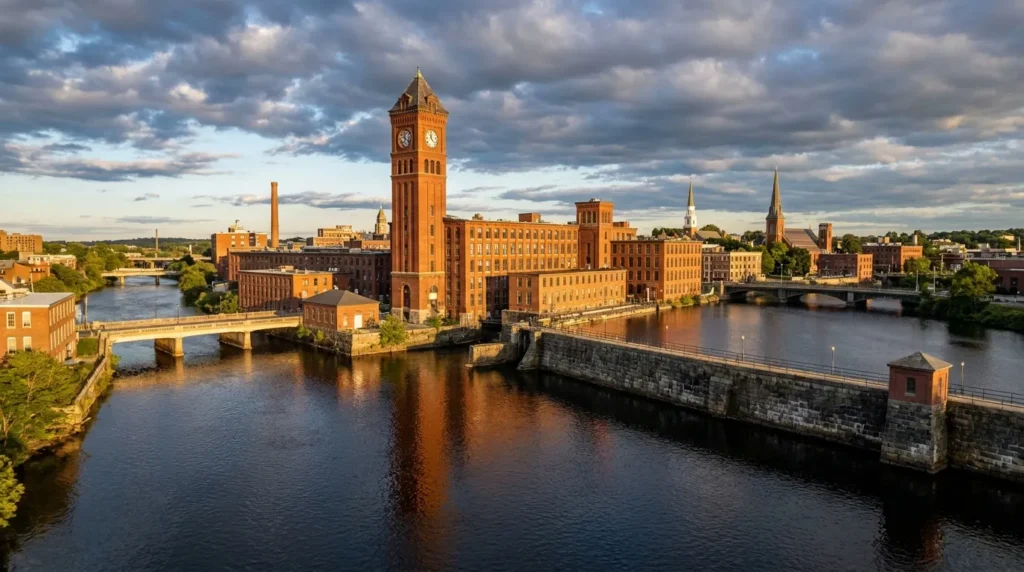
Industrial heritage becomes an attraction at Lawrence Heritage State Park and in former factory buildings converted into studios, schools, and event spaces. Small galleries, music workshops, and community theater groups animate the cultural scene, with a strong bilingual presence. The Merrimack River, with its bridges and canals, provides a distinctive backdrop unlike the flat inland cities of the region.

Sports and youth activities are organized around schools, with strong traditions in baseball and indoor soccer, a legacy of the Caribbean and Central American population. Boston is close enough for major concerts, museums, and professional games, so residents tend to combine everyday Latino life with frequent outings to the capital.

Lawrence

Attractions in Lawrence, the Merrimack Valley's Textile City in Massachusetts

A historic industrial city in the Merrimack Valley, home to the 1912 Bread and Roses textile strike. Today it is Massachusetts' most Latino city, with a channeled industrial heritage, Dominican festivals, and proximity to Boston.

The Lawrence Heritage State Park, in the downtown area, tells the story of the textile mills and the immigration that built the city. The Great Stone Dam and North Canal, with a walkway alongside the Merrimack River, are landmarks of the industrial era. The Bread and Roses Heritage Festival, held in September, celebrates the strike led by immigrant women in 1912. The Lawrence History Center, housed in the former Essex Company headquarters, rounds out the experience.

Den Rock Park, on the western side of the city, offers trails through granite outcroppings. The Merrimack River Trail and Riverwalk complete the outdoor recreation options. Bellevue Cemetery, with acres of old-growth trees, is a popular urban walking destination. Veterans Memorial Stadium hosts local matches and parades. Salisbury Beach State Reservation is forty minutes away.

The cultural scene has shifted with the Dominican and Puerto Rican majority: the Festival of the Three Kings in January, Dominican Independence Day in February, and Semana Hispana in June animate the city. Downtown along Essex Street features bodegas, pupuserías, and barberías. Boston, forty minutes away via the MBTA Commuter Rail (Haverhill Line) from Lawrence Station, provides access to a larger cultural offering.

  1. 1["Lawrence Heritage State Park"
  2. 2"Bread and Roses Heritage Committee Center"
  3. 3"Essex Art Center"
  4. 4"Lawrence History Center"
  5. 5"Cox Reservation (nearby)"
  6. 6"Den Rock Park"
Nightlife4.0 / 10
Parks & green spaces
  • ["Den Rock Park"
  • "Campagnone Common"
  • "Pemberton Park"
  • "Reservoir Park"
  • "Stevens Pond (North Andover
  • +2 more

Latest posts

Posts about Massachusetts

Coverage and updates related to this destination.

Showing content from Massachusetts, as there is no specific data for Lawrence yet.